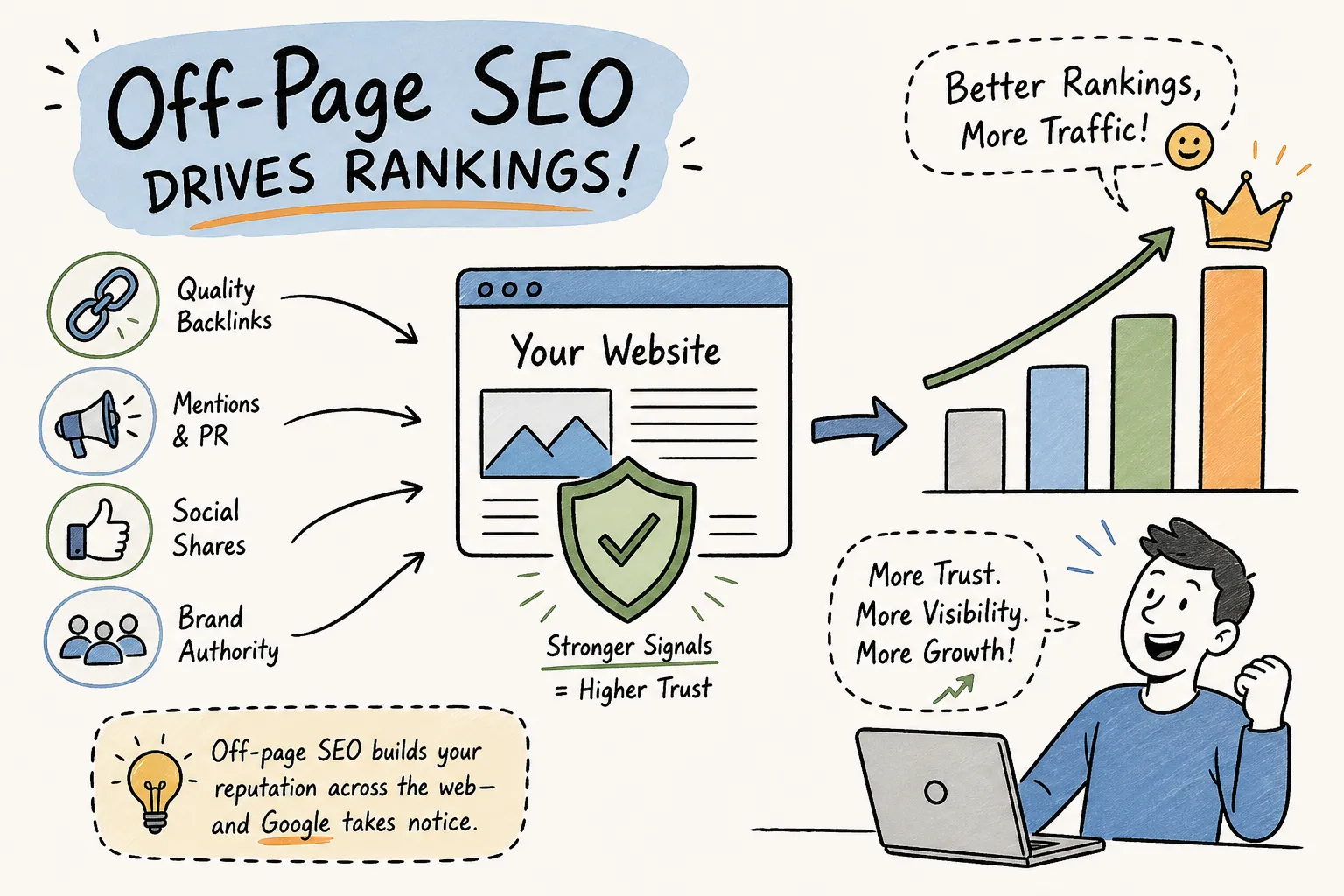
Understanding how does off page SEO impact website rankings is one of the most important questions any growth-focused business can ask. Many businesses prioritize on-page SEO, fixing title tags, optimizing content, and cleaning up site structure, yet still find their rankings stuck. At Brandleap Agency, we see this pattern consistently when auditing new clients: solid on-site work paired with a thin, low-authority backlink profile can limit ranking potential, often preventing pages from breaking onto page one, regardless of how well-optimized the content is.
This guide breaks down exactly how off-page SEO impacts website rankings, what recent industry data reveals about backlinks and referring domains, and which tactics deliver the best return per dollar spent. By the end, you’ll have a clear 90-day measurement plan and know exactly what to prioritize to prove results to stakeholders.
The off-page signals that actually move Google rankings
Google representatives have stated that backlinks are a ranking factor and remain important in practice. When another site links to yours, Google treats it as a vote of credibility. Importantly, Google does not publish precise weightings and has avoided characterizing links as singularly “most important” in recent public guidance, so it’s worth treating backlinks as a powerful signal within a broader system, not a guaranteed lever. The quality, relevance, and diversity of those votes matter far more than raw link count. A single editorial link from a respected industry publication carries more weight than 50 generic directory listings or low-relevance placements.
E-E-A-T (Experience, Expertise, Authoritativeness, Trustworthiness) is not a direct ranking factor in the way backlinks are. It is the quality framework Google’s search quality raters use to evaluate pages, particularly in YMYL categories like finance and healthcare. Brand mentions and citations help Google recognize and validate your entity in its knowledge graph, which supports reputation signals. Unlinked mentions don’t pass link equity the way a followed backlink does, but they still contribute to how Google understands your brand’s authority in a space.
Third-party metrics like Ahrefs’ Domain Rating and Moz’s Domain Authority are useful as proxy benchmarks, not as ranking targets in themselves. Google does not use these scores directly. Think of them as indicators of relative link profile strength for competitive analysis, not numbers you need to “hit” before your rankings improve.
How off-page SEO impacts website rankings: referring domain data
The research is consistent across multiple large-scale studies: referring domain count is the single strongest correlating backlink metric for organic rankings. Ahrefs’ analysis of roughly 920 million pages found referring domains outperform total link count as a predictor of ranking position. Backlinko-derived summaries report a correlation of approximately r = 0.38 for referring domains versus rankings. Unique domain diversity is the insight that matters most here: 100 links from 80 unique domains correlate with stronger rankings than 100 links from just 10 domains, even when the total link count is identical. Correlation studies consistently support this as a guiding principle, though it reflects association rather than direct causation.
Semrush’s 2024 Ranking Factors study, covered extensively in 2026 industry analysis, reported Domain Authority Score at a 0.21 correlation with SERP positioning, with referring domains close behind at 0.18. WebFX’s 2026 benchmark data shows the number-one ranking result has roughly 365 referring domains on average, with YMYL industries demanding considerably more. For practical competitive analysis, 200 to 400 referring domains (per WebFX and other dataset estimates) is a useful benchmark for most non-YMYL industries, though the actual threshold varies by industry, query intent, and the dataset used.
Backlink influence on rankings: off-page tactics ranked by ROI
Citation and local SEO signals
For local and regional businesses, consistent directory citations are the highest-efficiency play. They’re fast to build, relatively low-cost, and directly support local pack visibility in Google Search. The key is accuracy and consistency in your name, address, and phone number across all platforms, because inconsistency across directories undermines the signal rather than reinforcing it.
Guest posting and niche edits
Guest posting and niche edits occupy the middle tier of link building strategies. Guest posting is effective but labor-intensive: prospecting, pitching, and writing all have to happen before a single link goes live. Niche edits, which insert a link into an existing indexed page on a relevant site, offer a shorter path to a live placement and, in practitioner experience, tend to work well for national SEO campaigns as part of a diversified link profile.
Digital PR for SEO
Digital PR ranks highest for ROI among all link building strategies, even though it demands the most effort. A survey reported by Editorial.Link and BuzzStream (2025) found that nearly 49% of SEO practitioners identify digital PR as the most effective link building tactic overall, ranking it ahead of guest posting and linkable asset creation. Digital PR earns editorial mentions on high-authority news and industry publications that are very difficult to replicate through standard outreach. The trade-off is higher effort and a longer lead time, but the authority gains are proportionally larger than any other tactic, making it the preferred approach for businesses serious about how off page SEO impacts website rankings over the long term.
How digital PR and white-hat link building compound over time
A single editorial mention from a major publication can do more for your domain’s authority than dozens of lower-tier guest posts combined. Unlike paid links or manipulative placements, earned editorial links tend to persist and attract secondary links organically as other writers and publishers cite the same source. This compounding effect is why digital PR is the preferred strategy for businesses competing in high-difficulty niches where topical authority is a prerequisite for ranking.
Executing digital PR effectively means building genuine relationships with journalists and leading with editorial value rather than anchor-text optimization. Creating linkable assets, original research, surveys, and visual data, gives journalists something worth citing. At Brandleap Agency, our white-hat link building and digital PR services handle the full execution layer: outreach strategy, content creation, placement, and reporting. The distinction we draw for clients is clear: manipulative link schemes rent authority temporarily at the cost of penalty risk, while editorial link building builds authority as a durable business asset.
How long before new links actually move your rankings
Setting realistic expectations matters. Early ranking signals may appear within 2 to 6 weeks of a link going live, but 10 weeks is a more typical average for noticeable keyword movement. Broader, more stable traffic gains take 2 to 6 months. The timeline is shaped by three variables: how fast Google crawls and processes the linking page, the authority and topical relevance of the linking domain, and how competitive the target keyword is.
Several factors compress the timeline. Links from fast-crawled, high-authority pages that are topically relevant to your content register and pass authority faster than links from newly published or weakly indexed pages. Pages already ranking on page two often see faster movement from a single strong link than brand-new pages starting from zero. Patience and consistency matter more than any single tactic. One great link accelerates progress; a sustained campaign at scale changes your competitive position.
Measuring off-page SEO: your 90-day KPI plan
Tracking the right KPIs from day one is what separates campaigns that prove results from campaigns that generate reports. These four core metrics give you a complete picture of how off-page SEO is impacting your website rankings:
- Referring domain growth and quality: track new unique domains acquired and their authority scores, not just total backlink count
- Target keyword average position: monitor in Google Search Console weekly for movement on your priority terms
- Organic clicks and impressions: the GSC Performance report shows whether link authority gains are translating into more search visibility
- Referral traffic: Ahrefs and your analytics platform surface direct clicks from linking pages, capturing both immediate referral value and downstream ranking lift
Recommended tools for each metric
The most useful reporting tools are: GSC for impressions and average position, Ahrefs for referring domain analysis and new and lost link tracking, Semrush for authority score trends and competitor benchmarking, and Moz for domain authority and spam signal monitoring. Using them together gives you a complete picture rather than relying on any single platform’s data.
Monthly reporting cadence
Align your reporting with a monthly cadence. At week four, review new referring domains acquired and any early average-position movement in GSC. At month two, assess ranking changes on your target keywords and compare against pre-campaign baselines. At month three, compare organic traffic and conversions against the period before the campaign started. This cadence gives you enough data to make confident decisions about which tactics to scale and which to cut, without drawing premature conclusions from two weeks of movement.
To connect link growth to ranking outcomes, pull the date each new referring domain first appeared in Ahrefs and overlay that with keyword position changes in GSC. When average position improves in the weeks following a link campaign, that correlation becomes your proof point for stakeholders. Tracking referral traffic alongside organic traffic also captures both the direct value of link clicks and the downstream ranking lift, two independent signals pointing in the same direction.
Off-page authority is a long-term asset, not a one-time project
How does off page SEO impact website rankings over time? The data across every major study tells a consistent story: referring domain count is the strongest correlating backlink metric, digital PR earns the highest-authority links, and the full ranking impact unfolds over three to six months. Businesses that treat off-page authority as an ongoing investment consistently outperform those that run one campaign and wait. The compounding nature of editorial links means early movers accumulate an advantage that becomes progressively harder for competitors to close.
If you want a structured approach to building that authority without risking manual penalties or wasting budget on low-quality placements, Brandleap Agency’s white-hat link building and digital PR services are built for exactly this. Our team covers everything from outreach strategy to placement to transparent reporting, giving you a clear line of sight from link acquisition to ranking movement. Request a link-gap audit and start building your off-page authority today.