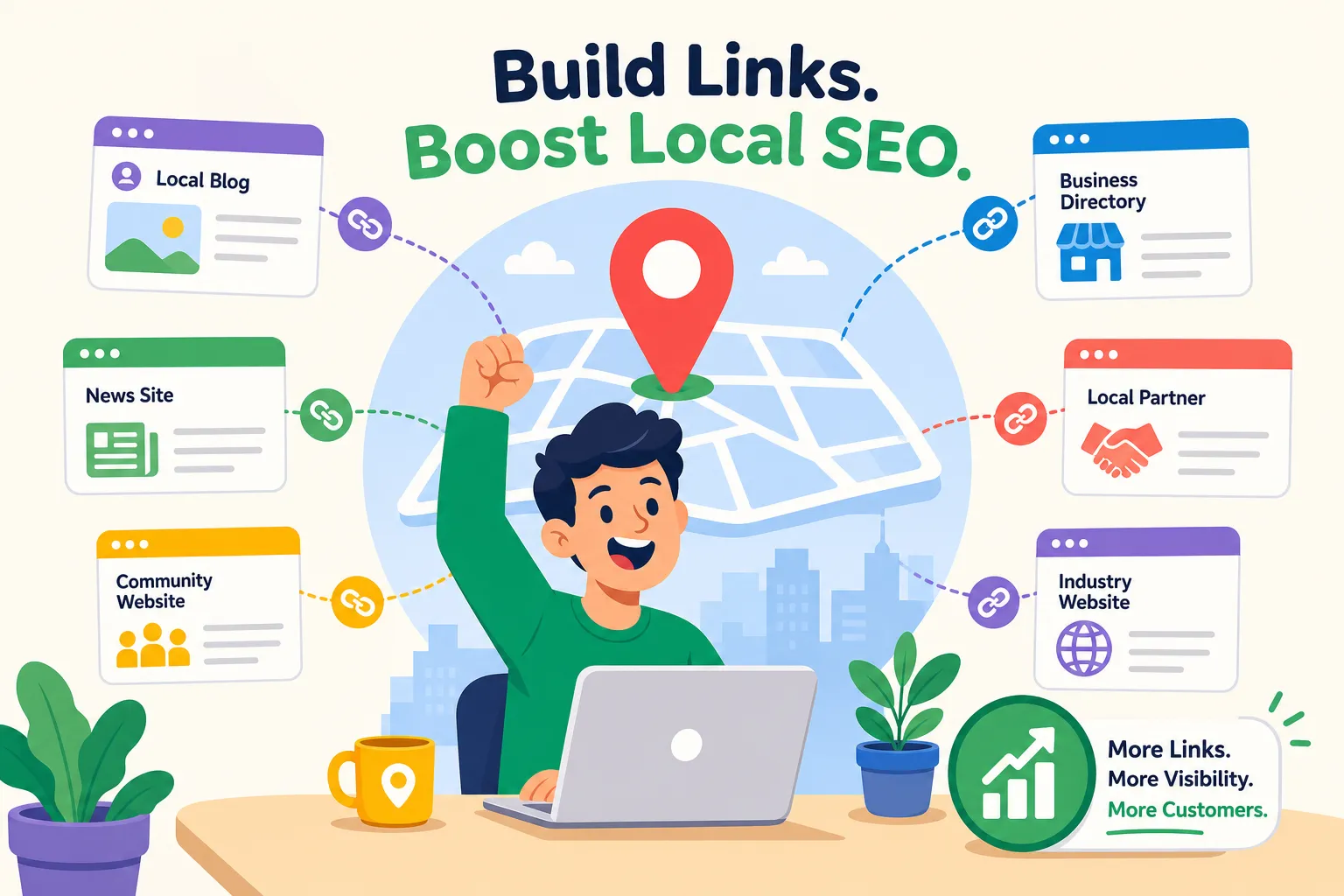
Link building for local SEO requires a different approach than generic link building, and most small businesses misunderstand that difference. They fall into one of two traps: either ignoring it completely, assuming it’s too technical or too time-consuming, or chasing generic directory submissions and wondering why nothing moves. Neither approach works, and the reason comes down to a fundamental misunderstanding. Local link building is its own discipline, not a watered-down version of what enterprise brands do.
According to Whitespark’s 2026 Local Search Ranking Factors study, backlinks account for roughly 24% of local organic rankings and 8% of local pack rankings. Those numbers matter, but only when the links come from the right sources. Research from Digital Applied in 2026 found that locally relevant backlinks are 2.3x more valuable than generic ones for local organic visibility. That multiplier explains why a single link from your city’s Chamber of Commerce often outperforms a dozen links from national directory sites that list every plumber in every zip code in America, a difference the research attributes to geographic trust signals, not just domain authority.
At Brandleap Agency, we’ve seen this play out consistently when working with small businesses across the US that have limited in-house marketing resources. The businesses that build local authority fastest aren’t the ones with the biggest budgets, they’re the ones targeting the right link sources with a repeatable process. This guide gives you that process, from the first citation you build to the local press pitch that earns you a feature in your regional newspaper.
Why local backlinks hit differently than generic link building
Standard link building is largely about domain authority accumulation: get links from high-authority sites, pass authority to your pages, and rank higher. Local SEO link building has a different goal. You’re building geographic relevance and trust signals that tell Google you are a real, established business embedded in a specific community. The mechanics overlap, but the targeting logic is completely different.
The ranking weight breakdown for 2026
The Whitespark data gives a clear picture: backlinks carry approximately 24% of local organic ranking weight but only 8% of local pack (Google Maps) weight. Google Business Profile signals now drive around 32% of local pack rankings (per the Whitespark and BrightLocal synthesis), which means GBP optimization is the higher-leverage move for map visibility. Links matter most for the organic results that appear below the map, though a strong backlink profile supports both. The practical takeaway is that you need links AND a well-optimized GBP, not one or the other.
Why a locally relevant link outranks generic directory links
The 2.3x multiplier from Digital Applied’s 2026 research comes down to how Google interprets geographic trust. A link from your city’s Chamber of Commerce, a local news article, or a community blog signals that real people and real institutions in your area vouch for your business. A link from a national directory that lists 50,000 businesses across every category carries almost none of that signal. Google is measuring geographic trust, not just page authority. Quality over quantity isn’t a cliché in local SEO, a business with ten strong local backlinks often outranks competitors with hundreds of irrelevant directory listings, which is consistent with the Digital Applied findings on relevance-weighted link value.
Link building for local SEO: citations and sponsorships
Before you pursue press coverage or sponsorship links, you need a clean citation foundation. Citations are structured mentions of your business name, address, and phone number across directories and listing platforms. They’re relatively straightforward to acquire, and they establish the baseline trust signals Google uses to confirm your business exists where you say it does. For a comprehensive reference list of places to build those listings, see the definitive list of local business directory citations for practical options and examples: local business directory citations.
The highest-authority citation sources for US small businesses
Prioritize these four tiers in order, though the right mix can vary by vertical and local market. Your local Chamber of Commerce member directory is typically hosted on a trusted .org domain with strong local authority signals. Your local BBB chapter is high-trust, geo-targeted, and widely recognized. City and state government business portals carry exceptional authority and pass strong location trust signals. Niche industry directories round out the foundation.
That last tier matters more than most business owners realize. For healthcare providers, Healthgrades and Zocdoc carry far more weight than generic directories. For legal professionals, Avvo and Justia are the priority. Home service businesses should focus on Angi and Houzz. Restaurants need Yelp, TripAdvisor, and OpenTable. A citation from the right industry-specific platform in your vertical is worth more than a dozen general listings. If you serve a specialized retail vertical like fine jewelry, our Local SEO for Jewelry Stores: The Ultimate Guide, 2026 covers vertical-specific citation and outreach tactics.
NAP consistency: the detail most businesses get wrong
Maintaining consistent NAP (Name, Address, and Phone number) formatting across every listing, including consistent use of abbreviations and punctuation, is one of the most commonly overlooked citation fundamentals. Variations like “St.” versus “Street” or “Suite 100” versus “Ste. 100” may seem minor, but inconsistencies can weaken citation trust signals and make it harder for Google to confidently surface your business in location-based searches. Audit your existing listings before you add new ones.
Local outreach for SEO: community-first tactics
Sponsoring a local youth sports league or contributing to a school fundraiser isn’t just good PR. It’s one of the most sustainable local link building strategies available to small businesses, because those links reflect genuine community relationships that Google can’t easily replicate or fake. That’s exactly why they carry real weight. For practical outreach ideas and community-focused link opportunities, this piece on ways any business can earn local backlinks provides actionable tactics you can adapt: 10 ways to earn local backlinks.
The most link-rich sponsorship categories are local nonprofits with active sponsor recognition pages, annual community events, school and university programs, downtown business alliances, and local sports teams. The critical filter is whether the organization maintains an active website with a sponsor listing page, not just social media accounts. A Facebook shoutout does nothing for your backlink profile. A sponsor page on a well-maintained local nonprofit site does. If you’re exploring sponsorships as a repeatable tactic, these sponsorship outreach and follow-up best practices can help you convert conversations into confirmed sponsor listings and links.
How to approach a sponsorship outreach without sounding like a pitch
The first outreach email should do one thing: secure a 15-minute discovery call. Keep it to two to four sentences, reference a specific point of audience overlap or shared community value, and ask for the call directly. Don’t attach a sponsorship deck, quote a price, or lead with what you want. A subject line like “Open to a 15-min call? Quick question about [Organization Name]” generally sees higher open and reply rates than anything that mentions sponsorship upfront, discovery-first approaches tend to outperform direct pitches at the subject line stage. The pitch comes after the conversation, not before. For templates and subject-line ideas that improve open rates for event and sponsorship outreach, consider using proven subject-line patterns when you reach out.
Local press outreach and how to earn PR backlinks
Earned media links from local news sites, regional lifestyle publications, and radio station websites are among the highest-value backlinks a local business can acquire. They come from editorially controlled domains that Google treats as credible, independent endorsements. Landing one well-placed local press mention is worth more than a month of directory submissions.
The highest-value local press sources for US small businesses
Regional newspapers, local TV and radio station websites, and city lifestyle magazines are the primary targets. Beyond standard editorial coverage, “Best of [City]” award programs hosted by local publications are a strategic entry point. Nomination pages typically include business listings with links, even before any editorial coverage happens. Getting nominated, or nominating yourself and promoting the vote, gets your business in front of the publication’s audience and into their link structure.
What makes a story worth pitching to a local outlet
Local journalists cover community impact, local milestones, seasonal angles, and data-driven local insights. They don’t cover product announcements. A plumbing company sharing data on pipe-burst incidents in their city during a cold snap can earn a quote and a link in a January safety article. A pediatric dentist sharing back-to-school oral health data for local parents has a story. Connect your expertise to something that affects the journalist’s specific audience right now, and the pitch becomes much easier to land. For tactical guidance on local outreach and link building techniques, Moz’s resource on local outreach and link building is a helpful reference.
A simple outreach email structure that gets responses
The most effective pitches follow a three-part structure: one sentence explaining why the story is relevant to their audience at this specific moment, one sentence on who you are and what the story actually is, and one clear ask, whether that’s an interview, a quote, or coverage consideration. No attachments, no PDF decks, no lengthy company backgrounds. Journalists receive dozens of pitches daily. The ones that get responses are short, specific, and immediately clear about the news angle.
Link practices that will get your site penalized
Google’s Penguin system now devalues most bad links algorithmically rather than issuing direct penalties, but manual actions still happen when the webspam team identifies clear, intentional manipulation. Understanding where the line sits protects you from undoing months of legitimate work with one bad decision. For an overview of how manual actions and penalties operate and real-world recovery case studies, the complete list of Google penalties and recovery insights is a useful read.
What Google’s guidelines actually prohibit (in plain language)
The clear violations are buying links without nofollow or sponsored tags, excessive reciprocal link exchanges, automated link creation, and keyword-stuffed anchor text in sponsored placements. Google has issued manual actions against major brands including J.C. Penney, Forbes, and Overstock for these practices, so the enforcement is real, not theoretical. Less than 1% of indexed sites receive manual penalties, but the algorithmic devaluation affects far more. If you’re paying for links and not tagging them correctly, you’re building a backlink profile that actively works against you.
The warning signs of a low-quality link building service
Any vendor promising dozens of links per month at a flat fee, bulk directory submissions, or guaranteed rankings through “private blog networks” is selling something that will eventually cost you more to fix than it ever generated in rankings. The simplest test: would this link make sense if Google never existed? A link from a local nonprofit sponsor page makes sense regardless of SEO. A link from a network of thin sites created solely to pass authority does not. That question filters out most of the risky services immediately.
Measuring whether your local links are actually moving the needle
Building links without tracking their impact is just activity without accountability. You need a baseline before you start, consistent monitoring after you launch, and a clear understanding of what the data actually means. This is also where many small business owners hit their ceiling: executing citations, sponsorship outreach, and press pitching simultaneously while running a business is a real time commitment.
Setting a baseline before you start outreach
Capture three data points before your first outreach email goes out. Your current Google Search Console clicks and impressions for your target local queries. Your local pack position for three to five priority keywords, tracked through a tool like BrightLocal or Semrush. A snapshot of your referring domain count and quality. Without these baselines, you have no way to attribute ranking changes to your link-building work rather than other factors.
Local link building strategies for tracking ranking changes over time
Watch two signals after your outreach campaign launches: position changes in local organic results for geo-targeted keywords, and local pack visibility changes for “near me” and city-specific queries. Results from local link building typically begin to surface within four to eight weeks. Initial movement often appears around the six-week mark, with more consistent shifts visible by the three-month point, though timelines can extend in competitive markets.
When to stop DIYing and bring in outside help
If you’re running a business, managing staff, and handling customer relationships, adding a consistent local link-building operation on top of that is genuinely difficult to sustain. That’s exactly why Brandleap Agency’s off-page SEO services exist. Our team handles the target identification, outreach execution, and backlink profile development systematically, so you’re not choosing between running your business and building your search authority. If you understand the local link building strategies outlined in this guide but don’t have the bandwidth to execute them consistently, that’s the right moment to bring in a specialist. We also offer tailored regional solutions such as our Local SEO Services Philippines: Expert Strategies for Success, 2026 for clients with specific geographic needs.
Build local authority now, before your competitors do
Local link building for SEO doesn’t require a large budget or hundreds of links. It requires the right targets, consistent outreach, and enough patience to let the results compound. Start with citations to establish your foundation, layer in sponsorships for community-rooted neighborhood backlinks, and pursue local press outreach for the highest-authority placements. Each layer reinforces the others.
The Digital Applied finding that locally relevant links carry a 2.3x advantage over generic ones should heavily influence how you approach every outreach decision in this guide. Volume without relevance doesn’t move local rankings. Relevance without consistency doesn’t sustain them. The businesses that start building local link authority now will be significantly harder to displace 12 months from now, because authority compounds in ways that paid traffic never does. For additional tactical approaches to local link building, this practical local link building guide offers step-by-step methods you can adapt to your market.
If you want help with link building for local SEO, Brandleap Agency is built specifically for small businesses that want expert execution without enterprise-level pricing. Reach out to our team to see what a targeted local link-building campaign looks like for your market, and get a free consultation to start. Learn more about our overarching service offerings on our Best Local SEO Service, Brandleap Agency page.