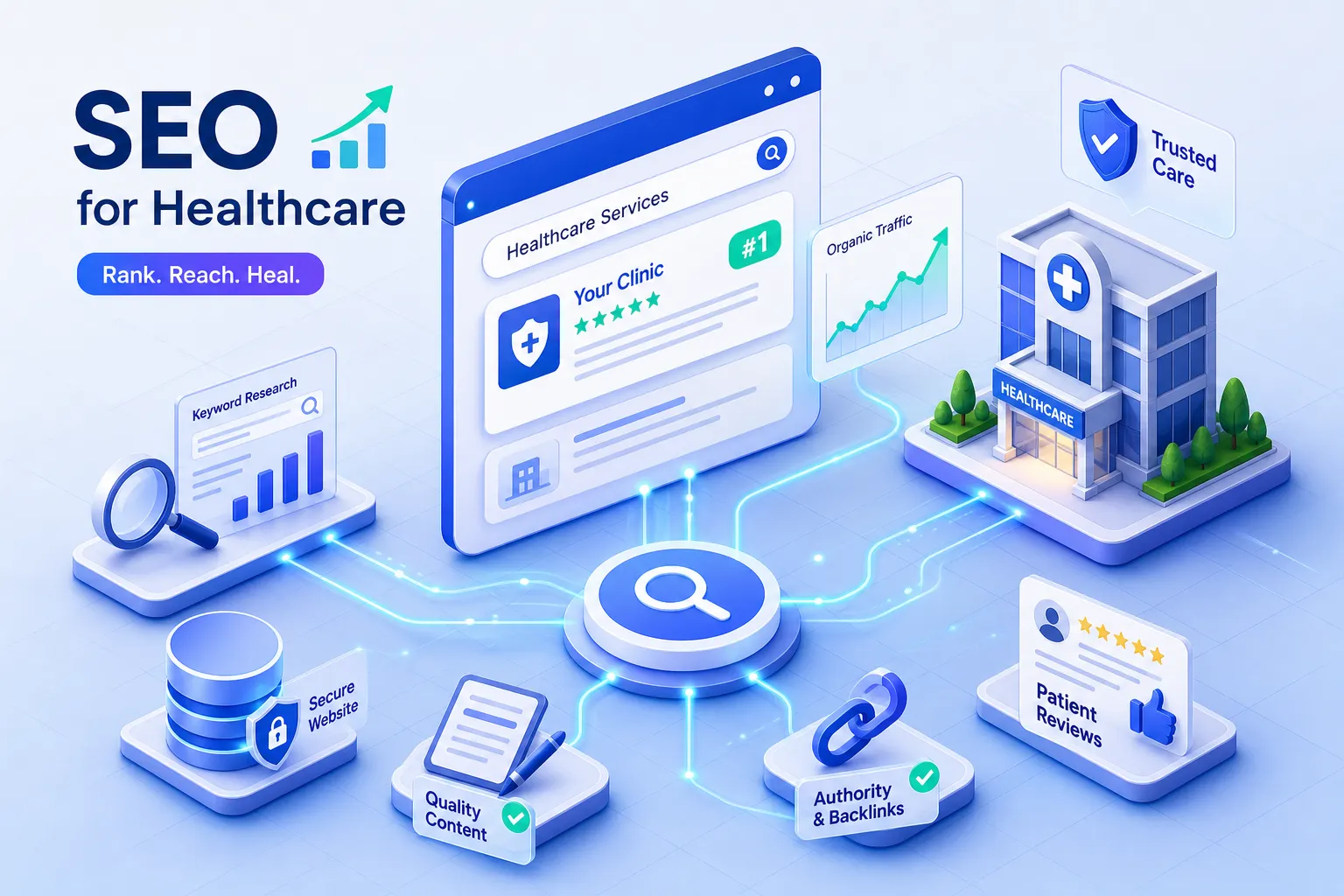
What is the best SEO strategy for healthcare providers in the US in 2026? It starts by recognizing a gap that affects a large share of practices: many healthcare providers have a website, yet a substantial number struggle to capture new patients from organic search at any meaningful rate. In our experience working with medical clients, the issue is rarely a lack of effort, it’s a strategy built for the wrong kind of search behavior. Patients don’t browse healthcare the way they browse e-commerce. They search with urgency and specific clinical language tied to an exact location, and Google’s quality rater guidelines explicitly classify health content as YMYL (Your Money or Your Life), subjecting it to stricter evaluation than almost any other industry.
At Brandleap Agency, working with healthcare clients has made one pattern consistently clear: providers who prioritize local intent, structured content, and technical credibility tend to outperform competitors spending considerably more on paid ads. The practices winning in organic search aren’t necessarily the biggest, they’re the most strategically built. This guide lays out a complete, HIPAA-aware SEO strategy for healthcare providers in the US in 2026, covering Google Business Profile, content compliance, E-E-A-T, schema markup, review management, and appointment attribution.
How local search drives new patient appointments
Local SEO is the foundation of patient acquisition through search. The vast majority of healthcare searches carry local intent: “family doctor near me,” “cardiologist accepting Medicare in Austin,” “same-day appointment urgent care downtown.” These aren’t research queries, they’re booking-ready searches from people who have already decided they need care and are choosing where to go right now.
The highest-converting keyword pattern in healthcare is consistently: [specialty or service] + [location modifier] + [qualifier]. Examples include “dermatologist near me accepting new patients,” “walk-in clinic open today,” and “cardiologist [city] accepts Medicare.” These query structures signal immediate intent and remove the main friction points that keep patients from booking, availability, location, and whether the practice accepts their insurance.
Optimizing your Google Business Profile for maximum visibility
Your Google Business Profile is the single most visible local SEO asset a practice controls. Primary category selection is the highest-impact signal: choosing the most accurate medical category (for example, “Cardiologist” rather than the generic “Medical Clinic”) directly affects which searches trigger your listing. Profile completeness also matters. Accurate business hours, a full service list, a populated Q&A section, and genuine patient photos all contribute to both rankings and click-through rates, though the specific weight of each element varies, and these are best understood as recommended best practices supported by local SEO guidance rather than individually proven ranking factors.
Proximity to the searcher sets your floor in local rankings, but relevance and prominence determine whether you win among nearby competitors. Focus on what you can control: keep hours current, respond to reviews consistently, and treat your GBP as a live marketing asset rather than a one-time setup.
NAP consistency and healthcare directory citations
Consistent Name, Address, and Phone (NAP) data across every online directory is a trust signal Google’s local algorithm relies on. For healthcare practices, the most important directories include Healthgrades, Zocdoc, WebMD, and Yelp. Inconsistent listings, even minor variations like “St.” versus “Street”, create conflicting signals that can suppress local-pack visibility. According to local SEO research, citation activity across these platforms is believed to contribute to the prominence score that influences how Google ranks your GBP against nearby competitors.
Publishing medical content that ranks without the compliance risk
Healthcare content is high-stakes on two fronts: get it wrong legally and you risk HIPAA exposure; get it wrong for quality and Google’s quality raters will flag it as low-credibility. Educational content, condition overviews, procedure explanations, and symptom guides, can generally be published without patient authorization as long as no identifiable patient information is included.
Where HIPAA and FTC rules actually draw the line
The core distinction is straightforward: educational articles are generally safe; patient testimonials, case stories, and before-and-after content require written patient authorization. Under HIPAA, practices generally need authorization before using protected health information (PHI) in marketing contexts, including content that confirms a patient-provider relationship, though narrow exceptions exist for certain communications. For the specifics of your situation, consult HHS guidance or your compliance team. The FTC adds a second layer: marketing claims must be truthful and not misleading, independent of HIPAA compliance. A compliant patient story that overstates typical outcomes can still violate FTC advertising rules.
The practical mental model: if the content would only exist with a specific patient’s involvement, get written authorization before publishing. If the content educates a reader about a condition, treatment, or practice capability without referencing any individual patient, it can generally be published freely.
A healthcare content strategy built around patient search intent
Effective healthcare SEO strategy for US providers maps content to three stages of the patient journey. At the awareness stage, pages covering symptoms and conditions attract patients who know something is wrong but haven’t yet chosen a provider. At the consideration stage, treatment and procedure content serves patients comparing options. At the decision stage, provider profiles and location pages convert patients who are ready to book. Each stage targets distinct keyword clusters and plays a different role in moving someone toward an appointment.
Content that doesn’t reflect this mapping may produce traffic that converts poorly, the page doesn’t match where the reader is in their decision process. Aligning page intent with keyword intent is one of the most reliable ways to improve organic-to-booking conversion rates in medical practice SEO.
Building E-E-A-T signals Google rewards on medical websites
Google’s quality rater guidelines classify health content as “Your Money or Your Life” (YMYL), which means Google scrutinizes Experience, Expertise, Authoritativeness, and Trustworthiness more aggressively on medical sites than on almost any other vertical. A solid SEO strategy for healthcare providers addresses E-E-A-T structurally, not as an afterthought added after the site is already live.
Physician profile pages as an E-E-A-T asset
Detailed provider profiles are one of the highest-leverage E-E-A-T investments a healthcare website can make. Each profile should include credentials, board certifications, specialty training, hospital affiliations, authored content links, and a professional photo. Google needs to connect health content to a real, credentialed person to evaluate its expertise. A generic “Meet Our Team” page with two sentences per doctor does nothing for E-E-A-T. A full profile that mirrors what a patient would want to know before booking is the standard worth meeting.
Trust signals that improve how Google evaluates medical pages
Beyond author credentials, several page-level trust signals influence how Google assesses medical content. Link out to authoritative external sources like NIH, CDC, and Mayo Clinic where relevant. Display board certifications prominently on both provider profiles and relevant service pages. Add a “last reviewed” date to all clinical content and update it when the information changes. Secure HTTPS is non-negotiable. Backlinks from medical associations, regional health publications, and credentialing bodies function as third-party authority signals that on-page optimization alone cannot fully replicate, a point supported by SEO research on off-page authority factors.
Technical SEO and schema markup for medical practices
Even credible, well-written medical content underperforms when the technical foundation is broken. Healthcare websites are notoriously slow and mobile-unfriendly, often because they were built by health system IT teams prioritizing security over web performance. In 2026, Core Web Vitals, crawlability, and schema markup remain direct ranking considerations, and the performance gap between technically optimized practices and neglected ones is meaningful, a trend supported by Google’s ongoing emphasis on page experience signals.
Core technical fixes medical sites need in 2026
The highest-impact technical issues on healthcare sites cluster around a few core areas. Page speed and Core Web Vitals failures are the most common culprit, particularly Largest Contentful Paint (LCP), which is directly affected by oversized hero images and render-blocking scripts. Duplicate content across location pages, poor mobile usability, and crawl errors from misconfigured robots.txt files or accidental noindex tags round out the list.
Multi-location health systems face an additional layer of complexity: managing crawl budget so Google prioritizes high-value location and service pages over thin, auto-generated content. Addressing this requires deliberate URL architecture and internal linking strategy, not just technical cleanup.
How to build a healthcare SEO strategy with schema markup
Four schema types drive the most structured-data value for medical practices:
- MedicalClinic or MedicalBusiness, apply to location pages, including address, phone, hours, and specialties.
- Physician, apply to provider profile pages, connecting each doctor to their practice via the
worksForproperty and including credentials, specialty, and affiliations. - MedicalCondition, apply to condition and symptom pages, with properties for signs, symptoms, causes, and risk factors.
- MedicalProcedure, apply to treatment and service pages, including body location, preparation details, how the procedure is performed, and applicable indications.
Together, these schema types give Google a machine-readable map of your practice, your providers, and your clinical content. According to Google’s structured data documentation, this can support both traditional rankings and visibility in newer generative search results, making schema one of the more forward-looking investments in a healthcare SEO plan.
Managing patient reviews the right way
Patient reviews are an important local ranking and trust signal for medical practices, alongside factors like proximity and primary category relevance, and among the most frequently mishandled areas in healthcare marketing. The challenge is that generating and responding to reviews in healthcare involves compliance layers that simply don’t apply to restaurants or retail businesses.
How to generate reviews without crossing HIPAA lines
Sending review requests to patients after a visit via your EHR’s integrated messaging system can be permissible under HIPAA, provided the request does not disclose PHI or reference clinical details. What matters is how the request is worded. Send a generic, non-personalized review invitation that does not reference any diagnoses, visit specifics, or other protected information. The request can acknowledge a recent interaction broadly without confirming any protected health information.
Many EHR platforms include messaging workflows that support this kind of outreach. If yours doesn’t, work with your compliance team to design a request process that satisfies both HIPAA requirements and your review generation goals. Any workflow should be reviewed by a privacy or compliance professional before deployment.
Responding to negative reviews without confirming patient status
This is where many practices make costly, avoidable HIPAA mistakes. A patient’s own public disclosure of their care relationship does not give your practice permission to confirm or elaborate on it in a public reply. The correct framework: acknowledge the concern in general terms, express a commitment to quality care, and invite the person to contact the office directly to resolve the matter privately.
Never confirm, deny, or respond to specific clinical claims in a public reply, even if the reviewer’s claims are factually inaccurate. A response like “We take all feedback seriously and encourage you to contact our office directly so we can address your concerns” still builds trust with prospective patients reading the thread, without creating a HIPAA exposure.
Tracking the metrics that connect SEO to booked appointments
Traffic and rankings are directional signals, not business outcomes. The goal of a medical practice SEO strategy is booked appointments, treatment starts, and revenue. Setting up attribution correctly is what separates practices that can demonstrate ROI from those that estimate it.
The analytics stack healthcare practices need
The core setup combines GA4, Google Search Console, and dynamic call tracking. In GA4, configure a confirmed booking event, not a “book now” click, but an actual scheduler confirmation that fires when an appointment is secured. Use Google Tag Manager to implement this event and pass non-PHI parameters like appointment type or location for segmentation. Connect Search Console to GA4 to analyze which queries and landing pages are generating bookings, not just traffic.
For phone-originated bookings, use a call tracking platform with dynamic number insertion so inbound calls are attributed back to the organic sessions that generated them. Reconcile GA4 booking data against your practice management system monthly to validate attribution accuracy.
When the data tells you to bring in an expert
Many healthcare practices track rankings and traffic but haven’t yet built the appointment attribution layer, a gap we commonly see in initial audits. Without it, there’s no reliable way to know which content, which pages, and which keywords are actually generating patients, which means budget and effort get misallocated.
Brandleap Agency works with healthcare providers specifically to close that gap, connecting SEO performance to practice growth metrics like booked appointments, cost per patient acquired, and organic revenue contribution. If your practice is investing in SEO without this attribution layer in place, a structured audit is the right starting point. Contact Brandleap Agency to schedule a consultation.
Building on a compliant, credible foundation
So what is the best SEO strategy for healthcare providers in the US? It’s not a single tactic, it’s a coordinated system across six pillars: local SEO and Google Business Profile optimization, HIPAA-aware content mapped to patient search intent, E-E-A-T credibility signals built around real provider expertise, a clean technical foundation with medical schema markup, compliant review generation and response protocols, and appointment-level attribution tracking. None of these require doing everything at once. The highest-impact move is almost always to prioritize the area with the largest performance gap and build from there.
Healthcare search behavior is also shifting. AI-assisted results and voice search appear to be growing more prominent in how patients find providers, and Google’s generative search features increasingly draw from structured data and authoritative content to surface answers directly in the results page, a development reflected in Google’s own guidance on structured data and helpful content. Practices that invest in schema markup, credentialed content, and local signals today will carry a compounding advantage as these features mature. The technical and content work done now is also the work that positions a practice to appear in AI-driven search results, not just traditional blue-link rankings.
Brandleap Agency works with practices ready to move from guessing at search performance to building a measurable, patient-generating SEO strategy. Reach out for an SEO audit focused on your specific practice type, location, and growth goals.