
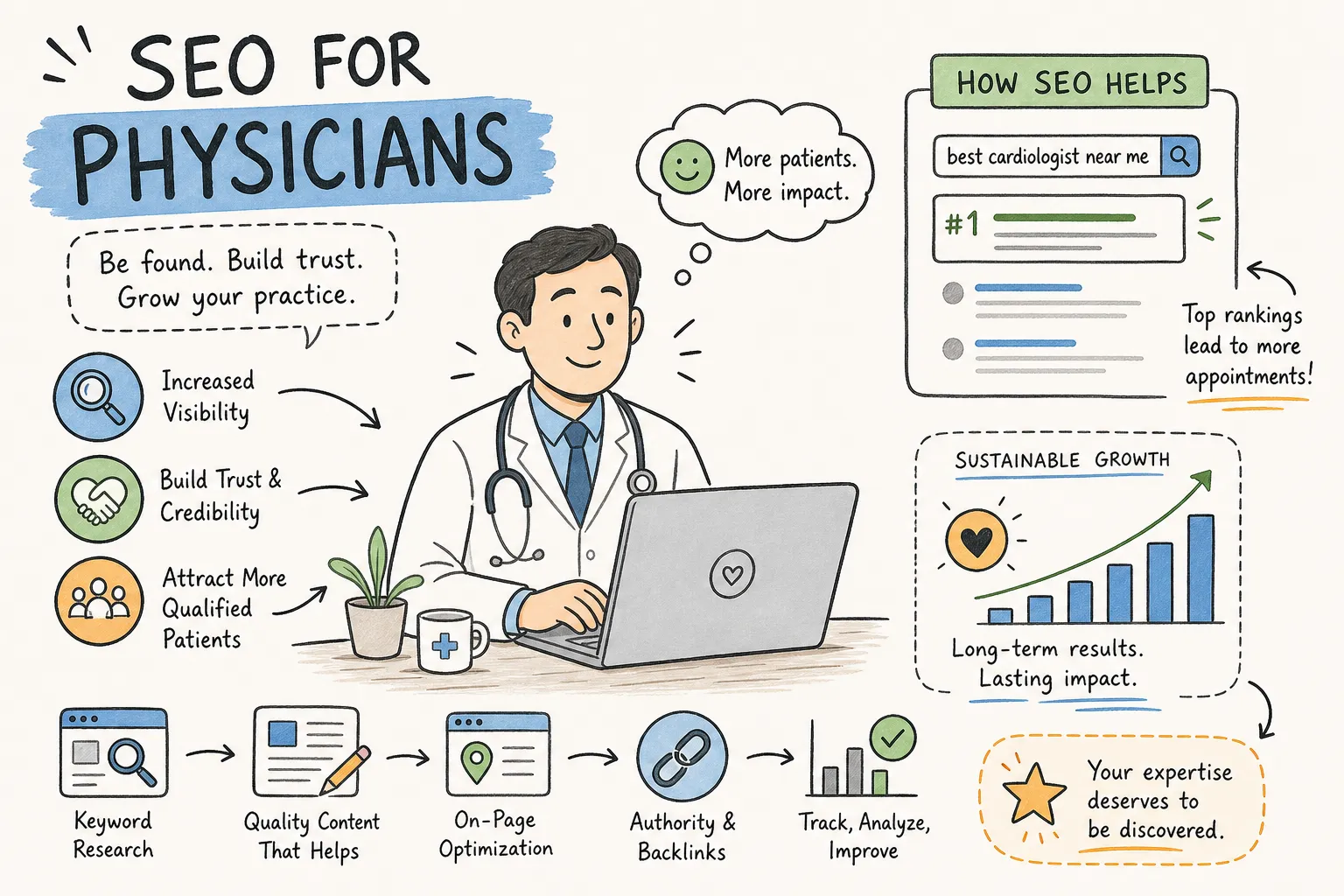
SEO services for physicians help practices appear in local search results and drive new patient bookings, but most medical practices are operating without them. Many patients today begin their search on Google, typing something like “internist near me” or “cardiologist Chicago,” and tend to choose among the top local results rather than asking a neighbor for a referral. Top local-pack positions capture the majority of clicks, so if your practice isn’t visible there, you’re losing patients to competitors before a single phone call is made. In 2026, organic visibility has become the most sustainable source of new patient acquisition for physician practices. Full-service digital partners like Brandleap Agency work with medical practices to build local search authority through integrated SEO campaigns tailored to how patients actually search. This guide gives you a clear picture of what SEO services for physicians include, what they cost, how HIPAA compliance fits in, which KPIs to track, and a practical framework for hiring the right agency or running an effective program in-house.
Why physician practices can’t compete without specialized SEO
How patients search for healthcare providers today
The majority of healthcare searches begin on Google, often include a location modifier, and frequently resolve via the Google Business Profile in the local pack or the top organic results on the page. Research consistently shows that users rarely go to page two, and most patients contact practices they can find online rather than calling an unfamiliar one they stumbled across elsewhere. Showing up in local search results isn’t a competitive advantage anymore. It’s the baseline requirement for practice growth.
The stakes are particularly high because local search is winner-take-most territory. The top three positions in Google’s local pack capture the overwhelming share of clicks, while positions four and below see dramatically less engagement. A practice ranking outside the local pack in a competitive market might as well be invisible to patients who are ready to book.
Why generic SEO misses the mark for medical practices
General-purpose agencies know how to rank e-commerce stores, SaaS products, and service businesses. Many lack the healthcare-specific keyword research experience and understanding of the relative authority of medical directories that physician SEO demands. Google also evaluates medical content under its YMYL (Your Money, Your Life) framework, which applies stricter E-E-A-T standards to health-related pages. A keyword strategy designed for a retail client will consistently underperform when applied to a physician practice.
HIPAA compliance is another area where generic agencies create risk without realizing it. Standard analytics configurations, Meta Pixels on appointment pages, and remarketing tags can collect data that qualifies as protected health information. An agency that doesn’t understand these distinctions doesn’t just underperform. It exposes your practice to regulatory liability.
What SEO services for physicians actually include
Local visibility and authority foundations
The core of any physician SEO engagement starts with local visibility: Google Business Profile optimization, consistent NAP (name, address, phone) data across directories, and healthcare-specific citation platforms like Healthgrades, Zocdoc, and WebMD listings. These components are the most directly tied to patient acquisition because they determine whether your practice appears when a nearby patient searches for care. For multi-provider practices, location page optimization extends this foundation to each physical site.
NAP consistency matters more than many practices realize. When your information differs across directories, Google loses confidence in which version to display. Healthcare-specific citations carry additional authority because they signal to search engines that your practice is legitimate and established in the medical ecosystem.
On-page, technical, and structured data work
Technical SEO covers the infrastructure that allows search engines to crawl, index, and understand your site: page speed, mobile performance, HTTPS security, XML sitemaps, and internal linking. For physician websites, structured data (schema markup) aids Google’s interpretation of your content and can improve click-through rates for local and rich results. Schema types like Physician, MedicalClinic, LocalBusiness, FAQPage, and AggregateRating help Google accurately categorize your pages and surface them in relevant searches.
On-page optimization covers title tags, meta descriptions, heading structures, and keyword placement on your service pages, provider bios, and location pages. These are the elements that tell Google what each page is about and determine which search queries it’s eligible to rank for. A well-optimized provider page does double duty: it ranks for searches on that physician’s name or specialty and serves as a conversion tool for patients evaluating whether to book.
Content and reputation management
Patient-facing content is how your practice builds E-E-A-T signals that Google rewards. Service pages, condition and treatment explainers, provider bios, and educational blog posts all contribute to Google’s assessment of your site’s expertise and trustworthiness. This matters especially for medical content, where Google applies more rigorous quality standards than it does for most other topics.
Reputation management, which includes encouraging patients to leave reviews and crafting compliant responses, affects both local rankings and patient conversion. Review velocity and quality are among the strongest signals in Google’s local ranking algorithm. Managing this process systematically, rather than passively waiting for reviews to appear, is a core component of any complete healthcare SEO program.
Local SEO services for physicians: GBP optimization and patient-intent keywords
Getting your Google Business Profile to work for you
Your Google Business Profile is often the first patient interaction with your practice. GBP optimization means getting the primary and secondary categories exactly right, completing the service list, uploading high-quality photos of your office and team, integrating an appointment link, and managing Q&A proactively. Google evaluates three factors for local ranking: proximity, relevance, and prominence. Each one is directly influenced by how thoroughly and accurately your profile is maintained.
Regular profile activity, including posts, review responses, and updated information, signals to Google that your practice is active and engaged. A neglected profile, even one with accurate basic information, performs worse than one that receives consistent attention. Building a regular rhythm for GBP maintenance from day one keeps your profile competitive over the long term. For an actionable checklist tailored to medical practices, see the Google Business Profile optimization checklist for medical practices.
Targeting how patients search, not how physicians diagnose
The most common keyword mistake in physician SEO is optimizing for clinical terminology instead of patient language. A patient experiencing joint pain searches “knee pain specialist near me,” not “orthopedic surgeon providing arthroscopic reconstruction.” Patient-intent keyword research maps the actual language patients use at every stage, from early symptom searches through appointment-ready queries, and aligns your content strategy to intercept them at each point.
This distinction drives the difference between traffic that converts and traffic that bounces. When your service pages speak the language your patients use, you capture higher-intent visitors who are already predisposed to book. When they’re written in clinical language, you rank for queries that other physicians search, not patients.
HIPAA compliance and your SEO strategy
Tracking tools and pixels that create hidden risk
Standard Google Analytics does not offer a Business Associate Agreement and is not HIPAA-compliant for use on pages where patients enter health information. Meta Pixel and most retargeting tags create similar exposure when placed on appointment request pages, symptom checkers, or patient portal login pages. Vendors that process patient data need BAAs in place, and your analytics setup needs to be evaluated with this in mind before any SEO campaign goes live.
HIPAA-compliant alternatives exist and are ready to implement. Consider these three options:
- Piwik PRO, a direct substitute for standard web analytics without the compliance risk
- Freshpaint, a healthcare-specific tracking layer that strips PHI before it reaches downstream tools
- Matomo, a viable option when self-hosted on compliant infrastructure with an appropriate BAA in place
Responding to patient reviews without legal exposure
The governing rule for review responses is straightforward but easy to violate under pressure: never confirm a patient relationship, never reference any detail from the review, and never include clinical information of any kind. Even a sympathetic response that says “we’re sorry for your experience in our office” can create HIPAA exposure by confirming the reviewer was your patient.
Use preapproved response templates for both positive and negative reviews. A positive response might read: “Thank you for sharing your feedback. We appreciate the opportunity to serve our community.” A negative response should acknowledge the feedback generically and redirect offline: “Due to privacy considerations, we’re unable to address specifics here. Please contact our office directly so we can assist you.” Preapproved templates and a clear review workflow protect your practice while still demonstrating responsiveness in public.
KPIs and ROI: what physicians should actually measure
The metrics that connect SEO to patient acquisition
Impressions and raw traffic are not business metrics. The KPIs that matter for a physician practice are organic traffic growth, phone calls from organic search (tracked with call tracking software), appointment form completions, and conversion rate. These metrics trace a direct line from search visibility to scheduled visits. According to conversion benchmarking data from Ruler Analytics, hospitals and clinics convert organic visitors at around 12%, dental practices at roughly 10%, and chiropractic practices at approximately 8%. Those are the targets worth measuring against.
Call tracking is particularly valuable for medical practices because a significant share of high-intent patients still call rather than submit a form. Without call tracking tied to organic search sessions, you’re underreporting the actual patient acquisition impact of your SEO investment by a wide margin. Dental practices can learn more about specialized approaches in our Dentist SEO Services: Unlock Success for Your Practice, 2026 resource.
Realistic timelines and expected return by practice size
Most physician SEO campaigns show meaningful ranking movement in three to six months (see how long SEO takes for medical practices) and measurable patient acquisition impact in six to twelve months. In highly competitive metro markets, or when building from a new domain, add another six months to both windows. Healthcare content falls under Google’s YMYL guidelines, meaning it faces stricter scrutiny during the initial indexing period, which can slow early momentum even when the technical work is solid.
ROI for medical practice SEO in the range of five to twelve times cost is frequently reported in industry analyses, driven by the high lifetime value of a retained patient. A solo practitioner in a suburban market with moderate competition will see results faster than a large multi-specialty group entering a high-competition city. Evaluate performance at the six-month mark before drawing conclusions about whether the program is working. For published benchmarks and ROI examples, see medical SEO ROI.
How to find and hire the right medical SEO agency
What a qualified healthcare SEO partner looks like
A credible healthcare SEO agency brings healthcare-specific case studies, not just general digital marketing wins. Their contract should list specific deliverables: GBP management, citation building, technical audits, content production, and monthly reporting tied to patient acquisition KPIs. They should demonstrate clear knowledge of HIPAA compliance and be willing to sign a BAA if their tools touch patient data. A full-service partner that handles SEO alongside content, technical work, and reputation management eliminates the coordination failures that happen when you’re managing multiple vendors with competing priorities.
See examples of integrated campaign approaches in our Medical Industry SEO Services That Drive Patient Growth offering. This integrated approach is what separates agencies with genuine medical practice digital marketing experience from generalists who apply a one-size-fits-all playbook. Ask for examples of campaigns run for your specialty type and request a breakdown of how they handle analytics compliance before committing.
Red flags that signal the wrong agency
Walk away from any agency that guarantees specific ranking positions. No one can guarantee Google rankings. Agencies that make this promise are either misleading you or deploying tactics that produce short-term gains and long-term penalties. Other clear warning signs include no demonstrated HIPAA compliance knowledge, reporting that focuses only on impressions or keyword counts, packages that don’t adapt to your specialty or market, and contracts that lock you in without performance accountability.
During a sales call, ask directly: “How do you handle analytics on appointment pages to ensure HIPAA compliance?” A qualified agency gives you a clear answer. A generic one changes the subject.
A checklist to evaluate any proposal before you sign
Use this framework to evaluate any agency proposal against a consistent standard:
- Confirmed healthcare client experience, with case studies from a similar specialty or practice size
- Demonstrated HIPAA compliance knowledge and willingness to sign a BAA if applicable
- Deliverables list that includes GBP management, content production, technical SEO, and citation work
- Sample monthly report that shows patient acquisition KPIs, not just traffic and rankings
- Reference from a practice in a comparable specialty and market
- Clear reporting cadence (monthly minimum) with a named account contact
- No guaranteed ranking promises in the contract
SEO is now a core growth channel for your practice
Patients search before they call. The practice that shows up in local results earns the appointment, and the one that doesn’t gets passed over before a single interaction occurs. In 2026, SEO for doctors is not an optional marketing experiment. It’s the infrastructure your patient acquisition depends on.
The right agency understands what complete SEO services for physicians include, maintains HIPAA compliance across analytics and review management, reports on metrics that reflect real patient growth, and integrates strategy with execution rather than handing off siloed deliverables. Medical practice digital marketing built around patient intent, local dominance, and consistent technical execution delivers measurable returns on investment.
Learn how our Healthcare SEO Services That Drive Patient Growth can grow your patient base, starting with a practice-specific SEO audit. The audit gives you a baseline, surfaces compliance risks in your current setup, and creates a roadmap built around your specialty, your market, and your growth goals. The longer you wait, the wider the gap grows between your practice and the competitors already investing in local search visibility.
Frequently asked questions about SEO services for physicians
How long does physician SEO take to show results?
Most practices see meaningful ranking improvements within three to six months. Measurable patient acquisition gains typically follow at the six to twelve month mark. Highly competitive metro markets or brand-new domains may take longer given the stricter scrutiny Google applies to healthcare content under its YMYL guidelines.
What makes SEO for doctors different from general business SEO?
Healthcare SEO requires patient-intent keyword research, compliance with HIPAA across analytics and tracking tools, and an understanding of the authority signals Google weights for medical content, including E-E-A-T standards and healthcare-specific directory citations. A generalist strategy optimized for retail or software will underperform for a physician practice.
Is local SEO for medical practices really that important?
Yes. The majority of healthcare searches include a location modifier, and the top positions in Google’s local pack capture the overwhelming share of patient clicks. Local SEO for medical practices, centered on GBP optimization, NAP consistency, and proximity-relevant content, is the highest-ROI component of most physician SEO programs.
How much do SEO services for physicians typically cost?
Physician SEO packages vary based on practice size, specialty, and market competition. Entry-level programs for solo practitioners in mid-sized markets typically start in the range of $1,000, $2,500 per month. Multi-location practices or those in highly competitive metro areas often invest $3,000, $6,000 or more monthly for a full-service engagement that includes content production, technical SEO, GBP management, and reputation management.