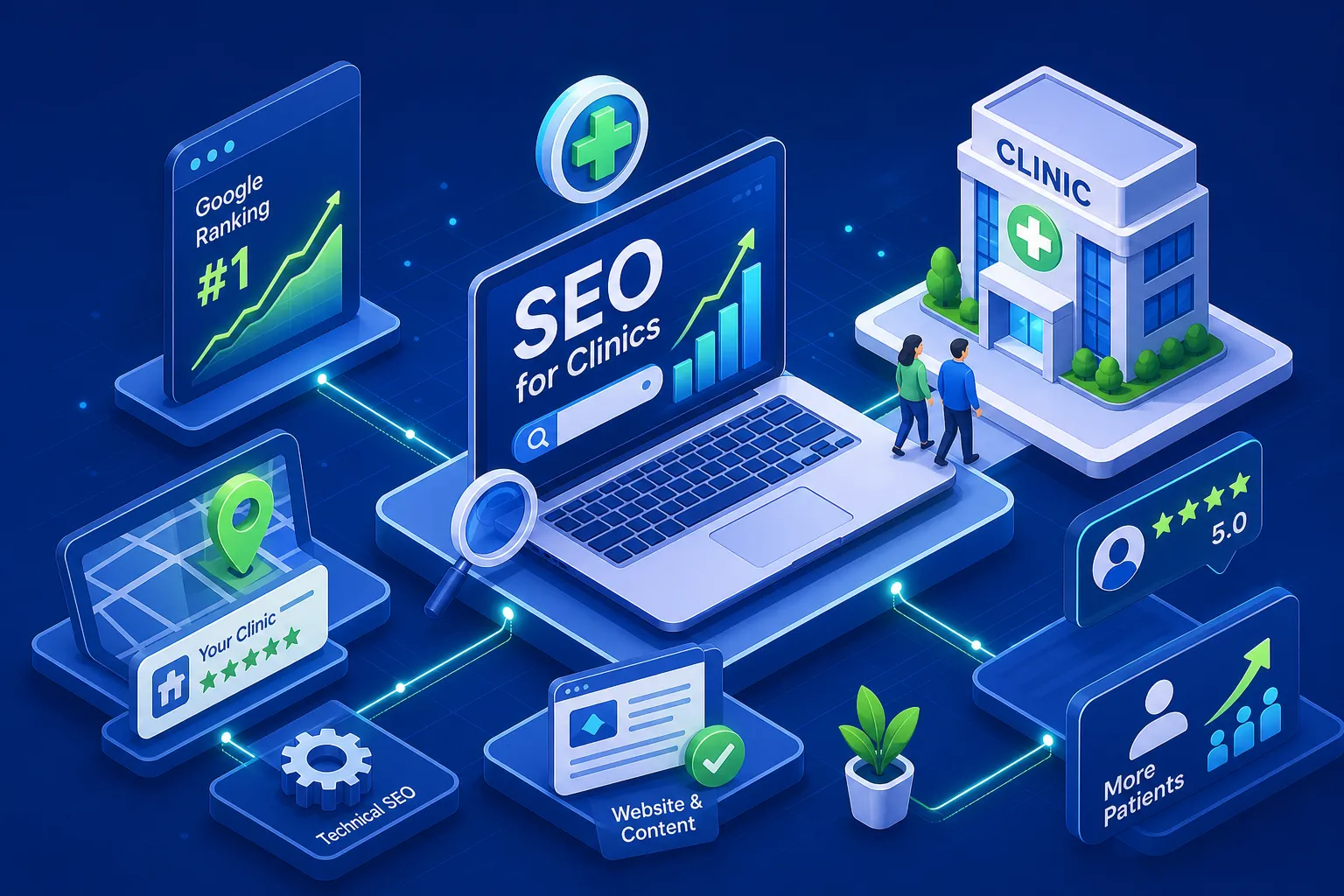
Most patients search online before they ever call a clinic. When someone in your city types “urgent care near me” or “dermatologist in [your city],” where does your practice appear? Most clinic websites are built to serve existing patients, not to pull in new ones through search. Owning a great practice does not guarantee visibility. Medical clinic SEO is the work that closes that gap, and it’s more systematic than most clinic owners realize.
At Brandleap Agency, we’ve watched well-established clinics lose new patient volume to smaller competitors who simply did the SEO work right. In some cases, the smaller clinic had half the staff and a fraction of the reputation, but it showed up first. This guide walks through exactly what that work looks like: Google Business Profile optimization, HIPAA-compliant tracking, medical schema, review strategy, and the KPIs that tell you whether it’s working. Whether you have one location or ten, these are the levers that convert searches into scheduled appointments.
Why Google holds medical clinic content to a higher standard
Google classifies healthcare websites under YMYL, “Your Money or Your Life.” Any content that could affect a reader’s health, safety, or financial decisions gets evaluated with far stricter quality criteria than content on, say, restaurant recommendations. This has real consequences for how your clinic’s website ranks in organic search.
Content covering symptoms, treatments, medications, or diagnoses gets scrutinized harder. Google’s quality raters look for evidence that the information is accurate, current, and written or reviewed by qualified professionals. A generic “About Us” page with no credentials doesn’t meet that bar anymore.
How to build E-E-A-T signals Google can actually measure
E-E-A-T stands for Experience, Expertise, Authoritativeness, and Trustworthiness. For clinics, that means listing provider credentials and medical licenses on your site, adding author bios to every blog post, citing reputable sources (CDC, NIH, peer-reviewed journals), and building backlinks from authoritative health publications. These aren’t abstract concepts. They’re specific signals the algorithm can parse and reward.
The HIPAA tracking trap most clinics fall into
Common SEO tools like Google Analytics and advertising pixels can accidentally capture Protected Health Information (PHI) when deployed on pages that collect patient data. Per HHS guidance, any third-party tool that touches PHI requires a signed Business Associate Agreement (BAA) before it can be used. The practical fix: remove tracking scripts from appointment forms, patient portals, and symptom-checker pages unless your vendor has a valid BAA on file. Google Analytics 4 is not HIPAA-compliant and should be restricted to public-facing, non-PHI pages like your blog or general service information.
The local ranking signals that determine clinic visibility
Whitespark’s 2026 local search ranking factor study gives clinics a clear hierarchy to work from. Google Business Profile signals carry 32% of total ranking weight. On-page content accounts for 19%. Reviews hold 16%. Links drive 15%. Behavioral signals contribute 8%, and citation consistency rounds out the remaining 7%. That breakdown tells you exactly where to spend your time in any medical clinic SEO effort.
GBP and on-page: where most of your ranking weight lives
Your Google Business Profile primary category is the single highest-weighted ranking signal, followed closely by proximity to the searcher and on-page keyword relevance. Dedicated location pages and service pages, not just a homepage, are what help Google match your clinic to specific searches like “knee pain specialist Austin TX.” Each service and each location needs its own page with unique, substantive content. A homepage alone cannot shoulder that responsibility.
Healthcare citations you cannot skip
Citations carry more weight for medical practices than for most other business types, because of the industry-specific directory ecosystem. NAP consistency (Name, Address, Phone) across Healthgrades, Vitals, Zocdoc, RateMDs, and WebMD is not optional. It’s how Google verifies your clinic’s legitimacy. Discrepancies between directories create trust gaps the algorithm penalizes. Fix your GBP first, then Apple Maps and Bing Places, then the healthcare-specific directories, then data aggregators like Data Axle and Neustar Localeze.
Medical clinic SEO: how to turn your Google Business Profile into a patient acquisition tool
A GBP that’s claimed but not optimized is a missed opportunity. Fully optimized profiles drive call clicks, direction requests, and direct bookings, all behavioral signals that feed back into your local pack rankings. Partial optimization doesn’t get partial credit. Google rewards completeness, particularly across the fields that matter most: categories, services, photos, and booking links.
Categories, services, and the language patients actually use
Select the most specific primary category available. “Orthopedic Surgeon” or “Pediatrician” outperforms the generic “Doctor” every time. Add up to nine secondary categories covering every service line you offer. For the Services section, write in plain patient language: “annual physical,” “skin cancer screening,” and “Invisalign” perform better in search than clinical codes or medical jargon. Only list services that have corresponding pages on your website. Otherwise, you’re creating a relevance gap that hurts both rankings and user experience.
Photos, booking links, and the Q&A section most clinics leave empty
Upload at least ten real photos at launch: exterior shots, interior spaces, treatment rooms, and provider headshots. Add new photos monthly. Stock images tend to underperform, patients notice them, and lower engagement signals can affect how Google evaluates your profile’s quality. Connect a direct booking link to a real-time scheduling tool like ZocDoc, Jane App, or Calendly. Direct booking links typically convert better than generic contact forms, which add friction and can interrupt a patient mid-decision. Seed the Q&A section yourself with the questions new patients always ask: which insurance you accept, parking availability, and the new patient intake process.
Google Posts as a consistent traffic driver
Use the Posts feature regularly, weekly or biweekly, per GBP best practices, to share provider announcements, new services, or seasonal health content. Each post should link back to a relevant page on your site. This keeps your profile active, signals recency to Google, and gives patients a reason to engage with your listing before they ever reach your website.
Schema markup for medical clinics: telling Google exactly what kind of business you are
Generic schema doesn’t serve medical clinics well. Google’s schema vocabulary includes specific types built for healthcare that unlock richer search results and sharpen how the algorithm categorizes your practice. Using the wrong schema type is a common technical SEO mistake that costs clinics visibility they’ve already earned through quality content.
MedicalClinic schema for your homepage and location pages
Use MedicalClinic as the primary schema type on your homepage and each location page, not the generic Organization or even MedicalBusiness. The MedicalClinic type supports properties like medicalSpecialty, availableService, and isAcceptingNewPatients that generic types lack.
Implement it as JSON-LD in the page and include opening hours, address, telephone, and booking URL. For multi-location clinic SEO, each location page needs its own schema block with location-specific data, treating locations as interchangeable is one of the most common and costly schema errors in healthcare SEO.
Physician and MedicalProcedure schema for provider and service pages
Each provider profile page should carry Physician schema with the doctor’s credentials, specialty, and hospital affiliation. Service and treatment pages should use MedicalProcedure or MedicalTherapy rather than the generic Service type. This level of specificity signals domain relevance and supports rich results in Google Search, giving your clinic a competitive edge over practices that rely on default schema or none at all.
Patient reviews: the local SEO signal with the shortest feedback loop
According to Whitespark’s 2026 local search ranking factor data, reviews represent 16% of local pack ranking weight. Review recency matters more than total count. Reviews from the last 90 days consistently outweigh a large archive of older feedback. To illustrate: a clinic with 20 fresh reviews from the past three months can often outrank one with 200 reviews spread over three years, because Google’s algorithm favors active, ongoing engagement over historical volume.
The velocity and response rules most clinics miss
A steady flow of three to five new reviews per month consistently outperforms a burst of 50 reviews followed by silence. Google rewards ongoing patient engagement. Equally important: practices that respond to 70% or more of their reviews tend to rank higher than those that don’t. Respond to every review, including negative ones. Use general language that never references a patient’s visit, condition, or any identifying detail. That’s the HIPAA boundary for public review responses, and crossing it carries real legal risk.
Building your review presence beyond Google
Healthgrades, Vitals, Zocdoc, and RateMDs aren’t just directories. They’re authority signals. A strong review presence across these platforms increases both your citation strength and your perceived trustworthiness for patients who check multiple sources before booking. Ask patients to leave reviews on these platforms alongside Google to build a diversified reputation footprint that no single algorithm change can disrupt.
Measuring results and deciding whether to hire an agency
Four KPIs give clinic owners a clear picture of whether their SEO for medical clinics is working: local pack ranking position by service and city, GBP action volume (calls, direction requests, website clicks), organic traffic to location and service pages, and new patient form submissions or booking completions from organic sources. Track these monthly. Quarterly tracking hides problems until they’re expensive to fix.
A quick multi-location audit checklist
For clinics with more than one location, run a NAP consistency check monthly on top directories and a full citation audit quarterly across all aggregators and healthcare directories. Each location page needs 300 or more words of unique content, its own schema markup, and hyper-local keywords that reference the specific neighborhood or city. Treat each location as its own SEO entity, because Google does.
When it makes sense to bring in an agency like Brandleap
Healthcare SEO carries a compliance layer that general-purpose agencies often miss, and the ongoing workload is real. GBP management, content updates, citation monitoring, and technical audits require consistent attention, and when that attention lapses, the gap between where you rank and where you could rank tends to widen. Brandleap Agency works with service businesses, including healthcare providers, to build the kind of trustworthy, locally optimized online presence that drives patient acquisition month over month. The goal isn’t vanity rankings. It’s a pipeline of patients who find you first and book because they trust what they see.
Start building your patient acquisition engine now
The core hierarchy here is straightforward. YMYL content standards set the foundation. GBP and on-page optimization drive most of your local ranking weight. Schema and citations verify your legitimacy. Reviews close the trust gap with both Google and prospective patients. Each of these levers is actionable, and most clinics haven’t worked through all of them yet.
SEO for medical clinics isn’t a one-time project. The practices that dominate local search in 2026 treat their digital presence with the same discipline they apply to clinical operations: consistent, documented, and continuously improved. Start with your Google Business Profile this week. Audit your citations next. Add schema to your location and provider pages after that. Build from there.
If you’d rather hand this off to a team that has done it before, Brandleap Agency is ready to help you build an online presence that earns new patient trust before they ever walk through your door. Contact us to see what your clinic’s local search growth actually looks like.