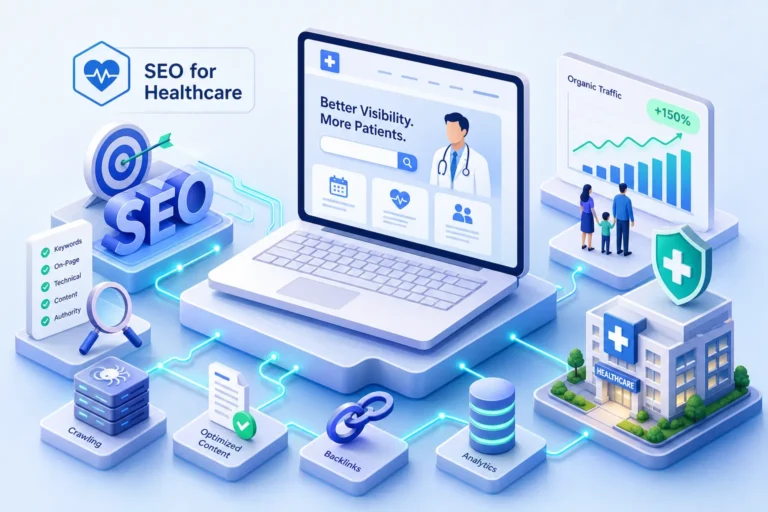
SEO services for healthcare help practices convert online searchers into booked appointments, and the numbers make the stakes clear. Seventy-seven percent of patients search online before booking a healthcare appointment, and 71% of those patients end up choosing a provider they found through search results (Kyruus Health Patient Access Journey Report). Google has become the front desk for the modern medical practice, fielding more first impressions than any receptionist ever could. The problem is that many general SEO agencies are not built for this environment. They lack the clinical content standards, compliance knowledge, and local search expertise that medical practices require.
At Brandleap Agency, we hear this exact frustration from dental offices, private clinics, and specialist groups that spent months with a non-specialized vendor and ended up with traffic but no new appointments. Healthcare SEO is a distinct discipline, and the gap between a generic campaign and a purpose-built one shows up directly in your schedule utilization rate. This guide gives you the complete picture: the core services to expect, the compliance lines that cannot be crossed, what results actually look like, and seven specific questions to ask before signing anything.
Why healthcare SEO demands a different playbook
Google classifies medical content as YMYL, short for Your Money or Your Life. This category covers any content that could affect a person’s health, financial stability, or safety, and the algorithm applies significantly stricter quality filters before ranking these pages. A dental blog with thin content or anonymous authorship is unlikely to rank well for medical queries even with a strong backlink profile, E-E-A-T signals carry substantial weight for YMYL pages, according to Google’s own Search Quality Evaluator Guidelines. The rules are simply different here.
What Google’s E-E-A-T standard means for your practice pages
Experience, Expertise, Authoritativeness, and Trustworthiness are not abstract concepts in medical SEO. They translate into specific, verifiable signals: provider bios with board certifications and medical school credentials, clinical content reviewed by a licensed physician before publishing, transparent authorship on every page, and a strong reputation built through healthcare directories and professional associations. These signals are the baseline for ranking, not bonus features you add later.
How patient search behavior differs from general consumer search
Most patient searches carry location and availability intent from the start. Queries like “family doctor accepting new patients Chicago” or “urgent care near me open now” are not browsing searches; they are ready-to-book searches. This is exactly why local SEO dominates medical practice marketing and why a strategy built around generic informational content misses the actual patient acquisition opportunity.
Core SEO services for healthcare practices
A purpose-built medical SEO package looks very different from a standard retainer. One concrete example of what a generic proposal often omits: HIPAA-compliant analytics configuration, a deliverable that broad-market SEO firms rarely include because they have no compliance framework to draw from. Knowing the full service stack lets you identify gaps in any proposal before you commit to a contract. Agencies that do not include most of these deliverables are unlikely to be fully prepared for healthcare SEO.
Technical medical SEO foundations for medical websites
Technical SEO for healthcare starts with a full site audit covering indexation errors, duplicate content, and crawl issues. From there, Core Web Vitals, mobile-first performance, and HTTPS security become non-negotiable for both ranking and patient trust. Healthcare-specific schema markup is where most broad-market agencies fall short. Properly implemented MedicalOrganization, Physician, MedicalClinic, and MedicalWebPage schema helps clinics appear in knowledge panels and rich results, improving click-through rates without requiring a higher organic position.
Clinical content: treatment pages, provider bios, and condition guides
SEO-led clinical content is not blog posts stuffed with keywords. It is service pages written with patient search intent as the starting point, doctor biography pages with credential schema and verifiable authorship, and condition or symptom guides that build topical authority over time. Every piece of this content should be reviewed by a licensed clinician or qualified medical editor before it goes live. That review process satisfies both Google’s E-E-A-T requirements and the trust standards your prospective patients apply when evaluating whether to book with you.
HIPAA-compliant SEO: directory listings and citation building
Healthgrades, Zocdoc, Vitals, and WebMD are the priority directories for medical practices. Beyond those four, NAP consistency, identical Name, Address, and Phone number formatting across 50-plus platforms, is a foundational signal for both local map pack rankings and patient confidence. Citation building in medical practice SEO is consistently deprioritized in standard retainers offered by general-purpose agencies, yet it remains one of the highest-leverage local ranking factors for clinics at any scale.
HIPAA compliance rules your SEO vendor cannot ignore
Non-compliant SEO practices in healthcare are not just ineffective strategy. They are a legal liability. Agencies that place standard tracking pixels on patient-facing pages, or that write review responses confirming a patient relationship, can expose your practice to HIPAA violations and the fines that follow. Before you sign with any vendor, confirm their compliance knowledge is real.
Tracking pixels, BAAs, and what your analytics setup must look like
Any vendor with access to patient data must sign a Business Associate Agreement, known as a BAA. This is a firm requirement under HIPAA, and any agency unfamiliar with the term is not a fit for healthcare work. Standard Google Analytics and Meta Pixel cannot be placed on appointment pages, patient portals, or condition-specific landing pages without creating compliance risk.
Privacy-safe alternatives are the compliant replacements your agency should already be using. Piwik PRO and Freshpaint, which acts as a secure data filter before passing information to downstream tools, are two platforms built specifically for this use case. Matomo, which requires self-hosting, is another option worth evaluating depending on your infrastructure.
The right and wrong way to respond to patient reviews
The rule is simple: never confirm or deny a patient relationship in a public review response. A compliant response acknowledges the feedback and invites the reviewer to contact the office directly. A non-compliant response says anything that confirms the person is a patient or references their visit. HIPAA-compliant review generation means asking patients to leave feedback through a secure, non-clinical communication channel, never through a tool that captures or references health information.
Local SEO services for healthcare: Google Business Profile tactics that fill appointment slots
For most single-location and multi-location practices, the local map pack is where patient acquisition actually happens. A well-optimized Google Business Profile appears before any website listing for the majority of “near me” and location-modified healthcare searches, which means your GBP is often the first thing a prospective patient sees about your practice.
What a fully optimized GBP looks like for a clinic
A fully optimized profile includes complete and accurate NAP data, the most specific primary category available (use “Orthopedic Surgeon” rather than “Doctor”), secondary categories for every service line, a direct booking link to real-time scheduling, weekly Google Posts, real photos of providers and the office interior, and a Q&A section pre-seeded with common front-desk questions about insurance, parking, and new patient intake. Research consistently shows that clinics with higher review counts and an active posting schedule tend to outperform competitors in the local map pack. Activity signals, post frequency, review response rate, and booking link engagement, carry meaningful weight alongside profile completeness.
Location pages, neighborhood-level targeting, and semantic SEO
Multi-location practices need dedicated landing pages for each office, built with locally relevant content rather than duplicate pages with a different city name swapped in. This is where semantic SEO becomes a real competitive advantage. That’s the model we use at Brandleap Agency, our local and semantic SEO services for healthcare providers are built to capture hyper-local patient intent, targeting neighborhood-level queries that general-purpose agencies routinely miss because they do not build content architecture around how patients in specific zip codes actually search for care.
Realistic pricing, KPIs, and timelines for medical practices
Healthcare SEO costs more than general SEO because the compliance requirements, clinical content review, and specialized technical work require more expert hours. A practice expecting results at $500 per month in a competitive metro market will be disappointed, and likely end up with a broad-market campaign that produces traffic without appointments.
What clinics and specialists actually pay in 2026
Solo practitioners typically invest between $1,500 and $3,500 per month for foundational services covering GBP management, basic content, and technical fixes. Multi-provider clinics with multiple locations or specialties run $3,000 to $8,000 per month. Telehealth platforms and health-tech companies with national reach typically invest $8,000 to $20,000 per month, and hospital systems or enterprise dental organizations often spend $20,000 or more. Most agencies also charge a one-time setup fee ranging from $2,000 to $8,000 before the monthly retainer begins, covering the initial audit and technical groundwork.
Which KPIs should you track beyond rankings?
Rankings are a leading indicator, not a business outcome. The metrics that actually matter for a practice are schedule fill rate (target 85 to 95%), no-show rate (below 10%), booked appointments attributed to organic search, and call volume generated from local pack visibility. Organic traffic milestones follow a predictable curve: expect 80 to 250 monthly visitors by month three, 200 to 800 by month six, and 500 to 2,000-plus by month twelve for a new site with consistent SEO investment. Meaningful appointment volume from search typically begins between months eight and twelve.
7 questions to ask before hiring a healthcare SEO agency
These questions function as a filter. Any agency that hesitates or gives vague answers is telling you something important about their actual experience with medical SEO services.
- Do you have case studies specifically for my specialty? Ask for a dental, orthopedic, or dermatology case study, not a generic “healthcare” reference. Look for concrete proof points tied to appointment volume or organic booking growth, not just traffic numbers.
- Will you sign a Business Associate Agreement? This is required for any vendor with access to your website or patient data. Hesitation here is disqualifying.
- Who reviews your clinical content before publishing? The answer must be a licensed clinician or qualified medical editor, not a content writer with a health niche background.
- How do you track conversions without violating HIPAA? They should describe server-side tracking, PHI filtering configurations, or a compliant analytics platform like Piwik PRO or Freshpaint. Vague answers about “privacy-first tools” without specifics are a red flag.
- What is your review generation process? It should never involve referencing treatment details or confirming a patient relationship. Ask them to walk through their exact workflow.
- What does your local SEO workflow include? GBP management, citation audits across 50-plus directories, and a location page strategy for multi-site practices should all be named without prompting.
- What KPIs will you report, and over what timeframe? Expect a realistic three-to-six-month window before meaningful local ranking movement. Any agency promising first-page rankings in 30 days is not telling you the truth about how medical SEO works.
How to evaluate their answers
Score agencies on specificity. Vague language about “driving results” or “boosting visibility” signals a non-specialized approach being repackaged as healthcare expertise. Concrete answers about BAAs, named compliant analytics tools, and a defined clinical content review process signal genuine experience in medical and clinic SEO. The difference in outcomes between these two types of agencies is the difference between traffic and filled appointment slots.
Choose the right partner, not just the cheapest option
Medical practice marketing through search is not a category where the lowest-cost option delivers adequate results. A poorly executed campaign carries compliance risk, erodes patient trust, and rarely produces the appointment growth you are after. Practices achieving 200-plus percent increases in organic bookings share a common profile: they work with agencies that understand HIPAA, have produced clinical content before, and know how to build local map pack visibility without putting patient data at risk.
Use the seven questions in this guide as your filter before any contract is signed. An agency that cannot name its clinical review process or does not know what a BAA is has already told you everything you need to know. SEO services for healthcare require specialized expertise, not a generalist playbook with a medical label on it.
If your practice is serious about growing its patient base through organic search, reach out to Brandleap Agency for SEO services for healthcare built around local intent, semantic relevance, and HIPAA-aware compliance. We bring the clinical content standards, compliant technical setup, and local map pack strategy your specialty requires, and we can start with a no-obligation assessment tied to your practice’s actual growth goals.

BrandLeap Agency & BrandLeap Fashion | Founder & CEO
Mithun is an experienced SEO consultant recognized for helping businesses improve their digital presence through technical SEO, content optimization, and sustainable organic growth strategies. Working in the digital marketing industry since 2019, he has developed expertise in increasing search visibility, driving targeted traffic, and building long-term growth through data-driven SEO solutions. He has worked with businesses across multiple industries, helping brands strengthen their online authority and achieve measurable growth results.