
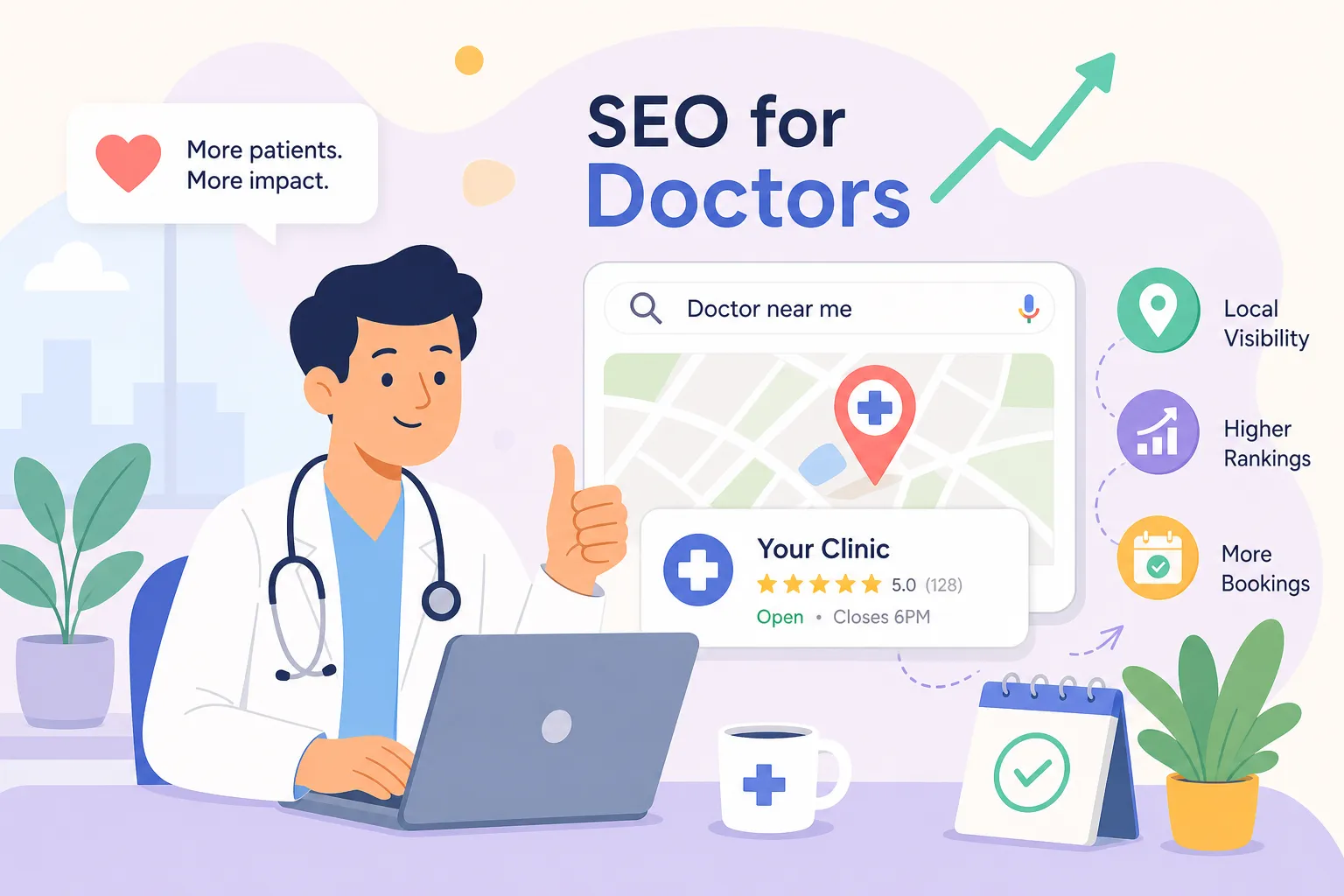
Many patients searching for a doctor in their city rarely scroll past the top local results. If your practice isn’t showing up there, you’re invisible to the majority of people actively looking for care, regardless of how good that care actually is. That’s the core problem SEO for doctors solves: not gaming an algorithm, but aligning what Google sees with what patients are already searching for.
Practices that work with a specialist like Brandleap Agency, which focuses specifically on ranking healthcare providers in competitive local markets, often see faster traction because the strategy is built around how patients phrase their queries at the point of need, not generic playbooks designed for e-commerce or retail. With the right foundation in place, progress can show up in patient volume within months rather than years, though timelines vary by market competitiveness and starting conditions.
This guide covers six areas that drive local rankings for medical practices: how patients search, Google Business Profile optimization, website structure, patient-focused content, review management, and realistic cost expectations. Work through them in order and you’ll have a clear plan you can act on immediately.
Why patients search differently than most doctors expect
How specialty and location drive almost every healthcare query
Patients rarely search by practice name. They search by need: “cardiologist near me,” “pediatrician accepting new patients in Austin,” “dermatologist open Saturday.” The dominant keyword patterns are specialty plus location, specialty plus “near me,” and condition plus doctor type. This search behavior means your entire online presence needs to be organized around these specialty and location pairings, not just a homepage that prominently features the doctor’s name.
A cardiologist in Dallas needs pages that signal “cardiologist in Dallas” clearly across every layer of the site. A pediatric practice in Chicago needs to own “pediatrician accepting new patients Chicago” before worrying about anything else. Start there, and you’re building physician SEO around how patients actually make decisions.
What local search rankings actually measure in 2026
Google uses four main signals to determine who shows up in the local Map Pack:
- GBP completeness and primary category selection, the single highest-leverage starting point for local SEO for doctors
- Review recency and velocity, how recently reviews are coming in, not just how many you have
- On-page relevance, service pages, physician bios, and schema markup that match patient search intent
- Citation consistency, matching NAP data across directories signals a real, stable local business
The priority order matters because it tells you where to focus first. Practices that reverse it, spending months building blog content before touching their GBP or review pipeline, consistently see slower Map Pack entry and lower click share as a result. Get the foundation right before building on top of it.
SEO for Doctors: Claiming and Optimizing Your Google Business Profile
The profile settings that directly affect local pack rankings
Primary category selection is one of the most critical GBP decisions a practice can make, and one of the most commonly mishandled. Using a broad category like “medical clinic” when you’re a dermatologist, or “health and medical” when you’re an orthopedic surgeon, leaves significant ranking potential on the table. Choose the most specific specialty category available: Dermatologist, Orthopedic Surgeon, Cardiologist, Pediatrician. That one setting shapes how Google matches your listing to patient queries.
Beyond category, complete every core field: address, phone, hours including holiday hours, appointment link, services listed in patient-friendly language, and attributes like telehealth availability, insurance accepted, and accessibility features. Upload authentic interior and exterior photos, and seed the Q&A section with the logistical questions patients commonly ask, including insurance, parking, and new patient availability. A fully complete profile consistently outperforms a sparse one in local rankings.
HIPAA-safe practices for posts, reviews, and messaging
GBP is a public-facing directory, not a patient communication channel. Treating it that way keeps you compliant and protects the practice from HIPAA exposure. Use Google Posts for practice announcements, general health education, seasonal hours changes, and service updates. Never reference a patient’s visit, condition, or any detail that could confirm someone received care at your practice.
For booking links and messaging features, verify whether your scheduling vendor requires a Business Associate Agreement (BAA) if protected health information could pass through the platform. This step is easy to overlook during GBP setup, and skipping it can create liability. When in doubt, link to your main scheduling page and keep the intake flow on your own HIPAA-compliant system.
Building a website that ranks for specialty searches
Service pages, physician bios, and location pages
A homepage alone won’t rank for “orthopedic surgeon in Denver.” Every key service and every location needs its own dedicated page, written around the specific search terms patients use when they’re close to booking. A dermatology practice offering Botox, acne treatment, and skin cancer screenings needs a separate page for each, not a single “services” page that lumps them together. This is the structural backbone of effective clinic SEO.
Physician bio pages should include credentials, board certifications, medical school, fellowship training, and clinical areas of focus. These details directly support Google’s E-E-A-T (Experience, Expertise, Authoritativeness, Trustworthiness) standards, which carry more weight for health-related pages than almost any other content category. Location pages need consistent NAP information, an embedded map, and content that genuinely ties the practice to a specific city or neighborhood.
Technical signals Google expects from healthcare sites
Schema markup helps Google understand exactly what your site represents. For medical practices, the key schema types are Physician for individual doctor profile pages, MedicalClinic for practice location pages, and MedicalOrganization for your homepage. Core Web Vitals set the performance baseline: LCP under 2.5 seconds, INP under 200 milliseconds, and CLS under 0.1. A page is considered “good” when 75% of real-world page loads meet each threshold, measured from Chrome field data across device types, with mobile performance weighted heavily.
HTTPS is non-negotiable for trust, both from Google and from patients who expect their health searches to land on secure pages. Consistent NAP across the site and across directories reinforces the entity signals that help Google confirm your practice is a real, stable local business. You don’t need to become a technical SEO expert to implement these, but you do need to know what to ask a developer or agency to handle on your behalf.
Content that earns patient trust before they ever call
SEO for Doctors, Procedure and Service Pages for High-Intent, Ready-to-Book Patients
For elective and procedure-heavy specialties like dermatology, orthopedics, and cosmetic care, procedure pages are the highest-converting content format available. A well-built page covering what a treatment involves, candidacy criteria, recovery expectations, and general cost range captures patients who are already close to booking. Someone searching “knee replacement recovery time” or “how long is recovery after a meniscus repair?” is dramatically closer to scheduling a consultation than someone searching “knee pain causes.” Build these pages with enough depth to answer the questions that would otherwise require a phone call, and you reduce the friction between a patient finding your site and booking an appointment.
Educational blogs and FAQ content for early-stage patient intent
Primary care and broader specialties benefit more from blog content and FAQ pages that answer common health questions and address logistical concerns like insurance coverage, the first-visit process, and telehealth availability. This content builds trust early in the patient journey and funnels readers toward service pages where the actual booking conversion happens. Think of blog content as the top of a funnel that procedure and service pages close.
The content mix shifts by specialty: elective practices lean on procedure pages and short explainer videos; primary care practices lean on educational blogs and FAQ clusters. Match your content investment to how your patients phrase their queries, and you’ll see far better returns than producing generic health content that doesn’t align with appointment intent.
Managing reviews without crossing HIPAA lines
Building a steady review pipeline that moves rankings
Review recency matters more than total count. In most competitive local markets, a practice generating a consistent stream of recent reviews can outperform one with a much larger but stagnant total, even if the older practice has accumulated reviews over several years. The goal is a sustainable, ongoing pipeline, not a one-time push. Build a workflow: after care is complete, use a compliant channel to send a simple request. The ask should stay general: “If you were happy with your experience, a Google review helps other patients find us.”
Do not pressure patients to leave reviews. Do not reference their visit, their provider, or any care details in the request. Keep it short, neutral, and easy to act on. Consistent monthly review generation is a more powerful local ranking signal than any single burst campaign.
How to respond to reviews the HIPAA-safe way
Responding to every review, positive and negative, signals engagement and trust to Google. The HIPAA constraint is firm: a response can never confirm that someone is a patient, reference any details of their care, or acknowledge a clinical relationship. Use a neutral template for every response: “Thank you for your feedback. We appreciate you taking the time to share your experience. If you’d like to discuss anything further, please contact our office directly.”
Apply this same structure to negative reviews. Do not get defensive, do not reference specifics about a visit, and do not attempt to correct the record publicly in a way that implies you know what care was provided. A calm, professional response that redirects to a private conversation protects the practice legally and often satisfies the reviewer.
Estimating costs and deciding whether to hire a medical SEO agency
What medical SEO services typically cost at each level
For a single-location practice, there are three realistic price tiers. At $500 to $1,500 per month, expect basic local setup, GBP optimization and management, review monitoring, and light technical work. At $1,500 to $3,500 per month, you get ongoing local SEO, citation building, review acquisition, and 2 to 4 content pieces per month, including service and location pages. At $3,500 to $6,000 per month, the scope expands to technical fixes, schema implementation, a full content strategy, and link building from credible healthcare directories and publications.
A useful way to think about ROI: calculate your practice’s actual patient lifetime value for your specialty, then determine how many new patients per month from organic search would cover your investment. For many practices, the threshold is lower than expected, and the question shifts from whether SEO pays to whether you’re positioned to capture the demand that already exists for your specialty in your market.
When working with a healthcare SEO specialist makes sense
DIY is viable if your practice has a marketing-savvy staff member who can consistently manage GBP, respond to reviews, and publish content on a regular schedule. The technical and compliance-specific layers are where most practices lose ground to larger health systems. Schema implementation, Core Web Vitals optimization, HIPAA-compliant review workflows, and competitive content strategy require a level of specialization that’s hard to maintain without dedicated resources.
Brandleap Agency works specifically with medical practices to build this full-stack local SEO infrastructure: GBP optimization; physician bios built for E-E-A-T; specialty content; citation authority across Healthgrades, WebMD, Zocdoc, Vitals, and other high-value directories; and technical fixes that bring sites into compliance with Google’s performance standards. For practices in competitive markets or those launching a new location, a specialist partner with healthcare-specific experience can meaningfully accelerate progress compared with building a strategy from scratch.
Start this week, not next quarter
Whether you go DIY or bring in a partner, the sequence of first steps is the same. Verify and complete your GBP profile first, choosing the most specific primary specialty category available. Then audit your website for missing service and location pages. Build a simple, compliant review request workflow. Publish one procedure or FAQ page per month. Review your budget and determine whether the workload justifies bringing in an agency partner. Keep in mind that actual timelines vary by market competitiveness and starting conditions, track impressions, clicks, GBP views, and appointment conversions to measure real progress.
Implementing SEO for doctors is not a one-time project. Each optimized page, each new review, and each backlink from a credible healthcare directory builds on what came before. The practices ranking at the top of local results today started building that foundation months or years ago, and the compounding effect works in both directions.
Practices that start now, even with a narrow focus on GBP and one or two service pages, build an advantage that competitors find hard to close. If you’re ready to accelerate with a team that builds healthcare SEO infrastructure specifically designed for competitive local markets, Brandleap Agency is ready to help.