Most business owners shopping for SEO have seen the same thing: a proposal that uses the phrase “advanced SEO services” prominently, lists eight bullet points, and never explains what any of them actually do for the business. You walk away knowing you’d pay more, but not why it would work better.
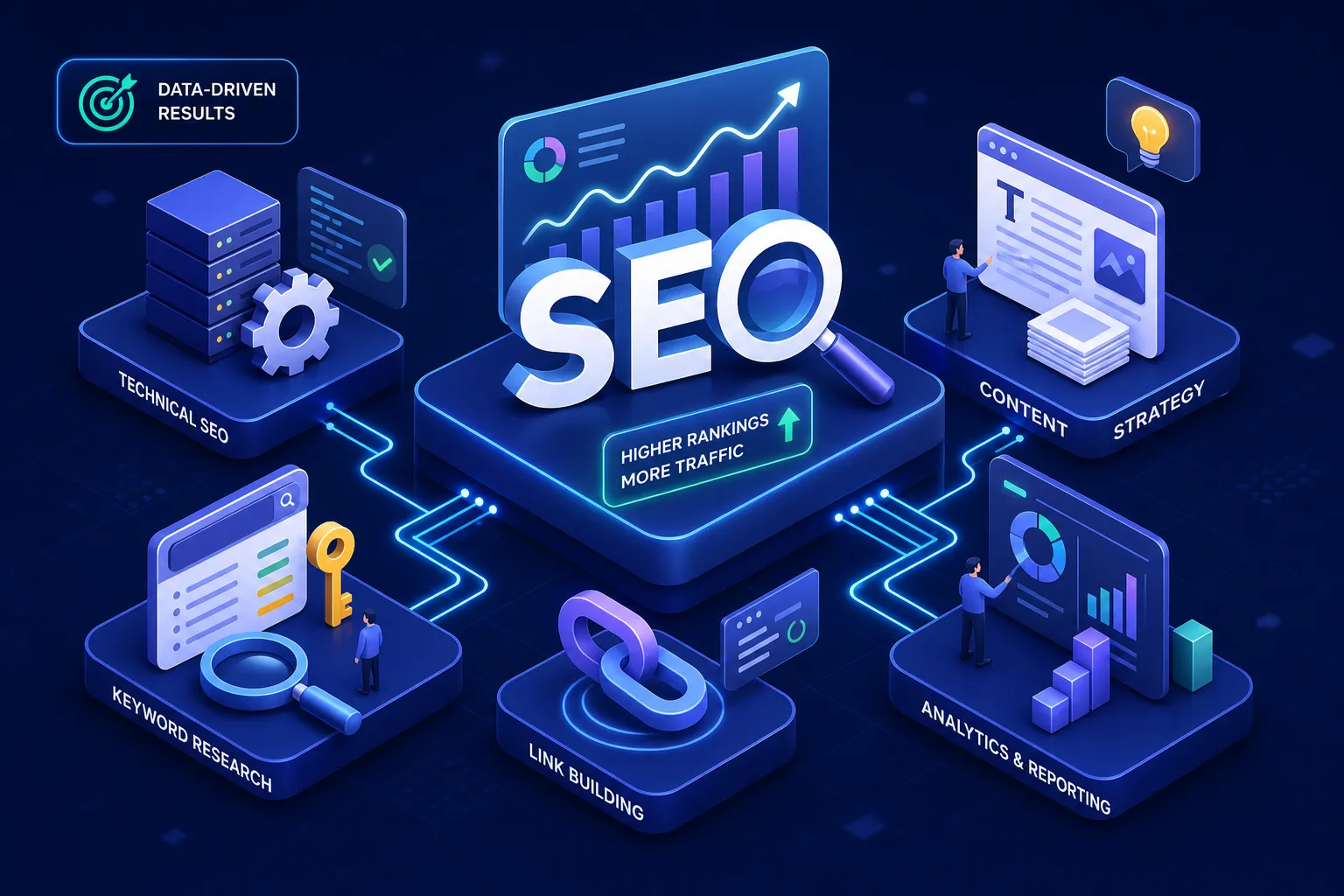
This article is the breakdown you’ve been looking for. We’ll unpack the four pillars that define a genuinely advanced SEO engagement: technical audits, semantic SEO, entity optimization, and topical authority. We’ll also cover real pricing benchmarks, the KPIs that actually matter, and how to evaluate an agency before you sign anything. A good advanced SEO package separates itself from generic retainers through depth of execution, not a longer checklist. Keep that standard in mind as you read.
What separates advanced SEO services from the standard package
A standard SEO retainer covers the basics: keyword tracking, title tag optimization, meta descriptions, and maybe a few backlinks per month. Those fundamentals still matter, but they don’t explain how Google understands a site or what it associates a brand with. Advanced SEO services go deeper on the underlying architecture of how Google reads, categorizes, and ranks a domain over time, and that architecture is where competitive gaps are actually decided.
What basic SEO never touches
Think of basic SEO as telling Google a page exists. Advanced work tells Google what a brand authoritatively covers. The layers most standard packages skip entirely are semantic structure, entity relationships, and content depth. Semantic structure refers to how the meaning and context of content are communicated, not just individual keywords. Entity relationships describe how Google connects a brand to specific topics, people, products, and concepts. Content depth is the degree to which a site actually covers a subject rather than just referencing it. Each of these layers compounds independently, which is why leaving even one unaddressed tends to cap organic growth.
Why most businesses plateau without advanced SEO
If organic traffic has flatlined despite consistent publishing, a missing semantic, entity, or depth layer is a common cause, especially in competitive verticals where well-funded rivals have already invested in technical infrastructure and semantic depth. Basic optimization gets you into the game. Advanced SEO determines whether you grow or stall at a traffic ceiling that never seems to lift.
Technical SEO audits: the non-negotiable foundation
Most reputable advanced engagements begin with a technical audit, not a surface-level crawl report, but a structured examination of how Google actually experiences the site. The outputs should be concrete: a prioritized fix list, identified indexation gaps, and documented issues with crawlability and page structure. Agencies that skip this step and jump straight to content production are working from assumptions, not measured data.
What a proper technical SEO audit examines
A thorough technical audit covers crawlability, indexation gaps, internal link structure, duplicate content patterns, canonicalization errors, and site depth. It also checks JavaScript rendering issues, orphaned pages that receive no internal links, and mobile performance at the template level. These aren’t abstract findings. They’re the factors that determine which pages Google can find, understand, and choose to rank.
Schema markup and Core Web Vitals as ranking levers
Structured data is not a checkbox. Schema markup helps search engines understand the entities and relationships on a page, which can strengthen relevance on competitive queries where context matters, particularly for rich results and AI-generated answers. For Core Web Vitals, the benchmarks are concrete: LCP under 2.5 seconds, INP under 200 milliseconds, and CLS under 0.1. These aren’t vanity metrics. Some published case studies report non-branded organic click uplifts in the 18 to 34 percent range within 90 days of significant architecture improvements. Technical work is the foundation everything else builds on.
Semantic SEO and entity optimization: what many agencies skip
Semantic SEO is how Google understands meaning, context, and the relationships between topics rather than just matching keywords on a page. It’s the shift from “this page mentions CRM software” to “this site is a trusted resource on sales pipeline management, lead tracking, and customer data tools.” Many agencies operating at a standard tier don’t offer this because it requires strategic depth and structured thinking rather than template-driven execution.
How entity optimization works in practice
Entities are named concepts Google can recognize and categorize: organizations, products, people, locations, and industry terms. Entity optimization means connecting those concepts consistently across a site through structured content, schema markup, internal linking, and aligned brand signals across the web. A business that sells accounting software doesn’t just target “accounting software.” It builds structured content around related entities, tax compliance, payroll processing, financial reporting, small business bookkeeping, with schema and internal links showing how those concepts relate to the product and brand.
How advanced SEO services build topical authority through semantic structure
When a site is built around clear entity relationships and semantic clusters, authority accrues faster because Google can verify expertise across a topic, not just a single page. This is the core of what Brandleap Agency’s advanced SEO engagements are designed to deliver: a structured approach to building entity authority that sits between what budget agencies offer and what full enterprise contracts charge. Rather than a collection of loosely related pages, the result is a domain Google can consistently identify as a subject-matter resource.
Topical authority: why content strategy is now an advanced SEO discipline
Topical authority means Google views a site as the go-to source on a defined subject area. It’s not built by publishing a lot of content. It’s built by covering a topic with depth and structural coherence, so Google can verify that expertise spans the full subject rather than existing in isolated articles.
Content clusters and pillar pages explained
The pillar-cluster model is the architecture behind topical authority. A pillar page covers a broad topic comprehensively at a high level. Cluster pages go deeper on specific subtopics and long-tail queries, and each one links back to the pillar. The pillar links out to the clusters. That internal linking structure signals to Google that the content belongs to one topical system, strengthening relevance for both head terms and long-tail searches across the entire cluster.
AI search visibility as an extension of topical authority
Sites with strong topical authority and clear entity structure are also more likely to be cited in Google AI Overviews, ChatGPT, and Perplexity. Generative AI systems pull from sources they can verify as authoritative on a subject. If a site covers a topic with semantic depth and structured content, it becomes a citation candidate in AI-generated answers, not just a blue-link result. AI-driven SEO and answer engine optimization are increasingly standard deliverables in advanced SEO packages in 2026, and early adopters in competitive verticals are already seeing measurable lift in branded citation frequency.
Is your business actually ready for advanced SEO services?
Not every business is at the right stage for a higher-tier investment. A good agency will tell you that directly. Generally speaking, businesses generating consistent organic traffic, even if that traffic has stalled, and running at least a modest content operation are the strongest candidates. Before committing to an advanced SEO retainer, it’s worth checking whether the signals are there that indicate you’ve genuinely outgrown basic optimization.
Signs you’ve hit the ceiling on basic optimization
The clearest indicators are traffic that has flatlined despite regular content production, keywords stuck in positions 8 to 15 that haven’t moved in months, and a visible gap between branded search performance (typically strong) and non-branded organic visibility (not growing). These patterns point to missing semantic and technical depth, not a lack of content volume.
When the competitive landscape demands it
In certain industries, the floor for SEO competitiveness has moved. Competitors who have invested in topical authority and technical infrastructure aren’t just outranking you on individual keywords, they’re compounding authority over time while standard optimization loses ground. When the competitive dynamics in your market have shifted to that level, continuing with a basic package means a shrinking share of results regardless of publishing frequency.
Pricing, KPIs, and choosing the right advanced SEO provider
Advanced SEO is a defined investment. Understanding the ranges before you start conversations with agencies gives you a concrete frame for evaluating what’s actually being offered, and whether the scope matches the price.
What advanced SEO actually costs in 2026
For small to mid-sized businesses in the U.S., advanced SEO retainers typically range from $1,000 to $5,000 per month, depending on scope and competition level. Mid-sized businesses in more competitive markets generally invest $2,500 to $10,000 per month. National campaigns in competitive verticals run $5,000 to $15,000 per month. These aren’t arbitrary agency fees, they reflect the volume and depth of work required to move the needle in a given market.
The KPIs to track and the timelines to set
The KPIs that actually indicate progress fall into five groups: organic visibility (impressions, share of voice, branded vs. non-branded split); ranking movement on commercial terms; organic sessions by landing page; conversion rate from organic traffic; and technical health scores including indexed URLs and Core Web Vitals status.
For timelines, plan around three phases. Early indicators like indexation improvements and initial ranking signals typically appear in months one through three. Measurable ranking movement on target terms shows up between months four and six. Meaningful traffic and conversion gains generally materialize by months nine through twelve.
How to evaluate an SEO agency before committing
A few filters cut through agency sales language quickly. Does the agency conduct a technical audit before proposing anything? Proposals without a site audit risk being built on assumptions rather than measured issues, that’s a meaningful red flag. Do they explain semantic SEO and entity strategy as core parts of their process, or do they describe their work entirely in terms of keywords and links? And do they tie deliverables to business outcomes like leads and revenue, or do they treat rankings and traffic as endpoints in themselves?
Brandleap Agency is built for businesses at exactly this decision point: teams ready to go beyond keyword-level optimization but not in a position to commit to enterprise SEO services pricing. It’s a practical entry point for accessing advanced strategy, technical SEO services, entity optimization, and topical authority development, without the overhead of a full enterprise contract.
The bottom line on advanced SEO
Advanced SEO services are a defined set of disciplines with specific outputs. Technical audits form the foundation. Semantic SEO and entity optimization are the differentiators that determine whether Google understands what a brand authoritatively covers. Topical authority is the long-term compounding asset that makes organic visibility durable rather than fragile.
If keyword rankings have stalled and competitors are pulling ahead in organic search, the gap is almost certainly in one of those areas. Closing it doesn’t require an enterprise budget, it requires a provider who knows how to execute at this level.
That’s what Brandleap Agency delivers. Every engagement starts with a technical audit, builds strategy around entity relationships and topical authority, and measures success against the business outcomes that actually matter. Reach out to Brandleap Agency to see what a depth-first advanced SEO engagement looks like in practice.