
You followed the playbook. You researched the keyword, placed it in the title, sprinkled it through the headers, hit the right density, and published. Then you waited. The rankings never came. If you’ve ever asked yourself, “What is semantic SEO, and why does it matter when I’ve done everything right?”, you’re not alone. The frustration is real, and the question is legitimate: what are you actually missing?
At Brandleap Agency, we frequently hear this from small business owners before they’ve ever encountered the term “semantic SEO.” They’ve done everything the old guides recommended, and they’re still invisible. The problem isn’t effort or execution. It’s that Google fundamentally changed what it rewards, and most content strategies haven’t caught up.
By the end of this guide, you’ll know exactly what semantic SEO is, how it differs from what you’ve been doing, and where to start building a strategy that actually aligns with how Google reads content in 2026.
What Is Semantic SEO? A Simple Definition
Semantic SEO is the practice of optimizing content for meaning, context, and user intent rather than exact keyword matches. Instead of asking “how many times does my target phrase appear on this page,” semantic search asks “does this page comprehensively address the topic a searcher is trying to understand?” Those are two very different questions, and Google has been moving toward the second one for years.
Think of it like the difference between a bad librarian and a great one. A bad librarian searches the card catalog for the exact words you said. A great librarian reads the full index, identifies related concepts, and recommends resources based on what you’re actually trying to learn, not just the words you used. Google is the great librarian now. It reads your page the same way.
The Role of Entities and Context
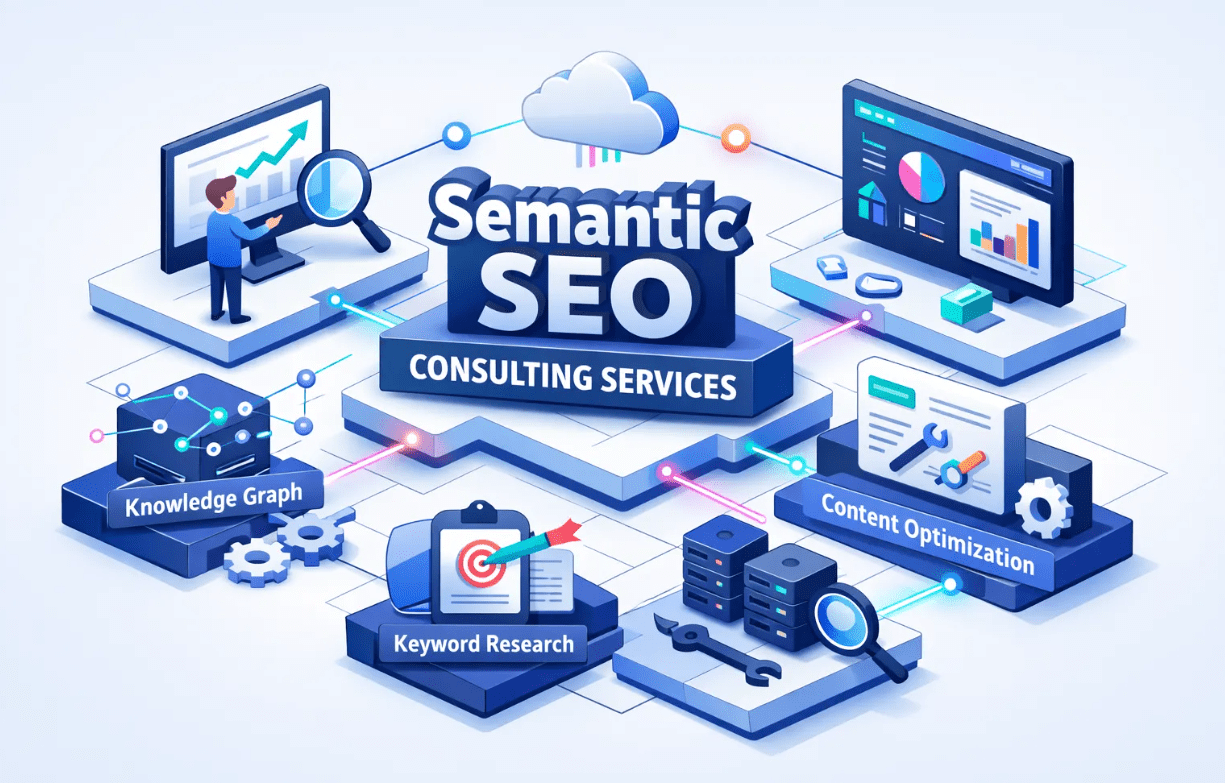
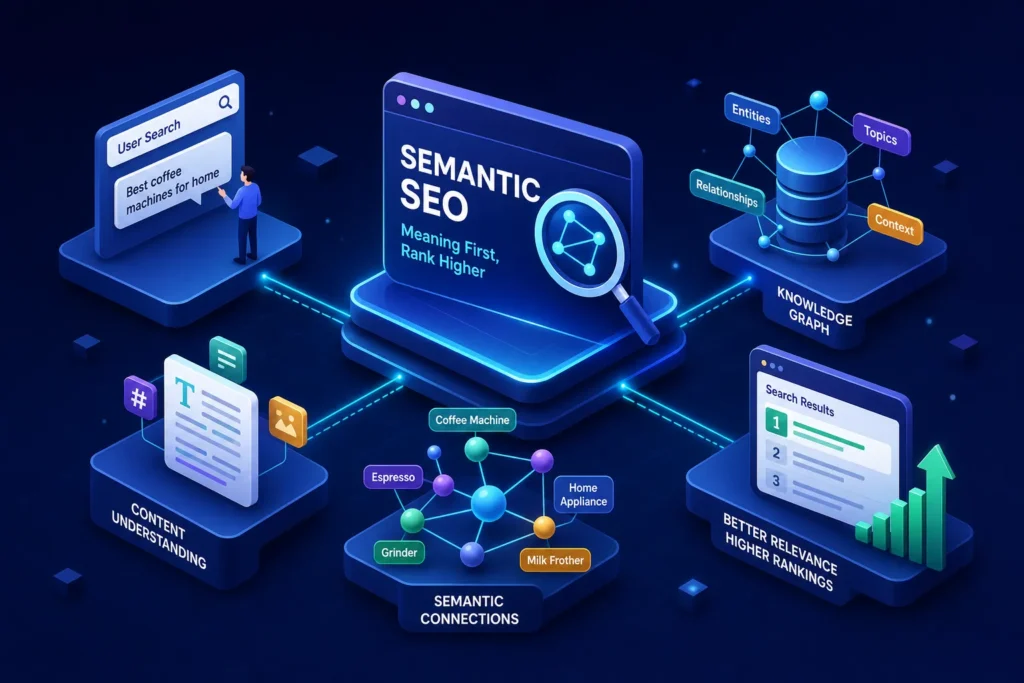
Central to semantic search is the concept of entities. These are the people, places, products, brands, and concepts a piece of content is fundamentally about. Google maps the relationships between these entities using its Knowledge Graph, a massive web of connections that tells it how topics relate to each other. When you write about “running shoes,” Google doesn’t just see that phrase; it sees a connection to athletic performance, foot health, major brands, and specific use cases like marathon training or trail running.
Content optimized for semantic search tells Google not just what your page says, but what it’s about and how it connects to a broader topic space. That distinction matters more than any keyword frequency metric you’ve been tracking.
What Is Semantic SEO vs. Traditional Keyword Optimization
The Old Approach and Why It Still Lingers
Traditional keyword-based SEO had a simple formula: find a keyword with decent search volume, place it in the title and H1, repeat it at a target density throughout the body, and build links to the page. It treated Google like a search-and-match machine that rewarded the most keyword-consistent documents. For a period, that worked reasonably well. Plenty of businesses built real traffic this way.
The problem is that formula stopped reflecting how Google actually operates, and many businesses are still running it today while wondering why rankings have plateaued. Google has expanded BERT-based natural language understanding to virtually all English queries as of 2025, 2026. It doesn’t need your exact keyword to understand your content. It reads intent.
LSI Keywords Weren’t the Answer Either
When some marketers realized pure keyword density wasn’t enough, they turned to LSI (Latent Semantic Indexing) keywords, related synonyms and co-occurring phrases that add variety to a page. This was progress, but it was still fundamentally keyword-centric thinking. LSI says “use related terms so Google doesn’t think you’re stuffing.” Semantic SEO says “build a full topical context that tells Google you own this subject area.”
The difference isn’t cosmetic. It’s architectural. LSI expands coverage around a single keyword. Semantic SEO builds interconnected content ecosystems, uses entity relationships, and leverages structured data to create meaning that search engines can parse at a structural level. One is a vocabulary adjustment; the other is a strategy overhaul.
Why Google’s Algorithm Updates Made Semantic Search the Standard
BERT, MUM, and the Move Toward Intent Understanding
BERT (Bidirectional Encoder Representations from Transformers) was the update that changed everything for content. In plain terms, BERT enabled Google to understand the full context of a sentence by reading it in both directions simultaneously. The word “bank” next to “river” means something different than “bank” next to “savings,” and BERT can tell the difference. For SEO, this meant Google could understand what a page was about without needing the exact query phrase present in the text.
MUM (Multitask Unified Model) extended this further, allowing Google to process information across languages, text, images, and video simultaneously. A single MUM-processed query can draw on multiple formats and sources to generate a comprehensive answer. The practical consequence for content creators is significant: Google no longer needs you to feed it exact phrases. It needs you to cover a topic completely and coherently.
What This Means for How You Create Content in 2026
Content that ranks today is content that comprehensively addresses a topic, answers the related questions a searcher naturally has, and signals topical authority through depth, structure, and interconnection. Topical SEO, building authority across a related cluster of subjects rather than optimizing individual pages in isolation, is how modern content earns durable rankings. Thin pages stuffed with keywords don’t just underperform; they actively signal low value to modern ranking systems. Google’s algorithms are designed to surface content that genuinely helps people, and they’re getting better at identifying the difference.
There’s also a newer dimension worth understanding: LLM-aware SEO. As AI Overviews and zero-click results become more common, content needs to be readable and citable by large language models, not just traditional crawlers. Schema markup, clear entity signals, and factually grounded content all contribute to appearing in AI-generated summaries. One legal firm built out a semantic content and Knowledge Graph strategy and secured 4.4x more clicks as a result, an outcome that reflects how businesses adopting semantic strategies early are now appearing as primary citations in AI Overviews.
Five Core Techniques to Build Your Semantic Content Strategy
1. Topic Clusters and Pillar Pages
The pillar-cluster model is the structural backbone of semantic SEO in practice. You create one comprehensive pillar page covering a broad topic at a high level, then build out cluster pages that go deep on specific subtopics, each linked back to the pillar and to each other. A marketing agency might have a pillar page on “SEO” with clusters covering local SEO, technical SEO, semantic SEO, and link building. The architecture tells Google you don’t just have one article on a subject; you own the full conversation.
The results support this approach. Industry benchmarks and HubSpot content analyses suggest that content organized into topic clusters generates approximately 30, 43% more organic traffic than standalone posts, with ranking improvements typically visible within 60, 90 days. Note that specific results vary by site and competitive landscape. The cluster approach works because it mirrors how Google’s Knowledge Graph organizes information: as a connected web of related concepts, not isolated keyword pages.
2. Entity Recognition and Schema Markup
Entity SEO means identifying the key people, places, products, and concepts your content covers and making those relationships explicit. Schema markup is how you do that in practice. It’s structured data (written in JSON-LD format) that tells Google exactly what your content contains, who created it, what questions it answers, and how it connects to established knowledge. FAQ schema and HowTo schema are the most accessible starting points for beginners, both commonly produce rich results in search. Article schema, by contrast, helps Google parse metadata like authorship and publication date but does not by itself generate special visual SERP features. According to Google’s structured data documentation, eligibility for rich results depends on the specific schema type and how completely it is implemented.
For Knowledge Graph optimization, the goal is to help Google unambiguously connect your brand or content to known entities. Adding an `@id` property pointing to your homepage, linking to Wikidata entries where relevant, and using `sameAs` attributes all strengthen your entity coherence. This isn’t advanced territory reserved for enterprise SEO teams. It’s increasingly a baseline requirement for content that competes in 2026.
3. Content Depth, Internal Linking, and Writing for Readers First
Comprehensive content doesn’t mean long content for its own sake. It means covering a topic thoroughly enough that a reader finishes the page without obvious unanswered questions. If someone reads your guide on “email marketing” and immediately searches for “how often should I send emails” because you never addressed it, you’ve left a ranking signal on the table. Map out related questions before you write and address them within the piece or link to dedicated cluster content that does.
Internal linking with descriptive anchor text is the connective tissue of your semantic architecture. Instead of “click here,” use anchor text that reflects the meaning of the destination page. For example, “learn how FAQ schema improves rich result eligibility” tells both readers and Google what the linked page is about, while a generic phrase like “read more” communicates nothing. This reinforces entity relationships across your content ecosystem and distributes topical authority through the full site structure.
Tools That Make Semantic Search Optimization Manageable
Free Options Worth Starting With
Google’s own tools are the most direct window into how the algorithm reads your content. The Google Natural Language API (free up to 5,000 units per month) extracts entities from any document and shows you which concepts Google detects as prominent. Google Search Console reveals query clusters and intent gaps, if you’re ranking for queries you didn’t target, that’s a signal about the entity relationships your content is already triggering. Google’s People Also Ask boxes are a practical source of related questions for building out cluster topics and FAQ sections. For practical tutorials and ongoing insights, see the Brandleap Agency Blog | Expert Digital Marketing Insights.
Paid Tools for Scaling Your Strategy
Once you’re publishing consistently and need to scale, paid tools add real leverage. InLinks builds a dedicated knowledge graph from your content and shows you which named entities Google detects on each page, making it one of the more purpose-built options for entity SEO. For keyword clustering and topic gap analysis, Ahrefs and SE Ranking both perform well. SEMrush handles topic clustering competently but isn’t a true entity SEO tool, so use it for gap analysis rather than entity mapping.
The decision framework is straightforward: start free, validate the approach, then invest in paid tools once you’re consistently publishing and need to manage a larger content ecosystem. Don’t pay for tools before you have the publishing velocity to justify them. Once you do, the right stack makes the strategy manageable at scale.
When to Handle Semantic SEO Yourself vs. Bring In a Specialist
Signs the DIY Approach Is Holding You Back
There’s a clear inflection point where semantic SEO complexity exceeds what a solo operator can manage effectively. The signals look like this: cluster pages exist in a spreadsheet but never get written; internal links are inconsistent because there’s no systematic plan; schema implementation has stalled because JSON-LD feels too technical; rankings have plateaued despite consistent publishing. These aren’t signs of failure. They’re signs that the strategy needs more structure than one person’s available hours can support.
What a Semantic SEO Partner Actually Does for Your Business
Working with an agency that specializes in semantic SEO strategy means getting a topical map built from your existing content and competitive environment, an audit that identifies entity gaps and internal linking failures, schema implemented at scale without requiring you to learn code, and a content calendar structured around pillar-cluster architecture. The result is a content ecosystem that compounds rather than a collection of unconnected articles that each have to fight for attention individually. If you’d rather skip the learning curve, many businesses choose to Achieve Better Rankings With Proven SEO Solutions, 2026 to accelerate results.
At Brandleap Agency, this is exactly how we approach semantic SEO for our clients. We build the technical architecture and content strategy so business owners can focus on running their business rather than decoding how Google’s Knowledge Graph connects entities. The goal isn’t to outsource your content, it’s to build a system that makes every piece of content you publish work harder and stay relevant longer.
What to Do With This Knowledge
Understanding what is semantic SEO in practice reframes what “good content” actually means. It’s not a trend or a technique layered on top of traditional optimization. It’s Google catching up to how humans actually think and search. Queries don’t happen in isolated keyword bubbles; they reflect goals, questions, and context. Content that ranks in 2026 mirrors that reality by covering topics fully, connecting related ideas, and giving both search engines and AI systems clear signals about meaning and authority.
Start with what you have. Audit your existing content for topic clusters you’ve accidentally built. Find the pillar page your site is missing. Add FAQ schema to your most-visited guides. Use Google Search Console to identify the entity territory you’re already occupying and build toward it deliberately. Small, systematic moves toward semantic structure compound quickly.
If you’re ready to move faster, the team at Brandleap Agency offers Ben Stace’s semantic SEO consultancy services that start with a topical audit and end with a clear roadmap. Reach out to learn what your content ecosystem is missing, and what it would take to own your topic area in search.

BrandLeap Agency & BrandLeap Fashion | Founder & CEO
Mithun is an experienced SEO consultant recognized for helping businesses improve their digital presence through technical SEO, content optimization, and sustainable organic growth strategies. Working in the digital marketing industry since 2019, he has developed expertise in increasing search visibility, driving targeted traffic, and building long-term growth through data-driven SEO solutions. He has worked with businesses across multiple industries, helping brands strengthen their online authority and achieve measurable growth results.