

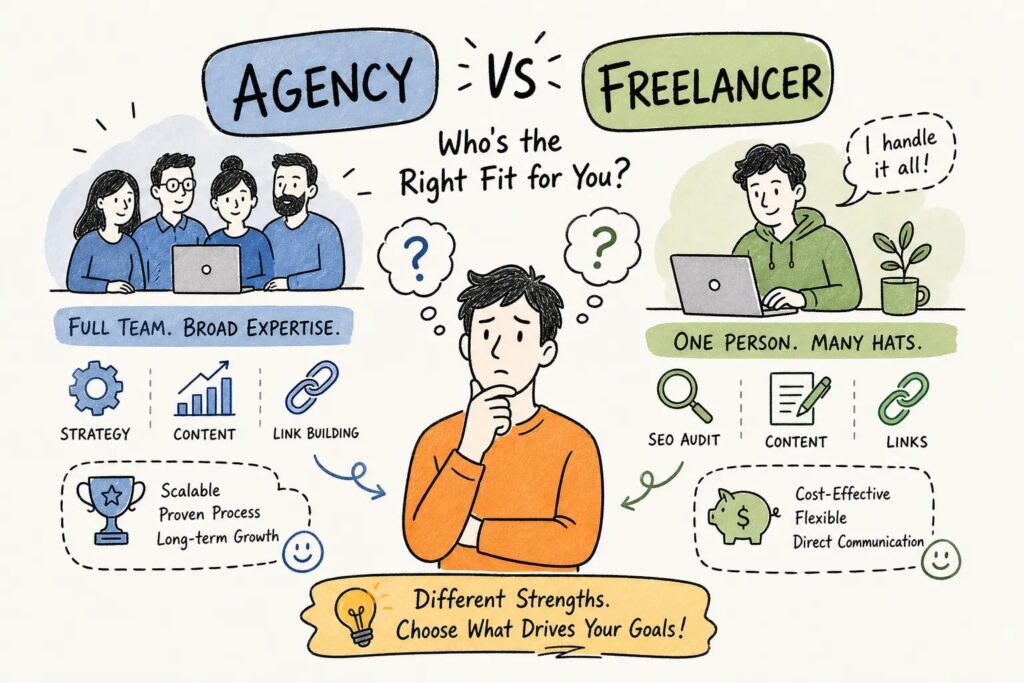
When weighing up an SEO agency vs freelancer for your business, the decision looks straightforward until you start examining the detail. Both options can deliver real results, and both can be a costly mistake if the fit is wrong. A business spending £500 a month working with a freelance SEO consultant is not solving the same problem as one investing £3,000 a month with a full-service agency, and treating them as interchangeable is where most businesses go wrong.
This article gives you the 2026 UK cost bands for both options, an honest breakdown of what each genuinely delivers, three clear hire-signals for each, and a short vetting checklist to help you choose with confidence. The decision rarely comes down to budget alone. It comes down to what your business actually needs executing right now.
What you’ll actually pay: UK pricing in 2026
Before comparing capability, it helps to understand the pricing structures clearly. The gap between a freelancer and an agency invoice is not arbitrary; it reflects a fundamental difference in how work gets done.
Freelancer cost bands and what drives them
UK freelance SEO retainers typically run between £300 and £1,500 per month, with project-based work sitting between £1,000 and £5,000 or more depending on scope. What pushes a freelancer’s rate upward is niche specialism, technical depth, and a proven track record of measurable results. What keeps costs lower is structural: there is no account management layer, no office overhead, and no team behind the invoice.
Project pricing for a one-off technical audit or a keyword strategy document tends to sit toward the lower end of that range. Ongoing monthly retainers for national campaigns push higher, often toward £1,200 to £1,500 per month for an experienced consultant. For most small businesses, a freelancer represents a cost-efficient entry point into professional SEO.
SEO agency vs freelancer: why the pricing gap exists
Agency retainers in the UK range from around £500 to £5,000 or more per month, with project fees commonly between £2,500 and £15,000 depending on the scope and deliverables involved. When you hire an agency, you are paying for a team: a strategist, a content writer, a technical SEO specialist, and a link-building team all working on your account simultaneously. That coordinated structure is what the higher cost reflects.
For a narrowly scoped project, that overhead is unnecessary. For a campaign that needs multiple disciplines running in parallel, the agency’s higher cost starts to make genuine economic sense. A business comparing a £900 freelancer retainer with a £2,500 agency retainer is not comparing like for like; it is comparing a single point of delivery with a coordinated team.
The expertise gap: what each option realistically delivers
Cost is secondary to capability fit. The more important question is whether the option you are considering can actually execute what your campaign needs.
Where freelancers genuinely excel
Freelancers are strongest on bounded, specialist work: a technical SEO audit, a keyword strategy document, a batch of on-page optimisation for existing pages, or a single campaign build. A skilled freelance SEO consultant can go very deep on one discipline quickly, without the overhead of coordinating a wider team. This suits businesses with a clearly scoped problem and a realistic timeline.
Consider a common pattern: a retailer needs twelve product pages optimised for a new e-commerce category. A freelancer delivers the work for around £1,200; the pages rank within six weeks. An agency would likely cost closer to £3,500 because it would add strategic consultation, competitor analysis, and account management the retailer simply does not need. For that job, the freelancer is the correct hire.
Why multi-discipline campaigns need a team
When a business needs technical SEO, content production, link-building outreach, and reporting all running in parallel, a single freelancer becomes a bottleneck. There are only so many hours in a working week, and asking one person to be equally strong across strategy, technical implementation, outreach, and reporting is asking for something that does not exist reliably. Agencies field specialists across each of these disciplines under one coordinated strategy.
Consider a manufacturer launching a new product who uses an agency to coordinate content, SEO, PPC, and email automation simultaneously. The integrated approach consistently outperforms previous launches handled by disconnected, freelancer-led work, often markedly so across both traffic and conversions. The lesson is not that agencies are inherently better; it is that they are better structured for complexity. When the campaign is complex, the team structure pays for itself.
Communication and accountability: where things get complicated
Many guides on this topic focus on cost and capability; fewer explore the day-to-day working reality, which is often where things go wrong.
The freelancer communication reality
A freelancer is often highly responsive at the start of an engagement. They are motivated, focused, and eager to deliver. The operational risk appears later: a freelancer is also running their own business, managing multiple clients, and has no backup if they fall ill or get overwhelmed. Freelancer contracts typically run on 14 to 30-day notice periods, with narrower SLAs than most agencies provide.
For businesses that need weekly reporting, fast turnarounds, or guaranteed continuity, this can become a genuine problem. A good freelancer mitigates this through clear contracts and defined deliverables from the outset. The difficulty appears most often when expectations are informal rather than written down.
How agency structure creates accountability (and where it can frustrate)
Agencies typically operate on 6 to 12-month minimum terms, with 30-day notice periods once the initial term has ended. They offer more formal SLAs: defined reporting cycles, approval timelines, and documented deliverables. Monthly tactical meetings and quarterly strategic reviews are standard across most UK agency retainers.
The common frustration is the account manager middleman. Clients who feel they never speak to the person actually doing the work are describing a structural problem that exists in many agencies, but it is not an inherent feature of the model. An agency that assigns dedicated strategists as the direct client contact, rather than passing everything through account management, closes this gap significantly. The accountability is there; the question is whether the right person is delivering it.
Scalability and long-term fit: which option grows with you
Where you are now is only part of the question. Where your business is going matters just as much when choosing an outsourced SEO partner.
When the freelancer model hits its ceiling
A freelancer is one person. As a business grows and needs more content, more link-building, faster technical fixes, and cross-channel coordination, a single point of delivery cannot scale to meet that demand without delay.
Businesses that start with a freelancer and grow often find themselves managing two, three, or four freelancers simultaneously. At that point, the business owner has quietly become the project manager, and that hidden cost never appears on an invoice.
Agency infrastructure and what full-team execution means in practice
Agencies can scale delivery without the client managing the coordination. When one specialist is away, another covers. When a campaign expands into a new channel, the specialist is already on the team. The coordination overhead stays inside the agency rather than landing on the client’s desk.
Some agencies design a model specifically to solve the personalisation problem that often pushes clients back toward freelancers. In this structure, each client works directly with a dedicated strategist as their single point of contact, while a full specialist team covering technical SEO, content, link-building, and paid advertising executes behind them. That structure combines the responsiveness you would expect from a freelancer with the depth and continuity of a full team. It is what the agency model looks like when it is built around client experience rather than internal convenience. Brandleap Agency is built on exactly this model.
SEO agency vs freelancer: three clear hire-signals for each option
The signals below are designed to help you self-identify quickly. If you recognise your situation in these signals, you have your answer.
Hire a freelancer when these three things are true
- The work is a defined, time-bounded project with a clear deliverable: a technical audit, a content plan, a site migration review, or on-page optimisation for a specific set of pages.
- Your budget is broadly under around £1,000 per month and the campaign scope is narrow, such as local SEO for a single location or a single-channel focus. Treat this as a guideline rather than a hard rule; scope matters as much as spend.
- You have the internal capacity to manage the relationship, review outputs, and follow up on implementation without additional resource.
This is a smart, cost-efficient choice for many small businesses and early-stage startups. The freelance SEO model is not inferior; it is designed for a different situation, and using it correctly means getting excellent value for a clearly scoped brief.
Hire an agency when these three things are true
- Your campaign spans more than one discipline: for example, technical SEO running alongside content production and link-building outreach simultaneously.
- You need continuity, meaning someone is always accountable regardless of holidays, illness, or shifting workloads.
- Your business is growing and you need a partner who can scale delivery without you managing the team yourself.
At this point, the agency’s structural overhead pays for itself through coordination, specialist depth, and the time you get back. Many clients find that the overhead effectively pays for the coordination and management time that would otherwise fall on them. It is not an additional cost so much as a function being handled on your behalf.
A short vetting checklist before you sign anything
Whether you are evaluating a freelancer or an agency, the questions below should produce clear, confident answers. Vague responses here are a reliable signal to keep looking.
What to ask a freelancer before you hire them
Ask for three examples of campaigns with measurable outcomes: organic traffic growth, ranking improvements, or conversion gains with actual numbers attached. Ask how they handle scope creep and what their notice period is. Ask who covers their clients when they are unavailable for an extended period. A confident, experienced freelancer answers all three without hesitation. Uncertainty or deflection on any of these points is a warning worth taking seriously.
What to ask an agency before you commit
Ask who will actually work on your account day-to-day and whether you will have direct access to that person, not just an account manager relay. Ask for a breakdown of which specialist handles which deliverable, and what your monthly reporting structure looks like in practice. Ask what the minimum contract term is and what notice is required after that term ends. An agency that is unclear about team structure or deflects on reporting cadence is worth walking away from. The right agency is transparent about all of this before you sign anything.
The answer is simpler than it looks
The core question in the SEO agency vs freelancer debate is not which option costs less, it is which option is built for what you need to execute. A freelancer is the right hire for a focused, bounded project where one specialist going deep quickly is exactly what the brief requires. An agency earns its cost when a campaign needs multiple disciplines, guaranteed continuity, and a structure that scales as the business grows.
Put plainly: the agency vs freelancer decision comes down to what your business needs to execute, not just what you can afford to spend. Many businesses that start with a freelancer outgrow the model without realising it, and the transition point is usually when coordination starts costing more in management time than the original saving was worth.
For businesses at that transition point, it is worth speaking with an agency built around a different model, one where clients get direct access to the strategist doing the work, supported by a full specialist team. Brandleap Agency is structured around exactly that approach. If that sounds like where your business is heading, it is worth starting a conversation.

BrandLeap Agency & BrandLeap Fashion | Founder & CEO
Mithun is an experienced SEO consultant recognized for helping businesses improve their digital presence through technical SEO, content optimization, and sustainable organic growth strategies. Working in the digital marketing industry since 2019, he has developed expertise in increasing search visibility, driving targeted traffic, and building long-term growth through data-driven SEO solutions. He has worked with businesses across multiple industries, helping brands strengthen their online authority and achieve measurable growth results.