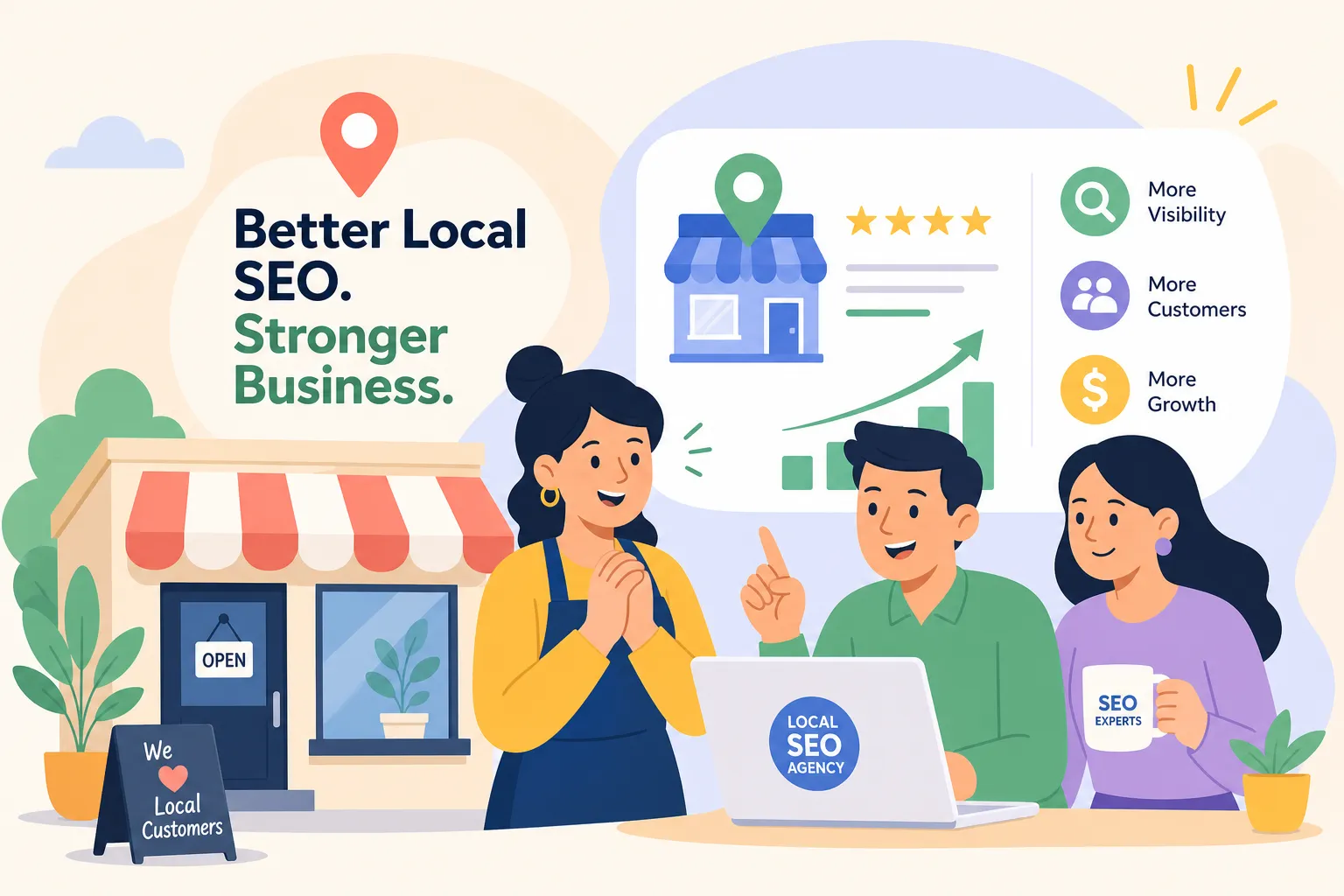
Choosing the wrong local SEO agency doesn’t just mean slow results. It means wasted budget, damaged citation data, and a competitor who wasn’t even on your radar six months ago now owns the top three spots in Google’s map pack. For small business owners weighing their options, the question of why choose Brandleap Agency for local SEO solutions is worth examining closely, and it deserves more scrutiny than most businesses apply before signing a retainer. Brandleap’s boutique structure is purpose-built for small business local SEO: founder-led, Yext-partnered, and designed to deliver integrated support without the large-agency overhead that pushes serious SEO out of reach for most small business budgets.
Local search is the direct path between your business and a nearby customer ready to buy. When someone searches “plumber near me” or “best HVAC company in Austin,” Google’s local results determine who gets the call and who gets ignored. The agency you hire to manage that visibility either compounds your competitive position over time or quietly erodes it. Understanding exactly what separates a strong local SEO partner from a costly mistake is the only reliable way to make that decision well.
The four evaluation criteria that matter most are proximity expertise, citation management, Google Business Profile optimization, and transparent reporting. By the end, you’ll have a concrete framework for evaluating any agency you’re considering, along with a clear picture of how the Brandleap Agency model holds up against every one of them.
Why local SEO agency selection is a higher-stakes decision than most businesses expect
The difference between local SEO and general SEO work
Local SEO operates on a fundamentally different success model than national or broad-reach SEO. Instead of targeting wide informational queries, it focuses on proximity-based searches, map pack placements, and community-specific keyword intent. A user searching “divorce attorney in Charlotte” expects results within a defined geography, and Google’s algorithm weighs distance, relevance, and prominence rather than pure domain authority to decide who shows up. An agency that excels at national campaigns may have no reliable framework for navigating that logic at the local level.
This distinction matters because understanding your market geography is just as important as understanding search algorithms. An agency needs to know which directories carry weight in your industry, how competitors are positioned at the ZIP code level, and what local search intent actually looks like for your top service keywords. Getting that wrong doesn’t just produce underwhelming results, it produces active damage to the citation consistency and GBP signals that take months of cleanup work to repair.
What a poor agency choice costs in real terms
The costs of the wrong hire stack up fast. There’s the monthly retainer you’re paying for work that isn’t moving the needle. Inconsistent NAP data planted across directories by a careless agency suppresses your map pack visibility until someone audits and cleans it up. And while your campaign stagnates, competitors who chose better partners are steadily occupying the ranking positions you should own.
Consider a hypothetical but realistic scenario: a local HVAC company spends six months with an agency that never claimed or fully optimized their Google Business Profile. During that same period, two competitors get their GBP categories right, build out their photo libraries, and generate a substantial volume of new reviews. By month six, those competitors hold the top map pack slots for the city’s highest-intent searches. The damage is recoverable, but only with the right partner in place and the patience for a three-to-six-month recovery window.
Why choose Brandleap Agency for local SEO solutions: the four criteria that define a trustworthy partner
Proximity expertise and local market knowledge
Proximity expertise means an agency understands local search intent in specific cities, knows which industry directories carry real ranking weight versus hollow ones, and can identify competitive gaps at the neighborhood or ZIP code level. It’s not a soft quality; it’s a testable one. In your discovery call, ask the agency to describe the search landscape in your city for your top two or three service keywords. If their answer is generic, that’s a signal they’re applying a template rather than a strategy.
Boutique agencies with a focused US-market orientation often bring stronger local market knowledge than generalist international shops on this dimension, though you should always ask for local case studies to confirm (for example, see Trusted Local SEO Company in Houston, Brandleap Agency). Their teams carry hands-on context about local search behavior in American markets, which shows up in how they approach category selection, service-area targeting, and competitive keyword mapping. For example, choosing the right primary GBP category in a competitive Chicago market versus a smaller market like Knoxville, Tennessee requires granular competitive awareness, not a copy-paste approach.
Citation management and NAP consistency
Citations are listings of your business name, address, and phone number across directories, aggregator sites, and industry platforms. When those details are consistent, they reinforce Google’s confidence in your business identity and location, which directly supports map pack visibility. Even small mismatches, a different phone format, an outdated suite number, send Google mixed signals that drag down your map pack visibility.
Strong citation management means auditing existing listings, removing duplicates, correcting inaccuracies, and distributing clean data through trusted networks. Brandleap’s Yext Listings Partner status is a concrete differentiator worth asking any prospective agency about. Yext is a widely used platform for accurate, real-time citation distribution, and an agency with direct partner access can manage that process at a level that manual submission methods simply can’t match. For a deeper dive into NAP consistency best practices, consult specialist resources that explain common citation pitfalls and remediation workflows.
Google Business Profile optimization as a non-negotiable service
Active Google Business Profile management is one of the fastest-moving levers in a local SEO engagement. GBP directly affects map pack rankings, review visibility, and click-through rates from local searches. A well-optimized profile, with the right primary and secondary categories, a keyword-informed description, current photos, active Q&A responses, and a consistent post schedule, signals to Google that the business is legitimate, active, and relevant to local queries.
The failure mode to watch for is the “set and forget” approach. Many lower-cost agencies complete an initial GBP setup during onboarding and then shift to minimal monthly contact. That’s not active management; it’s billing for inertia. A genuine local SEO partner treats GBP as an ongoing asset that requires monthly attention to maintain and improve its competitive position. If you’re evaluating map pack-focused tactics, reputable guides on map pack SEO strategies can help you identify sensible short- and long-term actions an agency should be taking.
Transparent reporting and accountability standards
Reporting transparency is a trust signal, not a bonus feature. An agency that delivers vague monthly summaries or obscures metrics behind marketing language is typically hiding stagnation. What you should expect is a clear dashboard showing GBP impressions, local keyword rankings, citation health scores, and lead source attribution, delivered on a predictable schedule with enough plain-language context that you don’t need a marketing degree to understand it.
A practical benchmark: your monthly report should show you exactly what moved, what didn’t, and what the agency plans to do about both. If you’re ever chasing your agency for updates or trying to interpret your own data without any guidance, that’s a structural problem with the engagement, not a temporary communication gap.
How Brandleap Agency approaches local SEO for small businesses
Founder-led accountability and personalized strategy
Brandleap Agency operates on a founder-led, boutique model where senior-level team members, including SEO, content, and web specialists, work on client accounts directly. That’s a meaningful distinction from the typical large-agency model, where a senior strategist closes the deal and a less-experienced team handles execution. Based on what clients consistently report across agency review platforms, the gap between what was sold and what gets delivered is one of the most common frustrations, and it’s largely a structural problem rather than an individual one.
Brandleap’s boutique structure is designed to address that gap. For small businesses that can’t afford to lose six months to a handoff problem, working directly with an experienced, accountable team matters. Verify this through client references or reviews, and ask specifically who will be managing your account day-to-day before you sign.
Integrated local SEO capabilities under one roof
Brandleap’s confirmed service offerings include GBP optimization, Yext-powered citation distribution, on-page local SEO, and transparent reporting, coordinated within a single engagement. That integration matters because gaps between siloed services are exactly where local campaigns break down. An SEO agency that doesn’t touch GBP, or a web shop that ignores local schema markup, creates blind spots that quietly undermine the rest of the work.
Many small businesses end up stitching together multiple separate vendors to cover what a full-service local SEO partner delivers in one engagement. Beyond the cost inefficiency, the coordination burden falls on the business owner, who now has to manage relationships, consolidate reporting, and troubleshoot when one vendor’s work conflicts with another’s. A multi-service model solves that problem at the source, review the specific deliverables list and pricing when you evaluate packages, or learn more about Brandleap’s offerings at Best Local SEO Service, Brandleap Agency.
What sets Brandleap’s reporting standard apart
Transparent reporting is a core operating principle in Brandleap’s model, not a marketing afterthought. Clients should expect measurable local KPIs tracked month-over-month, honest assessments of what’s working and what’s being adjusted, and proactive communication on ranking shifts before the client has to ask. That last point is the real differentiator: a great agency surfaces problems and solutions before you notice them yourself.
Clear reporting is what makes it possible for a business owner to evaluate ROI rather than simply accept an agency’s characterization of it. When you can see GBP impressions trending upward and begin tracing lead volume back to specific local keywords, you’re making informed decisions about your marketing budget rather than guessing. Ask Brandleap to walk you through a sample report or a redacted client dashboard during your discovery call.
Pricing signals and realistic timelines for local SEO results
What local SEO actually costs in 2026
US market pricing for local SEO services generally falls into a few tiers. Starter packages run roughly $500 to $800 per month and typically cover basic GBP management, citation setup, and foundational on-page work. Growth-level engagements range from $800 to $1,500 per month and add content creation, review management, and more detailed reporting. Comprehensive plans run from $1,200 to $2,500 or more for competitive markets requiring technical SEO, local link building, and multi-location support. (These ranges reflect broad market data; actual pricing varies by agency and scope.)
Use pricing as a filter in both directions. Agencies quoting well below market rates are usually cutting corners on citation quality, GBP management depth, or reporting rigor. Agencies quoting significantly above market without a clear deliverable breakdown are a red flag in the other direction. For an up-to-date perspective on market rates, see industry pricing benchmarks such as those outlined in industry pricing benchmarks for SEO services in 2026. Brandleap’s boutique model is specifically designed to deliver integrated local SEO results without the large-agency overhead that pushes comprehensive packages out of reach for most small business budgets.
How long before a local SEO campaign shows measurable movement
Realistic expectations for local SEO timelines follow a phased pattern. Most campaigns see initial GBP impression growth within six to eight weeks of active optimization, consistent with widely reported timelines across the industry. More competitive map pack ranking improvements typically take three to six months, depending on geographic competition, current citation health, and how quickly technical on-page issues get resolved.
A practical milestone framework looks like this: month one covers audit, setup, and baseline documentation. Months two through three target citation cleanup, GBP optimization, and early ranking signals. Months four through six should produce measurable local ranking movement and early lead attribution data. If your agency can’t show you progress against those milestones, that conversation needs to happen before month seven, not after. For additional context on typical timelines and recovery windows, consult resources that explain how long local SEO typically takes.
Questions to ask before you sign with any local SEO agency
Questions that reveal how an agency actually operates
These questions belong in every discovery conversation. First: how will you manage and update our Google Business Profile each month? Second: what citation distribution platform do you use, and how do you handle NAP inconsistencies across directories? Third: what does our monthly report include, and who walks us through it? Strong answers name specific tools, describe a repeatable process, and identify a specific person responsible for communication. Vague answers to these questions are a reliable proxy for vague execution.
These aren’t adversarial questions; they’re exactly what a serious agency expects from a well-informed client. Any agency worth hiring should welcome them without hesitation.
Red flags that signal an agency isn’t built for local SEO success
A few concrete red flags should end the conversation immediately: no mention of GBP management in a local SEO proposal, generic reporting templates with no local-specific KPIs, and an inability to explain how they handle duplicate citation removal. Watch for the “set and forget” pattern too, where an agency completes onboarding and then shifts to minimal contact for the rest of the retainer. That’s not campaign management; it’s billing for a setup that’s no longer being actively maintained.
A strong agency, and Brandleap’s model is built around this principle, communicates proactively. You shouldn’t have to request an update to find out what’s happening with your campaign. If you’re already chasing answers in a sales conversation, that dynamic won’t improve after you sign.
The right local SEO partner compounds your results over time
Local SEO agency selection is not a commodity decision. A poor choice quietly drains budget, introduces citation problems, and hands competitive ground to rivals who move faster, ground that takes longer to recover than it took to lose. The right choice builds map pack visibility, citation authority, and lead volume month over month on a foundation that strengthens with time.
The four criteria that separate strong agencies from costly mistakes are proximity expertise, citation management, active GBP optimization, and transparent reporting. These aren’t premium add-ons. They’re the minimum standard any agency should clear before you commit to a retainer. Evaluate every agency you consider against each of them explicitly.
If you’re asking why choose Brandleap Agency for local SEO solutions, the answer lies in their confirmed capabilities: Yext Listings Partner status, an integrated local SEO service set, and a founder-led model built around accountability and transparent reporting. That said, the best way to evaluate any agency, including Brandleap, is to request case studies, client references, and a sample report before you commit. Start with a discovery conversation and bring the questions from this article with you. For more ongoing guidance and examples, review the Brandleap Agency Blog | Expert Digital Marketing Insights.