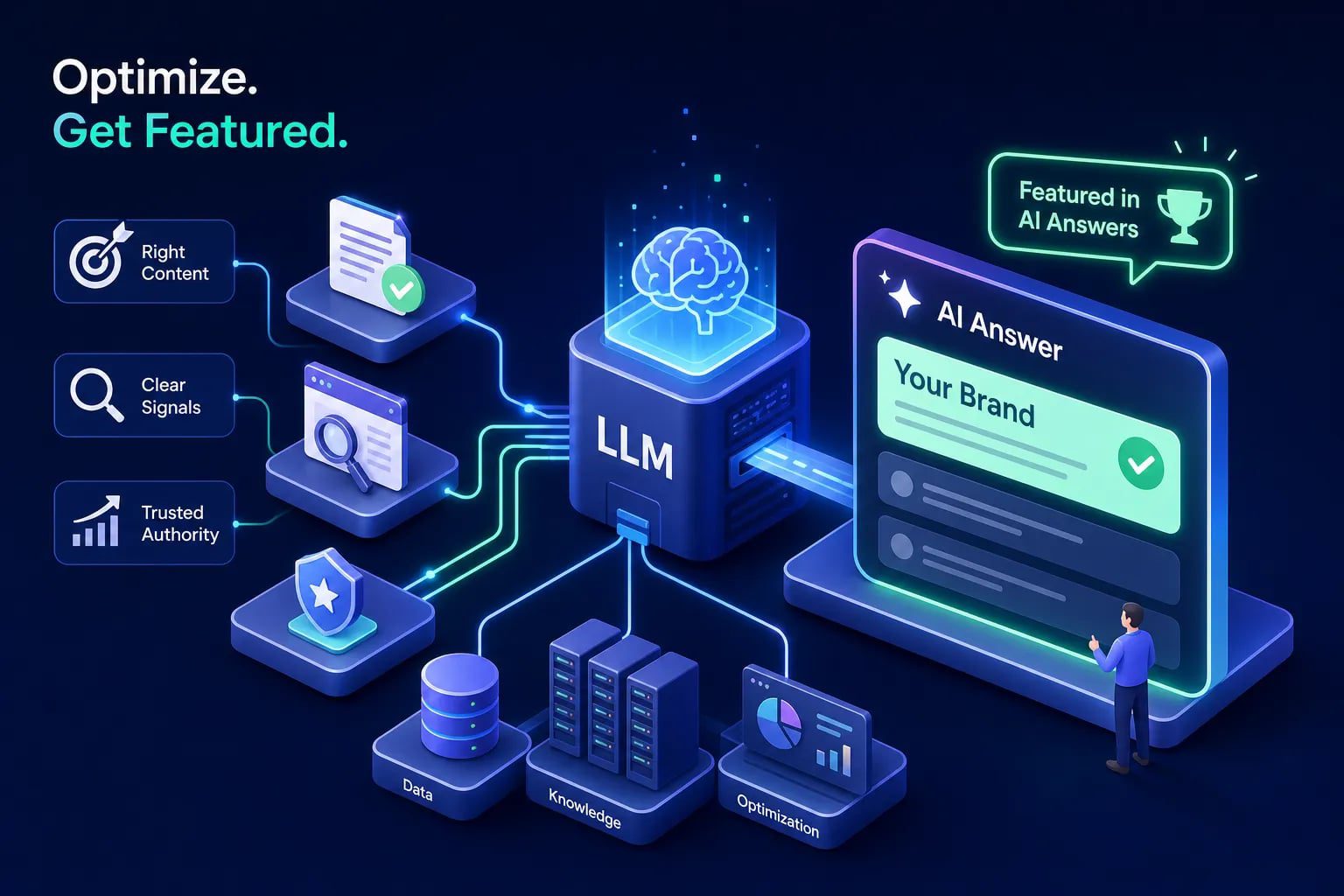
A growing number of people now get their answers directly from ChatGPT, Google’s AI Overviews, and Perplexity without clicking a single search result. A business can sit comfortably on page one of Google and still be completely invisible to those AI-generated responses. That gap between traditional rankings and generative visibility is exactly what LLM optimization is designed to close. At Brandleap Agency, we have been working on this capability as a core part of client strategy for several years, long enough to have built a structured, repeatable approach around it.
LLM optimization, at its core, is about structuring and positioning your content so AI models recognize your brand as credible, relevant, and worth surfacing in their answers. It’s not about gaming an algorithm. It’s about speaking clearly enough that machines trained on billions of documents can accurately identify who you are, what you do, and why you’re a trustworthy source. The businesses that figure this out now may gain a meaningful head start over those still focused exclusively on rankings while the way people search continues to shift.
How LLM optimization starts: understanding how AI sources information
LLMs don’t search the way Google does. Google crawls, indexes, and ranks pages in response to queries. Large language models generate responses from patterns absorbed during training, and in many cases they supplement that with real-time retrieval. Understanding the difference changes how you think about visibility entirely.
How parametric memory shapes brand recognition
When a model generates a response without pulling live data, it’s drawing on what’s called parametric memory. This refers to the patterns, associations, and entity relationships baked into its weights during training. If your brand, your founder, your services, and your areas of expertise have been discussed across authoritative sources that made it into that training data, the model has a representation of you. Brands that appear in high-authority content, citations, and referenced guides are better represented in that knowledge base. Thin, isolated web pages with no third-party validation rarely make the cut.
When AI models use real-time retrieval
Tools like ChatGPT with web search enabled and Perplexity actively pull from live web pages to ground their answers. This is retrieval-augmented generation, or RAG, and it means that content published today can influence AI responses today, not just after a model’s next training cycle. For businesses, this is important: well-structured, clearly written, well-indexed pages are more likely to be retrieved and cited in these real-time systems. Poor structure and vague language make it harder for the retrieval layer to identify your content as a relevant match.
What this means for businesses trying to get found
If your brand isn’t cited across authoritative sources, isn’t structured for easy extraction, and doesn’t have a coherent entity footprint across the web, your chances of being surfaced in AI-generated answers are much lower, regardless of your Google ranking. That’s the uncomfortable reality. The good news is that the signals that make a brand AI-visible are all things you can influence, and this article covers exactly how.
Why your Google rankings won’t automatically get you into AI answers
Google rewards relevance, authority, and page experience. LLMs reward clarity, entity recognition, directness, and citation-worthiness. These overlap, but they’re not the same thing. A page optimized purely for keyword density and backlinks can rank well and still get completely ignored in AI responses if it buries the answer in padding and doesn’t deliver a clean, extractable response.
The difference between ranking signals and AI recognition signals
A long-form article that hedges every claim, buries the answer in paragraph five, and structures itself around keyword placement might perform fine in traditional SERPs. But an AI model looking to extract a clear, authoritative answer won’t have patience for it. AI systems favor content that is modular, explicit, and formatted for direct extraction. That’s a meaningfully different bar than what most SEO content has been written to hit.
The visibility gap many businesses aren’t tracking
Many businesses have no visibility into whether they appear in AI-generated answers. Traditional rank tracking doesn’t cover this. You can watch your position for target keywords climb week after week while your brand is never mentioned in a single AI response to those same questions. Businesses need a new measurement lens: one that tracks AI answer inclusion, brand citation frequency, and entity authority across AI tools, not just SERP positions.
Who is getting left out of AI responses right now
Consider two law firms. The first has a good Google ranking built on backlinks and keyword-optimized content, but its pages are dense, generic, and vague. The second has solid but not dominant rankings, with clear service descriptions, structured FAQs, consistent mentions across legal directories, and references in industry publications. When someone asks an AI tool for the best employment lawyer in their city, the second firm is far more likely to appear. The stakes are real, and as AI adoption grows, that effect is likely to compound as more users route their questions through AI instead of traditional search.
The content signals that shape what LLMs include in responses
Understanding what LLMs actually reward in content is where optimization becomes practical. Each signal below has a direct implication for how you build and update your content strategy, starting with the signals you can act on immediately.
Topical depth and semantic coverage
LLMs favor content that covers a subject comprehensively and coherently. A single shallow blog post on a topic won’t establish your authority the way a cluster of interconnected, well-developed content will. Businesses that own a topic cluster, covering a subject from multiple angles with authoritative, interlinked content, are far more likely to be treated as credible sources by AI models. This is the pillar page and content cluster model, and it applies just as directly to AI visibility as it does to traditional SEO.
LLM optimization signals: entity recognition and RAG relevance
If your brand name, your founder’s name, your core services, and your location appear consistently and clearly across your website, social profiles, directories, and third-party content, AI models can build a coherent entity around your business. Inconsistency, vague positioning, or thin mentions fragment that entity and reduce your chances of being surfaced. Consistent entity signals across the web act as a trust multiplier for both traditional search and AI-driven visibility.
This is also where RAG systems make entity clarity especially important. When a retrieval-augmented model queries the live web to ground its answer, it’s looking for pages that clearly signal relevance to a topic and a trustworthy source behind the content. Brands with a strong, consistent entity footprint rank higher in that retrieval layer, even before content quality becomes a factor.
Answer-first structure and clear language
LLMs extract concise answers from pages. Content that front-loads the answer, uses clear headers, avoids ambiguity, and writes in plain declarative language is significantly more likely to be surfaced. Hedged, jargon-heavy content doesn’t translate well into AI summaries. In practice, definitive statements like “X is…” are far easier for AI systems to quote and attribute than vague, qualified prose that never quite says anything directly.
How does LLM optimization change content structure?
Once you understand the signals, the next step is rebuilding your content architecture to match them. Here’s a practical framework for structuring pages to perform in AI contexts.
Writing in a direct, question-and-answer format
Structuring key sections of a page around specific questions your audience asks, with clear answers immediately below, mirrors how AI models look for contextual grounding. FAQ sections, definitional blocks, and summary boxes all serve this purpose well.
The strongest citation-friendly page structure follows a predictable pattern: a direct answer near the top, question-led H2 sections with short answer-first paragraphs, comparison tables or lists where they add clarity, and a FAQ block toward the bottom. That’s not just good UX, it’s the format AI retrieval systems are built to parse.
Schema markup and structured data for AI parsing
FAQ schema, HowTo schema, and Organization schema help both search engines and AI models understand the structure and intent of your content. FAQ schema is especially valuable because question-and-answer markup maps directly to how AI summaries are assembled. It’s worth noting that schema improves your chances of inclusion but doesn’t guarantee it, content quality and topical relevance still come first.
Organization schema matters for a different reason: it helps AI systems identify who you are, connect your site to a known entity, and associate your content with consistent brand information. Use schema for clarity and machine-readable structure, not as a shortcut.
Aligning content with conversational queries
AI search tends to be more conversational than typed keyword searches. Structuring content around natural language questions, such as “What’s the difference between SEO and GEO?” rather than “SEO GEO comparison”, aligns better with how people actually prompt AI models. Revisiting your existing content with this lens often reveals dozens of quick improvements: headings that can become questions, sections that can open with direct answers, and pages that can be restructured to match how users actually phrase their queries.
Authority and trust: the off-page signals LLMs rely on
No amount of on-page formatting compensates for a weak authority footprint. LLMs weight trustworthiness heavily, and that trust is built largely through how the wider web talks about you. External signals determine how credible an LLM considers your brand, and they’re non-negotiable.
Getting cited and mentioned in authoritative sources
Being referenced in respected publications, industry blogs, podcasts, and research builds the kind of citation trail that LLMs use to validate credibility. Digital PR, expert commentary, and thought leadership content are directly relevant here, not just for traditional SEO purposes. Co-citation across independent, trusted sources increases confidence within AI systems that your brand is real, relevant, and authoritative enough to include in generated answers. The pattern is consistent: brands cited frequently across high-quality sources get surfaced; brands with weak third-party validation don’t.
Brand mentions, backlinks, and citation building
Traditional link building and citation building, especially for local businesses, contribute to an LLM’s entity knowledge about your brand. Consistent NAP data, mentions in relevant directories, and backlinks from topically relevant sources all reinforce your brand’s footprint in the data that models draw from. For local and service-based businesses, this isn’t optional. It determines both local SEO performance and AI visibility, and it needs to be treated as a core investment rather than a secondary task.
How generative engine optimization (GEO) extends this work
GEO is the formalized discipline that combines on-page optimization, entity building, authority signals, and content structuring specifically for AI-driven search environments. Where traditional SEO asks “How do I get users to click my result?”, GEO asks “How do I get the AI to use my content in its answer?” These are different goals that require different strategies. Businesses that start building GEO foundations now are creating a lead that compounds over time, one that’s hard to close for competitors still focused exclusively on Google rankings.
How Brandleap helps businesses build AI visibility that lasts
At Brandleap Agency, LLM optimization and generative engine optimization aren’t add-ons or experimental offerings. They’re a core part of how we build digital presence for clients who want to stay relevant as search evolves. The Brandleap team approaches this as a structured discipline: auditing how a client’s brand currently appears (or doesn’t) in AI responses, identifying gaps in entity authority and content structure, and building a roadmap to close those gaps systematically.
A real engagement starts with an AI visibility audit: we assess how your brand is represented across AI tools, identify content structure weaknesses, and evaluate your entity footprint across the web. From there, we move into content restructuring, entity building, and schema implementation, followed by tracking citation frequency and AI response inclusion over time. It’s a concrete, measurable process, not an abstract concept. Clients can see where they stand at the start and track exactly how that changes.
The window to act is now, not later
Search is shifting faster than most businesses realize. LLM optimization isn’t a future concern to revisit once AI-generated search matures. It’s a present gap that’s costing businesses visibility, leads, and customers right now. The most urgent shift is treating AI visibility as a distinct goal from rankings, one that demands clear content, entity authority, and citation-worthiness across the web. Those three things don’t happen by accident, and they don’t happen overnight.
Businesses that move on this early will be far better positioned than those who wait until the shift is obvious. If you want a specialist guiding this work rather than a generalist agency figuring it out on your time, reach out to the Brandleap team to start building AI visibility that holds up as search continues to shift.