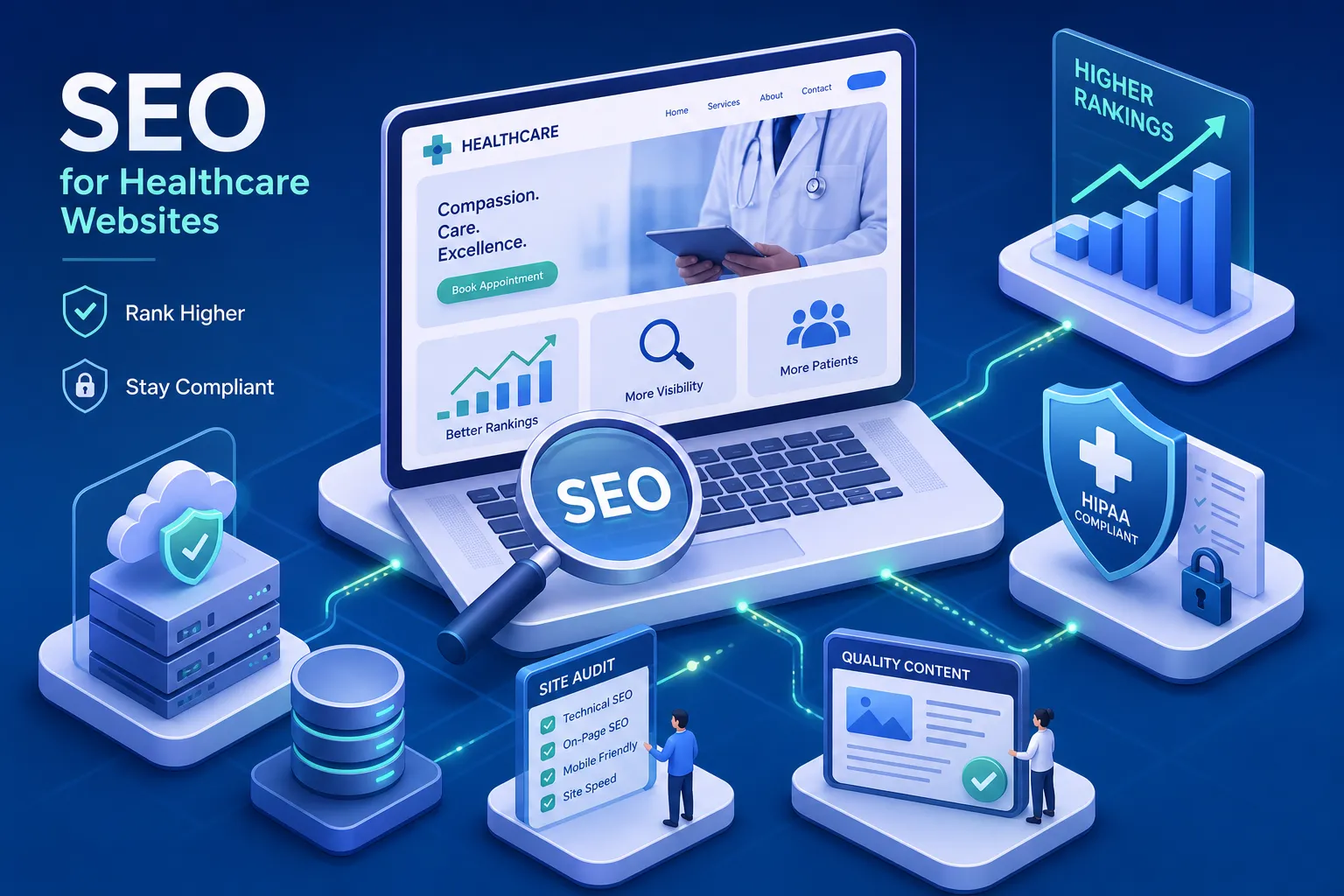
Healthcare websites operate under a different set of rules than almost any other vertical online. Effective SEO for healthcare websites requires strategies that address Google’s strict YMYL classification, HIPAA compliance constraints, and local patient intent, three pressures that rarely appear together in other industries. A clinic can deliver exceptional care and maintain a professionally designed website, yet still fail to appear anywhere on page one for the searches that matter most.
Generic SEO guides skip the parts that make healthcare uniquely difficult: YMYL classification, E-E-A-T credibility requirements, HIPAA constraints on analytics and tracking, location-based patient intent, and structured data that actually communicates your practice’s entities to Google. At Brandleap Agency, we’ve audited and rebuilt healthcare SEO strategies across clinics, multi-location groups, and specialty practices long enough to see the same fixable mistakes show up repeatedly. This guide is built from that experience.
By the time you finish reading, you’ll have a clear audit framework covering technical health, content credibility, structured data, and local optimization, plus a KPI structure that connects organic search to actual patient acquisition rather than vanity metrics.
Why Healthcare SEO Is Harder Than It Looks
Healthcare falls under Google’s YMYL classification, which stands for “Your Money or Your Life.” That designation tells the algorithm that content in this category can cause real-world harm if it’s inaccurate, so quality raters apply a significantly higher scrutiny bar than they would to a restaurant review or a clothing retailer. Medical pages are evaluated for professional expertise, source credibility, authoritativeness, and up-to-date information. Thin or unvetted content simply won’t compete regardless of how well the technical SEO is executed.
The HIPAA Compliance Layer Most SEO Guides Ignore
HIPAA creates specific constraints on digital marketing that general-purpose SEO practitioners routinely miss. Retargeting pixels, standard analytics configurations, and form data handling on patient-facing pages can all create compliance exposure. Google Analytics, for example, is not HIPAA-eligible for pages that handle protected health information because Google does not offer a Business Associate Agreement for that product. Appointment request forms, symptom checkers, and intake pages must be handled with HIPAA-compliant infrastructure, not standard third-party tracking. The wrong setup is not just a ranking risk, it’s a legal one with material financial consequences.
How Google’s Quality Rater Guidelines Affect Medical Rankings
Quality raters are instructed to evaluate whether a careful person would seek out experts or highly trusted sources for the topic, because minor inaccuracies in health content can cause genuine harm. Medical pages with no named author, no visible credentials, and no cited sources will struggle to rank even if the underlying technical optimization is solid. YMYL classification means the content credibility layer is non-negotiable, and it must be addressed before any other optimization can deliver its full value.
E-E-A-T Signals That Make or Break Medical Content
E-E-A-T (Experience, Expertise, Authoritativeness, Trustworthiness) is the strategic framework beneath every content decision on a healthcare website. Unlike a one-time checklist, it’s the lens Google applies to decide which medical websites deserve to surface when someone searches for symptoms, treatments, or local providers. Every piece of content published should be evaluated through this framework before it goes live.
Building Clinician Profiles That Actually Signal Expertise
A high-E-E-A-T physician profile does specific things well. It places the provider’s full name and credentials near the top of the page. It should clearly state their specialty, training background, institutional affiliations, and years in practice, and include a professional headshot. Licensing information and links to verifiable professional profiles, including hospital affiliations and medical board listings, strengthen the entity signal Google needs to confirm the person is real and qualified. Generic bio blurbs with no specifics are a missed opportunity that directly affects how the algorithm evaluates the page. Applying solid SEO for doctors at the profile level is one of the highest-impact improvements a practice can make.
Content Review Chains and Editorial Transparency
Medical content should make a clear distinction between the person who wrote it and the licensed clinician who reviewed it for accuracy. Even when a skilled health writer drafts the copy, a licensed physician or specialist should be listed as the medical reviewer, with their credentials visible. Visible review dates, sources cited from NIH, CDC, or peer-reviewed journals, and a published editorial standards page all contribute to the trust layer that Google’s quality raters are trained to reward.
The Trust Signals That Reinforce Authority Site-Wide
Several basic elements are commonly missing on clinic websites, and their absence quietly suppresses rankings in YMYL categories. These include HTTPS across the entire domain, a detailed “About” page that names the practice ownership and provides real contact information, a visible privacy policy, and an editorial or “Why trust us” page that explains sourcing standards and update frequency. Each of these signals tells Google that the organization behind the site is real, accountable, and operating to a professional standard.
Technical SEO Issues That Block Medical Sites from Ranking
Technical problems are often the silent ranking killer for healthcare websites, particularly for multi-location clinic groups and hospital systems with large, complex site architectures. A technically broken site cannot be rescued by strong content alone. The algorithm must be able to discover, crawl, and correctly interpret pages before content quality becomes a meaningful ranking factor at all.
Site Architecture, Crawlability, and the Duplicate Page Problem
The most common culprits across healthcare sites are orphaned service pages with no internal links pointing to them, duplicated location pages with near-identical copy across branches, poor internal linking between related service and condition pages, and bloated XML sitemaps that waste crawl budget on low-value URLs. Multi-location practices frequently create a single corporate location page rather than distinct, individually linked location pages with unique content. That architecture makes it nearly impossible for Google to rank the right page for location-specific patient searches.
Core Web Vitals and Mobile-First Performance
Google indexes the mobile version of a site first, which means mobile performance problems directly affect rankings for every visitor, including desktop users. Unoptimized hero images, render-blocking scripts, and poorly implemented fonts are the most common causes of LCP failures on clinic websites. The thresholds to target in 2026 are specific: LCP under 2.5 seconds, INP under 200 milliseconds, and CLS as close to zero as possible, measured at the 75th percentile of real user mobile data. A site that fails those thresholds on mobile is penalized regardless of how strong the content strategy is.
SEO for Healthcare Websites: Schema Markup That Gives Google a Clear Picture
Structured data is not optional for healthcare websites that want to compete in 2026. Schema allows Google to understand entities, not just pages, so it can connect a physician to a practice location, a procedure to the conditions it addresses, and a practice to its specialty. Most clinic websites either skip schema entirely or implement it incorrectly. Either way, the result is the same: meaningful ranking opportunity left unrealized.
The Right Schema Types for Clinics, Physicians, and Procedures
The core schema types for a healthcare website break down cleanly by page type. Use MedicalClinic or MedicalOrganization for the practice entity on the homepage or main practice page. For individual provider pages, Physician schema (or the newer IndividualPhysician type introduced in Schema.org v24) should include the provider’s credentials, specialty, and practice affiliation. Treatment and service pages should use MedicalProcedure with the most specific subtype available, such as DiagnosticProcedure or SurgicalProcedure.
FAQPage schema should only appear on pages that visibly include real question-and-answer content. JSON-LD is the preferred implementation format across all of it. A critical rule applies throughout: schema markup must match what a user can actually read on the page. Google will discount or ignore markup that doesn’t reflect visible content. You can validate any implementation using Google’s Rich Results Test or the Schema.org Markup Validator before pushing changes live.
Here is a minimal JSON-LD example for a physician page to illustrate the structure:
{
  "@context": "https://schema.org",
  "@type": "Physician",
  "@id": "https://example.com/dr-jane-smith",
  "name": "Dr. Jane Smith, MD",
  "description": "Board-certified internal medicine physician with 15 years of practice.",
  "medicalSpecialty": "InternalMedicine",
  "worksFor": {
    "@type": "MedicalClinic",
    "name": "Example Family Health Clinic",
    "address": {
      "@type": "PostalAddress",
      "streetAddress": "123 Main St",
      "addressLocality": "Austin",
      "addressRegion": "TX",
      "postalCode": "78701"
    }
  }
}
Multi-Location Schema and Entity Graph Consistency
Each clinic location should have its own schema block with a unique address, phone number, and operating hours. Using a stable @id value across pages is what connects the location, its physicians, and its services into a coherent entity graph that Google can trust and navigate. Practices that reuse a single generic organization schema across all location pages create entity ambiguity that suppresses local pack visibility across every branch. A sound hospital SEO strategy at the schema level is just as important as the content decisions made above it.
Local SEO for Healthcare Websites: Bringing New Patients Through the Door
Winning local rankings and structured data is only half the equation if you can’t connect that visibility to booked appointments. Local search is where patient acquisition actually happens for most clinics and specialty practices. Someone searching “orthopedic surgeon near me” or “urgent care open now” is not browsing, they are ready to book. The practices that win this intent consistently own three things: an optimized Google Business Profile, accurate citations across major healthcare directories, and a steady flow of patient reviews.
Google Business Profile: The Highest-ROI Local Asset for Any Clinic
A fully optimized GBP for a medical practice includes accurate NAP (name, address, phone), correct primary and secondary categories, detailed service descriptions, a booking link, up-to-date hours including holiday adjustments, professional photos, and regular posts. Multi-location practices need a separate, individually optimized profile for each location, and each profile should link to its own dedicated landing page rather than a generic homepage. This setup is the single fastest path to visible local pack presence for new patient searches.
Citation Consistency, Healthcare Directories, and NAP Accuracy
Citation value comes from accuracy and consistency, not volume. The name, address, phone number, and specialty information must match exactly across Healthgrades, WebMD, Zocdoc, Vitals, Doximity, Bing Places, Apple Maps, and Yelp. Inconsistent data across these listings creates entity confusion that suppresses local pack visibility. The priority tier for U.S. healthcare practices should start with Google Business Profile, Healthgrades, WebMD, and Zocdoc, then extend to Doximity, RateMDs, and Vitals as the authority layer deepens.
Patient Reviews: How They Affect Rankings and Appointment Conversions
Reviews play a dual role in healthcare local SEO. They influence local pack rankings directly, and they’re the primary trust signal a prospective patient checks before deciding to book. A systematic post-visit review request process, sent via text or email with a direct link to the GBP review form, consistently outperforms any passive approach. Responding to every review, positive or negative, signals to both Google and prospective patients that the practice is engaged, credible, and accountable.
Measuring Patient Acquisition from Organic Search
The most common measurement mistake in healthcare marketing is treating rankings or traffic volume as the primary success metric. Organic visibility is a leading indicator, not a business outcome. A KPI framework built for patient acquisition starts from the appointment and works backward through the funnel.
The KPI Hierarchy: From Search Visibility to Scheduled Appointments
A reliable measurement framework organizes metrics into three tiers. Tier 1 covers business outcomes: appointments booked, qualified phone calls, new patients attributed to organic search, and revenue per organic visit. Tier 2 covers conversion economics: organic conversion rate, cost per patient acquisition, and qualified lead rate. Tier 3 covers visibility signals: organic traffic, CTR, rankings, and local pack appearance.
Clinics should optimize decisions around Tier 1 and use Tiers 2 and 3 as diagnostic tools to understand why Tier 1 numbers are moving in a particular direction. Tracking all three tiers together gives a far more complete view of what the healthcare SEO best practices you’re implementing are actually returning in clinical revenue.
Attribution Methods That Connect SEO to Real Clinical Revenue
The practical attribution setup requires UTM-tagged organic landing pages feeding into a booking or inquiry flow, call tracking with source attribution tied to organic landing pages, and ideally a CRM connection that maps sessions to verified appointments and new patients. Last-click attribution consistently undervalues SEO in longer patient decision cycles, where someone may research a specialist weeks before booking. Multi-touch attribution gives a more accurate picture of how organic search assists conversions over time, and it’s the setup worth investing in once the foundational tracking is in place.
Building a Healthcare SEO Foundation That Strengthens Over Time
SEO for medical websites is more demanding than other industries not primarily because of keyword competition, though that’s real in most markets. It’s more demanding because the compliance, credibility, and trust requirements are all elevated at once. Practices that address all five layers, YMYL and compliance strategy, E-E-A-T signals, technical health, structured data, and local optimization, and measure results against actual patient acquisition metrics will consistently outperform competitors who treat medical SEO as a standard content-and-backlinks exercise.
The clinics that build a technically sound, credibility-forward SEO foundation in 2026 will strengthen those advantages as search continues to evolve toward AI-driven results. Answer Engine Optimization and generative search are already changing how patients find providers. Practices with strong entity graphs, high E-E-A-T signals, and consistent structured data will carry those advantages directly into the next generation of search visibility.
If you want a second set of eyes on where your healthcare website stands across all five of these areas, the team at Brandleap Agency runs focused SEO for healthcare websites audits that prioritize fixes by impact and compliance risk. Request your healthcare SEO audit and get a clear, actionable picture of what’s limiting your practice’s organic visibility and where the highest-impact fixes are.