Personal injury lawyer SEO is one of the most competitive digital battlegrounds in any industry, and the stakes behind every ranking position reflect that reality. PI firms aren’t just competing with other law firms in search. They’re fighting for the same clicks that cost $150 to $400 per visit on Google Ads, where terms like “truck accident lawyer” can clear $800 per click in major U.S. cities. That cost reflects one reality: a single signed client generates $25,000 to $100,000 in firm revenue. A page-one organic position often drives case inquiries without direct media spend, though not every impression converts to a lead or signed case.
At Brandleap Agency, we work with PI firms in highly competitive markets and see the same problem repeatedly: great attorneys with invisible websites. The firms filling their intake calendars aren’t always the best litigators. They’re the ones who’ve built search visibility across every signal that matters. This guide lays out exactly what separates those firms from the ones paying premium CPCs just to stay alive.
Why personal injury lawyer SEO operates in a different competitive league
Personal injury search terms carry some of the highest CPCs in any industry. “Car accident lawyer near me” regularly clears $110 to $275 per click, while “wrongful death lawyer” runs $180 to $350 in competitive markets. Those prices aren’t arbitrary. They reflect what a signed case is worth downstream, and every organic ranking you hold eliminates that cost while compounding authority over time.
What makes personal injury law firm SEO harder than general attorney SEO is the urgency behind the searches. Someone typing “car accident lawyer near me” needs help today. Search engines respond to that urgency by weighting local signals, review volume, and domain authority simultaneously. You can’t win by doing just one thing well. You need local pack presence and strong landing pages backed by credible backlinks. Every one of those signals must outperform firms that have been investing in them for years.
Local SEO for lawyers: claiming your spot in the local map pack
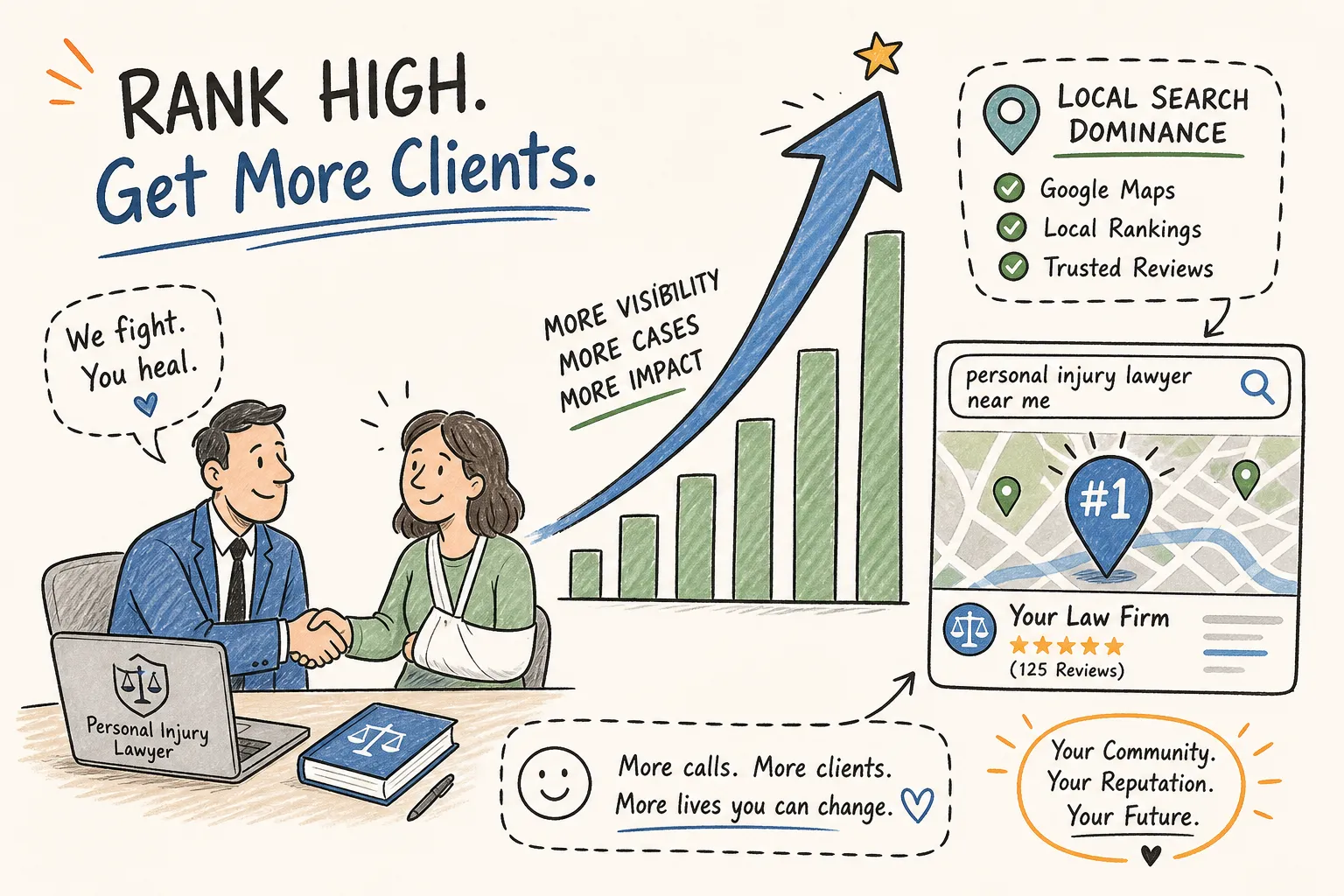
Rankings.io’s 2024 local SEO study on personal injury attorney rankings found that the city listed in the Google Business Profile has the single greatest impact on local pack placement, followed closely by selecting the correct primary category. For PI firms, that means “Personal Injury Attorney” as the primary category, full stop. GBP optimization isn’t optional in this niche, it’s the foundation everything else builds on. Your profile also needs consistent photo uploads, regular posts, and a keyword-informed business description that clearly reflects your actual service areas.
Review count correlates more strongly with local pack placement than review rating does. In major metros like Los Angeles, New York, and Chicago, firms typically need 100 to 300+ Google reviews before they break into top-three positions, with some markets averaging 200+ among current map pack holders. Review generation needs to become a repeatable intake process, not a one-time ask. Based on best-practice intake workflows, the most effective approach is to send a review request at case resolution, follow up once by text, and respond to every review publicly within a short window, treating each step as a standard operating procedure rather than an afterthought.
Citation accuracy, meaning consistent name, address, and phone data across directories, remains a top-five local ranking factor for law firms. Inconsistent NAP data across Avvo, Justia, FindLaw, and Yelp can materially reduce local authority and should be audited regularly. Your priority citation stack should cover Google Business Profile, Justia, Avvo, FindLaw, Super Lawyers, and Martindale-Hubbell first. Audit these quarterly, and use a tool like BrightLocal or Whitespark to track inconsistencies at scale before they cost you rankings.
Practice-area landing pages for personal injury lawyer SEO
The strongest page template for local PI visibility is a dedicated city plus service page, such as “Car Accident Lawyer in Houston.” Each page needs to be genuinely unique: include local court references, state-specific statutes of limitations, a local phone number, and case outcomes tied to that market. Thin pages that swap city names and repeat the same template copy don’t rank, search engines and potential clients both notice the difference, and behavioral metrics like bounce rate bear that out.
A high-converting city page follows a specific structure above the fold: a location and practice-area H1, a benefit-focused headline, a visible click-to-call number, trust signals like years in practice and review scores, and a short lead form asking only for name, phone, and a brief case description. Case results and testimonials go next, followed by local relevance signals like office location and service area details. An FAQ section closes the page. Every element serves the conversion, not just the ranking.
Schema markup: the underused edge in legal search
FAQPage schema remains one of the least-adopted tactics in legal SEO. Combined with LegalService and LocalBusiness schema on service pages, and Attorney schema on individual bios, structured data tells search engines exactly what you offer, where you offer it, and who delivers it. A well-structured FAQ section at the bottom of each service page can trigger expanded search results and meaningfully improve click-through rate without requiring additional backlinks or content volume.
Pillar pages and internal linking architecture
Every primary practice area, car accidents, truck accidents, slip and fall, wrongful death, deserves a long-form pillar page of at least 2,000 words. Supporting that pillar with eight to twelve topically related blog posts, all linking back to it, builds the kind of topical depth that pushes broader practice-area terms to page one. Internal linking is architecture, not decoration.
The link-building strategy behind top-ranking PI firms
Before any outreach begins, your firm needs complete, verified profiles on Avvo, Justia, FindLaw, Super Lawyers, and Martindale-Hubbell. These serve as both citation signals and referring domains from recognized legal authority sites. They’re the baseline every competitive PI page shares, and missing them puts you behind before a single editorial link is built.
Top-ranking PI pages in competitive cities tend to carry 50 to 200+ unique referring domains. The most impactful links come from legal publications, regional news outlets, and bar association resource pages.
Outreach tactics that produce editorial links
The approaches that consistently deliver results in PI link building include guest posts on established legal blogs, digital PR pitching local news with accident statistics or settlement data, broken link replacement on law school and bar association resource pages, and journalist outreach for expert quote placements. Each tactic targets the same goal: links that a credible publisher would genuinely choose to place.
High-quality PI link profiles are dominated by branded and entity anchors from directory profiles, plus topically relevant contextual anchors from editorial placements. Over-optimized exact-match anchor text is a flag in this niche. The goal is link diversity from credible sources. Build links that a journalist or resource curator would genuinely publish, and the anchor profile takes care of itself.
Tracking personal injury lawyer SEO performance against real case economics
PI firms using organic search as a lead channel typically see a 5% to 8% visitor-to-lead conversion rate. Of those leads, roughly 8% to 20% convert to signed cases, depending on intake speed and case selectivity. Run the math at a base case of 6% visitor-to-lead and 12% lead-to-signed-case. At those rates, every 1,000 qualified organic visitors produces roughly seven signed cases. At a conservative $40,000 in firm revenue per case, that’s approximately $288,000 in potential revenue from 1,000 organic visits. Over a 12 to 24-month horizon, law firm marketing SEO can produce a lower cost-per-signed-case than paid search for many firms, though the comparison depends on market, budget, and execution quality.
The KPIs worth tracking monthly are:
- Organic sessions by landing page, separated between city pages, pillar pages, and blog content
- Local pack impressions and clicks from Google Search Console
- Google Business Profile calls and direction requests
- Form submissions and call volume attributed specifically to organic traffic
- Cost per signed case from organic, benchmarked against your paid search CPA
Tracking these separately from paid channels is what allows a firm to make data-driven decisions about where to invest next. Blended reporting hides what’s actually working and makes it impossible to double down on the channels producing the lowest cost per signed case.
When to bring in a specialized legal SEO partner
Many digital marketing agencies can build a website and run ads. Far fewer understand the competitive dynamics of PI firm search engine optimization, the ethical constraints around attorney advertising in each state, or the citation ecosystem specific to legal directories. Choosing an agency that has actually ranked PI firms in competitive markets is the difference between a 12-month SEO investment that produces cases and one that produces reports.
What separates a legal SEO specialist from a generalist is pattern recognition. A specialist knows that a PI firm in a major metro likely needs 200+ reviews before the map pack is realistic. They know which schema types matter for legal SERP features and the difference between foundational directory links and editorial links that actually move competitive rankings. That knowledge compresses the timeline between starting and seeing measurable results.
Brandleap Agency works with personal injury firms and professional service providers in high-stakes markets, combining technical SEO, local SEO for lawyers, content strategy, and white-hat link building under one roof. The founder-led model means senior-level strategy is applied directly to your campaign rather than delegated to a junior team member after the pitch. If your intake line is quiet while competitors seem to own every local search result, that’s a signal your SEO strategy needs a full audit and a clearer competitive roadmap, which is exactly where a specialized partner starts.
Build the system, then scale it
Personal injury lawyer SEO rewards firms that treat it as a multi-signal discipline, not a single tactic. Local pack visibility, practice-area landing pages with proper schema, consistent citation authority, and a sustained link-building program produce minimal results in isolation. They compound when they work together, and that compounding is what makes organic search one of the highest-ROI channels in this niche over a 12 to 24-month horizon.
Start with your Google Business Profile, audit your existing landing pages against the top three competitors in your market, and map your current backlink profile against theirs. Those three steps will show you exactly where the gap is. From there, progress is a function of execution speed and consistency, not strategy decks.
Firms that hold top positions in competitive markets today began this build 12 to 18 months ago. If you want a partner who specializes in ranking personal injury firms in those same markets, Brandleap Agency is worth a conversation. The gap closes with execution.