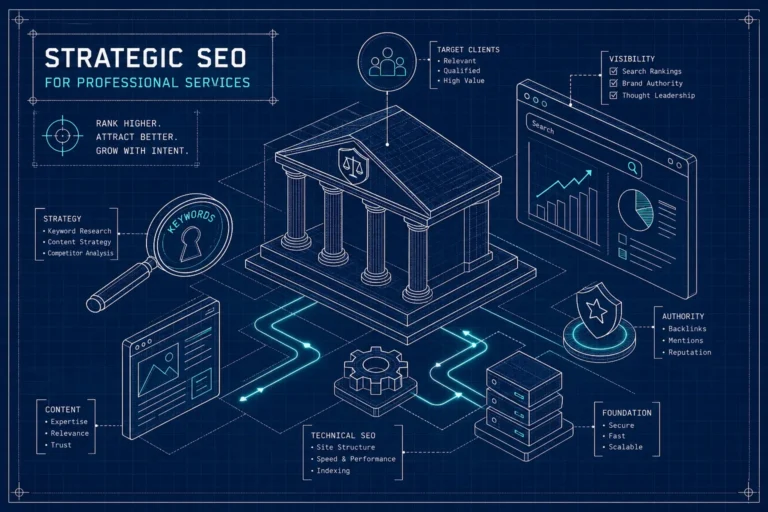
SEO for professional services firms works differently than it does for most industries, and that gap explains why so many talented practitioners remain invisible online. Your firm has genuine, deep expertise that prospective clients are actively searching for, but that expertise stays undiscoverable until it’s structured in a way search engines can find, interpret, and reward. A brilliant tax attorney or a seasoned management consultant with 25 years of experience will still lose organic traffic to a competitor whose website is built around topical authority, not just credentials.
The stakes are higher here than in most industries. Google classifies legal, financial, and consulting content as YMYL (Your Money or Your Life), which means the E-E-A-T framework carries significantly more algorithmic weight than it does for a travel blog or an e-commerce store. Pages with strong E-E-A-T signals consistently rank higher in competitive professional services verticals, while thin content, anonymous pages, and unverified credentials get suppressed. Thin content gets penalized harder in YMYL categories than in almost any other content type, a distinction Google’s quality rater guidelines make explicit when evaluating pages where a reader’s financial or legal decisions are at stake.
This guide covers the unique challenges professional services firms face in organic search, the highest-impact tactics by category, and a concrete 90-day roadmap you can start this week. Working with a team that specializes in semantic SEO for professional services, such as Brandleap Agency, helps firms move from scattered blog posts toward the structured topical authority that drives rankings in regulated, expertise-driven niches.
Why Professional Services SEO Works Differently Than Most Industries
The E-E-A-T Mandate That Rewrites the Rules for Service Firms
Google’s quality rater guidelines classify professional services content as YMYL, so the algorithm evaluates trust signals at a granular level: named authors with verifiable credentials, citations to primary sources such as statutes and court documents, and transparent business details including physical addresses and accurate contact information. SEO for law firms and accounting practices must clear a higher standard than SaaS or e-commerce, because the consequences for a reader acting on that content are real and often significant. Every page benefits from named authorship, demonstrated expertise, and verifiable credentials.
Long Buying Cycles and How They Reshape Keyword Strategy
Professional services buyers don’t convert in a day. Research and evaluation can span weeks or months, which means a keyword strategy built only around high-intent service pages misses most of the funnel. A prospective client might start with “what does a forensic accountant do,” consume educational content for several weeks, and only then search “forensic accountant near me pricing.” Capturing that full journey requires content at every intent layer, from early awareness through late-stage evaluation, not just a handful of transactional pages.
Building Content Authority That Makes Your Expertise Searchable
Service Pages: The Non-Negotiable Foundation for Professional Services SEO
Every core service your firm offers needs its own dedicated page. Lumping practice areas onto a single overview page leaves significant ranking opportunity on the table and makes it nearly impossible for search engines to understand what you actually do. Each service page should open with a clear description, walk through your process, embed proof in the form of case summaries and credentials, and close with a direct call to action. These pages pull the majority of organic rankings and must function as conversion assets, not digital brochures.
Topical Depth and the Semantic SEO Advantage for Consultants and Firms
Google rewards websites that cover a subject comprehensively. A firm that publishes 15 interconnected pieces on estate tax planning will consistently outrank a competitor with a single generic service page, because the cluster signals genuine topical authority rather than surface-level keyword coverage. This is where a structured semantic SEO approach becomes a real competitive differentiator. Brandleap Agency builds content clusters around each practice area so a firm’s site becomes the recognized authority on that topic, satisfying E-E-A-T requirements without producing disconnected, generic content. Research from content marketing studies suggests that clustered, interlinked content earns more organic traffic and more citations in AI-generated overviews than standalone posts, a meaningful advantage as AI Overviews become a standard part of how prospects research professional services firms.
Practitioner Bios and Case Studies as Trust Multipliers
Practitioner bios need real credentials, actual headshots, named specializations, and links to content the practitioner has authored. Anonymous “our team” pages contribute nothing to authority signals. Case studies in a problem-approach-result format, embedded directly on service pages rather than buried in a separate blog section, consistently rank among the highest-converting content types for professional services firms. Placing mini case summaries on a service page means prospects encounter proof at exactly the moment they’re deciding whether to reach out.
Local Citations and Reputation Signals That Influence Rankings
Why NAP Consistency and Directory Listings Still Matter
Name, address, and phone number consistency across every citation source is foundational. Inconsistencies between your website, Google Business Profile, and industry directories confuse both search engines and prospective clients trying to verify that you’re legitimate. For professional services, niche directories carry additional weight because they confirm industry relevance alongside contact data: Avvo, Justia, and FindLaw for law firms; Clutch and G2 for consultants; CPA-specific directories for accounting firms. Domain authority figures for these directories shift over time, so verify current metrics using a tool like Ahrefs or Moz before prioritizing your outreach. These aren’t just traffic sources; they are trust signals that reinforce your E-E-A-T profile.
Local SEO for Professional Services Firms: The Google Business Profile Advantage
A fully optimized Google Business Profile with accurate categories, individually listed services, consistent hours, and regular photo updates is one of the fastest wins in local SEO for professional services firms. Many firms claim their profile and stop there. The ongoing signals, including posts, Q&A responses, and timely review replies, are what push profiles higher in local pack rankings over time and separate actively managed profiles from neglected ones.
Client Reviews as Both a Ranking Factor and a Conversion Lever
Google’s local algorithm weights review quantity, recency, and response rate. Firms without an active review acquisition process are regularly outranked by competitors with fewer credentials but more visible social proof. Reviews work on two levels simultaneously: they influence local rankings, and they convert site visitors who are still deciding between you and the firm they evaluated before yours.
Technical SEO and Schema: The Structural Backbone Most Firms Skip
Schema Types That Help Professional Services Firms Stand Out in Search Results
Three schema types form the foundation for any professional services SEO strategy. ProfessionalService or Service schema belongs on each individual service page, defining exactly what you offer and who provides it. LocalBusiness schema covers firm location, hours, and contact data. Person schema on practitioner bio pages ties named individuals to the organization and reinforces the expertise signals Google is looking for. FAQ schema tied directly to service pages captures featured snippet opportunities and addresses specific pre-hire questions prospects are already searching. These tend to be the highest-intent queries in your niche, making them worth targeting explicitly. Implement everything in JSON-LD format and validate using Google’s Rich Results Test before publishing.
Core Technical Priorities That Affect Crawlability and Conversion
Site speed, mobile responsiveness, HTTPS, and clean URL structure are non-negotiable prerequisites. A slow or unsecured site sends an untrustworthy signal at exactly the moment a prospective client is deciding whether to contact you. Canonical tags, a thematic XML sitemap, and duplicate content prevention across practice area pages keep crawl budget focused on your highest-value pages rather than diluted across thin, redundant URLs.
A 90-Day SEO Roadmap for Your Professional Services Firm
Month 1: Technical Foundation and Local Presence
Start with a technical audit covering site speed, HTTPS configuration, mobile parity, and canonical errors. Claim or fully optimize your Google Business Profile, and audit NAP consistency across every directory relevant to your profession. Implement Organization and LocalBusiness schema as your structural base, then identify the top 5 to 10 niche directories for your industry and ensure accurate, complete profiles exist on each.
Month 2: Content Authority and On-Page Optimization
Build or rebuild dedicated service pages for each core offering, with embedded case study summaries, practitioner attribution, and a clear process description. Publish several high-quality thought leadership pieces targeting high-intent informational queries within your primary practice areas, prioritizing topics where your practitioners can speak from direct experience. At the same time, map out your content cluster framework: plan 8 to 12 supporting articles per core service that build topical depth and link back to each service page. Topical depth is a common shortfall among professional services sites, and this phase is what separates firms that rank from those that don’t.
Month 3: Link Acquisition and Baseline Measurement
Launch one linkable asset, whether original data, an industry report, or a resource guide, and begin outreach to niche publications and expert quote platforms like HARO or Qwoted. Set up Search Console and rank tracking for your priority keywords. Establish conversion benchmarks for organic traffic: contact form submissions, phone call clicks, and consultation bookings. Rankings are a leading indicator; what you’re actually measuring is qualified pipeline generated by organic search.
In-House SEO vs. Hiring an Agency: How to Make the Right Call
When Building Internal SEO Capability Makes Sense for Your Firm
Internal SEO works when you have a dedicated marketing hire with SEO training, consistent content production bandwidth, and the willingness to build expertise over a year or more. For smaller firms, this structure often isn’t cost-effective. The risk is strategic dilution: a generalist marketer managing SEO, social media, events, and PR simultaneously rarely builds the topical depth or technical rigor that professional services SEO requires.
What to Look for When Hiring an SEO Agency for Professional Services
Look for agencies that demonstrate fluency in E-E-A-T compliance, semantic content strategy, and local citation management, not just those who promise rankings based on link volume. The specific capability to prioritize is semantic SEO expertise, because professional services firms need structured topical authority programs, not scattered blog posts. Brandleap Agency anchors its approach in semantic SEO and understands the compliance constraints of regulated industries, which positions it to build the content architecture these firms need to rank and convert simultaneously. Before signing any contract, ask for examples of content cluster work and topical authority building in expertise-driven or regulated niches.
Structure Your Expertise, Then Let Search Do the Rest
Your firm’s expertise is a genuine asset. The challenge is that it stays invisible until it’s structured for search engines to interpret and reward. These three elements, content authority built around topical depth, a consistent local presence anchored in citations and your Google Business Profile, and a clean technical foundation with proper schema, function as a system rather than as isolated tactics. None of them delivers full value alone.
The 90-day roadmap gives you a sequenced starting point: fix the technical foundation first, build content authority in month two, then invest in link acquisition once there’s something worth pointing links at. Each phase compounds on the one before it. For many professional services firms, organic search generates leads that convert at significantly higher rates than paid traffic, because prospects who find you through search have already done research and are closer to a decision.
If you want faster results with a team that has built this playbook specifically for professional services firms, Brandleap Agency offers semantic SEO programs designed around exactly this kind of structured, authority-first approach. That’s the foundation that effective SEO for professional services firms is built on. Contact Brandleap Agency to build the content architecture your expertise deserves.

BrandLeap Agency & BrandLeap Fashion | Founder & CEO
Mithun is an experienced SEO consultant recognized for helping businesses improve their digital presence through technical SEO, content optimization, and sustainable organic growth strategies. Working in the digital marketing industry since 2019, he has developed expertise in increasing search visibility, driving targeted traffic, and building long-term growth through data-driven SEO solutions. He has worked with businesses across multiple industries, helping brands strengthen their online authority and achieve measurable growth results.