



Most businesses shopping for paid search help have no clear picture of what PPC management services actually deliver, what a fair price looks like, or what results they should hold a provider accountable for. That knowledge gap leads to wasted budget, broken expectations, and agency relationships that don’t last six months. You sign a contract, the agency runs some ads, reports on clicks and impressions, and three months later you’re still not sure if any of it worked, a pattern many businesses report after their first agency engagement.
This article closes that gap. You’ll get a clear breakdown of what Google Ads management and paid search services actually include, how pricing is structured across different models, what realistic KPIs look like by business type, how onboarding works, and the exact questions to ask before you sign anything. Where examples are useful, we’ll reference what a transparent, results-focused setup looks like at an agency like Brandleap, which works specifically with small businesses that need real outcomes without the enterprise price tag.
What PPC management services include
Paid search management is not just running ads. It’s a multi-layer service covering strategy, execution, and ongoing optimization across multiple paid media channels. Knowing what’s in scope lets you compare providers accurately instead of assuming all packages are equal.
Platforms and campaign types you should expect
Google Ads Search campaigns are the baseline for virtually every managed package. Most mid-tier engagements expand to Microsoft Advertising, Google Display, Google Shopping for e-commerce accounts, and remarketing. More advanced programs layer in YouTube, Performance Max, Meta, and LinkedIn based on the client’s funnel and audience. Before evaluating any provider, get clear on which platforms your business actually needs. A local contractor typically doesn’t need LinkedIn, its audience targeting is built for professional buyers, which makes it the right fit for a B2B SaaS company reaching decision-makers but poor value for a trade service chasing local homeowners.
What the day-to-day scope of work looks like
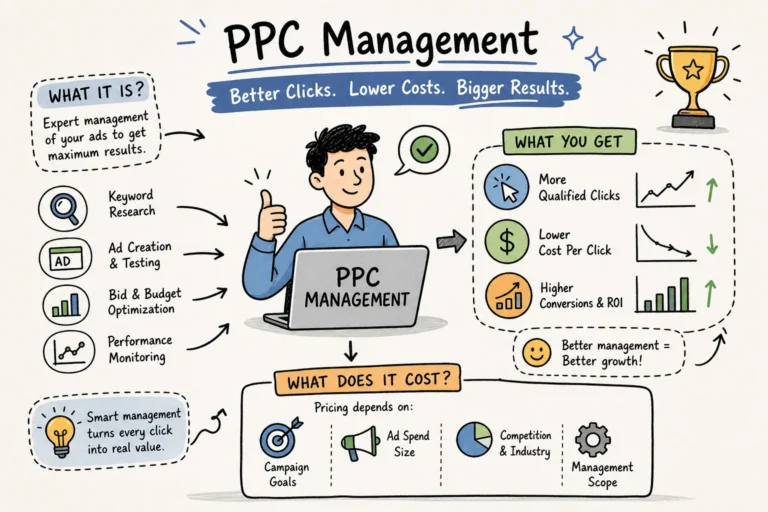
Any reputable paid media management company should include these core tasks without additional charges: keyword research, campaign structure and setup, ad copywriting, audience targeting, negative keyword management, bid and budget optimization, A/B ad testing, conversion tracking setup and verification, landing page review, and monthly performance reporting. These are standard deliverables. Landing page development and conversion rate optimization support are typically add-ons, not part of a standard retainer. If an agency bundles those in without clarifying scope, ask exactly what that looks like in practice, whether it’s a set number of hours, a defined deliverable, or a project-based addition to the retainer.
Starter, growth, and enterprise tiers explained
Tier differences usually come down to account complexity and the level of hands-on attention. Starter packages handle single-channel, single-location accounts with standard reporting. Growth packages typically add dedicated account management, more frequent strategy reviews, and cross-channel coverage. Enterprise programs layer in click-fraud protection, feed optimization, attribution analysis, and hands-on landing page development. Know which tier your business actually needs. Paying for enterprise-level features when you’re running one Google Search campaign is money you won’t get back.
How PPC management services are priced
Pricing transparency separates trustworthy agencies from those that make it deliberately confusing. Here’s how the three main models work and what you should expect to pay in 2026.
Flat retainers and percentage-of-spend models
Flat monthly retainers typically run $1,500 to $10,000 per month depending on account size and scope, with basic accounts often starting around $500 to $1,500 (based on 2026 industry pricing benchmarks). Percentage-of-ad-spend pricing usually lands at 10 to 20 percent of monthly media spend, with most agencies setting a minimum fee floor. Flat retainers are predictable and budget-friendly for smaller accounts. Percentage-based pricing scales with your media spend and creates some alignment between your investment and the agency’s incentive to grow it.
Hybrid and performance-based pricing
Hybrid pricing combines a base retainer with a performance bonus or percentage component. It’s common for larger accounts where media spend fluctuates significantly month to month. Performance-based pricing tied to leads, cost per acquisition, or revenue exists but gets used selectively. It requires clean tracking infrastructure, agreed attribution methods, and verified data, not just a handshake. If an agency pitches pure performance pricing without first auditing your tracking setup, treat that as a yellow flag.
What businesses at different stages actually pay
To anchor your expectations: mid-market accounts typically run $2,500 to $7,500 per month, and enterprise or multi-channel programs can reach $10,000 to $25,000 or more (figures drawn from 2026 agency pricing benchmarks). The management fee should never be evaluated in isolation. A $3,000 monthly fee managing $30,000 in ad spend at 10 percent is reasonable. That same fee managing $5,000 in spend is a different conversation entirely. Always think about the fee relative to the spend it manages and the revenue it’s expected to generate.
PPC outsourcing, handing campaign management to an external agency rather than building an in-house team, makes the most financial sense when the cost of a skilled in-house hire exceeds what a qualified agency charges, or when campaign complexity requires specialized platform expertise your team doesn’t have. PPC campaign management handled externally also tends to benefit from cross-account pattern recognition that an in-house manager working on a single account simply can’t accumulate.
What results you should realistically expect
Most client-agency relationships break down over expectations, not performance. Setting clear KPIs by business type before you sign prevents that friction and gives you a legitimate basis for holding a provider accountable.
KPIs and benchmarks by business type
For e-commerce, the primary KPIs are ROAS, CPA, conversion rate, and average order value. A 4:1 ROAS is a commonly cited profitable baseline across many DTC verticals in 2026, though the right target depends on your margin and customer retention rate. Industry benchmarks for e-commerce Google Ads conversion rates average around 2.8 percent, with categories like beauty and fashion running higher. CTR, CPC, and impression share serve as campaign health indicators, not primary success metrics.
For home services, cost per lead and cost per booked job are the benchmarks that matter. Cheap leads that don’t convert to booked appointments aren’t wins; they’re noise. A strong agency should report at the job level, showing that CPL is low enough to preserve margin and that booked-job rate and average job value justify the spend. Conversion rates for home services verticals like HVAC average around 6.5 percent on Google Search, which ranks among the highest across industries.
For B2B, CPL and conversion rate are the core top-of-funnel metrics, but they’re incomplete without pipeline context. Because B2B sales cycles are longer, ask agencies to report to the opportunity level, not just lead volume. Revenue cannot be tied to ad spend if tracking stops at form fills. The benchmark to anchor on is whether paid search is producing enough qualified pipeline to beat your customer acquisition cost target.
How long before paid search shows meaningful results
Most well-structured Google Ads campaigns exit the formal learning phase within about seven days, though accounts with lower conversion volume or larger campaign changes can take two to three weeks. Optimization decisions that meaningfully move ROAS or CPL generally require four to eight weeks of consistent data, and for accounts with long sales cycles or low monthly conversion volume, that window can stretch to 60 to 90 days before trends are statistically reliable. Budget for a learning period and resist drawing conclusions from the first 30 days of data. Early decisions made on thin data sets cause more damage than the learning phase itself.
What the onboarding process looks like from contract to launch
Onboarding quality is one of the clearest signals of an agency’s operational maturity. A well-run paid media management company has a repeatable onboarding sequence that gets campaigns live in one to two weeks without surprises.
The standard onboarding sequence
Day zero is the handoff: welcome documentation and access requests. Day one, a single intake form collects your goals, budget, historical data, and points of contact. Days one through three cover account audits, tracking verification, competitor review, and strategy development. By the end of the first week, campaigns are built, internal QA is complete, and ad copy is ready for client review. Launch typically happens within seven to fourteen days of signing.
At Brandleap, this sequence is documented, not improvised, every step is mapped, communicated, and tied to a specific deliverable so clients know what happens when and what they need to provide to keep it on schedule.
What you need to prepare before onboarding begins
The faster you can complete your side of the handoff, the faster campaigns go live. Before onboarding starts, have the following ready:
- Access to Google Ads, Google Analytics 4, and Google Tag Manager
- Confirmation that conversion tracking is firing correctly
- Your target CPL or ROAS goals
- Previous campaign data if available
- Any existing creative assets, brand guidelines, or landing page URLs
Most launch delays trace back to slow access approvals on the client side, not the agency. Designate one internal owner for these tasks before you sign.
Ten questions to ask before hiring a pay-per-click agency
These questions separate capable, transparent agencies from vendors who can talk the talk but can’t back it up with specifics. Use them in your next vetting call.
Questions about ownership, tracking, and reporting
Start with the four questions that reveal accountability:
- Who owns the ad accounts and data, and what happens when we leave? You should own your accounts. If an agency builds campaigns inside their own managed accounts, your data leaves when you do.
- What reporting do you provide, how often, and what’s included? Monthly reporting is the standard floor. Ask whether reports tie performance to conversions and revenue, not just clicks.
- What tools and tracking setup do you use beyond the ad platform? Competent agencies think beyond Google Ads; they verify GA4, GTM, and offline conversion data.
- Can you show me a change log or examples of optimization work from a comparable account? This reveals whether they’re actively managing accounts or running on autopilot.
Questions about strategy, staffing, and fit
These six questions test strategic competence and cultural fit:
- How do you measure success beyond platform metrics? The answer should connect ad performance to business outcomes, not vanity numbers.
- Who manages the account day to day, and how many other accounts do they handle? Ask what a typical account load looks like for the strategist assigned to your account, very high caseloads are a signal that your account won’t get meaningful attention.
- What will your audit find, and can you quantify the dollar impact of your recommendations? Generic audits are sales tools. Useful audits are specific and commercially grounded.
- How do you approach keyword strategy and budgeting for my business specifically? Generic answers here mean generic work later.
- What results have you achieved for similar clients? Ask for case studies or references in your industry or with comparable campaign goals.
- When have you told a prospect they shouldn’t run PPC, and why? This is the strongest fit test on the list. A credible partner can articulate when paid search isn’t the right channel. Agencies that say PPC is always the answer are selling, not advising.
Choose a partner, not just a vendor
Understanding what PPC campaign management includes, how pricing is structured, what KPIs to hold providers accountable to, and what to ask during vetting puts you in a position to make a confident decision instead of a hopeful one. The information in this article is enough to shortlist the right providers and filter out the ones that can’t back up their pitch with specifics.
For small businesses that want a straightforward, ROI-first starting point, Brandleap Agency’s Google Ads management is built for exactly this context: transparent pricing, clear reporting, and a focus on generating real business outcomes rather than dashboard metrics that look good but mean nothing. You’ll know what you’re paying, what work is being done, and what results to expect at each stage.
Whether you go with Brandleap or another provider, run every candidate through the ten questions above to find the right PPC management services partner. The agencies that can answer them clearly, specifically, and without deflection are the ones worth talking to further.

BrandLeap Agency & BrandLeap Fashion | Founder & CEO
Mithun is an experienced SEO consultant recognized for helping businesses improve their digital presence through technical SEO, content optimization, and sustainable organic growth strategies. Working in the digital marketing industry since 2019, he has developed expertise in increasing search visibility, driving targeted traffic, and building long-term growth through data-driven SEO solutions. He has worked with businesses across multiple industries, helping brands strengthen their online authority and achieve measurable growth results.