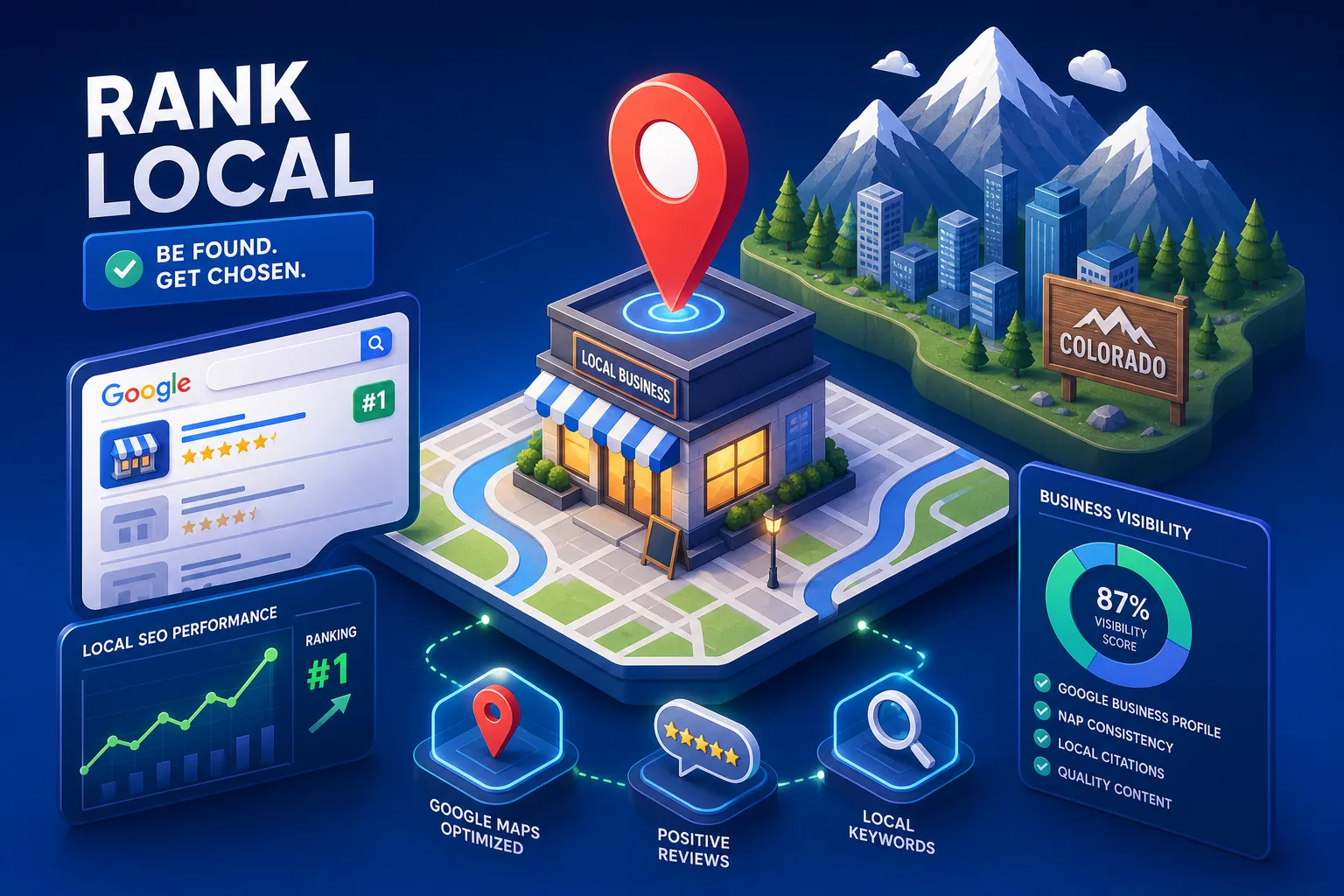
Colorado businesses lose customers every single day to competitors who aren’t better at their craft, they’re just better at showing up. Local SEO in Colorado is one of the most misunderstood investments a small business owner can make, partly because the advice floating around the internet is so generic it applies nowhere specific. Denver is saturated in ways most business owners don’t fully grasp. Boulder skews boutique but competes fiercely on brand reputation and search visibility. Colorado Springs carries military-adjacent search patterns that generic SEO playbooks consistently overlook. In many cases, the gap between a business that ranks and one that doesn’t comes down to the local search signals Google uses to decide who lands in the map pack and who gets buried on page two.
The patterns local businesses across Colorado face are the same ones the team at Brandleap Agency works through with clients across dozens of U.S. markets: under-optimized Google Business Profiles, inconsistent citations, and no repeatable system for generating reviews. This guide breaks down exactly what moves rankings in Colorado, what it costs to get real help, and how to separate an agency that will move your business forward from one that will drain your budget with nothing to show.
Why local SEO in Colorado is more competitive than it looks
Most generic SEO advice treats every city the same. Colorado’s three primary markets operate very differently from each other, and a strategy built for one won’t automatically translate to another. Understanding those differences is the foundation of any local search campaign that actually delivers results.
How Denver, Boulder, and Colorado Springs differ as search markets
Denver is the most expensive market and the most saturated, especially in home services, legal, and medical. Agencies headquartered downtown may charge a 10 to 15% premium over remote competitors, and the bid landscape in paid local search reflects that competition. Boulder skews toward wellness, tech, and outdoor retail, with a searcher base that is highly educated and often evaluating brand values alongside service quality. Colorado Springs has a large military population, which means search modifiers like “TRICARE acceptance” or “near Peterson Space Force Base” create specific intent patterns that some agencies miss entirely. Treating Colorado Springs like a smaller version of Denver is one of the fastest ways to waste a local SEO budget.
The seasonal search patterns Colorado businesses need to plan for
Colorado follows two clear seasonal peaks that should drive your content calendar and Google Business Profile update schedule. Summer tourism from May through September drives 30 to 40% higher search volume for outdoor recreation, food, and hospitality. Winter shifts urgency to furnace repair, snow removal, and roofing, with November and December showing the sharpest spikes in those categories. The critical point is timing: content published during a peak is almost always too late to rank. Google typically needs two to four months to index and build trust in new pages, which means your seasonal content strategy has to start in late winter for summer demand and in early fall for winter.
Google Business Profile: your highest-impact local SEO ranking fix
GBP signals carry 32% of the total weight in Google’s local ranking algorithm, according to the 2026 Moz and Whitespark Local Ranking Factors surveys. No other signal category comes close for the amount of direct control you have over it. A well-optimized profile can move a business from the bottom of the local pack into the top three, particularly in lower-competition niches or markets like Colorado Springs where the field is less crowded than Denver.
The specific GBP fields that move rankings in Colorado markets
Primary category selection is the single most impactful field in your entire GBP profile. Choose the wrong one and Google doesn’t understand what you do, which means proximity alone won’t save you. After category, keywords in your business name rank as the third most impactful specific factor, which is why businesses that legitimately include a service keyword in their name consistently outperform those that don’t. Predefined services jumped from rank 81 to rank 22 in the 2026 Moz/Whitespark survey, making them a critical field that most business owners leave blank. Photos and weekly posts round out the profile and drive behavioral signals like clicks and direction requests.
Why “open at the time of search” is now a top-10 ranking factor
Google now actively filters local results by real-time open status. If your hours are incorrect or incomplete, your listing can disappear from searches happening outside those listed hours. This became a top-10 ranking factor in 2026, and it affects businesses across all Colorado markets. Set your primary hours accurately, add special hours for holidays, and use the “more hours” feature to specify pickup windows or phone availability. Getting this wrong means you’re invisible during the exact moments customers are ready to call.
Local SEO Colorado: Citations and Directories That Build Authority
Citations have dropped to just 6 to 7% of the local ranking algorithm, down from 13% in 2020 (Moz/Whitespark). That decline doesn’t mean you can ignore citation accuracy. It means you should stop chasing volume and focus on getting the right listings correct. For Colorado businesses, that means a specific set of state and city-level directories that carry real authority and trust signals.
The Colorado directories worth your time
The Colorado Secretary of State business listing is the most important state-level citation for legal credibility. Google’s entity matching relies on consistent, verifiable business information, and the SOS database is one of the highest-trust sources for that verification. The Association of Colorado Chambers directory provides regional trust signals across multiple cities. For eligible businesses, the Colorado Black Chamber of Commerce and the Colorado Supplier Diversity Directory, particularly valuable for businesses pursuing government contracts, are both worth pursuing. Tech companies should also look at the Rocky Mountain High Technology Directory, which adds industry-specific relevance on top of local authority.
NAP consistency: why small discrepancies kill your local rankings
NAP stands for name, address, and phone number, and even minor variations across listings confuse Google’s entity matching. “St.” versus “Street,” a missing suite number, or an old phone number on a single directory can create conflicting signals that suppress your ranking. The platforms to audit first are Google, Yelp, Bing Places, Apple Maps, and the Better Business Bureau. These carry the highest domain authority, Yelp at 93 to 96, BBB at 86 to 91, and feed data into dozens of downstream directories. Fixing these five platforms cleans up the majority of citation noise for most Colorado businesses.
Reviews and behavioral signals: the 20% of local SEO Colorado businesses tend to under-prioritize
Review signals carry 20% of the local ranking algorithm, yet many Colorado businesses either ignore this lever entirely or ask for reviews the wrong way. The common mistake is treating reviews as something that happens naturally over time. In competitive markets like Denver and Boulder, review velocity is a deliberate strategy, not an afterthought.
Why review velocity matters more than your total count
Google weights the recency and rate of new reviews more heavily than an accumulated total that has gone quiet. A business with 40 reviews and a steady monthly stream will consistently outrank a competitor with 120 total reviews but no recent activity. Here is a practical cadence that works in dense urban markets: request a review within two hours of service completion via SMS. Keep the message under 160 characters with a direct Google review link. Send one follow-up email three to five days later if no review was submitted. A 4.0-plus rating is the minimum threshold for Local Pack consideration, so maintaining that floor matters as much as building volume.
Behavioral signals your customers are already sending Google
Clicks-to-call, direction requests, and website visits from your GBP collectively account for 8 to 9% of local ranking signals. These happen naturally when your profile is complete and compelling, but you can accelerate them by actively using specific GBP features. The call button, messaging feature, Q&A section, and accurate service area settings all drive these interactions. Think of your GBP as a landing page: the more useful and complete it is, the more customers engage, and the more Google interprets that engagement as a signal of relevance.
What local SEO in Colorado actually costs in 2026
Business owners deserve straight pricing benchmarks, not vague ranges designed to get them on a sales call. Here is what legitimate local search optimization actually costs across Colorado’s three main markets, based on published agency pricing data and industry benchmarks from the 2026 local SEO market.
Monthly retainer benchmarks for Denver, Boulder, and Colorado Springs
In Denver, most credible local SEO campaigns run $1,500 to $5,000 per month. High-competition industries like legal and medical typically start at $3,000 and often run higher. Boulder ranges from $1,000 to $2,800 depending on the category and competition level. Colorado Springs is the most accessible market, with effective campaigns starting around $800 to $1,200 for lower-competition niches and rising to $2,800 for contested industries. Any quote significantly below these ranges deserves serious scrutiny. Retainers priced well under $800 per month almost always produce worse outcomes than doing nothing, because the work volume required to move rankings cannot be executed at that price point.
One-time audits vs. ongoing retainers: where to start
If you’re not sure where your local search performance is breaking down, a one-time audit is the right starting point before committing to a monthly retainer. Standard technical audits run $750 to $2,500. A full local SEO setup covering GBP optimization, citation building, and initial on-page work typically costs $1,500 to $3,000 as a one-time engagement. The audit makes sense when you need a clear diagnosis before you can budget intelligently. A retainer makes sense when you already know you need ongoing execution and competitive monitoring, which is the case for most businesses in Denver or any high-competition Colorado niche.
How to pick the right local SEO agency for your Colorado business
Dozens of agencies operate across Denver, Boulder, and Colorado Springs, and the hardest part isn’t finding one. It’s knowing who to trust with a budget that actually matters to your business. The vetting process comes down to a short set of questions that reveal whether an agency understands your market or is selling confidence without capability.
The short checklist for vetting a local SEO consultant in Colorado
Start with verifiable case studies. Ask for specific clients, specific outcomes, and the timeframe in which those results were achieved. Generic testimonials without numbers are not case studies. Then ask whether you’ll retain full ownership of your GBP, website, and all assets if you cancel. Any agency that hedges on this question is building lock-in rather than earning trust. Ask who will actually manage your account month-to-month, since staffing mismatch, where a senior strategist sells the engagement but a junior account manager executes it, is one of the most common disappointments in the industry.
Watch for these red flags in any proposal:
- Guaranteed first-page results
- No contract clarity on specific deliverables
- Agencies that don’t ask about your target service area before proposing a scope
- Reporting dashboards that show impressions and traffic without tracking calls or leads
Those reports measure activity. They don’t measure results.
Why Colorado businesses trust Brandleap Agency
Brandleap Agency works with local service businesses in competitive markets across the country, including Denver and Colorado Springs, applying a structured, research-driven approach to local SEO that prioritizes measurable outcomes over vanity metrics. The gap between what many budget-tier agencies deliver and what a business actually needs to rank in a competitive Colorado market is significant. Brandleap focuses on closing that gap with transparent pricing and account ownership that stays with you. If you’re evaluating options, reach out before you sign anywhere else, the conversation costs nothing.
The action sequence that actually moves rankings
Local SEO in Colorado is a compound strategy where each signal reinforces the others. Start with your Google Business Profile: get the primary category right, fill in predefined services, correct your hours, and add photos. Then audit your NAP consistency across the five highest-authority platforms, Google, Yelp, Bing Places, Apple Maps, and BBB. Add the Colorado-specific directories that match your business type. Build a review generation habit with a simple SMS workflow that runs after every completed job. Then budget for a partner who can scale what you’ve built and keep pace with competitors who aren’t standing still.
Businesses that treat local SEO in Colorado as an ongoing priority consistently outrank those that treat it as a one-time task. Rankings shift as algorithms update and competitors sharpen their strategies. The businesses holding top-three map pack positions in Denver, Boulder, and Colorado Springs in 2026 got there through sustained, methodical effort, not a single optimization sprint. If you’re ready to improve your local SEO Colorado presence, Brandleap Agency offers professional audits and full local search management without inflated agency overhead. Request an audit today and find out exactly where your market opportunity stands.