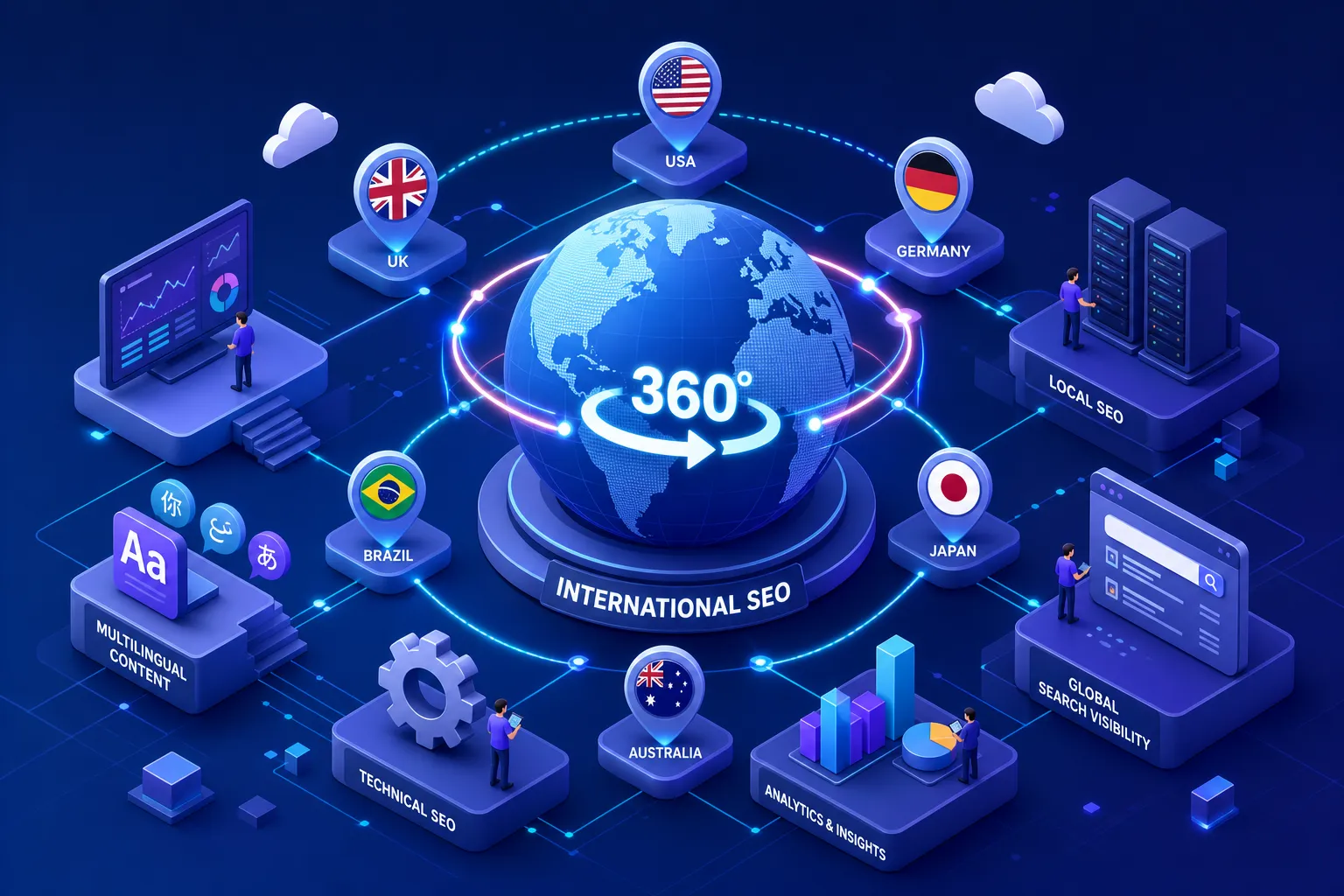
The most expensive assumption in global digital marketing is that international SEO is just translation with a few extra steps. It isn’t. A true 360 international SEO engagement spans six distinct service layers, and most businesses don’t discover how much they’ve underestimated the scope until their campaigns stall on page three in Frankfurt or never surface at all in Paris. At Brandleap Agency, we work across these engagements in multiple markets simultaneously, and the gap between what clients expect when they sign a contract and what the work actually requires is consistently the root cause of underperformance. This guide breaks down every layer of a comprehensive 360 international SEO services program, what to look for when you’re evaluating a partner, and what you should realistically budget before you commit.
What a full-service international SEO engagement actually covers
The “360” framing isn’t marketing language. It signals a multi-layered engagement that addresses every stage of international search performance, not just keyword lists or metadata updates. Each layer depends on the one before it, which means content built on a broken technical foundation is unlikely to rank; technical issues often prevent indexing or correct geo and language targeting before a visitor ever sees the page.
What 360 international SEO services include
A complete global SEO engagement covers international strategy and market selection, technical SEO architecture and implementation, multilingual keyword research and page mapping, localized on-page optimization, cross-border link building and digital PR, and performance tracking segmented by country and language. These six layers aren’t a menu where clients pick three and skip the rest. They’re a system, and every gap creates a ceiling on what the campaign can achieve.
Strategy and market selection come first
A real engagement starts with market research, not execution. Which countries have enough search demand for your product or service? Which languages should be prioritized based on commercial intent? What are competitors doing in each target market, and how long will it realistically take to compete with them? Skipping this step and going straight to content production is one of the most common ways international SEO budgets get wasted on markets that don’t have the demand or conversion potential to justify the investment.
How the layers connect in a real campaign
Consider a US-based software brand entering the French and German markets. That campaign needs a new subdirectory structure, correctly implemented hreflang annotations, localized keyword sets built from native-speaker research, culturally adapted content, and region-specific backlinks from German and French publications. None of these work in isolation. The technical structure determines how Google interprets the content. The content determines whether the backlinks have anything worth pointing to. All of it runs in parallel, not sequentially.
The technical foundation that makes or breaks global rankings
Technical international SEO is where most campaigns succeed or fail before a single piece of content goes live. The architecture decisions you make early signal to Google exactly which version of your site should rank in which market, and getting those decisions wrong can take months to unwind.
Site architecture: ccTLDs, subfolders, and subdomains compared
ccTLDs (example.fr, example.de) deliver the strongest country signal and local trust, but each country domain behaves as a separate entity. That means you’re building domain authority from scratch in every market. Subdirectories (example.com/fr/) consolidate all link equity and authority under one root domain, which makes them the preferred structure for most multilingual sites. Subdomains (fr.example.com) offer operational separation but don’t share authority as cleanly as subdirectories and are generally treated more like independent domains by Google. The right choice depends on your budget, technical resources, and how much authority your root domain already carries.
Hreflang implementation done right
Hreflang is non-negotiable for multilingual sites, and the implementation requirements are specific. Every page needs a self-referential tag, all alternate versions must reference each other reciprocally, every URL in the hreflang cluster must return a 200 status code, and an x-default tag handles users who don’t match any specific locale. The most common errors that break campaigns include pointing hreflang at noindex pages, using incorrect ISO language or region codes (en-UK instead of en-GB is a classic mistake), and mixing implementation methods across HTML head tags, XML sitemaps, and HTTP headers. Pick one method and apply it consistently across the entire site.
Geo-targeting signals and crawlability
Google Search Console’s geo-targeting settings supplement hreflang for subdirectory setups by adding an explicit country signal to each language folder. For large multilingual sites, crawl budget becomes a real consideration: if Googlebot can’t efficiently crawl your localized pages, they won’t rank regardless of how well they’re optimized. One of the most common technical mistakes agencies make is misusing canonical tags between language variants, which can cause Google to consolidate pages it should be treating as separate localized versions.
Multilingual content and market-specific keyword strategy
Localization is not translation. Treating them as the same thing is a reliable way to waste content budget across multiple markets while producing pages that rank for nothing. This section covers how multilingual SEO services approach keyword research and page-level optimization differently from standard content production.
Why keyword research by market beats direct translation
Search behavior differs materially by country and language. A term with strong commercial volume in US English may carry a completely different primary intent in its German equivalent, or it may have near-zero search volume because that market phrases the concept differently. Strong agencies use Semrush and Ahrefs for baseline data, then layer in local SERP analysis and native-speaker review to validate commercial intent before mapping any keyword to a page. Skipping native-speaker validation is how clients end up with technically correct translations that nobody actually searches for.
Building localized landing pages that actually convert
A localized page isn’t a translated page with a different URL. It has culturally adapted messaging, locally relevant examples, and market-specific trust signals like local phone numbers, regional certifications, and pricing in local currency. The content structure reflects how that market’s audience searches and makes decisions, not how the US audience does. Blog content plays a supporting role here too: building topical authority by region through localized editorial content accelerates rankings for the main commercial pages in each market.
International link building and cross-border domain authority
A global site with clean technical architecture and strong localized content still stalls without market-specific link authority. Country-specific link building is an area where many agencies fall short, largely because it requires genuine outreach infrastructure in each target country rather than a single centralized team running the same playbook everywhere.
Country-specific outreach and digital PR
Backlinks from country-relevant domains, those with matching ccTLDs or strong local audiences, send far stronger relevance signals for target-country rankings than generic high-DA links from international directories. International digital PR involves local media placements, country-specific publisher relationships, and partnership content that earns links from regionally authoritative sources. Country-relevant backlinks typically carry stronger local relevance than generic international links, which is why genuine in-market outreach is a core component of any credible global SEO services program.
What makes a backlink valuable in international SEO
Across every market, the criteria for link quality are consistent: domain authority, topical relevance, geographic relevance, language match, and anchor text context. What changes is how you earn those links in each country. White-hat outreach built around genuine content value outperforms mass link schemes everywhere, and this is especially true in competitive European and APAC markets where Google’s spam detection has grown more sophisticated. Campaigns that cut corners here pay for it in penalty recovery time, not just ranking stagnation.
Cross-market analytics and performance tracking
If you can’t see what’s working by country and language, you can’t optimize. Reporting structure is one of the most underrated components of a global SEO services program, and it’s where a lot of agencies deliver generic dashboards that obscure what’s actually happening in each market.
Tools and metrics that matter across borders
The standard analytics stack for a multi-market campaign includes Semrush or Ahrefs for rank tracking segmented by country and language, Google Search Console properties configured per locale for impressions and CTR data, and Google Analytics 4 for organic conversion tracking broken out by region. For markets like China or Russia, engine-specific tools become necessary since Google’s data doesn’t apply. Per-market metrics worth tracking: organic sessions, keyword rankings by locale, CTR by country and device, and conversion rates segmented by language and region.
What results look like at scale
Properly executed 360 international SEO services programs deliver results that are measurable and significant over time. Published case study data points to campaigns achieving close to 300% organic traffic growth within 22 months after a full multilingual rollout, with other documented programs showing over 1,300% increases in global organic traffic following expansion into new language markets with a complete technical and content overhaul. (Results vary by industry, domain authority, and market competitiveness; these figures reflect specific campaigns and are not guaranteed outcomes.) The pattern across these campaigns is consistent: rankings and impressions move first, sessions and CTR follow in the three-to-six-month window, and conversions and revenue take the longest, often six to twelve months before the commercial impact is clearly visible. That timeline sets realistic expectations for anyone evaluating what a global SEO investment actually delivers and when.
How to choose the right global SEO agency
Evaluating proposals requires enough specificity to tell the difference between agencies that actually deliver and those that promise results without the infrastructure to produce them. The questions below function as a practical filter.
The deliverables checklist to evaluate any proposal
When reviewing an agency proposal for international SEO work, ask these questions directly:
- Does the agency include international keyword research with native-speaker validation for each target market?
- Do they cover technical setup including hreflang audits and site architecture recommendations?
- Is content localization handled in-house or outsourced to freelancers with no SEO context?
- Do they have a documented country-specific link building process?
- Is performance reporting segmented by market, language, and device?
- Does the engagement include strategy and market selection, or does it assume you’ve already decided where to expand?
Any proposal that can’t answer these questions with specifics is telling you something important about how the work will actually be executed.
What full-service international SEO costs in 2026
Realistic pricing for a genuine full-service global SEO engagement breaks down like this. Campaigns targeting two to four markets with active content and link building typically run $4,000 to $10,000 per month. Multi-region programs covering five or more markets with substantial content volume and international PR run $10,000 to $20,000 per month. Enterprise-scale global rollouts covering dozens of locales start at $25,000 per month and scale from there. The main cost drivers are the number of target countries, content volume, translation and localization requirements, and whether the agency is handling strategy plus execution or execution alone. (Pricing ranges reflect 2026 market rates aggregated from industry sources and may vary based on scope.)
Why a full-service model outperforms a fragmented vendor approach
Managing separate vendors for technical SEO, content localization, link building, and analytics creates coordination failures that compound over time. When rankings stall, each vendor points to someone else’s deliverable as the problem. No single vendor owns the full picture, so strategy drifts and execution gaps widen. Brandleap Agency’s integrated model is designed to address this directly. Our engagements cover technical audits, multilingual content, white-hat authority building, and cross-market analytics under one roof, with senior-level strategy applied directly to each campaign rather than delegated to junior staff after the kickoff call. When every layer of the program runs through the same team, dependencies get managed before they become problems rather than after.
The bottom line before you hire
A 360 international SEO approach is not a single tactic or a deliverable you can check off a list. It’s a coordinated system: technical architecture that signals correctly to search engines, localized content built from genuine market research, cross-border authority earned through country-specific outreach, and analytics that tell you exactly what’s working in each market. The agencies that deliver real results across multiple countries treat every layer as a dependency, not an optional service tier.
Before you sign a contract with any global SEO partner, use the deliverables checklist in this guide to stress-test the proposal. Ask about hreflang experience and how they handle implementation errors. Ask what their site architecture recommendation process looks like. Ask how they handle localization and whether native speakers are involved. Ask how reporting is segmented by market. Vague answers on any of these points signal exactly what the engagement will look like once the contract is signed.
If you want a full-service 360 international SEO services program where every layer is covered and senior-level strategy drives execution from day one, Brandleap Agency builds exactly that kind of engagement. Reach out to discuss your target markets, and we’ll show you what a properly scoped international program looks like for your business. Get a custom quote today.