
If you’re researching a global SEO agency, you’ve likely already discovered that international search is a fundamentally different discipline from domestic SEO. Most businesses make the mistake of assuming the work functions like domestic SEO with a translation layer bolted on. It doesn’t. Appearing in search results across multiple countries requires a completely different technical stack, content strategy, and team skill set. Hiring the wrong partner doesn’t just waste budget, it can actively damage your rankings in foreign markets that can take well over a year to recover.
This guide breaks down exactly what a global SEO agency does, which services matter most, what realistic pricing looks like in 2026, and the questions you must ask before signing anything. At Brandleap Agency, we’ve helped businesses navigate this space, and the gap between what clients expect and what agencies actually deliver is wider than most realize.
By the end, you’ll know how to shortlist qualified international SEO partners, estimate what your budget should actually cover, and decide whether hiring a global SEO agency or building internal capability makes more sense for your situation, with enough specificity to hold any agency accountable during the vetting process.
What a Global SEO Agency Actually Does (And How It Differs from Standard SEO)
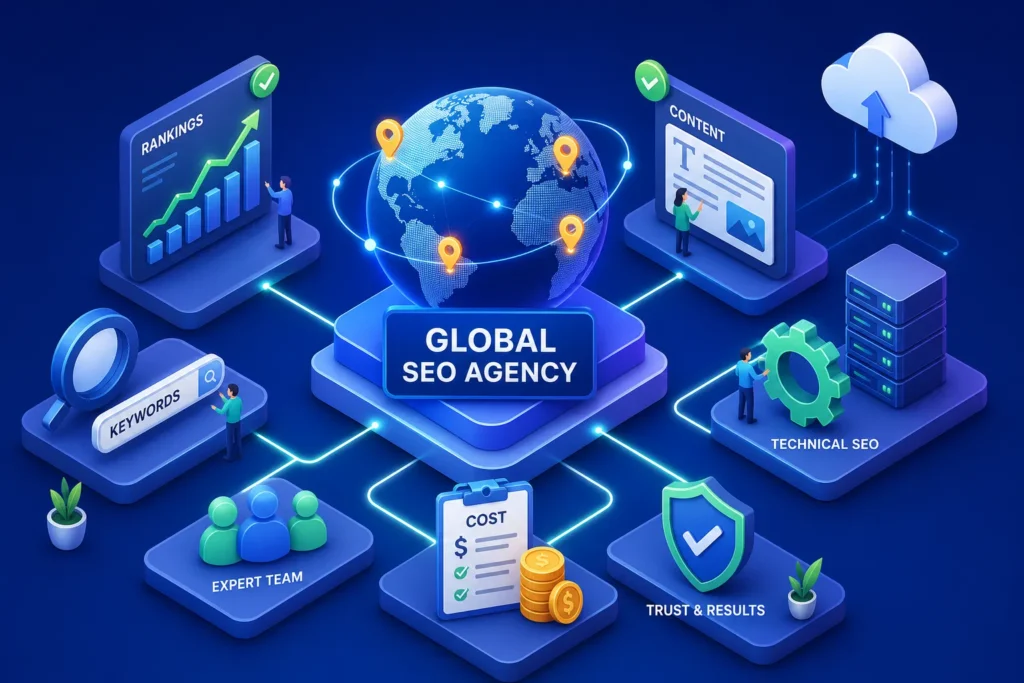
A global SEO agency handles the full architecture of appearing in search results across multiple countries, languages, and sometimes entirely different search engines. This work goes well beyond standard on-page optimization or domestic keyword targeting.
Most standard SEO agencies are excellent at targeting one market in one language. The moment you add a second country or a second language, the technical requirements shift dramatically. A UK-targeted page can cannibalize a US-targeted page if hreflang tags are missing or misconfigured. Regional keyword behavior, search volume, and SERP layouts vary country to country, even for the same product category.
A legitimate multi-regional SEO agency operates across three coordinated layers simultaneously. The first is technical infrastructure: URL architecture, crawlability across regions, and Core Web Vitals by locale. The second is strategic research: country-specific keyword maps and competitor analysis by market. The third is content operations: localization, cultural adaptation, and regional link building. These aren’t tasks one department handles sequentially, they require coordinated specialists working in parallel, which is why domestic SEO expertise doesn’t automatically scale globally.
Multilingual SEO vs. Multi-Regional SEO: Why the Distinction Matters for Your Budget
These two terms get used interchangeably in agency pitches, but they describe fundamentally different strategies with different technical requirements. Confusing them at the planning stage costs months of ranking progress.
Multilingual SEO targets audiences by the language they speak, regardless of where they live. A French-speaking audience in France, Canada, and Senegal all consume the same language, but their search behavior and regional references differ. The URL structure typically uses language subfolders like /fr/ or /es/, and hreflang attributes signal the language to search engines using language-only codes like hreflang="fr".
Multi-regional SEO targets users by geography, often within the same language. A US English audience and a UK English audience use different terminology, encounter different legal contexts, and respond to different pricing. This approach requires locale-specific hreflang tags like en-US versus en-GB, geotargeting configuration in Google Search Console, and in many cases, separate country-code domains or regional subfolders. The content governance required is significantly more complex than multilingual SEO alone.
Most international websites need both strategies working together. A brand selling in Germany and France needs language-specific pages and region-specific signals. A multilingual SEO agency that can’t execute both simultaneously isn’t equipped for full international growth, no matter how polished its pitch deck looks.
Core Services You Should Expect from Any Serious Global SEO Agency
Knowing what to ask for protects you from agencies that oversell capabilities they don’t actually have. These are the non-negotiables for any legitimate global SEO agency engagement.
Hreflang Implementation and URL Architecture
Hreflang tags tell search engines which page to serve to which audience based on language and region. Implementing them incorrectly, missing return tags, wrong locale codes, or broken canonicalization, causes duplicate content issues and misrouted traffic. In our audit experience, the majority of hreflang implementations contain at least one error category that causes Google to ignore entire language clusters. A qualified agency audits your existing URL structure before recommending ccTLDs, subdomains, or subfolders, since each carries different SEO implications and maintenance overhead.
International Keyword Research
International keyword research is not a translation exercise. Search volume, keyword intent, and competitive density vary significantly by country. Tools like Semrush and Ahrefs allow international SEO specialists to build country-specific keyword maps, identify gaps where local competitors rank but your site isn’t indexed, and surface regional terminology that no direct translation would capture. Agencies that skip this step and simply translate your existing keyword list set you up to miss entire market opportunities.
Localization, Geotargeting, and Alternative Search Engines
Localization goes beyond translating words. It adapts pricing references, cultural context, imagery, and legal disclosures for each market. Geotargeting ensures the right content reaches users in the right country through server-level signals and Search Console configuration.
In markets where Google isn’t dominant, a capable agency builds platform-specific strategies rather than applying a one-size-fits-all playbook. Baidu in China, Yandex in Russia, and Naver in South Korea each have distinct ranking algorithms, and treating them as Google equivalents is a reliable way to forfeit market share from day one.
The Right Vetting Questions (And the Red Flags That Should End the Conversation)
Most agencies can present a polished deck. The questions below cut through that to reveal whether a team can actually execute multi-regional SEO at the level your expansion requires.
- Which markets have you expanded clients into, and can you share organic traffic data before and after?
- Who are the actual strategists and localization specialists who will work on our account, not the sales team presenting today?
- How do you approach international keyword research for a market where our product category doesn’t have established search volume yet?
- What does your hreflang audit process look like, and how do you handle a CMS migration mid-engagement?
Guaranteed rankings in specific countries are the clearest signal to walk away. No agency controls Google’s algorithm in any market, and a promise of a specific SERP position in a foreign market is either fabricated or based on low-competition, low-value keywords. Equally concerning: agencies that describe their process in vague terms, refuse to share case studies with start and end rankings, or can’t name the tools they use for international keyword research. If an agency pitches content volume without mentioning hreflang, geotargeting, or localization, they haven’t done international SEO before. They’ve done domestic SEO in a different language.
Global SEO Services Pricing: What It Actually Costs in 2026
Pricing for global SEO services varies more than any other digital marketing category because scope complexity differs so dramatically by market count, language count, and site architecture. The agency pricing across the market benchmarks below reflect current agency pricing across the market.
For businesses entering one or two international markets with an existing English-language site, monthly retainers from established multi-regional SEO agencies typically start between $5,000 and $10,000. Mid-market engagements covering three to five countries with full localization and link building range from $10,000 to $25,000 per month. Large global programs targeting eight or more markets with aggressive content operations run $30,000 to $60,000 or more monthly. Full-scale multilingual SEO programs for enterprises with complex site architectures can exceed $100,000 per month.
For project-based work, international SEO setup projects, including technical audit, hreflang implementation, URL architecture planning, and initial keyword research across target markets, typically cost between $5,000 and $25,000. Technical SEO audits alone range from $2,000 to $15,000 depending on site size and region count. Hourly rates for qualified international SEO specialists fall between $100 and $149 per hour in the US market.
The risk of unusually cheap international SEO isn’t wasted budget, it’s rankings damage in markets where ranking recovery can stretch well beyond a year. Low pricing almost always signals outsourced translation without localization, templated hreflang that doesn’t account for your specific URL structure, or link building from low-authority regional directories. A realistic budget for a small business entering one international market is $2,500 to $5,000 per month with a qualified partner.
Enterprise-Quality International SEO Without the Enterprise-Only Price Tag
The assumption that global SEO agency expertise is only accessible at $30,000 or more per month is outdated. The real question is whether an agency brings genuine international SEO capability or just geographic reach with the same domestic playbook applied in a different language.
The right partner for a growth-stage business combines documented technical capability, verifiable hreflang experience, a clear international keyword research methodology, and a localization workflow that goes beyond machine translation, all paired with transparent reporting and a team that communicates strategy in plain language. You don’t need a multinational SEO agency with 400 employees to execute a strong two-country expansion. You need a team that has done it before, can explain exactly what they’re doing and why, and will connect SEO performance directly to your business metrics by region.
At Brandleap Agency, the international SEO work we do for clients follows the same technical rigor used at the enterprise level: proper hreflang implementation, country-specific keyword research using professional-grade tools, localization strategies built for human search behavior rather than word-for-word translation, and regular reporting tied to organic traffic and conversion data by region. We built our service model specifically for small and mid-market businesses that need enterprise-quality international strategy without the enterprise-level overhead that most large agencies require.
For deeper reading on how we approach this, see our International SEO Agency overview, learn more about Why Local SEO Agency Selection Matters for Small Business, or review our guidance for market-specific engagements like choosing an SEO Agency in India: How to Choose the Right Partner.
Making the Right Call: Global SEO Agency vs. Internal Capability
Hiring a global SEO agency is a significant decision, and the gap between what different agencies can actually deliver for international markets is enormous. The agencies that get results approach multilingual and multi-regional SEO as fundamentally different disciplines, invest in hreflang and URL architecture before touching content, and conduct real international keyword research rather than translating existing keyword lists.
Use the questions in this guide during your next discovery call. Request specific market case studies with traffic data. Ask who’s doing the actual localization work and how quality is verified in languages the core team doesn’t speak. And if pricing sounds too good for the scope you need, treat it as a warning, not a deal.
Whether you’re evaluating an international SEO partner for the first time or reconsidering your current strategy, the fundamentals covered here give you a clear lens to judge any global SEO agency’s actual capabilities. Ready to see what an accessible international SEO partnership looks like in practice? Reach out to the team at Brandleap Agency. We’re straightforward about what we do, what it costs, and what results you can realistically expect.

BrandLeap Agency & BrandLeap Fashion | Founder & CEO
Mithun is an experienced SEO consultant recognized for helping businesses improve their digital presence through technical SEO, content optimization, and sustainable organic growth strategies. Working in the digital marketing industry since 2019, he has developed expertise in increasing search visibility, driving targeted traffic, and building long-term growth through data-driven SEO solutions. He has worked with businesses across multiple industries, helping brands strengthen their online authority and achieve measurable growth results.