If your organic traffic has flatlined despite years of consistent publishing, zombie pages are likely the culprit buried inside your own index. These are URLs that are technically live, publicly accessible, and consuming Google’s attention without giving anything back. They’re more common than most site owners realize, and according to Ahrefs data, roughly 96% of all web pages receive zero organic traffic from Google. That number is striking, but it’s also a signal. Most sites are carrying massive amounts of dead weight, and that dead weight has consequences.
You’ve been publishing content consistently for years. Your page count is up, your blog archive is deep, and your site looks like an authority in your niche. But rankings for your best pages aren’t moving. Something is wrong, and it has nothing to do with missing keywords or a weak backlink profile.
At Brandleap Agency, a site audit is almost always the starting point for new client engagements, and zombie content is one of the most consistent problems we uncover. This article covers exactly what zombie pages are, how they damage your SEO performance, how to identify them using real data, and precisely how to fix each type without creating new problems in the process.
What zombie pages actually are (and how your site ends up with them)
The anatomy of a dead page
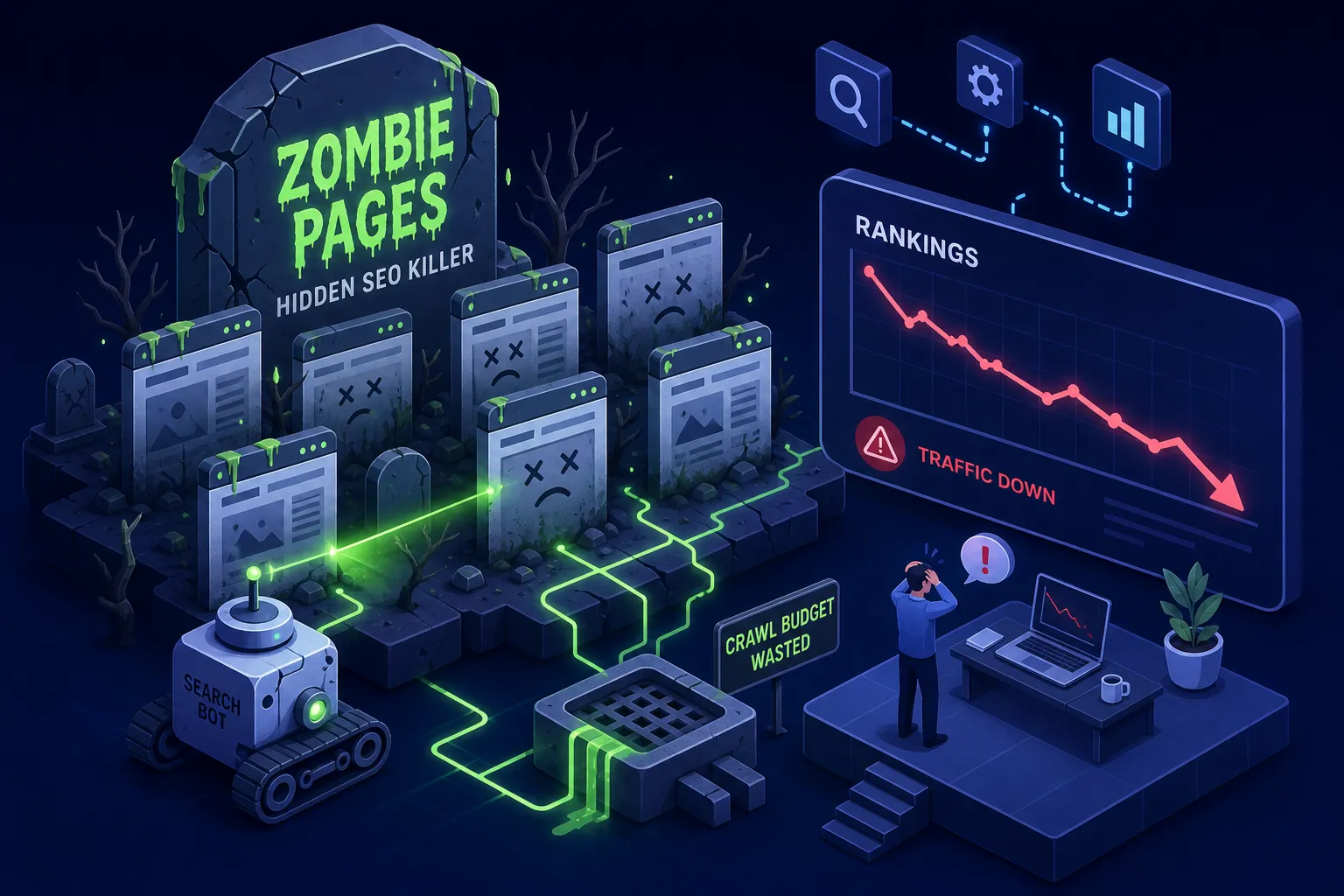
A zombie page is a URL that is indexed by Google, consumes crawl resources, but generates no measurable traffic, impressions, or conversions over a sustained period, typically six to twelve months. These are not pages in development or deliberately excluded from search. They are live, public, and pulling weight they cannot carry. Common forms include thin blog posts written around low-volume keywords that never ranked, outdated articles about discontinued products or services, and auto-generated pages created by e-commerce filters, tag archives, or category pagination.
The core problem is that zombie pages don’t just sit quietly. They compete with your best content for Googlebot’s limited attention and dilute the quality signals your domain sends to search engines. They also scatter your internal link equity across URLs that will never convert a single visitor.
How content decay and orphan pages build over time
Most zombie content starts with good intentions. A team publishes aggressively to build topical coverage, churns out duplicate variations of the same subject, or inherits a pile of URLs from a site redesign without auditing what carries over. Orphan pages, specifically, URLs with no internal links pointing to them, are a common byproduct of CMS migrations and structural overhauls. Without internal links, Googlebot often never finds these pages, and users certainly don’t.
Content decay is the slower version of the same problem. A page that once ranked and drove real traffic can gradually become irrelevant as fresher, more authoritative content on competing sites takes over. The page still exists in the index, still gets crawled occasionally, but contributes nothing. That’s the definition of a zombie: technically alive, functionally dead.
How to identify zombie pages on your site
Pulling page-level metrics from GA4 and Google Search Console
Start with two data exports. In GA4, go to Reports, then Engagement, then Pages and Screens. Set the date range to at least six months and look for pages with near-zero views and minimal engagement time. In Google Search Console, open the Performance report, switch to the Pages tab, and filter for URLs with zero clicks and zero impressions over the same period. Neither tool alone gives the full picture. Joining both exports in a spreadsheet lets you cross-reference pages that neither rank nor engage users, which is the most reliable starting definition of a zombie page.
The thresholds that separate zombie pages from just-slow ones
Classification should use multiple signals together, not a single metric in isolation. Pages with fewer than five organic sessions per month over six consecutive months, zero impressions in Search Console, no conversions, and no external backlinks are strong zombie candidates. Supporting signals that confirm the classification include a ranking position outside the top 50 for any relevant query, a bounce rate above 85%, and an average time on page under 20 seconds. The goal isn’t to delete everything with low traffic; it’s to isolate pages where every available signal points to irrelevance.
Audit tools that make discovery faster and more accurate
For orphan page detection, Sitebulb offers solid guided reporting, flagging isolated URLs that lack internal links and cross-referencing sitemap data automatically. Screaming Frog is a flexible option for combining crawl data with GA4 and Search Console exports in a single workflow. For scaled auditing across large sites, Ahrefs Site Audit and Semrush Site Audit both surface indexability issues and low-inlink pages efficiently, making them useful complements to a crawler-based approach. No single tool covers everything; the strongest audits combine at least two data sources.
The real damage: how zombie content hurts crawl budget and rankings
What happens when Googlebot hits a wall of low-value pages
Every site receives a finite crawl budget, the number of pages Googlebot will crawl and process within a given timeframe. When a large share of that budget gets spent on thin, orphaned, or duplicate URLs, high-value pages get crawled less frequently and updated signals take longer to register. For small sites under a few hundred pages, this matters less. For sites with thousands of URLs, index bloat is a genuine performance bottleneck. Googlebot makes allocation decisions, and low-value pages actively compete with your best content for that attention.
Index bloat compounds the problem. When low-value pages exist in volume, they slow the recrawling of your important pages, meaning content updates, new internal links, and fresh signals all take longer to process. A site with 3,000 indexed pages and only 400 generating any meaningful engagement is a common version of this problem, and the cost shows up in competitive markets where timing matters.
How low-value pages dilute site authority
Beyond crawl budget, zombie pages send weak quality signals to Google about the site as a whole. A domain where 40% of indexed pages generate zero clicks and zero impressions looks less trustworthy than one where nearly every indexed URL contributes something. This is the core argument behind content pruning as a strategy: a leaner, tighter index often outperforms a bloated one because internal link equity concentrates on the pages that actually deserve it. Consolidating weak pages into fewer, stronger assets makes those assets harder to ignore in the rankings.
Matching the right fix to each zombie page
How to choose the right fix: update, merge, redirect, or delete
Not every zombie page deserves the same treatment. If a page covers a topic worth owning but was published with thin content, updating it with genuine depth, a stronger semantic structure, and better internal links is the right call. If two or three pages overlap on the same topic, consolidating them into one well-developed piece and redirecting the others with a 301 preserves any accumulated link equity while creating a stronger single asset. If a page has no backlinks, no traffic, and no realistic path to relevance, deleting it and returning a 410 Gone status removes it from the index decisively and faster than a passive 404.
The key principle is that the fix should match the page’s actual situation. Redirecting to a loosely related destination is worse than a clean deletion because Google may treat it as a soft 404 and pass no value at all. Every redirect needs a genuinely relevant destination, or it shouldn’t be a redirect.
When noindex is the right short-term move
Noindex is not a deletion signal; it is an indexing control signal. It’s the right choice when a page needs to stay accessible to users or internal teams but shouldn’t appear in search results. Pagination pages, filtered category URLs, and low-value utility pages are common candidates. It also provides a safe holding pattern for pages you plan to improve later: apply noindex now to reduce index bloat, then remove the tag once the content is genuinely ready to compete. Avoid using noindex as a permanent workaround for pages that should simply be removed from the site entirely.
What to expect after a content pruning project
The short-term dip and why it’s normal
Most sites experience a brief drop in organic traffic immediately after content pruning. Pages are leaving the index, Google is reprocessing the site’s signals, and consolidated URLs need time to establish authority in their new configuration. Based on recovery data from client projects, stabilization typically occurs within the first four to eight weeks, with early ranking improvements on stronger pages beginning to surface. In one well-documented pruning case from the SEO community, clear recovery appeared by week eight and full recovery around the three-month mark, with sustained gains continuing beyond that point.
The long-term gains and how to track them
Meaningful traffic gains from content pruning typically become measurable between 60 and 90 days, with larger lifts appearing at the three-to-six-month mark. Seer Interactive reported a 23% year-over-year organic traffic increase within six months of a pruning project. Gains in that same range have been documented across content-focused case studies from agencies including Animalz and HubSpot, with some reporting lifts between 29% and 44%. To track recovery accurately, set up a segment in GA4 for pruned URLs and monitor Search Console click and impression data for surviving pages week over week. If log file analysis is available, crawl frequency changes on priority pages are one of the earliest positive signals to watch for.
When it makes sense to bring in a professional site audit
Why zombie page cleanup is harder than it looks
Identifying zombie pages at scale requires combining crawl data, analytics exports, and search performance data across potentially hundreds or thousands of URLs. Making the wrong call on a page with hidden backlink value, or thin content that still ranks quietly for a long-tail phrase, can cost more than the cleanup saves. The decision logic is clear in theory but nuanced in execution, especially for e-commerce sites with dynamic URL structures, content-heavy blogs with years of archive pages, or sites that have gone through multiple redesigns without a clean audit.
The risk of over-pruning is real. Removing pages that carry silent value strips away equity you can’t easily recover. Under-pruning carries the same cost from the other direction: zombie content stays in place, the index stays bloated, the crawl budget stays diluted, and the quality signals stay weak.
How Brandleap’s semantic SEO and site audit services approach the problem
At Brandleap Agency, site audits are built around semantic SEO principles, which means we don’t just flag low-traffic pages and recommend deletion. We map content relationships, identify topic clusters where consolidation creates a stronger signal, and prioritize fixes based on actual authority and business impact. The result is a pruning strategy that reduces index bloat without stripping away pages that carry silent value. For businesses ready to stop guessing and start recovering rankings with a structured approach, our content audit service is where that work begins.
Stop letting dead content drag your rankings down
Zombie pages aren’t just a clutter problem. They’re an active drag on crawl efficiency, domain authority, and organic visibility. The fix is methodical: audit with data from GA4 and Search Console, classify pages using multiple signals, apply the right treatment from the update, redirect, delete, or noindex playbook, and then track recovery over a 60-to-90-day window.
The evidence from documented pruning projects is consistent: a leaner, tighter content index tends to outperform a bloated one. Fewer pages competing for crawl attention means more resources directed toward the URLs that actually drive results. That’s not a theory, it’s a pattern the data confirms repeatedly.
Running this audit across a full site is a significant undertaking, that’s exactly where Brandleap Agency makes the difference. Reach out to schedule a site audit consultation, and let’s identify exactly what’s holding your organic performance back.