Every content marketer eventually hits the same wall: you’ve built real search equity through months of careful SEO work, and now you want to distribute your best articles to larger audiences. The fear is that republishing your content on third-party sites will cannibalize your rankings, trigger duplicate content issues, or hand your hard-earned authority over to someone else’s domain. At Brandleap Agency, syndicated content SEO is one of the most common topics we tackle with content-driven clients who want broader distribution without sacrificing what they’ve built in organic search.
The honest answer is that content syndication and SEO are not inherently at odds. The technical implementation determines whether syndication helps or hurts you. Get the setup right and it compounds your visibility. Get it wrong and you’re effectively competing against yourself in search results. This article gives you a clear framework covering canonical tags, duplicate content risks, partner selection, and measurement so you can make that decision confidently.
What Syndicated Content Actually Does to Your Search Rankings
Content syndication means publishing your original article, or a close version of it, on third-party sites to reach audiences beyond your own domain. The SEO impact is not a simple win or loss. It depends entirely on how the syndicated copy is set up and where it lives. The upside is real: Stacker’s content syndication program (documented in a 2021 Moz case study) contributed to a 380% increase in organic traffic and a 500% increase in referring domains, with domain authority climbing from 56 to 59 in a single year.
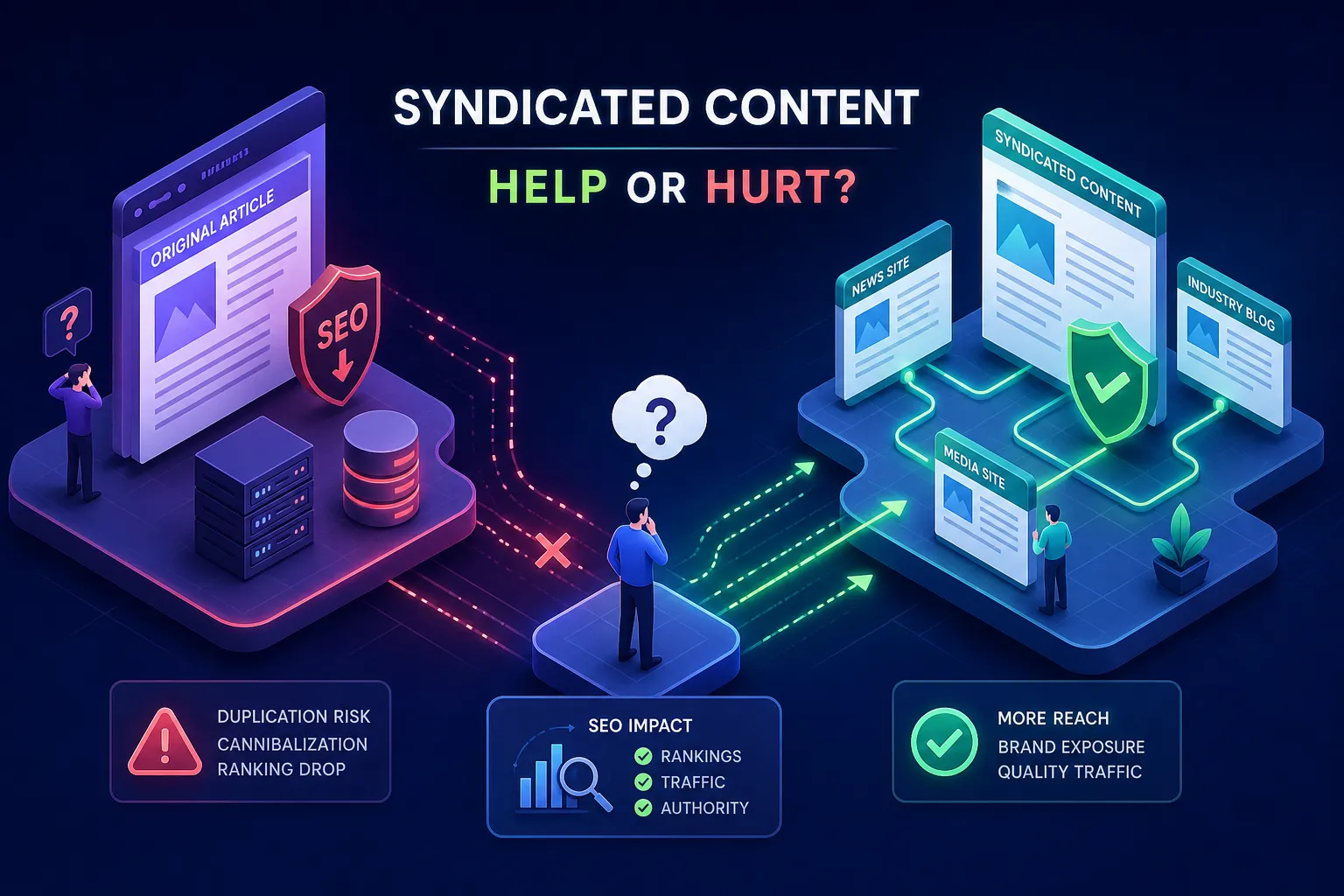
When the technical implementation is wrong, the outcome flips. The syndicated copy can outrank your original, split link equity across two competing URLs, or leave Google to guess which version deserves to be indexed. That uncertainty is where syndication turns from a distribution strategy into a ranking liability.
The Real SEO Upside of Content Redistribution
Handled correctly, syndicated content SEO delivers three legitimate gains. Brand exposure from high-authority placements generates direct and branded search traffic that Google interprets as a quality signal. Referral traffic from syndicated articles demonstrates that your content earns engagement beyond your own site. Do-follow attribution links from syndication partners contribute directly to your domain authority and off-page SEO profile.
The scale of these gains can be meaningful. Stacker Studio’s analysis of 71 client domains showed median organic traffic rising from 78,581 to 96,950 after syndication partnerships, with keywords ranking in positions one through three jumping from 18,559 to 30,002. (Stacker Studio published these aggregate figures as part of their publisher network reporting; the dataset covers pre- and post-syndication windows across client sites.) These aren’t outlier numbers from a single lucky campaign. They reflect a consistent pattern across dozens of sites where syndication, done right, compounds organic growth rather than undermining it.
When Republished Content Becomes a Rankings Liability
The scenarios where syndication hurts are predictable and avoidable. The most common: the partner site publishes the syndicated copy before your original gets indexed, giving the external version a head start. A more damaging outcome happens when the syndicating site has stronger domain authority and Google simply decides their version is the preferred one to rank. Without canonical tags or attribution signals pointing back to your original, you lose the ranking credit for content you created.
The core risk in content redistribution isn’t the content itself, it’s the absence of clear signals telling Google which URL owns that content. Without that technical scaffolding, even well-written, well-placed syndicated articles can quietly drain ranking authority from your domain.
The Duplicate Content Problem (and What Google Actually Does About It)
The most persistent misconception about syndication is that Google issues penalties for duplicate content the way it would for keyword stuffing or manipulative link schemes. That’s not accurate. Google does not apply manual actions for duplicate content in the traditional sense. The actual risk is consolidation: Google finds two versions of the same content across two domains, clusters them, selects one as the canonical, and filters the other out of search results. If Google picks the wrong version, you lose.
The practical consequence isn’t a penalty. It’s an invisible ranking reassignment that transfers your page’s authority to a URL you don’t control. That distinction matters because it changes how you respond. The solution is not to avoid syndication, it’s to give Google the signals it needs to make the right choice.
What Google Does When It Finds the Same Content on Two Domains
Google’s canonical selection process weighs several factors: internal link patterns, sitemap entries, page authority signals, and any existing canonical tags. When both versions of the content compete without clear signals, Google resolves the ambiguity independently, applying its own ranking criteria. That process may favor the external domain, especially if that domain carries more authority or earns more backlinks to that specific page.
The result is that your original article gets filtered from results not because you were penalized, but because Google made a reasonable algorithmic decision in the absence of better information. Providing that better information is exactly what canonical tags are for.
When Duplicate Content Turns Into a Real SEO Problem
Silent de-duplication by Google, where it simply chooses the canonical and moves on, causes no active damage in most cases. The scenarios that actively hurt rankings are more specific. When no canonical points back to your domain, your page loses the topical authority it had earned. When the partner’s page earns backlinks that would have pointed to your original, those links build someone else’s domain authority instead of yours. When your syndicated copy outranks your original, the traffic and conversion value flows to a URL you don’t own. Each of these outcomes is preventable at the technical implementation level, not the content level, and the fix starts with canonical tags.
Syndicated Content SEO: The Right Technical Setup
Three technical levers determine whether your syndication strategy protects or erodes your organic rankings: the canonical tag on the partner’s page, the noindex tag and when it applies, and attribution links back to the source. Each has a specific, predictable effect. Understanding what each lever does, and what it doesn’t do, removes the guesswork from syndicated content SEO decisions.
How to Implement rel canonical for Syndicated Articles
The partner site should include a cross-domain canonical in the of the syndicated page pointing to your original URL:
This signals to Google which URL you want indexed and credited. According to Google’s own canonical guidance, cross-domain rel=canonical is treated as a strong hint rather than an absolute directive. Google will usually consolidate ranking signals to your original page when pages are near-identical, but it may choose to disregard the tag if signals conflict or the pages differ materially. For the canonical to work as intended, the target URL must return a 200 status code, be indexable, and not carry a noindex tag. Both you and your partner need to agree on this setup before the syndicated copy goes live. A canonical added after indexing has already occurred is better than nothing, but timing matters.
The canonical tag is your primary control lever for syndicated content SEO; without it, Google makes its own decision about which version to rank, and that decision may not favor you.
When to Use Noindex Instead (and When Not To)
If the goal is simply to prevent the syndicated copy from appearing in Google search results at all, a noindex tag on the partner’s page achieves that. The tradeoff is worth understanding clearly. Unlike robots.txt, which blocks Google from crawling a page, noindex allows crawling but instructs Google to remove the page from its search index. A noindexed page can still be crawled, but the practical effect is that it disappears from search results, and how link signals from a noindexed page are treated can be nuanced, so you shouldn’t rely on it to pass link equity.
Never mix noindex and rel=canonical on the same page. These two directives send conflicting signals, and noindex wins. The canonical gets ignored, and the page is removed from search. If your goal is to preserve ranking credit for your original, the canonical approach is correct. Noindex is appropriate only when you want the syndicated copy invisible to search engines entirely and have no expectation of passing link signals through that page. Google’s own documentation recommends choosing one approach, canonical or noindex, based on your specific goal rather than combining them.
Attribution Links: The SEO Benefit Beyond Just Credit
A do-follow attribution link back to your original article works differently from a canonical tag, and both can coexist. The canonical consolidates indexing signals and tells Google which URL to rank. The do-follow link contributes directly to domain authority by adding a backlink to your off-page SEO profile. These are two separate mechanisms addressing two separate SEO outcomes.
A well-structured syndication agreement includes both: a canonical pointing to the original URL and a visible attribution link in the article body or author section. Before finalizing any arrangement, confirm the link’s rel attribute in the published HTML, partners may apply rel=”nofollow” or rel=”sponsored” treatments that reduce the link’s authority value. Ask for an example or screenshot to verify. Partners who resist implementing both a canonical and a do-follow attribution link are delivering less SEO value than their distribution reach might suggest.
How to Choose Syndication Partners That Help, Not Hurt, Your Rankings
Even technically perfect canonical implementation can’t compensate for a poor partner choice. The quality of the partner site, its authority, audience relevance, editorial standards, and willingness to implement canonical tags correctly, determines how much SEO value the arrangement actually returns. Distribution reach matters far less than distribution quality.
Free Platforms vs. Paid Syndication Networks: What to Know
Free platforms offer reasonable options for brand exposure and referral traffic. Medium’s import tool automatically adds the source URL as the canonical (see Medium’s import documentation for exact steps), which protects your SEO when set up correctly. LinkedIn Articles and Business2Community accept republished content and serve professional and B2B audiences well. These platforms won’t dramatically scale your distribution, but they carry meaningful authority and serve real audiences.
Paid networks like Outbrain (approximately 557 million monthly users, per Outbrain’s own network estimates) and Taboola (approximately one billion monthly users, per Taboola’s reported figures) distribute content at scale across major publisher inventory. These operate more like content discovery advertising than editorial syndication. They don’t typically involve canonical tags, so UTM tracking and conversion attribution become your primary measurement tools. They serve different goals and require separate evaluation criteria from editorial syndication partnerships.
Content Redistribution Best Practices: What to Ask Before You Agree
Before committing to any syndication partnership, get clear answers on four criteria. Will the partner implement a rel=canonical pointing back to your original URL? Will they include a do-follow attribution link in the body or byline, and can they confirm the link rel attribute? Does their domain serve an audience that matches the content’s topic and intent? Do they have a track record of editorial quality rather than thin content aggregation designed to capture ad revenue?
Partners who check all four boxes deliver compounding SEO value through syndicated links that build authority and traffic signals that reinforce your domain’s relevance. Partners who satisfy only one or two are brand distribution channels, not organic growth amplifiers. Know which outcome you’re buying before you agree to the arrangement.
Tracking What Syndication Actually Gives You
Without tracking, you’re operating on assumption. UTM parameters are the foundational measurement tool, and GA4 is where the full attribution picture comes together. The goal is to trace the complete funnel from syndicated click to lead or sale, not just to count pageviews that may never convert.
Setting Up UTM Parameters Correctly for Every Syndicated Placement
Use four parameters consistently across every syndicated placement. Set utm_source to the specific partner name (for example, “medium” or “businesscom”), standardize utm_medium to “syndication” across all placements, use utm_campaign for the content program name, and add utm_content to distinguish individual articles or placements from each other. A clean example looks like this:
https://yourdomain.com/article/?utm_source=medium&utm_medium=syndication&utm_campaign=q3-content&utm_content=seo-syndication-guide
Two rules break reporting if ignored. Use lowercase consistently, GA4 is case-sensitive, and a capital “M” in “Medium” creates a separate row from “medium” in your acquisition reports. Never tag internal links with UTM parameters, because this creates false new sessions and distorts attribution, making internal navigation look like external traffic.
The Metrics That Actually Tell You If Syndication Is Working
Traffic counts alone won’t tell you whether syndication is worth the effort. A layered measurement approach gives the full picture. At the traffic layer, track sessions and engaged sessions by UTM source to see which partners drive real audience attention. At the lead layer, track form submissions, demo requests, and newsletter signups attributed back to syndication placements. At the conversion layer, connect CRM-stage outcomes to the UTM data so you can see which placements drive qualified pipeline.
A placement that sends 500 sessions but zero form fills is not a win. A placement that sends 50 sessions and three qualified leads is. Measurement is what separates a content distribution strategy from a content distribution expense, and it’s the standard any serious syndicated content SEO program should be held to.
The Bottom Line on Syndicated Content SEO
The content itself doesn’t hurt your rankings. The implementation does. When the canonical tag is in place on the partner’s page, attribution links are verified as do-follow, the partner is vetted for editorial quality and audience fit, and every placement is tagged for measurement, syndication becomes a net positive for organic visibility and domain authority. These aren’t complex requirements. They’re a checklist that most content teams can execute once they know what to ask for.
What makes syndicated content SEO complicated is that it requires coordination across multiple teams and partners simultaneously: your content team, your technical SEO setup, the partner’s editorial and development team, and your analytics configuration. One broken link in that chain, a missing canonical or an untracked placement URL, quietly undermines the rest. A deliberate syndication strategy accounts for all of these layers from day one rather than retrofitting fixes after the fact.
If you’re building a content program that needs to reach wider audiences without risking the rankings you’ve earned, the answer isn’t to avoid content syndication. It’s to do it with a clear technical and measurement framework in place. That’s the kind of integrated approach Brandleap Agency brings to content-driven clients: distribution that amplifies organic visibility rather than competing against it. Reach out to map out a syndication strategy built around the outcomes you’re actually trying to drive.
Frequently Asked Questions About Syndicated Content SEO
Does syndicated content hurt SEO?
Syndicated content does not automatically hurt SEO. Problems usually occur when the republished version lacks a proper canonical tag, attribution link, or other clear signals showing Google which page is the original source.
What is a canonical tag in content syndication?
A canonical tag tells search engines which version of a syndicated article should be treated as the primary URL. Ideally, the partner site should include a cross-domain canonical pointing back to the original article on your website.
Can syndicated content outrank the original article?
Yes. A syndicated copy can sometimes outrank the original, especially when it appears on a stronger domain and there are no clear canonical or attribution signals. Proper technical implementation helps reduce this risk.
Should I use noindex or rel=canonical for syndicated content?
Use rel=canonical when you want Google to recognize your original article as the preferred version while still allowing the syndicated page to remain accessible. Use noindex when you do not want the syndicated version to appear in search results at all.
How do I track the performance of syndicated content?
Use consistent UTM parameters on links from syndication partners and monitor the results in GA4. Track metrics such as referral sessions, engaged sessions, form submissions, leads, and conversions to understand which placements are generating meaningful results.