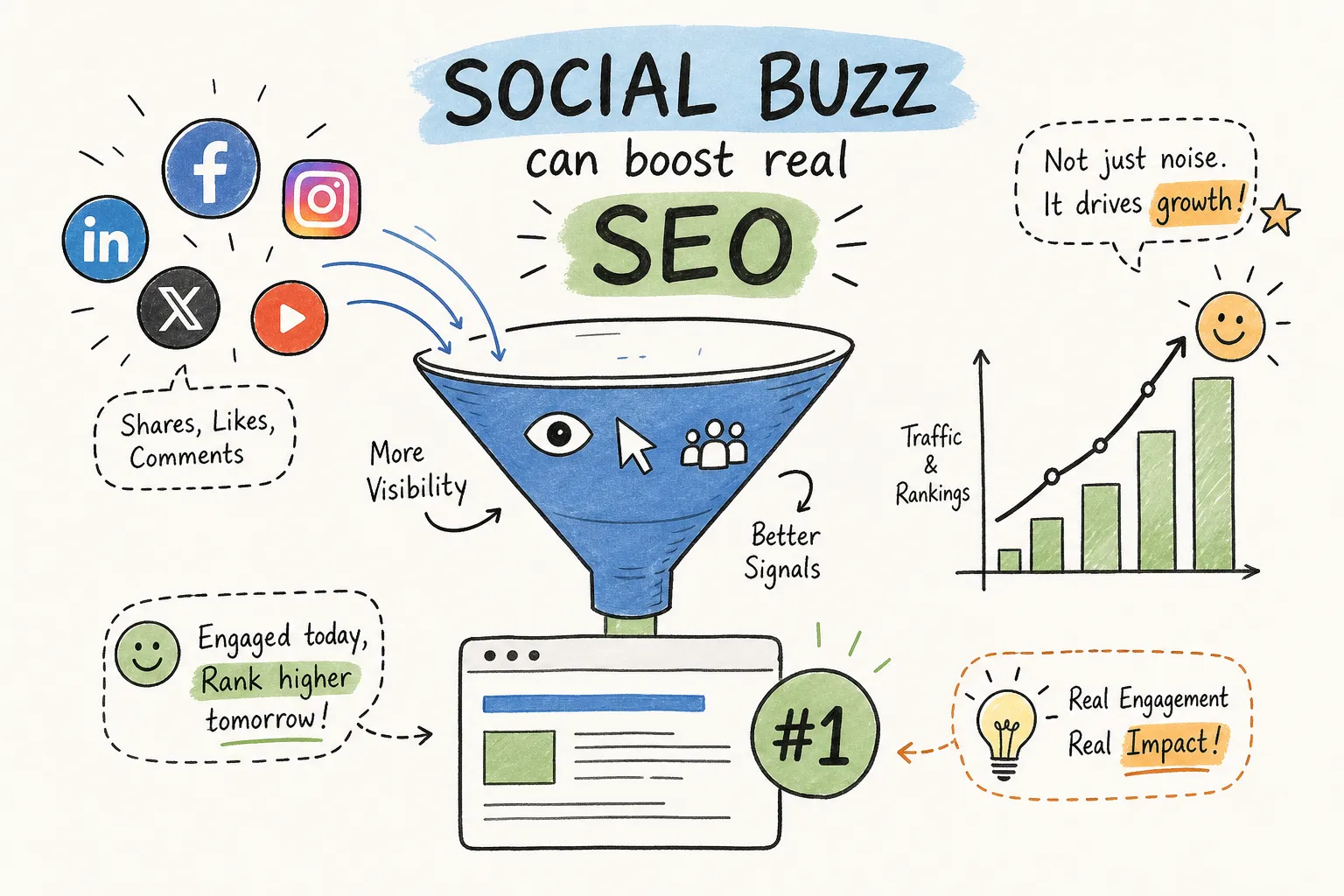
The relationship between social media and SEO is real, but not the way most people think. Most business owners assume that getting more likes and shares will push their pages up Google’s rankings. It’s a reasonable assumption, but it’s not how any of this works.
Social engagement doesn’t directly move the needle in Google’s algorithm. What it does is set off a chain of events that does. More visibility leads to more backlinks. More backlinks build authority. More authority earns rankings. Understanding that sequence is the difference between random posting and a strategy that actually compounds over time. That’s the kind of clarity that separates Brandleap Agency from the noise: they don’t treat social and SEO as two separate to-do lists; they treat them as one growth system.
This article breaks down the mechanics, the platforms, and the specific actions that make social media a serious search asset in 2026.
The truth about social signals and Google rankings
Google has confirmed this repeatedly, through spokespeople including John Mueller and Matt Cutts: likes, shares, and comments are not direct ranking factors. The algorithm has no reliable way to verify social engagement data across third-party platforms, so it doesn’t use it. If you’ve been chasing likes as an SEO tactic, that energy belongs somewhere else.
Strong social engagement and strong rankings do tend to appear together, but correlation isn’t causation. High-performing content earns shares because it’s well-researched and genuinely useful. That same quality is what earns backlinks and organic traffic. Social signals are a symptom of good content, not the cause of good rankings. Recognizing that distinction tells you exactly where to focus your effort.
There is one narrow but meaningful exception worth knowing: Google Business Profile engagement, including reviews and posts on Google’s own platform, does carry some weight in local search rankings. For businesses competing in local markets, this is a direct lever worth pulling.
How social media and SEO work together indirectly
Backlinks from social reach
When a piece of content earns significant social traction, it reaches journalists, bloggers, and website owners who might link to it. Those links are what Google actually counts. Research from Fractl (published in their content marketing study) found that a campaign generating 40,000 social shares also produced a 40% lift in organic U.S. traffic, but the driver was high-quality content reaching the right people, not the share count itself. The shares were the vehicle; the content was the engine. Note that this type of research reflects a general content amplification pattern; specific results will vary based on industry and content quality.
Increasing branded search volume
Brand search volume is another indirect signal worth paying attention to. When more people search your brand name directly, Google reads that as a trust indicator. Social media is one of the most effective channels for building branded search volume over time. The more your brand shows up in feeds, the more people look it up. That lookup behavior feeds directly into your search presence, reinforcing your authority in ways that compound over time.
Social-driven traffic also matters at the behavioral level. When visitors from social platforms actually read, click through, and spend time on your content, that positive behavior reinforces your site’s relevance to Google. It’s not a direct ranking signal, but it contributes to the broader picture of a trustworthy, useful site, and those behavioral patterns accumulate in meaningful ways.
Social media and SEO: platform opportunities you shouldn’t ignore in 2026
July 2025 indexing update changed the game for businesses with professional accounts. Google now indexes public photos, Reels, videos, and carousels from professional accounts, including content published on or after January 1, 2020. That means your best-performing Instagram content from the past several years is eligible to surface directly in Google search results. Content with strong captions, high engagement, and relevant keywords is most likely to appear. Personal accounts and private profiles are excluded, so the first step is confirming your account is set to professional.
LinkedIn is an underused SEO asset, especially for B2B businesses. LinkedIn content regularly ranks in Google search for professional and industry-specific queries. A well-written company post or LinkedIn article can capture branded search traffic, earn external links from other sites, and reinforce your authority in your niche. If you’re not publishing consistently on LinkedIn, you’re leaving indexed real estate on the table.
Facebook’s direct impact on organic search rankings is minimal, but a complete and active Facebook Business page contributes to brand consistency signals and can capture local search visibility. For businesses optimizing their presence in Google’s local pack, a well-maintained Facebook presence reinforces the entity signals that tell Google your business is legitimate, active, and worth showing.
Optimizing social profiles for branded search
Your social media bio is one of the most crawlable parts of your profile, and one of the most overlooked profile SEO opportunities available to you. Use your primary keyword and a clear description of what you do in the first two lines. Don’t bury your value proposition. Your username and handle should match your brand name consistently across platforms. Inconsistent handles fragment your brand authority and make it harder for search engines to connect your activity across the web.
Every social profile should link back to your website. If you’re working with limited link real estate, like Instagram’s single bio link, use a redirect page that points to your core pages. These links reinforce the connection between your social presence and your domain. The goal is to make every profile a clear signal pointing back to one authoritative source.
Consistency is a trust signal that most businesses underestimate. When your profile photo, brand name, bio copy, and contact details match across Instagram, LinkedIn, Facebook, and X, search engines can more confidently associate all of that activity with one authoritative entity. This kind of social media optimization (SMO) quietly determines whether your entire cross-platform effort reads as coherent authority or scattered noise. Inconsistency at this level undermines your search credibility, even if every other part of your strategy is solid.
Turning social content into a keyword strategy asset
Platform-native search is the fastest way to find what your audience is actually typing. Enter your core topics into Instagram, TikTok, and YouTube’s search bars and study the autocomplete suggestions. These phrases reflect real in-platform search behavior, not keyword tools built on historical data. Use them in captions, video titles, alt text, and descriptions. Mix broad, niche, and branded hashtags, keeping it to three to five per post rather than loading up on high-volume tags that drown your content in noise.
Each piece of social content should ladder up to a keyword theme your website is already targeting. A blog post built around a specific search query becomes a carousel on Instagram, a short video on YouTube, and a LinkedIn article. That multi-platform amplification sends consistent topical signals back to your domain and increases the surface area through which people can discover your content, creating more entry points into your funnel.
Alt text is another social search optimization layer that too many businesses skip entirely. On Instagram especially, writing descriptive, keyword-relevant alt text on every image post improves accessibility and strengthens the content’s discoverability in both platform and Google search. It takes 30 seconds per post and most businesses never do it. That’s a competitive edge hiding in plain sight.
Brandleap Agency builds exactly this kind of integrated system for clients: social content that actively supports SEO goals, profiles optimized for branded search, and platform actions tied to measurable growth outcomes. Instead of running a social calendar and an SEO plan as disconnected projects, Brandleap operates them as one system with shared objectives and shared metrics.
Measuring social media and SEO impact
The biggest mistake businesses make is tracking social and SEO in completely separate dashboards and then wondering why neither seems to connect. Start by monitoring branded search volume in Google Search Console over time. If social activity is building brand awareness, you should see branded impressions and clicks trend upward in parallel. That correlation is one of the clearest signals that your social presence is doing real SEO work.
Track referral traffic from social platforms in your analytics and pay attention to what those visitors do. High engagement rates from social traffic, measured by pages per session, time on site, and return visits, tell you that your content is attracting the right audience and creating the kind of behavioral signals that support rankings. Vanity metrics like total followers and raw like counts tell you almost nothing useful.
Set up UTM parameters on every link you share across social platforms. This gives you clean attribution data showing which platforms and which content types are driving the most valuable traffic. Over time, those patterns show you where to concentrate your content effort for maximum SEO leverage.
What this means for your strategy right now
Social media won’t rank your pages by itself. But it builds the ecosystem that makes ranking far more likely: the backlinks that come from content reaching the right audiences, the brand search volume that signals trust, and the traffic behavior that tells Google your site is worth showing. That ecosystem doesn’t build itself, not overnight, and not through random posting.
The clearest takeaway is this: high-quality content, amplified through the right platforms and backed by optimized social profiles, creates a compounding effect that grows your search presence over time. Chasing vanity metrics misses that entirely. The businesses growing organically right now are the ones treating social media and SEO as a single integrated system, not two separate projects competing for the same calendar.
Start by auditing your social profiles for consistency and keyword alignment. Then map your next month of social content to the keyword themes your site is already targeting. If you want that alignment built into a complete system from day one, that’s where working with a team like Brandleap Agency makes the difference. The gap between businesses that grow organically and those that stay stuck is rarely effort. It’s strategy.