If you’re searching for a proven approach to SEO for home service contractors, the guide below shows the exact system that separates contractors who dominate the local pack from those who lose jobs to a less-skilled competitor with a stronger Google presence. Picture a plumber with 12 years of experience, a spotless crew, and dozens of satisfied customers who would refer him in a heartbeat, yet he keeps losing jobs to a competitor across town whose work is average at best. This isn’t bad luck. It’s a solvable problem rooted in local search mechanics, and the fix is more systematic than most contractors realize.
Local SEO for home service businesses is driven primarily by three high-weighted signal groups: your Google Business Profile, your service-area pages, and your review velocity. According to the 2026 Whitespark and BrightLocal local ranking factor surveys, these signals collectively account for the majority of local pack ranking weight for home services. Other signals, schema markup, citation consistency, and call tracking, exist to reinforce those three, and none of them should be ignored since they independently influence rankings as well. This guide reflects the same contractor SEO framework the team at Brandleap Agency applies when building local visibility for home service clients.
By the end, you’ll have a prioritized action plan you can start on this week or hand directly to an agency with specific instructions on what to build and in what order.
Why the local pack works differently for service-area contractors
According to the 2026 Whitespark and BrightLocal signal surveys, Google Business Profile signals account for approximately 32% of local pack ranking weight. On-page signals follow at around 19%, with review signals carrying 16, 20% and link signals at roughly 15%. What matters most for contractors is understanding which of these signals they can actually move in the next 90 days.
Proximity works differently for service businesses than it does for restaurants or retail shops. When a homeowner searches for an HVAC tech from their couch, they’re not physically near any contractor’s office. Google knows this, which is why GBP completeness and review signals carry more algorithmic weight for service-area queries than proximity alone, a finding supported by the 2026 local search ranking research. A well-optimized profile in a city 15 miles away can outrank a dormant profile two blocks from the searcher.
There’s also a newer layer that local SEO for contractors must account for. Google’s AI Overviews now pull from entity recognition and specific service mentions inside review text, a pattern documented in 2026 industry research on AI search visibility. A review that says “fixed our furnace fast” carries more signal value than “great service” because it connects your business to a specific service query. Review content strategy is no longer just a reputation concern; it directly influences whether your business appears in AI-generated answers.
Optimizing your Google Business Profile: where rankings start
Your primary GBP category is the single most important individual ranking factor out of 187 measured factors, according to the 2026 Whitespark survey. For HVAC businesses, “HVAC Contractor” is the standard primary category, with some experts recommending seasonal switches to “Air Conditioning Repair Service” in summer. For plumbing, “Plumber” is correct. Electricians use “Electrician.” The rule is simple: choose the most specific category that matches your highest-revenue service, then layer in secondary categories for adjacent queries.
Google Business Profile optimization matters more in 2026 than it did two years ago. Google now favors profiles with clearly defined geographic coverage over vague “statewide” designations. Define your actual service cities, not the widest possible area. On photos, recency outperforms volume: a handful of photos uploaded this month signals active operation more effectively than 200 photos uploaded three years ago.
Profile completeness is not optional. Fill out every service listed inside the GBP, write a business description that uses natural service language (not keyword-stuffed copy), and complete every attribute available to your category. Dormant profiles consistently rank below active ones. Regular posts, prompt Q&A responses, and fresh photo uploads tell Google your business is operating.
SEO for Home Service Contractors: Building Service-Area Pages That Rank City by City
Every city you serve deserves its own dedicated page, this is a cornerstone of effective service area page SEO. “Areas we serve” list pages don’t rank. Individual, substantive city pages do. Each page needs:
- A city-specific H1 headline
- A localized intro paragraph that establishes how long you’ve worked in that area
- A services list with internal links
- Real job photos from that location
- Local testimonials with customer names and neighborhoods
- A strong CTA with a click-to-call button
Primary city pages should target 1,200, 1,800 words; suburb pages work well at 800, 1,200 words, based on industry best-practice guidance for local SEO for contractors. The key to making these pages genuinely local is specificity. Reference neighborhood names, local housing types, and area-specific service concerns. In northern markets, freeze-prone pipes are worth a section. In Gulf Coast cities, storm damage restoration patterns deserve mention. Thin pages that swap city names into a boilerplate template are a waste of crawl budget and won’t rank.
Every city page should include LocalBusiness schema with the areaServed property set to that specific location. Internal linking also matters here: connect city pages to your relevant service pages, and link from service pages down to city-specific variations. This structure builds topical authority for both the service and the geography simultaneously, the combination that local-pack SEO rewards.
What a strong city page outline looks like
A well-built primary city page follows a predictable structure: an H1 that names the service and city, two to three opening paragraphs establishing local context, a services section with individual H3 headings and internal links, a photo gallery sourced from actual jobs in that city, a testimonials block with neighborhood-level specificity, a brief FAQ targeting local search questions, and a CTA section with a tracked phone number. Suburb pages follow the same outline at roughly half the depth.
A review velocity strategy that outpaces local competitors
A contractor with 30 total reviews and 10 collected in the last 90 days frequently outranks a competitor with 150 reviews and none in 18 months. Reviews within the last 90 days carry the most algorithmic weight. According to 2026 review velocity research, top-ranked home service contractors in competitive markets sustain 15, 25 new reviews per month. The category median for HVAC, plumbing, and electrical sits at just 3, 6 per month, which means consistent velocity alone puts you ahead of most competitors.
The most reliable way to build velocity is a same-day follow-up workflow. Text the customer a direct Google review link the same day you complete a job, ideally within a few hours while the experience is still fresh. Keep the message brief and personal, something like: “Hi [Name], it was great working with you today. If you have a minute, a Google review would mean a lot to us.” Contractors who build this step into their job-close checklist consistently outperform those who ask sporadically or rely on end-of-month email blasts.
When you respond to reviews, aim for a 90%+ response rate with replies within 24 hours, a correlation supported by the 2026 BrightLocal engagement signal research. Responses that naturally reference the service performed reinforce the relevance signals in the review text itself. A reply that says “Thanks for trusting us with your water heater replacement in Riverside” does more SEO work than “Thanks for the kind words!”
Schema markup and citation consistency: the technical foundation
Use GeneralContractor as your primary LocalBusiness schema type, or the most specific trade subtype available: Plumber, Electrician, RoofingContractor, or HVACBusiness. Build individual Service schema blocks for each key offering with the areaServed property defining geographic coverage. For service-area businesses operating from a home address, use GeoCircle to define a coverage radius. You can include the residential address inside the JSON-LD, which Google requires for local business validation per schema.org guidance, without displaying it publicly in your page HTML.
Getting your citations clean before building new ones
Citation signals account for approximately 7% of local ranking weight according to the 2026 Whitespark survey, which sounds small until you see how badly inconsistent data suppresses everything else you’ve built. Inconsistent name, address, and phone number data across Yelp, Angi, HomeAdvisor, and data aggregators like Neustar Localeze and Data Axle actively undermines your rankings. Audit your citations before expecting any other tactic to reach full effectiveness. Correct every mismatch, then build consistent listings on the high-authority directories: BBB, Yelp, Angi, Houzz, and Nextdoor carry the most direct ranking signal weight for home service trades, per the same 2026 research.
Tracking calls and proving what your SEO investment earns
CallRail is a widely used choice for home service businesses, offering keyword-level attribution, direct Google Ads integration, and clean GA4 sync, connecting organic search rankings to actual calls and booked jobs. WhatConverts is a solid option for contractors who want pure attribution data without call center features. Both are reliable; the right choice depends on whether you need just tracking or tracking plus call management.
The single highest-leverage tracking move most contractors skip is assigning a dedicated tracking number to the GBP listing specifically, separate from the website number. All calls from the local pack then flow into a clearly labeled source in your dashboard, making it straightforward to calculate how much revenue your GBP drives each month. Without this step, local pack calls get lumped into generic “direct” traffic and you lose the ability to quantify the return on your SEO work.
Both CallRail and WhatConverts push call events into GA4 as custom events. This lets you and your agency see call conversion rates alongside web form fills in a single dashboard, giving a complete picture of which local SEO for home service contractors actions are generating real revenue. If you’re handing this guide to an agency, that reporting setup should be one of the first deliverables you request.
Putting it all together
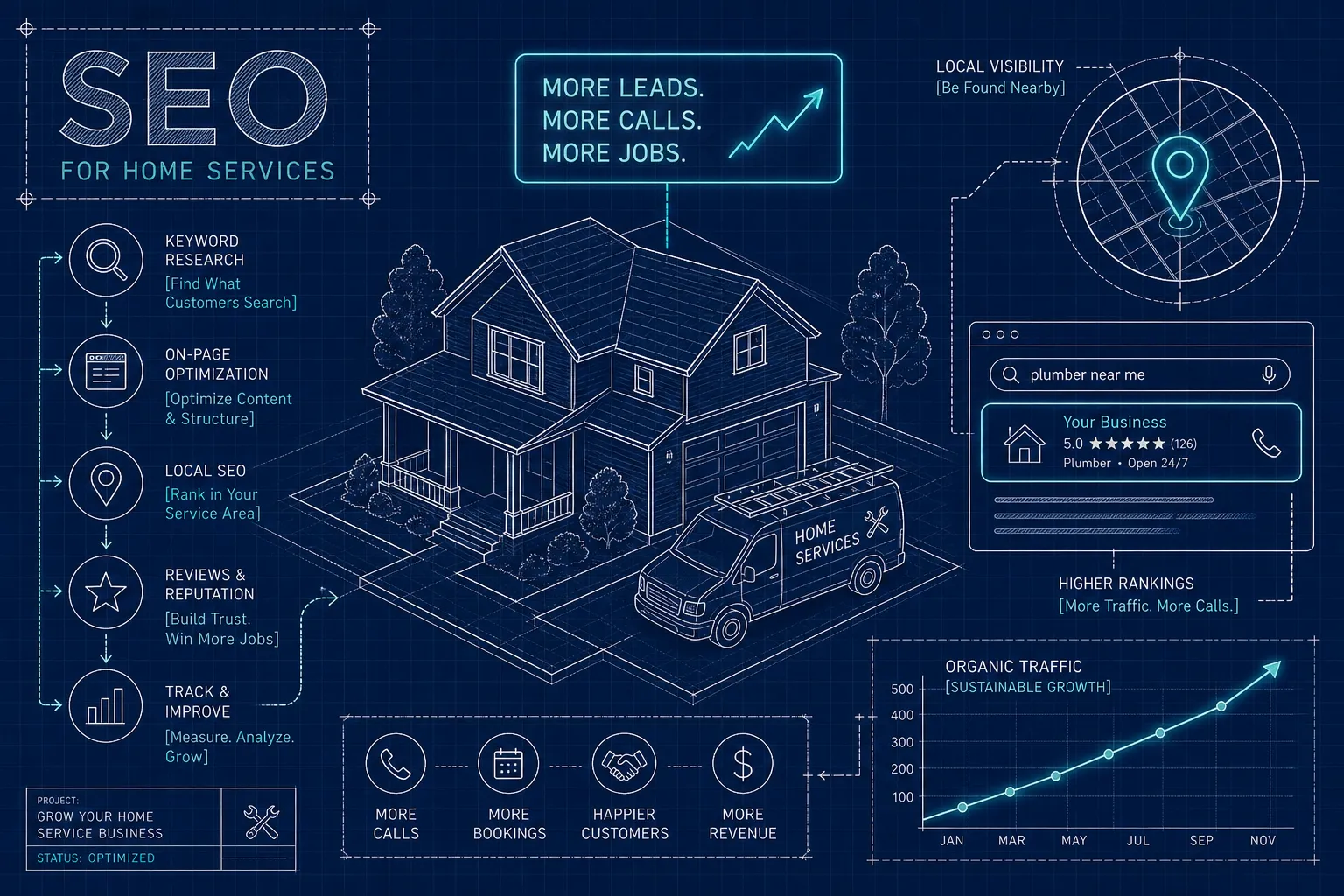
The full system for SEO for home service contractors looks like this: a complete, active GBP with the right primary category drives local pack visibility. City-specific service-area pages capture organic search traffic for individual markets. Consistent review velocity signals relevance and trust to both Google and prospective customers. Schema markup and citation accuracy provide the technical foundation that lets everything else work. Call tracking closes the loop by connecting rankings to revenue.
Most contractors who manage this themselves make real progress in one area and stall in the others, because the tactics need to function as a connected system. A generalist SEO agency that has never built rankings for a plumbing or HVAC business tends to apply the same playbook it uses for a law firm or a SaaS product, and that costs months of slow progress and budget spent on signals that don’t move the local pack needle.
Contractors who see the fastest results typically work with an agency that has already built this system for their specific trade. At Brandleap Agency, we build these systems specifically for home service contractors: GBP optimization, city-page architecture, review workflows, schema implementation, and call tracking configured as a complete package from day one. If you want to see exactly where your local SEO stands, reach out for a free local SEO audit. We’ll identify what’s suppressing your rankings and walk you through what the fix looks like in plain terms.