Seventy-six percent of local searches lead to a call or visit within 24 hours (Google/Ipsos research on mobile local search behavior). For a plumber, roofer, electrician, or HVAC technician, that stat represents a massive daily window of homeowners ready to book. Yet many home service businesses are either invisible when those searches happen or losing the click to a competitor who put the work into their local presence. That’s exactly the gap that home services local SEO is built to close.
At Brandleap Agency, we build and manage these local search systems for home service businesses every month. Clients who commit to the process consistently see stronger long-term returns than they were getting from paid ads alone, and unlike pay-per-click, the results compound over time rather than stopping the moment the budget does. This guide covers the five areas that drive the most impact: your Google Business Profile, city and service pages, citations and schema, review growth, and call tracking. Work through them in order and you’ll have a complete, compounding local presence.
Why the Map Pack is your most valuable piece of digital real estate
The Local Map Pack is the block of three business listings that appears above organic results when someone searches “HVAC repair near me” or “roofing contractor in Dallas.” For home services businesses, that three-pack consistently drives more qualified calls than other placements on the page. Users searching for contractors aren’t browsing, they need help now, and the Map Pack is where they look first.
Service-area businesses play by slightly different rules than restaurants or retail shops. Because you don’t always display a storefront address, Google can’t rely as heavily on proximity. For service-area businesses, Google shifts weight toward relevance and entity trust: how well your profile matches the search, how consistent your business information is across the web, and how much local engagement your listing generates. That’s actually good news, you can out-rank a closer competitor simply by optimizing more thoroughly.
What home services local SEO actually produces in numbers
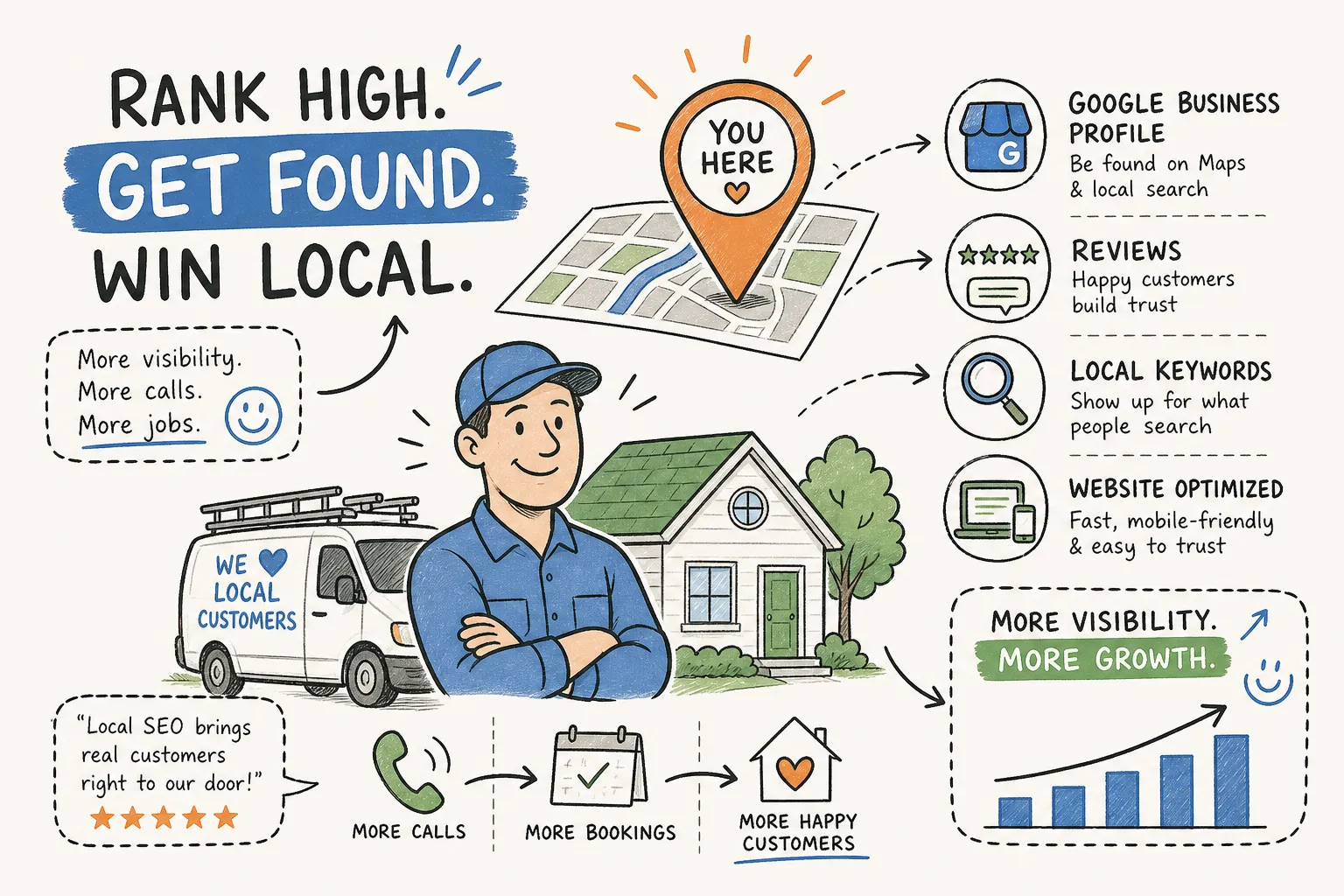
According to the Whitespark 2026 Local Search Ranking Factors survey, GBP signals account for roughly 32% of Map Pack ranking influence, making your Google Business Profile the single highest-leverage asset you control. Contractors who build this foundation properly typically see 20 to 50 additional leads per month after 6 to 12 months of consistent work. One construction contractor case study documented 176 confirmed inbound leads from 333 tracked calls and form submissions over 19 months, alongside a 200% increase in local first-page rankings. These aren’t outlier numbers, they’re what happens when you treat local search as a system rather than a checkbox.
Home services local SEO: Google Business Profile optimization
Your GBP is the foundation of your entire local search strategy. An incomplete profile reduces your ability to compete for relevance and category matches, two of the factors Google weighs most heavily in the Map Pack. Start with your primary category and make it as specific as possible. Using the most specific category available, “Roofing Contractor” rather than “General Contractor”, will typically produce better category relevance and search matching, because Google uses that primary category to connect your listing to relevant queries. Add secondary categories only for services you genuinely offer: a roofing company that also handles gutters and siding should add those as secondaries.
The Services tab is where most contractors leave ranking power on the table. Don’t list “Roofing” as a single entry. Break it down into specific jobs: Roof Replacement, Roof Repair, Emergency Roof Tarping, Storm Damage Assessment, Roof Inspection. Each specific service entry helps Google understand the full scope of what you do and match you to more granular searches. Add a clear description to each service and include pricing where it makes sense for your business.
Photos and profile activity that build trust and signal relevance
Upload at least 20 high-quality photos, industry guidance generally recommends 20 to 30 as a practical target. The types that perform best for contractors are before-and-after job photos, branded trucks or equipment in the field, and crew members in uniform actively working. Strong visuals serve two purposes: they build trust with homeowners evaluating your business, and they signal active profile management to Google, which rewards listings that are regularly updated.
What does a good GBP post actually look like? Lead with a completed job, a photo of the finished roof replacement in Naperville, a note about the issue you solved, and a call to action (“Scheduling now for this week, call or message us”). Keep posts between 100 and 200 words, and publish at least twice a month. Beyond posts, fill out every applicable attribute: free estimates, emergency services available, veteran-owned, locally owned. Only check what’s true, but fill every field that applies. An incomplete attributes section is a missed relevance signal.
Home services local SEO: city and service pages that rank and convert
Your website is the second tier of local SEO for contractors, and the architecture you use matters as much as the content itself. The structure that performs best for service-area businesses targeting multiple towns is a hub-and-spoke model: your homepage handles the brand and primary market, individual service pages cover each core offering, and separate location pages target each city or town cluster. This keeps content organized the way customers actually search.
Each city page needs an H1 that states the service and location clearly, “Drain Cleaning in Austin, TX” or “Roof Replacement in Chicago, IL.” The body copy should mention the city, surrounding towns, the county, and nearby neighborhoods naturally throughout the page. Don’t assume Google will infer your service area from your address. State it explicitly with a service-area section that lists every town where you work.
Why FAQ sections win featured snippets and near-me queries
A well-built FAQ block on each location page serves two functions. First, it answers the real questions homeowners have about cost, response time, permits, and service radius, which directly improves conversion once someone lands on the page. Second, FAQ content is consistently pulled into featured snippets and voice search results for near-me queries, extending your visibility beyond standard ranked positions.
Keep your FAQs unique per page. Duplicating the same five questions across 30 city pages creates thin content that Google discounts. Write FAQs specific to each location: mention the local permit process, reference neighboring towns in the service radius question, and tailor pricing language to what that market expects.
Citations, schema markup, and the trust signals Google needs
Local citations and schema markup serve the same underlying purpose: they help Google verify your business identity and confirm where you work. Citations are mentions of your business name, address, and phone number across directories and platforms. For home service contractors, priority listings include:
- Google Business Profile
- Bing Places
- Apple Maps
- Yelp
- Angi
- HomeAdvisor
- Thumbtack
- BBB
- Houzz
NAP data must match exactly across every listing, including abbreviations. “St.” versus “Street” creates entity confusion that suppresses local rankings.
Schema markup is the structured data layer on your website that communicates the same information to Google in machine-readable format. Place LocalBusiness schema on your homepage and contact page with your name, address, phone number, and openingHoursSpecification. On each service page, use Service schema with serviceType, provider, and areaServed set to the correct cities. For service-area businesses covering a geographic radius rather than a list of towns, areaServed can use a GeoCircle with your coordinates and service radius. On a straightforward site, a developer or schema plugin can typically handle the implementation in a few hours, though more complex sites with dozens of service pages may take longer.
Building a review growth engine that improves rankings and closes leads
Reviews are the second most influential Map Pack signal, according to 2026 local ranking factor research, and most contractors treat them as a nice-to-have rather than a managed system. Google weighs review velocity, recency, quantity, sentiment, and the specificity of language in those reviews. A review that says “great job” moves the needle far less than one that says “fixed our furnace same day, explained the repair clearly, and cleaned up before leaving.” Specific service language helps Google categorize your business more precisely and match it to more relevant searches.
The best time to ask for a review is immediately after job completion or within 24 hours, ideally in person at the close of the job, with a quick follow-up text as a backup. Text outperforms email for response rate in home service contexts. Send a short message with a direct GBP review link and a specific prompt: “Mention what we fixed and how the team did.” That nudge moves customers toward the detailed, service-specific language that carries the most ranking and conversion weight. This is the core of effective review management for contractors, not chasing stars, but engineering the specificity that signals quality to both Google and future customers. For a practical look at timing and messaging, see this best-time-to-ask-for-reviews guide.
Responding to reviews: a ranking signal most contractors ignore
Respond to every review, positive or negative. When you respond, include service-specific language naturally: “Thanks for trusting us with your water heater replacement” reinforces your category signals to Google. An unanswered review is a missed trust signal and a lost conversion opportunity for every homeowner reading your profile before calling. Responding to negative reviews professionally demonstrates accountability, and that matters to fence-sitting prospects who are still deciding whether to call.
Tracking calls, leads, and what your local SEO is actually producing
The last piece of the system is measurement. Without proper tracking, you can’t distinguish which city pages are generating calls, which GBP actions are driving leads, or whether your investment is producing results worth continuing. Set up dynamic call tracking numbers on each city page so calls can be attributed to the specific page that generated them. UTM parameters on local content let you trace traffic sources in GA4. GBP Insights gives you profile views, direction requests, and direct calls from the listing itself.
Connect GA4 goal tracking for form submissions alongside call tracking so you’re measuring total leads across every channel. Industry benchmarks put the conversion rate from local search traffic at 5 to 15%. If you’re sending 300 visitors per month to a city page and getting fewer than 15 inquiries, the page content or conversion elements need attention before you add more traffic.
Reading your results: what good progress looks like at 3, 6, and 12 months
Months one through three are the foundation phase: GBP completeness, citation cleanup, and baseline impressions on the rise. Months four through six are when ranking improvements appear and first lead increases become visible. By months six through twelve, consistent compounding growth typically kicks in, usually 20 to 50 additional leads per month from organic search and Maps combined. Don’t abandon a working strategy at month four because the numbers aren’t dramatic yet. Local SEO is a compounding asset, not a paid campaign you can pause and restart. For deeper tactics on how to structure ongoing local programs, our coverage of Local SEO for Real Estate: Rank Higher in Your Market, 2026 includes tactical examples that translate well to contractor sites.
Your home services local SEO action plan: where to start
The priority order for any home service business is straightforward: optimize your GBP first, build your city and service pages second, clean up citations and add schema third, build a review system fourth, and set up call and lead tracking fifth. Every well-built page, every review earned, and every citation cleaned up makes the next lead cheaper to acquire, and builds an organic foundation that paid ads alone can never provide. If you’re expanding your in-house capability or pitching clients, you may also find value in our guide on How to Sell SEO: Boost Your Business Today, 2026 for packaging services and demonstrating ROI.
If you’d rather have this entire home services local SEO system built and managed for you, that’s exactly what Brandleap Agency does. We build and manage every piece of this system, GBP, schema, city pages, reviews, and reporting. You run the jobs; we run the rankings. Request a local SEO growth audit and we’ll show you exactly where your current local presence is leaving leads on the table. For general best-practices and broader context on local SEO for service businesses, this comprehensive guide for home service contractors is also a helpful reference.