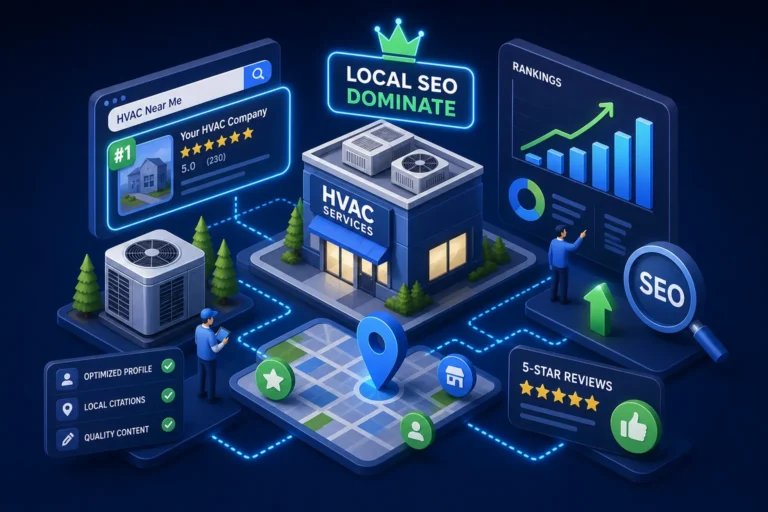
Many HVAC companies invest in marketing. They run Google Ads, post on social media, and pay for leads through third-party platforms. Yet their competitors sit in the top three Map Pack spots, capturing calls before anyone else gets a shot. That gap is not random. It comes from a deliberate local SEO strategy built on targeted HVAC SEO services, and the contractors who commit to that approach tend to book more jobs month after month while others compete for whatever is left.
Local search behavior has sharpened considerably. A homeowner whose AC stops working at 6 PM searches “AC repair near me,” sees three businesses in the Map Pack, and calls the first one with strong reviews. Most users never scroll to page two, and very few visit more than one or two websites before picking up the phone. Research consistently shows a steep drop in click-through rates after the first page, which means the ranking gap between page one and page two translates directly into a lead volume gap.
Agencies that run trade-specific HVAC SEO services approach this differently from generic digital marketing shops. At Brandleap Agency, every tactic ties back to a booked job, not a vanity metric like impressions or keyword rankings in isolation. This guide gives HVAC contractors a clear-eyed look at what actually drives local leads, what it costs, and how to find the right partner to execute it.
The Local Search Tactics That Turn HVAC Searches into Booked Calls
Five core local SEO levers drive lead volume for HVAC contractors: Google Business Profile, Local Services Ads, service-area pages, citations, and schema markup. None of these works in isolation. They function as a connected system, and the strongest results come from building all five in sequence. That said, the best starting point is always the highest-intent demand, which means GBP and LSAs first.
Google Business Profile Is Your Highest-Leverage Local Asset
A fully optimized GBP profile does more for local lead volume than almost any other single investment. For HVAC contractors, that means selecting “HVAC Contractor” as the primary category, adding accurate secondary categories like Air Conditioning Contractor and Furnace Repair Service, completing every available field, and setting service areas to the specific cities and ZIP codes you actually serve. Profile completeness is directly connected to Map Pack visibility. An incomplete profile signals to Google that the business may not be actively managed, which suppresses rankings.
GBP is typically the highest organic local lead source for HVAC contractors because it appears directly in Maps for “near me” searches, which are among the highest-converting query types in local search. Fresh photos, weekly posts tied to seasonal demand (AC tune-ups in spring, furnace prep in fall), and active Q&A management all contribute to the engagement signals Google uses to assess an active, relevant business. Q&A management in particular is a recommended best practice for keeping your profile accurate and current in front of high-intent searchers.
How HVAC SEO Services Improve GBP and LSA Performance
Local Services Ads appear above standard PPC and above organic results, carrying Google’s “Google Guaranteed” badge. That badge meaningfully affects click-through rates because it signals to homeowners that Google has verified the business. For urgent, same-day HVAC calls, LSAs are the fastest-converting paid channel available. The typical cost per lead through LSAs runs $25 to $75, compared to $10 to $30 for established organic search.
LSAs and organic GBP rankings are not the same system, but they share inputs. Review quantity, review recency, profile completeness, and service-area accuracy strengthen both. Contractors who run LSAs alongside a well-run organic search program see the strongest total lead volume because they capture urgent calls through the paid unit and ongoing demand through Maps and organic results at the same time.
Service-Area Pages, Citations, and Schema Markup
A single homepage cannot rank for every city in a contractor’s service footprint. A dedicated service-area page for each major market, built with the city name, specific services offered, local trust signals, and internal links, gives Google the geographic relevance signals needed to rank for location-plus-service queries like “AC repair in [city].” These pages are where significant organic lead volume is generated across multi-location operations.
Citation consistency, meaning your business name, address, and phone number matching exactly across all directories, functions as a trust signal that reinforces local authority. Schema markup adds a technical layer on top: HVACBusiness schema on the homepage, Service schema on each individual service page, and FAQPage schema where genuine Q&A content exists. Schema does not directly drive leads, but it helps Google correctly interpret what your business does and where, which supports rankings across the board.
Seasonal Content and Local Keyword Targeting That Match How Homeowners Actually Search
HVAC search demand follows a predictable seasonal pattern. Cooling searches peak from roughly May through August, centered on terms like “AC repair near me,” “air conditioner not cooling,” and “emergency AC repair.” Heating searches rise from October through January, dominated by “furnace repair,” “heater not working,” and “furnace replacement.” Contractors who plan content around this cycle capture demand before it peaks. Those who don’t are always publishing too late.
Targeting High-Intent Heating and Cooling Search Terms
There is a meaningful difference between informational keywords and commercial ones, and it affects lead quality significantly. “How does central AC work” attracts curiosity. “AC repair [city]” attracts someone ready to call. A strong local HVAC SEO strategy prioritizes service-plus-location keyword patterns because they rank for the exact intent that converts: a homeowner with a broken unit who needs help now. High-intent terms with lower search volume consistently outperform broad informational terms with high volume and low conversion rates.
A Seasonal Content Calendar That Captures Demand Before It Spikes
The clearest guidance from SEO data is to publish seasonal content 60 to 90 days before the expected peak. For summer AC content, that means publishing in February or March. For winter heating content, that means publishing in August or September. Pages need time to index, accumulate signals, and climb in rankings before the search volume surge arrives.
Blog content targeting middle-of-funnel queries, such as “what to do when your AC stops working in [city]” or “signs your furnace needs replacing,” captures homeowners who are close to calling but not quite there yet. This content builds familiarity and keeps your business in front of the right audience during the consideration window. Combined with service pages targeting transactional terms, a well-planned seasonal content strategy covers the full funnel from awareness to call.
Review Management: The Ranking Signal Most HVAC Companies Ignore
Many HVAC contractors lack a formal, consistent review-generation process. They rely on happy customers to volunteer one, which means review volume grows slowly and unevenly. That is a problem because reviews are both a local ranking factor and a conversion factor. A contractor with 200 reviews and a 4.8 rating is positioned to outrank a competitor with 30 reviews and a 4.2 rating in many situations, since review signals, including quantity, recency, and velocity, are among the stronger inputs in Google’s local ranking algorithm. That said, reviews are one part of a broader system that also includes profile completeness, relevance, and proximity.
Why Google Weighs Reviews as a Local Trust and Relevance Signal
Review quantity, recency, and response rate all factor into how Google assesses local authority. A business that collected 200 reviews two years ago and has added none since sends a weaker signal than a business with 150 reviews and a steady stream of new ones each month. In competitive metro markets, HVAC contractors regularly need 200 to 300 or more reviews to compete for top-three Map Pack visibility. In major metros like Houston or Atlanta, that number climbs higher. The floor is not fixed, but the pattern is consistent: review velocity matters as much as total count.
Building a System That Generates Reviews Consistently
The mechanics of a reliable review system are straightforward. Request reviews immediately after a successful service call, using an SMS link that takes the customer directly to your GBP review form rather than to a page where they have to search for it. Train technicians to mention it at job completion as part of a standard wrap-up, built into the process rather than treated as optional. Respond to every review, including negative ones, because Google rewards active engagement with review profiles, and a thoughtful response to a critical review often does more for conversions than a five-star rating on its own.
HVAC SEO Services: Pricing, Packages, and What to Expect
Pricing for HVAC SEO services in 2026 breaks into three tiers, and understanding what each level actually covers helps contractors match budget to goal rather than shopping by price alone.
HVAC SEO Pricing Tiers and What Each Level Covers
Basic local plans run $500 to $1,500 per month and typically cover GBP optimization, citation building, and foundational on-page SEO. These are appropriate for single-location contractors in less competitive markets who need to establish baseline visibility. Standard mid-range programs run $1,500 to $3,500 per month and add ongoing content production, service-area page expansion, and structured reporting. This is where most growth-focused single-location contractors should be operating.
Comprehensive programs for competitive markets or multi-location operations run $3,500 to $5,000 or more per month and include aggressive authority building, full technical SEO, and broader content strategy. Project-based work covering audits, site migrations, or full service-page builds typically runs $2,000 to $10,000 as a one-time engagement. Some agencies also offer performance-based hybrid models where a reduced retainer is paired with a per-qualified-lead or revenue-share component, though these arrangements vary widely and attribution clarity is essential before signing.
Lead Benchmarks and What 6, 12 Months of SEO Actually Produces
Well-ranked local HVAC contractors typically generate 20 to 50 organic leads per month once a program matures, with organic cost per lead landing at $10 to $30. Client results from our programs illustrate what is realistic: one contractor saw 312% organic traffic growth in six months, 63 additional monthly digital leads, and 89 GBP calls per month compared to 12 at baseline. Other programs have produced 200% organic traffic growth in six months generating 30 to 40 new inquiries monthly, and a 453% organic traffic increase in 12 months with service bookings up 45%.
The timeline follows a consistent pattern. Months one through three are foundational: technical fixes, GBP optimization, citation cleanup, and initial page builds. Months four through six are when rankings start moving. By months six through twelve, organic lead volume often begins outpacing equivalent PPC spend on a cost-per-booked-job basis. Contractors who exit at month three consistently leave those returns on the table.
How to Choose the Right HVAC SEO Agency (and the Red Flags That Should Make You Walk Away)
A contractor who has done the research knows what good HVAC digital marketing looks like. The challenge is separating agencies that can deliver from those that will take a retainer and produce a traffic report full of numbers that don’t connect to the phone ringing. The vetting process matters as much as the marketing itself.
10 Questions Every HVAC Contractor Should Ask Before Signing
Any capable agency should answer these questions directly and confidently. Hesitation, vague language, or pivoting to different questions is information in itself. Push for specifics, especially on the two questions below the list.
- Do you work with other HVAC or trades clients, and can you share documented results?
- How do you improve Google Business Profile rankings and Map Pack visibility specifically?
- Which keywords will you prioritize first, and why those over others?
- How do you measure success, and what metrics appear in monthly reports?
- How do you approach service-area pages and location-specific content?
- What is your link-building strategy, and how do you avoid risky tactics?
- Who owns my website, GBP, analytics, and ad accounts if I leave?
- Is any work outsourced, and to whom?
- How do you handle the contract if results stall or underperform?
- What is the notice period and exit process?
Pay particular attention to questions four and seven. An agency that measures success in calls and booked jobs instead of impressions and traffic is oriented toward your actual business goal. An agency that won’t confirm you own your own accounts is a retention strategy dressed up as a service.
Red Flags That Signal You’re About to Waste Your Budget
The clearest warning sign is any guarantee of rankings or a “page one in 30 days” promise. Google’s algorithm is not something any agency controls, and contractors who get sold on ranking guarantees usually end up with black-hat tactics that produce short-term gains and long-term penalties. Equally problematic is an agency whose monthly reporting leads with traffic and impressions rather than calls and booked jobs. If the metrics don’t connect to revenue, the reporting exists to justify the retainer, not to improve your business.
HVAC lead generation services require hyper-local expertise. An agency that cannot speak fluently about seasonal demand patterns, LSA mechanics, Map Pack behavior, and service-area page strategy is not built for trades businesses, regardless of their general SEO track record. Watch for vague link-building explanations, long lock-in contracts with no performance provisions, and any situation where the agency cannot explain their process in plain language. These are not minor concerns. They are reliable predictors of poor outcomes.
The Action Sequence That Moves the Needle
The path from invisible to booked follows a clear sequence: optimize GBP first, build out service-area pages for every market in your footprint, run LSAs alongside organic to capture urgent demand, build reviews systematically with a post-job request process, and publish seasonal content on a planned calendar that gets pages indexed before demand peaks. None of these steps is optional if you’re competing in a serious market.
Choosing the right agency to execute this is where the investment either pays off or disappears. Our team at Brandleap Agency runs exactly these HVAC SEO services for trades businesses, with senior-level strategy applied directly to each client account rather than delegated to junior staff. Every tactic maps back to booked jobs, and our reporting reflects that. If you want an audit of your service area and a plan to improve booked jobs using professional HVAC SEO services, reach out to our team and we’ll walk you through where your biggest opportunities are sitting uncaptured.

BrandLeap Agency & BrandLeap Fashion | Founder & CEO
Mithun is an experienced SEO consultant recognized for helping businesses improve their digital presence through technical SEO, content optimization, and sustainable organic growth strategies. Working in the digital marketing industry since 2019, he has developed expertise in increasing search visibility, driving targeted traffic, and building long-term growth through data-driven SEO solutions. He has worked with businesses across multiple industries, helping brands strengthen their online authority and achieve measurable growth results.