If you’re wondering how law firms get more clients through Google search, the answer comes down to one thing: a system that works across multiple placements simultaneously. Seventy-one percent of people who search for legal services on Google contact a law firm within 24 hours. That is not a statistic worth skimming past. It means the window between a potential client’s search and their first call is measured in hours, and if your firm isn’t visible when that search happens, someone else answers the phone.
At Brandleap Agency, we’ve observed the same pattern across law firms of every size: attorneys with a solid Google foundation generate a consistent, predictable flow of qualified leads without depending on referrals or word-of-mouth alone. The firms that win on Google aren’t necessarily the ones spending the most. They’re the ones who’ve built each layer of their presence deliberately and connected them into a single system.
This article gives you that system, structured as a 90-day plan you can start this week. By the end, you’ll know how to own the Google Local Pack, run paid campaigns that convert, build a review process that runs itself, and track every lead from the first click to a signed retainer.
Why Google search is where most legal clients start their journey
Legal searches on Google carry some of the highest purchase intent of any category. Someone searching “personal injury attorney near me” is not browsing options or doing casual research. They’ve already made the decision to hire, and they’re evaluating who to call first. This is fundamentally different from social media traffic, where audiences are passive, or display advertising, where you interrupt rather than answer.
“Personal injury lawyer near me” generates 450,000 monthly searches in the U.S. alone. “Divorce lawyer near me” gets 60,500 monthly searches. Every one of those queries represents a person with a live legal need. Visibility in those results is a business-critical function, not a marketing nice-to-have.
The three ways Google surfaces law firms to prospective clients
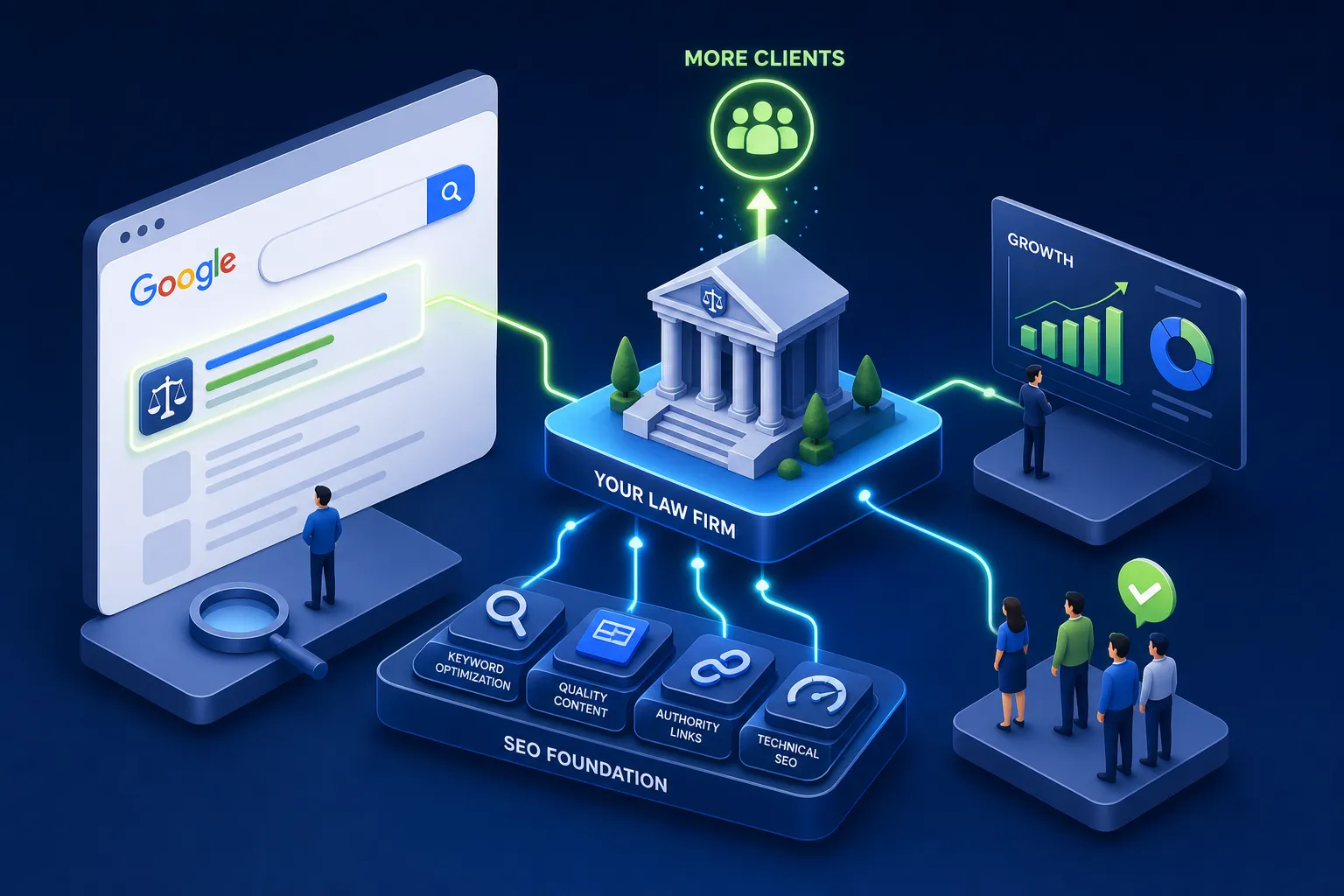
Google displays law firms in three distinct placements: the Local Pack (the map-based results with three listings and star ratings), organic blue-link results below the map, and paid placements at the top of the page via Google Search Ads and Local Services Ads. Appearing in all three is achievable, but each requires a different approach. Many firms rely primarily on paid placements, leaving substantial organic intent untouched, the kind of intent that competitors with a stronger foundational presence are already capturing.
What high-intent legal searches actually look like in 2026
Not all legal queries are equal. Someone searching “what happens if I can’t afford a lawyer” is researching, not hiring. Someone searching “criminal defense lawyer Dallas” is ready to call today. Your first priority is targeting transactional queries, the searches where the person is actively evaluating firms and ready to take action. Build your entire Google presence around those keywords first, then expand into informational content once the foundation is solid.
How law firms get more clients through Google search by optimizing their Google Business Profile
Your Google Business Profile is the single highest-leverage action in law firm local SEO. GBP signals account for roughly 32% of Local Pack ranking weight, making it the place every attorney should invest time first. The mistake most firms make is treating GBP as a one-time setup rather than an ongoing channel that requires regular attention to stay competitive.
Category selection, NAP consistency, and the signals Google prioritizes
Choose the most specific primary category available for your core practice area. “Personal Injury Attorney” outperforms a generic “Lawyer” category because Google interprets it as a stronger relevance signal for practice-area searches. Keep your firm’s name exactly as it appears on your website and official documents. Adding city names or keywords to the business name violates Google’s guidelines and can get your profile penalized or suspended.
NAP consistency is non-negotiable. Your name, address, and phone number must match exactly across your website, GBP, and every directory where your firm appears. Even minor discrepancies, like “Suite” versus “Ste” in your address, create trust conflicts that weaken your local authority. Write a business description that mentions your main practice area and city naturally in the first sentence, written for a person reading it, not a search algorithm.
Building a review system that generates leads consistently
Reviews account for roughly 20% of Local Pack ranking weight, and recency matters more than raw volume. In the competitive markets we track, top-ranking firms typically carry 50 to 150+ reviews, a 4.0+ star rating, and a steady stream of new reviews arriving each month. A one-time burst of reviews followed by months of silence signals inactivity to Google and to prospective clients scanning the profile.
Build a simple post-matter review request process: ask promptly within a few days of a positive client outcome, make the request personal rather than automated, and always respond to every review, positive or negative, with a professional and specific reply. Respond to negative reviews especially, because prospects read how you handle criticism as a signal of how you handle clients.
Posts, Q&A, and photo activity that keeps your profile active
Publish a Google Post with a clear call to action at least biweekly, whether that’s a case win announcement, a client FAQ, or a seasonal legal reminder. Seed your Q&A section with the most common questions prospects ask before hiring, and answer them directly. Upload fresh photos of your office, team, and work environment monthly. These activities correlate consistently with stronger profile engagement and more direct calls, even when they don’t guarantee a ranking jump overnight.
Local SEO factors attorneys consistently underestimate
Most law firms optimize their GBP and stop there. But the Local Pack and organic results work together, and your website’s local relevance signals reinforce both. Ignoring them means leaving ranking gains on the table while competitors quietly accumulate them.
Practice area pages and location-specific keyword targeting
Every practice area your firm offers needs its own dedicated page, optimized for city-level keywords. A family law firm in Dallas should not have one generic “services” page. It needs a “Dallas family law attorney” page, a “Dallas child custody lawyer” page, and a “Dallas divorce attorney” page, each targeting specific transactional queries. This structure tells Google precisely what you do and where you serve clients, which directly strengthens both organic and Local Pack relevance signals.
Citation building, NAP consistency, and why directory presence still matters
Citations on legal directories function as prominence and trust signals. The authoritative directories for U.S. law firms are Avvo, Justia, FindLaw, Martindale-Hubbell, Lawyers.com, and Super Lawyers, alongside general directories like Yelp, BBB, Apple Maps, and Bing Places. Consistency matters most. If your address or phone appears differently across Avvo, FindLaw, and Justia, Google registers a trust conflict that weakens your local authority. Audit existing citations before building new ones.
Backlinks and domain authority as a supporting local signal
Backlinks are less decisive for Local Pack rankings than GBP and reviews, but they significantly strengthen your organic visibility and overall domain authority. For law firms, the highest-value links come from local legal directories, bar association pages, community organizations, and press coverage. A link from a regional news outlet covering a case outcome carries substantially more authority than a cluster of generic directory links. Start with the low-hanging fruit: ensure your state bar listing links to your site, then build from there.
Google Ads and Local Services Ads: which one fits your practice area
Paid placements can generate qualified leads immediately, but the cost structure and lead quality differ sharply depending on which product you use and what practice area you’re in. A firm spending budget in the wrong place can burn through thousands of dollars with little to show for it.
How Google Search Ads and LSAs work differently for attorneys
Google Search Ads charge per click and require strong landing page optimization to convert. You control targeting, messaging, and budget, but you pay for every click regardless of whether that person contacts you. Local Services Ads charge per lead, not per click. They appear above even regular Google Ads, carry a “Google Screened” verification badge, and connect prospects directly to your firm. For most attorneys, LSAs produce lower-cost, higher-quality leads because the prospect contacts you through Google’s interface after seeing that verification signal. Some legal markets report LSA cost-per-lead of $50 to $150, compared to $200 to $600 per qualified lead through Search Ads.
Realistic CPC benchmarks by practice area and what to budget for
Personal injury is the most expensive paid search vertical in legal: expect $50 to $200+ per click on competitive terms, with well-optimized campaigns converting at 5% to 12%. Criminal defense is more accessible at an $8 to $12 average CPC, with conversion rates averaging around 11%. Family law falls in the middle. It generally tracks closer to broader legal services averages, though precise benchmarks vary by market and should be validated with your own campaign data before committing to a fixed target. Build your budget around a target client acquisition cost, not an arbitrary monthly spend ceiling. If a signed client is worth $5,000 in fees and you’re converting leads to clients at 20%, you can afford to spend up to $1,000 per lead and still break even.
How law firms get more clients through Google search with proper tracking
Most law firms track form fills and call volume. That is not attribution. Real attribution means knowing which keyword, campaign, and ad drove a specific signed client. Without that level of clarity, budget decisions are guesswork, and Google’s Smart Bidding algorithm optimizes toward the wrong outcome, maximizing form fills instead of signed retainers.
The tracking stack every law firm needs in 2026
The foundation is Google Tag Manager and GA4 for event-based measurement. Layer in dynamic call tracking with source-level attribution so every call is tied to a specific channel. Add UTM parameters to every paid link, and use hidden form fields that capture source, medium, campaign, landing page, and Google Click ID on every submission. This infrastructure ensures no lead enters your intake process without a complete source record attached, the prerequisite for everything else to work.
Connecting CRM data to Google Ads with offline conversion imports
The most powerful step most law firms skip is importing signed retainers back into Google Ads as offline conversions. When Google’s algorithm sees which clicks produced actual signed clients, not just form fills, Smart Bidding shifts spend toward those high-value queries automatically. Your CRM should track each lead from “new inquiry” through “consultation booked,” “qualified,” and “signed client,” and that status data should feed back into Google Ads regularly. This closes the loop between your marketing spend and your revenue, turning your campaign data into a self-improving system over time.
Your 90-day plan to build a consistent Google client pipeline
The work above can feel overwhelming when viewed all at once. The key is sequencing it correctly: foundations first, growth second, optimization and scale third. This phased approach prevents the common mistake of launching paid campaigns before the tracking is set up or running ads to an unoptimized landing page.
Days 1 to 30: fix the foundation
Claim and fully optimize your GBP, including category selection, business description, photos, and accurate hours. Audit NAP consistency across Avvo, FindLaw, Justia, Martindale-Hubbell, Yelp, and your state bar directory. Build or rewrite practice area pages with city-level keyword targeting. Set up GTM, GA4, call tracking, and form tracking with proper source attribution. Launch your review request process starting with every client matter that closes this month.
Days 31 to 60: build authority and launch paid campaigns
Begin a backlink outreach campaign targeting local legal directories, bar association pages, and community organizations. Publish Google Posts weekly with a clear call to action. Launch Local Services Ads if your practice area qualifies, and if your budget supports it, layer in Google Search Ads with tightly themed ad groups and dedicated landing pages for each practice area. At this stage, you’re building volume while the organic foundation matures.
Days 61 to 90: optimize, scale, and eliminate waste
Review call recordings and form submissions to identify where leads are dropping out of the process. Pause underperforming ad groups. Import signed-client offline conversions into Google Ads and let Smart Bidding optimize toward real client value. Double down on content and review velocity in the practice areas generating the most calls. By day 90, you’ll have actionable tracking and performance data to drive smarter decisions going forward. Noticeable Local Pack ranking gains typically take three to six months or longer in competitive markets, but every future optimization will be grounded in real data rather than assumption.
When hiring a law firm SEO specialist makes the most sense
The plan above is executable for a firm with a dedicated internal resource who can work on it consistently across 90 days. If no one on your team has the time or the expertise to execute each layer correctly, results will be slow and inconsistent, and some mistakes, like GBP policy violations or poorly structured ad accounts, can be costly to unwind. If your firm lacks the internal bandwidth to execute this correctly, working with an agency that already has legal market benchmarks calibrated, like Brandleap Agency, shortens the timeline considerably. The advantage is that CPC benchmarks, keyword strategy, and Local Pack tactics are already dialed in for attorney clients, which cuts the learning curve and accelerates the path to measurable results.
The system is the differentiator
The law firms ranking consistently at the top of Google aren’t the ones outspending everyone else on ads. They’re the ones with a fully optimized GBP, steady review velocity, practice-area-specific pages, and attribution tracking that connects every marketing dollar to actual signed clients. No single piece of this creates the result alone, but together they compound into a client pipeline that doesn’t depend on referrals or luck.
Start with the first 30 days and treat it as the non-negotiable foundation. The tracking won’t lie, the reviews will build, and the organic visibility will grow. The strategy itself is straightforward, consistent execution across 90 days is what separates the firms people find from the ones they never see. That’s the real answer to how law firms get more clients through Google search.