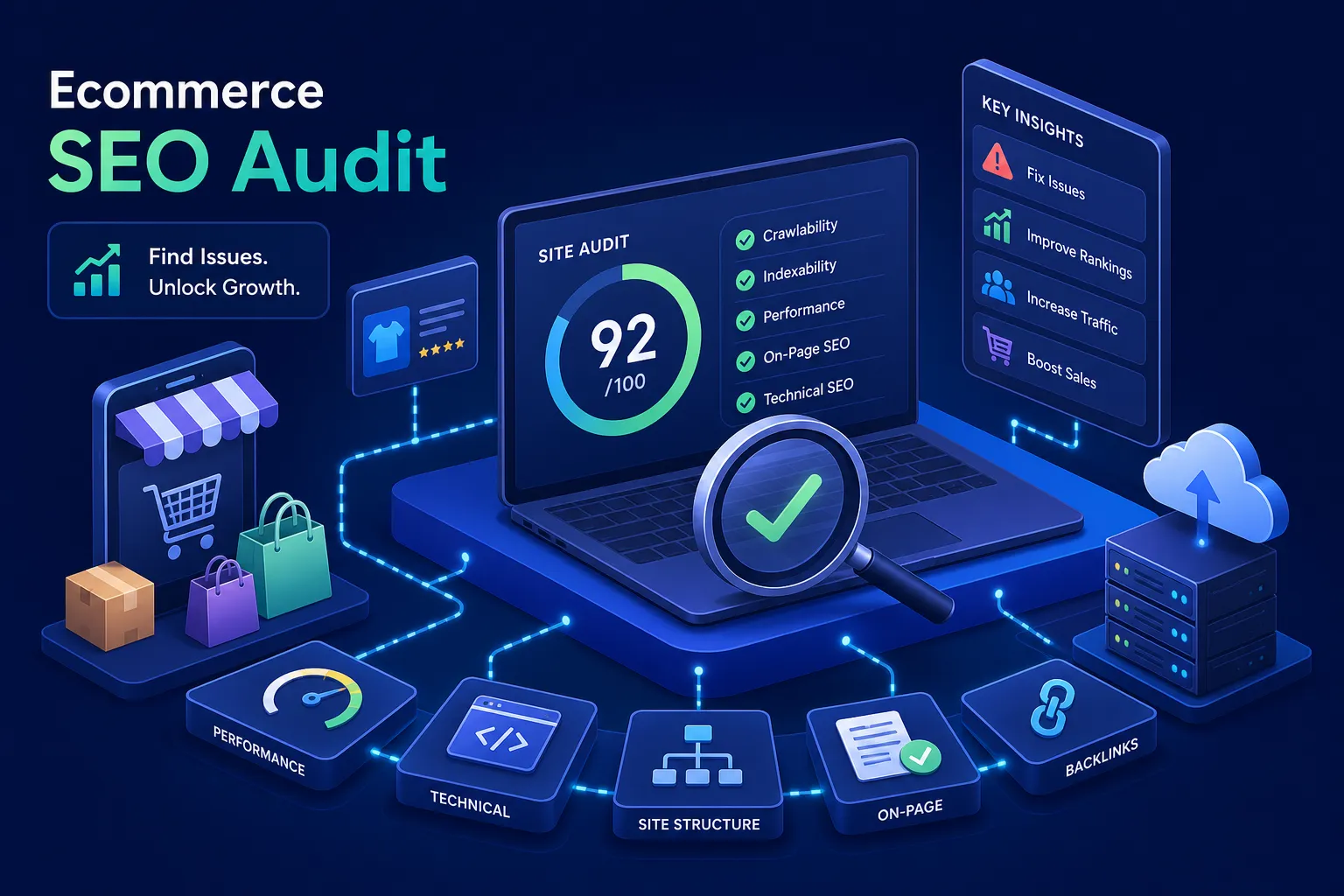
Your store is live, your products are solid, but organic traffic refuses to move. Technical problems are among the leading causes of lost organic performance for ecommerce sites, though content gaps, backlink authority, and product-market fit all play a role too. What separates stores that break through from those that plateau is a thorough set of ecommerce SEO audit services that map every layer of the site against how Google actually crawls, indexes, and ranks product-based content, including the platform-specific traps most generic audits never touch. A real audit goes far deeper than a tool-generated score. It surfaces the configuration-level issues that automated scanners flag but never interpret.
Stores that want prioritized, actionable roadmaps, not just raw findings, are working with specialized partners like Brandleap Agency. This guide walks you through exactly what a professional audit covers, what it costs in 2026, and how to evaluate any proposal before you sign. By the end, you’ll have a 20-point checklist to score any agency quote and a clear picture of what separates a report that collects dust from one that actually moves rankings.
What a real ecommerce site audit actually examines
Crawlability, indexation, and the faceted navigation trap
Ecommerce catalogs are uniquely vulnerable to crawl waste and index bloat in ways that standard content sites never face. Faceted navigation, the filters your shoppers use to browse by size, color, or price, generates thousands of near-duplicate URLs that eat your crawl budget and dilute the ranking signals on your most important category and product pages. For example, a 5,000-SKU store running uncontrolled filters can quietly accumulate many tens of thousands of indexable URLs, most of which Google should never see.
Any technical SEO audit for ecommerce must address robots.txt directives, canonical tag logic across filtered URLs, and XML sitemap configuration as its first layer. The fix isn’t simply blocking everything. Filters with real search demand, like “black leather jackets,” deserve dedicated landing pages, while low-value parameter combinations should be canonicalized back to the clean base collection page and, where appropriate, excluded from crawling entirely.
Product page SEO and schema markup gaps
A product page audit examines title tag structure, meta descriptions, heading hierarchy, image alt text, and schema markup completeness. For Google rich result eligibility, ecommerce pages need Product markup as the foundation, with Offer, AggregateRating, Review, and BreadcrumbList added where applicable. Missing or malformed schema is a common reason stores lose rich result eligibility, and the revenue impact is direct: no star ratings, no price previews, and lower click-through rates.
This is where most automated audit tools fail. They flag a missing tag but don’t evaluate schema accuracy or completeness at the template level. A product page audit that checks a single URL and calls it done misses the reality that one broken template affects thousands of pages simultaneously.
Page speed, Core Web Vitals, and internal linking structure
Bloated themes, unoptimized images, and heavy app or plugin stacks consistently drag down Core Web Vitals scores, particularly on mobile. These aren’t abstract performance metrics. Google uses Core Web Vitals as a ranking signal, per Google’s own published guidance, and slow mobile performance directly suppresses product and category page visibility in competitive verticals.
Internal link architecture is equally critical and frequently overlooked. Poor internal linking means Google can’t efficiently pass authority from your high-value category pages down to individual product pages. Neither issue can be diagnosed from crawl data alone, both demand manual review to catch the configuration-level problems that automated tools miss. Both belong in every ecommerce SEO health check.
Platform-specific checks your online store audit must include
Shopify SEO audit: where the platform creates its own problems
Shopify’s architecture generates duplicate URL patterns from collection routes, product variant URLs, and filter parameters that a non-specialist will miss entirely. A Shopify SEO audit must specifically review canonical tag logic across collection and product templates, since theme-level misconfigurations can quietly create duplicate content at scale. App stack risk is another Shopify-specific problem: overlapping apps that inject duplicate scripts or break canonical logic are common in stores that have accumulated tools over time without auditing them.
GA4 ecommerce event tracking accuracy and checkout trust signal reviews round out the Shopify audit scope. If your conversion tracking is broken, you can’t accurately measure what any SEO improvement actually delivers. That makes every subsequent SEO improvement harder to justify internally.
WooCommerce and Magento: plugin debt and configuration complexity
WooCommerce behavior is largely driven by plugins, and plugin conflicts are the most common source of SEO breaks on WordPress-based stores. A proper audit reviews active plugins for conflicts, duplicated functionality, and theme-level SEO regressions, alongside WordPress database health, which directly affects crawl performance. These platform-specific conflicts, for example, two SEO plugins writing competing canonical tags, won’t appear in a standard crawl report. They require hands-on manual review to surface and resolve.
Magento audits operate at a higher level of technical complexity. Cache and indexer status, layered navigation duplicate handling, extension conflicts, and multi-store canonical configuration all require platform expertise to interpret correctly. A generic audit applied to a Magento store will miss the configuration-level issues that most commonly suppress rankings.
Ecommerce SEO audit services: deliverables and timelines
Core deliverables from a thorough audit engagement
A professional ecommerce SEO audit should deliver a written findings report, a prioritized fix list ranked by impact and effort, keyword-to-page mapping with gap and cannibalization analysis, a backlink quality assessment, and a phased implementation roadmap. Higher-tier audits also include a competitor gap analysis and estimated traffic or revenue impact per fix. A debrief call to walk stakeholders through findings is standard for any reputable provider and should be non-negotiable in your evaluation.
Realistic timelines from kickoff to final report
Small to mid-sized stores should expect a full audit report within one to two weeks. Larger catalogs with faceted navigation, multi-store setups, or significant technical debt typically take two to six weeks. Quick-win fixes, including metadata updates, redirects, and broken link resolution, can often be acted on within days of receiving the report.
Technical fixes like crawl rules, schema implementation, and Core Web Vitals work typically take two to six additional weeks depending on development resource availability, which is usually the variable that pushes timelines toward the longer end. Content-level improvements, category page optimization, and authority-building follow over the next one to three months.
Ecommerce SEO audit services cost: what the market looks like in 2026
Pricing tiers by store size and audit depth
Small stores with straightforward catalogs typically pay $300 to $1,500 for a solid audit. Mid-sized ecommerce sites with larger SKU counts, faceted navigation, and content requirements usually fall in the $1,500 to $7,500 range, with the $3,000 to $5,000 window being the most common for a thorough manual audit. Enterprise retailers or multi-region stores regularly see quotes of $10,000 to $25,000 and above. These bands reflect current market rates and scale with site complexity and audit depth. Most reputable agencies use fixed-fee or tiered package pricing scoped by site size and audit depth.
Why cheap audits cost more in the long run
Automated audits priced under $500 are diagnostic tools, not strategic assessments. They flag issues but don’t interpret them, prioritize them, or connect them to revenue impact. A store that acts on an unranked list of 200 technical flags without a prioritized roadmap wastes engineering time on low-impact fixes while missing the ones that actually move rankings. Any ecommerce SEO audit services cost conversation should always include what implementation support looks like after the report lands.
20-point checklist to evaluate any audit proposal
Technical and on-page coverage: 10 items to verify
Run any proposal through this list before you sign. If even three or four of these are missing, the audit scope isn’t comprehensive enough to drive real results:
- Crawl budget analysis
- Canonical tag audit across templates
- Faceted navigation handling with a resolution strategy per URL type
- Core Web Vitals assessment on mobile and desktop
- Schema markup completeness at the template level
- Product page template review (not just spot-checks)
- XML sitemap configuration
- Internal link structure mapping from category to product pages
- Mobile performance testing
- Duplicate content identification with recommended resolution for each type
Deliverables, process, and provider quality: 10 items to score
These ten factors separate a professional audit engagement from a commodity report. A strong proposal will hit most of them without you having to ask:
- Prioritized fix list with explicit impact and effort scoring
- Competitor gap analysis included
- Keyword-to-page mapping with cannibalization review
- Phased implementation roadmap with sequencing logic
- Debrief call included in the engagement
- Timeline commitment provided in writing
- Platform-specific knowledge demonstrated in the proposal itself
- References or case studies from stores similar to yours in size and industry
- Implementation support available after the report is delivered
- A defined method for tracking ranking and traffic progress after fixes go live
From audit findings to ranking improvements: why execution is the real differentiator
The “report-and-ghost” problem in ecommerce SEO
A common outcome in this industry: an agency delivers a polished audit report and considers the engagement closed. The store is then left to hand off 80 technical line items to an overwhelmed developer with no context on what matters most or why. Without someone to own the implementation, the most valuable findings sit in a PDF while rankings stay flat. Addressing this gap, through prioritized fix lists, implementation support, and post-audit check-ins, is what separates a useful audit from an expensive shelf document.
Organic ranking improvements after resolving technical issues typically begin appearing within two to six weeks for straightforward fixes, with clearer gains visible at the one-to-three-month mark. But that timeline assumes someone is actually executing the roadmap, not just holding the report.
How Brandleap bridges the audit-to-ranking gap
Brandleap Agency treats an ecommerce SEO audit as the starting point of an ongoing engagement, not a standalone deliverable. From identifying crawlability issues and schema markup gaps to executing the fixes, optimizing product page templates, and tracking keyword movement over time, Brandleap covers the full cycle. Every layer of digital marketing sits under one roof, technical SEO, content, on-page optimization, and off-page authority building, which means nothing falls through the gap between the report and the results.
Senior-level judgment applied throughout the process makes a meaningful difference when you’re trying to prioritize 60 audit findings and decide which three to fix first for maximum ranking impact. That kind of strategic triage is what turns a thorough audit document into measurable ranking movement.
The bottom line on ecommerce SEO audit services
A quality ecommerce SEO audit covers crawlability, product page structure, duplicate content from faceted navigation, page speed, schema markup, and internal linking. It delivers a prioritized roadmap with impact and effort scoring, not just an unordered list of issues. Pricing scales with site complexity, and anything under $500 is a diagnostic snapshot, not a strategic assessment.
Use the 20-point checklist above to score any proposal before you commit. Look for platform-specific knowledge, a debrief call, a written timeline, and a clear answer to the question: “What happens after we receive the report?” If a provider can’t answer that, the report is where the value ends.
If you’re ready to move from diagnosis to execution, contact Brandleap Agency for ecommerce SEO audit services built around your platform, your catalog size, and a roadmap your team can actually implement. The goal isn’t a thorough report. It’s measurable ranking growth.