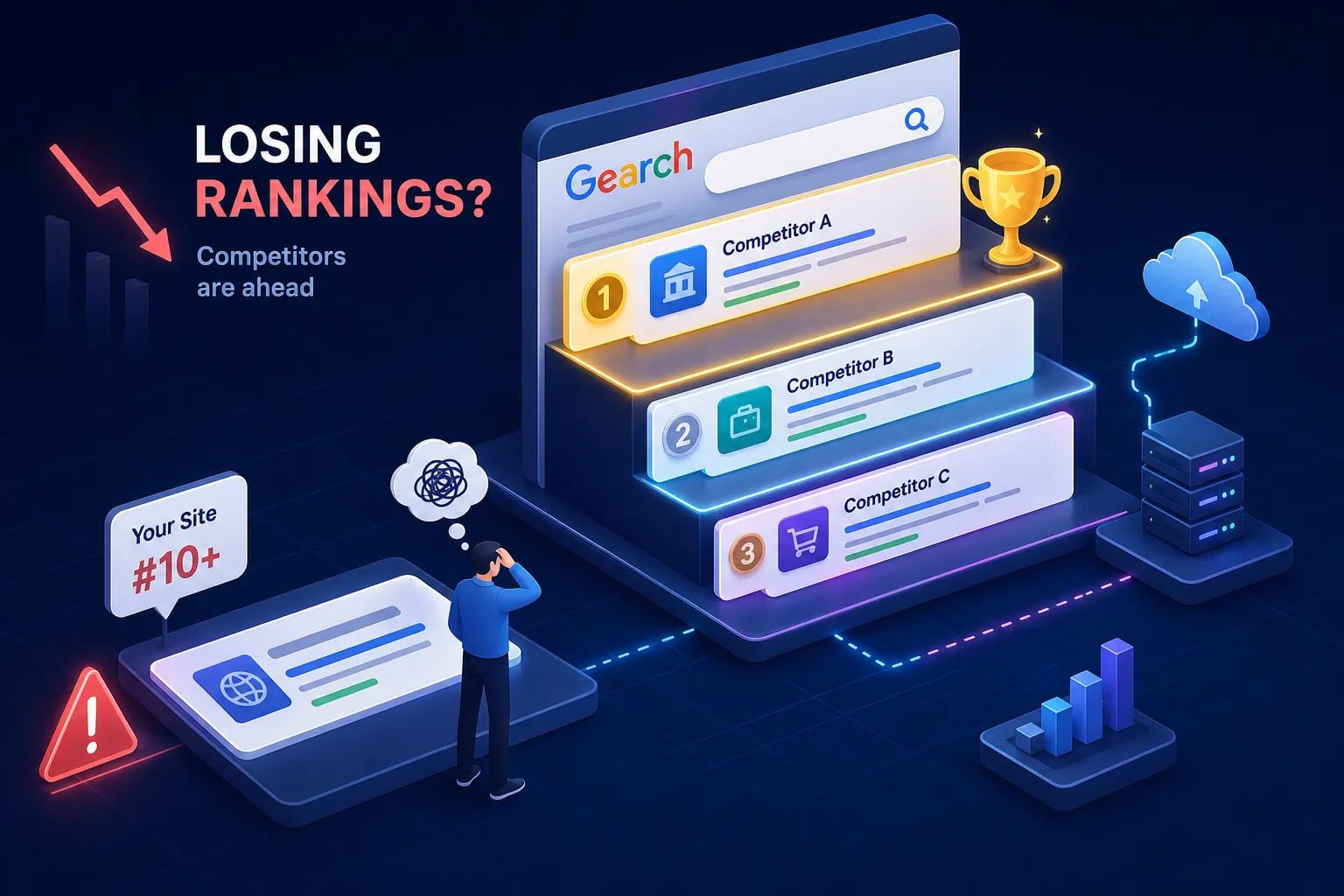
If competitors are showing up before you in search results, you already know how frustrating that is: a business you know is smaller, newer, or less experienced somehow appears above yours when you search your own service on Google. The good news is that it is never random. Competitors do not outrank businesses by accident; they outrank them because of specific, measurable gaps that can be identified and closed. Whether you are running a service business in Cairo or anywhere else in Egypt, those gaps follow a predictable pattern.
This article is a practical diagnostic. By the end, you will know exactly which gap is costing you the most visibility, whether that is in the local pack, in organic rankings, in your technical setup, or in paid search. You will also have five quick checks you can run today and a 30/60/90-day action plan to start recovering ground.
What a competitor gap analysis actually tells you
A competitor gap analysis is a structured comparison: where does a competitor earn search visibility that you do not? The analysis covers four distinct layers because competitors rarely dominate everywhere. They typically win in one or two areas, and those are exactly where to focus your energy and budget.
The four layers are local pack signals, organic authority and backlinks, on-site content depth, and technical SEO plus paid search presence. At Brandleap Agency, our cross-channel gap audits use tools like Ahrefs for backlink gap analysis and Google’s own Auction Insights for brand bidding exposure to map each layer precisely, rather than guessing which fix will move the needle. Knowing the “where” before acting on the “how” is what separates a recovery strategy from an expensive shot in the dark.
The four gap categories that explain most ranking losses
Each layer presents as a question you should be able to answer after reading this article. Is my Google Business Profile weaker than my top competitors on relevance signals? Do my competitors have significantly more referring domains? Does my content fully answer the search intent behind my target queries? Are competitors exploiting technical or paid search advantages I have not noticed? These four questions map directly to the four gap types.
Why fixing one gap without the others rarely works
Many businesses update their Google Business Profile and expect a ranking jump, only to see nothing change because the backlink gap is what is actually driving the competitor’s advantage. Others invest heavily in content while ignoring crawl errors that prevent Google from indexing new pages efficiently. A proper competitor gap analysis tells you which lever matters most for your specific situation, so you stop spending resources on the wrong fix.
Why competitors are showing up before you in local search results: the GBP, reviews, and NAP problem
Most local businesses lose their first visibility battle right here. Google’s three local ranking factors are relevance, proximity, and prominence. Proximity is essentially fixed; you cannot move your business to rank higher on that dimension. Relevance and prominence are the primary levers you can influence, though some prominence signals, such as broader brand demand and third-party mentions, may require longer-term or external efforts beyond standard profile optimization.
A competitor with a better-configured primary category and a stream of recent reviews will consistently outrank a business that has not touched its Google Business Profile in months. In competitive service industries, the review velocity required to stay competitive varies by market and vertical; benchmarking the top three local competitors in your specific category is the most reliable way to set a target. A profile with no new reviews in 90 days can weaken engagement signals and reduce competitiveness against active profiles, especially where nearby competitors maintain a steady stream of fresh reviews.
GBP fields that quietly hurt local pack rankings
According to local SEO practitioner consensus and Google’s own guidance, the primary business category is the single most influential on-profile signal in GBP. If yours is set incorrectly or is too broad, you are starting every local pack race at a disadvantage. Beyond primary category, the fields that cause the most damage when wrong or incomplete include business name consistency, address pin accuracy, hours, and service area settings. Incomplete fields do not just reduce your profile score; some trigger reverification processes or suppress visibility outright.
How NAP inconsistency across directories erodes local authority
Google cross-references your business information across citation directories to establish trust. When your name, address, or phone number appears in different formats across platforms like Yellow Pages Egypt, Waseet.net, Dalili Egypt, and your Google Business Profile, those conflicting signals reduce your prominence score. NAP consistency is not a one-time fix; it requires ongoing audits, especially after any business change like a new phone number or address update.
Review velocity: why your competitors’ review count is not the whole story
Total review count matters less than most people think. In some cases, a smaller but more active profile can outrank a larger but stale one, because review recency and velocity are weighted alongside other prominence signals like proximity and primary category. Practitioner surveys and local SEO analyses from 2025 and 2026 indicate that Google’s emphasis on review engagement has grown stronger. The metric to watch is not your total count but how many genuine reviews your profile is earning per month compared to the top three competitors in your category.
The backlink and content depth gap
For searches without strong local intent, service-plus-problem queries, comparison searches, or informational questions, competitors outranking you in search results typically have more referring domains and more thorough content. A competitor with twice your backlink authority starts every ranking race ahead of you, regardless of how well-optimized any individual page on your site happens to be.
The referring domain gap is easy to spot using Ahrefs or Semrush. Compare the domains linking to a competitor’s site versus yours, then identify the types of links they have that you lack: digital PR mentions, local news coverage, industry directories, or resource page placements. Once you know the categories, white-hat link building efforts can be targeted at exactly those same source types rather than scattered broadly.
Why content depth beats content volume
Search intent alignment is where most small business content fails. A competitor who answers the full question on a single page, including follow-up questions a searcher would naturally have, will consistently outrank a business with ten thin pages that each cover part of the same topic. Google rewards topical depth, not keyword repetition. A well-built content cluster covering a service and its related questions builds topical authority far faster than scattered blog posts that never link together coherently.
Technical SEO and Google Ads advantages your competitors exploit
Two underestimated factors drive more ranking gaps than most business owners realize. First, a competitor’s site may simply load faster, use cleaner crawl structure, and implement proper schema markup, all of which improve how Google indexes and ranks their pages. Second, competitors may be running Google Ads against your branded search terms, meaning when someone searches your business name, a competitor’s ad appears above your organic result, capturing intent you should have owned.
Technical SEO signals that give competitors an edge
The most common technical advantages include Core Web Vitals performance, particularly Largest Contentful Paint, mobile usability, proper canonical structure, and local business schema markup. A competitor with a technically clean site earns better crawl efficiency, which means new content gets indexed faster and rankings stay more stable over time. For smaller business sites, the issues that compound most frequently are slow load times, weak internal linking, poor mobile experience, and incomplete indexation, and these four problems reinforce each other.
Brand bidding: are competitors showing up on your own name in search results?
Brand bidding is when a competitor runs Google Ads targeting your business name as a keyword. It works because searchers who already know your business are still served a competitor’s ad above your organic result. Google Ads Auction Insights is the tool that reveals this. Open the report on your brand campaign and look for competitors with a meaningful overlap rate and a rising position-above rate. A manual incognito search for your business name will confirm what you see in the data. When a competitor is consistently appearing above your branded organic listing, a defensive brand protection campaign is a cost-effective response.
Five quick checks to run before anything else
These five checks cover the highest-leverage diagnostic points from all four gap categories. Each one takes under 15 minutes and will give you a clear picture of where the biggest gaps are before you spend a cent on fixes.
Checks 1 through 3: your local presence health
Check 1: Search your primary service category on Google Maps and pull up the top three competitor GBP profiles. Compare their primary categories, photo counts, total reviews, and the date of their most recent review against your own profile.
Check 2: Run your business name and address through a citation audit tool to identify NAP inconsistencies across major Egyptian directories including Yellow Pages Egypt, Dalili Egypt, Waseet.net, Cylex Egypt, and your GBP.
Check 3: Count the reviews each top competitor gained in the last 30 days by sorting their reviews by “most recent.” This is a direct proxy for review velocity and will tell you exactly how far behind your engagement signals are.
Checks 4 and 5: organic authority and paid exposure
Check 4: Enter your domain and your top competitor’s domain into Ahrefs or Semrush’s backlink comparison tool. Note the referring domain gap and, more importantly, identify which types of sites link to the competitor that do not link to you.
Check 5: Open Google Ads Auction Insights on your brand campaign and look for any competitor with a meaningful overlap rate. If you are not running brand campaigns yet, do a manual incognito search for your business name and see whether any competitor ad appears above your organic listing. The answer will tell you whether brand protection should be on your 30-day priority list.
A 30/60/90-day plan to reclaim your search visibility
Gap analysis without prioritization leads to paralysis. The plan below sequences fixes from high-impact-fast to high-impact-slow, so you recover the most damaging gaps first and build momentum before tackling the longer-term authority gaps.
First 30 days: fix what is actively hurting you
Correct your GBP primary category, hours, address pin, and phone number. Resolve major NAP inconsistencies on the priority directories identified in Check 2. Launch a review request process, whether through post-service follow-up emails or SMS, that targets the velocity gap you measured in Check 3. If a competitor is actively brand bidding, set up a defensive brand campaign immediately to protect the impression share you are currently losing to them.
Days 31 to 60: build the authority your competitors already have
Begin targeted white-hat link building toward the referring domain types you identified in Check 4. Prioritize sources that already link to two or more of your competitors, since those sites have demonstrated interest in your niche and are the most efficient outreach targets. Publish or update your core service pages with deeper content that fully matches the search intent behind queries where competitors currently outrank you. Submit corrected citations to the remaining key directories in your market.
Days 61 to 90: measure, adjust, and defend
Pull updated Auction Insights data, re-run the GBP competitor comparison from Check 1, and measure your review velocity progress against the baseline you established in Check 3. Identify which organic ranking positions have improved and which still need work. Use this data to either continue the current strategy or shift focus to the next gap layer, typically content clusters and technical refinements at this stage. By day 90, the target is a clear measurement of progress and a prioritized list of the remaining gaps to address in the next quarter.
Where to go from here
When competitors are showing up before you in search results, that is not bad luck. It is a measurable gap in one or more of four specific areas: local signals, content authority, technical SEO, and paid search presence. The fastest path to recovery is knowing exactly which gap is largest before investing time or money in fixes.
The five quick checks give you a diagnostic snapshot you can complete today. The 30/60/90-day plan gives you a sequenced roadmap that closes the most damaging gaps first and builds toward sustained visibility over the following months.
If you want a full competitor gap analysis done properly, the team at Brandleap Agency handles everything from GBP audits and NAP cleanup to backlink analysis, technical SEO fixes, content strategy, and Google Ads brand protection campaigns. You focus on serving your customers; we focus on making sure they can find you first.