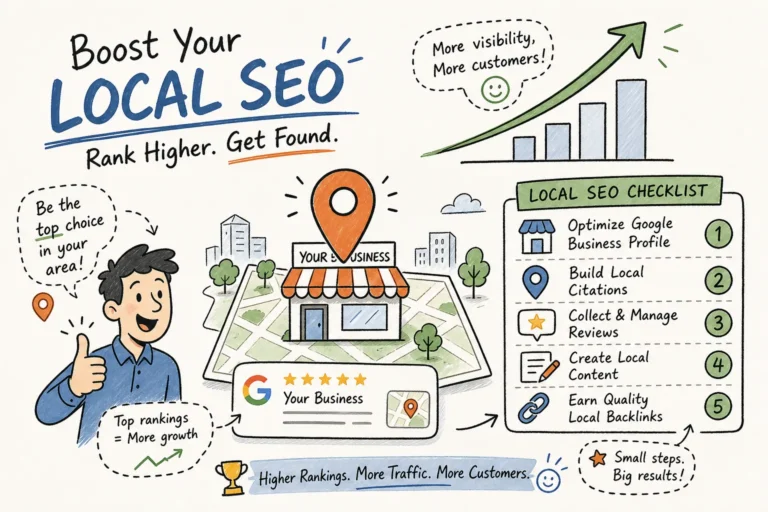
You check Google Maps and there it is: a competitor with half your reviews, a weaker reputation, and a business that’s been open for fewer years than yours sitting comfortably in the local pack. Meanwhile, you’re on page two. That frustration isn’t random, and it isn’t bad luck. It’s a signal that specific ranking levers aren’t working for you yet, and if you’re asking how do I improve my local SEO ranking, you’re already asking the right question.
Local SEO in 2026 isn’t guesswork. According to the Whitespark 2026 Local Search Ranking Factors report, Google’s local pack algorithm distributes weight across clearly defined categories: Google Business Profile signals account for 32%, reviews for 20%, on-page SEO for 15%, and links for 8%. The businesses winning the local pack consistently aren’t doing everything perfectly, they’re doing the high-weight things better than everyone else.
At Brandleap Agency, we’ve spent years running local SEO audits for small businesses across the US, and the pattern is almost always the same: a handful of fixable gaps are costing the most ranking ground. This guide walks through 10 prioritized steps in the order that produces the fastest, most measurable results, so you can improve your local SEO ranking without the trial-and-error.
How do I improve my local SEO ranking? Start with your Google Business Profile
Your GBP is responsible for 32% of your local pack ranking weight, which makes it the single most impactful place to invest your time. Most businesses have claimed their profile but stopped well short of full optimization. That gap is where rankings are lost.
Pick the right primary category first
Primary category selection is the number one individual ranking factor in the Whitespark 2026 study, and it determines how Google matches your profile to relevant searches. The mistake most businesses make is choosing a broad category that technically applies rather than the most specific one available. “Restaurant” won’t compete with “Vietnamese Restaurant” for relevant queries. Search your top two or three competitors directly in Google Maps and check which categories they’ve selected, then confirm you’re using the most precise match available for your business.
Secondary categories extend your visibility for related searches without diluting your primary relevance.
Complete every section of your profile
Complete GBP profiles rank two to three times higher than incomplete ones. The sections businesses skip most often are also the ones that provide the clearest relevance signals: service descriptions, Q&A responses, product listings, and attributes. Attributes like “women-led,” “veteran-owned,” or “wheelchair accessible” directly improve visibility for intent-based searches. If a user searches for “veteran-owned HVAC company near me,” a business with that attribute set will be meaningfully more competitive for that query, so leaving it blank puts you at a real disadvantage.
Keep your profile active with fresh photos and posts
Uploading 10 to 15 new photos monthly signals an active, relevant business to Google. For posting frequency, aim for at least once per week as a baseline, if your business generates frequent, timely content (restaurants and retailers especially), increasing to two or three times per week makes sense. Posts archive after seven days, which is exactly why consistent weekly posting matters. The direct ranking impact comes more from prominence signals than from post content itself, but steady activity correlates strongly with better local pack performance. One quick win that’s easy to overlook: keep your business hours accurate year-round, including holiday hours, since this directly affects visibility for time-sensitive searches like “open now.” For additional guidance on posting cadence and frequency, see this guide on how often you should post on GBP.
2. Build a clean, consistent citation footprint
Citations are the trust infrastructure of local SEO. NAP consistency across directories makes businesses 40% more likely to appear in the local pack. The errors causing the most damage are often small and easy to correct, which makes this a high-priority fix.
Create your master NAP record before touching any directory
Before submitting to or updating any directory, build a single document that captures your exact legal business name, full address format (including suite or unit designation), phone number with area code, and canonical website URL. Pick one format and commit to it everywhere. The difference between “Suite 100” and “Ste. 100” seems trivial, but when Google finds these discrepancies across dozens of directories, it creates ambiguity about whether these are the same business or different ones, and that ambiguity pushes rankings down.
Claim the platforms that actually matter
Work through citations in a tiered order. Start with Tier 1 core platforms: Google Business Profile, Apple Business Connect, Bing Places, Facebook, and Yelp. From there, move to Tier 2 using data aggregator services and citation providers; tools like BrightLocal and Yext can push your data downstream to hundreds of smaller directories, while Whitespark specializes in citation research and cleanup. Then target Tier 3 niche directories relevant to your industry: Healthgrades for medical businesses, Houzz for home services businesses, Avvo for legal. Build five to ten quality citations per month rather than blasting 50 at once, and link to specific service or location pages rather than always defaulting to your homepage.
Audit and fix citation errors regularly
Run a citation audit every quarter using a tool like Moz Local, Whitespark, or BrightLocal. These tools crawl hundreds of directories and flag inconsistencies, duplicates, and missing listings. When you find duplicates, request removal, suppression, or a merge depending on the platform’s rules. Track everything in a simple spreadsheet with columns for the platform name, current status, any notes, and the last date you verified the listing.
3. Turn your review strategy into a ranking engine
Reviews now account for 20% of local pack weight, up from 16% in 2023. That jump is significant. Treating reviews as a passive byproduct of good service is a strategic mistake. The businesses ranking at the top are actively generating reviews through repeatable systems.
Build review volume with a repeatable ask system
According to the BrightLocal Consumer Review Survey, 87% of consumers read reviews before choosing a local business. Google weighs review quantity heavily, and most local SEO practitioners treat 10 reviews as an early trust benchmark worth reaching first. For review request mechanics, ask immediately after a positive interaction and send a direct link to your GBP review page to remove friction from the process.
On channel choice, test both SMS and email to see what resonates with your specific audience, response rates vary by industry and customer base, so the right mix is worth finding. The goal isn’t a one-time campaign; it’s a steady system. Rather than targeting a fixed monthly number, benchmark against your local competitors and aim to match or exceed the median review velocity in your market.
Review recency is the factor most businesses ignore
Review recency remains one of the most underrated local ranking factors, labeled as such by Whitespark’s research and growing in importance through 2026. A business with 200 reviews collected two years ago will often lose ground to one with 80 reviews collected steadily over the past six months. Google’s algorithm interprets steady review velocity as a signal of an active, engaged business. A sudden spike followed by silence can actually work against you. Build velocity into your system rather than running periodic review drives.
Respond to every review, positive and negative
Responding to reviews contributes to prominence and signals engagement to Google. For negative reviews, acknowledge the issue, avoid arguing publicly, offer a path to resolution, and keep the response short. For positive reviews, be specific rather than generic, reference the service the customer mentioned rather than writing boilerplate “thank you” copy. That specificity also reinforces keyword relevance in your review content.
How do I improve my local SEO ranking on my website? Fix these three things
On-page SEO carries 15% of local pack weight and is the layer you have the most direct control over. Three website-level fixes produce the majority of the impact.
Create dedicated location and service pages
A single homepage targeting “plumber Austin TX” won’t rank competitively for businesses serving multiple areas or offering multiple services. Each service and each location you target needs its own dedicated page. A proper location page includes a unique description of services in that area (not copied from another location page), an embedded Google Map, local customer testimonials, and a clear call to action. Service pages should follow a similar structure: service name, target area, specific problem solved, and proof in the form of reviews or case studies.
Add LocalBusiness schema markup
Schema markup is a direct data feed that tells Google exactly who you are, what you do, where you’re located, and when you’re open. The highest-impact fields are name, address, geo-coordinates, telephone, opening hours specification, and URL. When your schema matches your GBP and your citations precisely, you reinforce the same entity signals across multiple sources. For practical implementation notes on local business schema markup, see this guide to local business schema. Google trusts what it can verify consistently, and schema is one of the clearest ways to make that verification straightforward.
Use local keywords naturally in meta titles and content
A well-structured local meta title follows this formula: Primary Service + City or Neighborhood + Differentiator. “Emergency Plumber in Austin, TX, Same-Day Service” communicates both relevance and a competitive advantage in the title alone. Integrate geo-keywords into page headings, body copy, and image alt text throughout each location or service page. Also keep Core Web Vitals in check: mobile speed and load time influence how well your on-page signals convert into ranking performance.
5. Earn local backlinks and build community content
Links carry 8% of local pack weight directly, but they compound the authority of everything else in your profile. The most effective local link-building tactics don’t require large outreach campaigns, which is good news for small businesses.
Get links from local organizations and press
The most accessible local backlinks come from a predictable set of sources: Chamber of Commerce membership (which typically includes a directory listing with a backlink), local newspaper features, sponsoring a community event or sports team, and city business association listings. Five to ten quality local backlinks per month is sufficient to see movement in most markets. Relevance and trust matter more than volume. A single link from the local Chamber of Commerce or a regional news outlet outweighs dozens of links from generic directories.
Write content that serves your local community
Generic blog content rarely earns links. Locally-relevant content does. A neighborhood guide published by a real estate agent serves a genuine community purpose while attracting links from local sites, and it creates additional ranking opportunities for long-tail local queries that competitors haven’t targeted. This type of content positions your business as a community resource and earns organic links over time. The key is picking a single content type that fits your business naturally and publishing it consistently rather than spreading effort across formats.
6. Set up tracking so you know what’s actually working
Without a measurement system, you can’t tell which fixes moved the needle and which need more time. For a single-location business, connecting GA4 and GBP Insights can often be done in under an hour, multi-location setups will take longer, but the process is the same.
Connect GBP Insights with Google Analytics 4
Add UTM parameters to the website link in your GBP so GA4 can track traffic that originates from Maps and local search separately from other organic traffic. Inside GBP Insights, monitor four metrics weekly: profile views, direction requests, calls, and website clicks. A drop in direction requests is worth investigating, check your GBP category, hours, and listing information for anything that may have changed. A drop in calls following a review spike might point to a response tone issue. Track these numbers consistently and they’ll tell a clear story over time.
Monitor local pack rankings with dedicated tools
Standard rank trackers won’t show your local pack position accurately because proximity and personalization cause rankings to vary by location. Tools built for local search, like LocalFalcon, Places Scout, or BrightLocal’s rank tracker, use geo-grid mapping to show where you rank at a street-by-street level. For a recent comparison of the best local rank tracking tools, review this guide to pick a tracker that fits your workflow. Set up a monthly benchmarking routine: record your local pack position for your top five keywords and compare month over month. Movement in these numbers is the clearest signal that your work to improve your local SEO ranking is paying off.
Build a monthly local SEO review cadence
Once a month, run through a short checklist: check for new citation errors, verify GBP hours and information are current, review your ratio of new-to-total reviews, check for unanswered reviews, and compare ranking movement against the prior month. This routine catches small problems before they compound into bigger ranking drops. For business owners who want this process handled without adding it to an already full schedule, working with Brandleap Agency compresses the learning curve and keeps the high-impact fixes prioritized.
Start with the biggest levers and build from there
The priority order matters. Start with GBP optimization because it carries the most weight, then address citations and reviews, then reinforce with on-page improvements and local links. Set up tracking from day one so you can see what’s moving.
Improving your local SEO ranking in 2026 comes down to consistency and completeness, not a one-time setup from two years ago. The algorithm favors active profiles, steady review velocity, accurate information across every directory, and websites that clearly signal local relevance. None of these are technically complex, but all of them require ongoing attention. The businesses that win local search are the ones that treat it as an operational habit, not a project.
If you’re ready to stop guessing and start ranking higher in local search, the Brandleap Agency team is here to help. Whether you need a full local SEO audit or a partner to manage the ongoing work, we can pinpoint exactly where your rankings are leaking and fix what matters most. Explore our local SEO services, or get in touch with Brandleap Agency, and if you’re still asking how do I improve my local SEO ranking, that’s exactly the conversation we’re built for.

BrandLeap Agency & BrandLeap Fashion | Founder & CEO
Mithun is an experienced SEO consultant recognized for helping businesses improve their digital presence through technical SEO, content optimization, and sustainable organic growth strategies. Working in the digital marketing industry since 2019, he has developed expertise in increasing search visibility, driving targeted traffic, and building long-term growth through data-driven SEO solutions. He has worked with businesses across multiple industries, helping brands strengthen their online authority and achieve measurable growth results.