Finding cheap SEO services is one of the most confusing tasks in digital marketing. You’ll find $99/month automated tools sitting next to $500/month agency packages and $1,500/month boutique services, all promising roughly the same thing: better Google rankings for your business. The gap between what those price points actually deliver is enormous, and the cost of choosing wrong isn’t just wasted money, it can mean Google penalties, lost rankings, and months of recovery work to undo the damage.
Small business owners are absolutely right to look for affordable SEO services. You don’t need an enterprise budget to compete locally. What you do need is a realistic picture of what each price tier buys, what questions to ask, and which warning signs should make you walk away. At Brandleap Agency, we review proposals from across this market regularly, and the difference between a smart budget buy and a costly mistake usually comes down to knowing what to look for before you sign anything.
This guide gives you that framework. No vendor cheerleading, no vague advice. Just a direct breakdown of pricing, deliverables, red flags, and the questions you need to ask before committing to any SEO service.
Why budget SEO has such a complicated reputation
The skepticism most business owners bring to this search is completely earned. The phrase “cheap SEO” became synonymous with bad outcomes for a reason, and that history still shapes what you’ll find at the lowest price tiers today. Understanding where that reputation came from helps you separate the legitimate from the predatory.
The history of low-cost SEO and why the stigma stuck
In the early 2000s, SEO was largely a manipulation game. Agencies at the low end of the market built link farms, stuffed pages with keywords, and used automated tools to fake authority at scale. It worked briefly, because Google’s algorithm wasn’t equipped to catch it. When Google rolled out its Penguin and Panda updates, sites built on those shortcuts faced penalties and ranking losses, and the clients who paid for those services were left with damaged websites and no recourse. The agencies had already moved on to the next client.
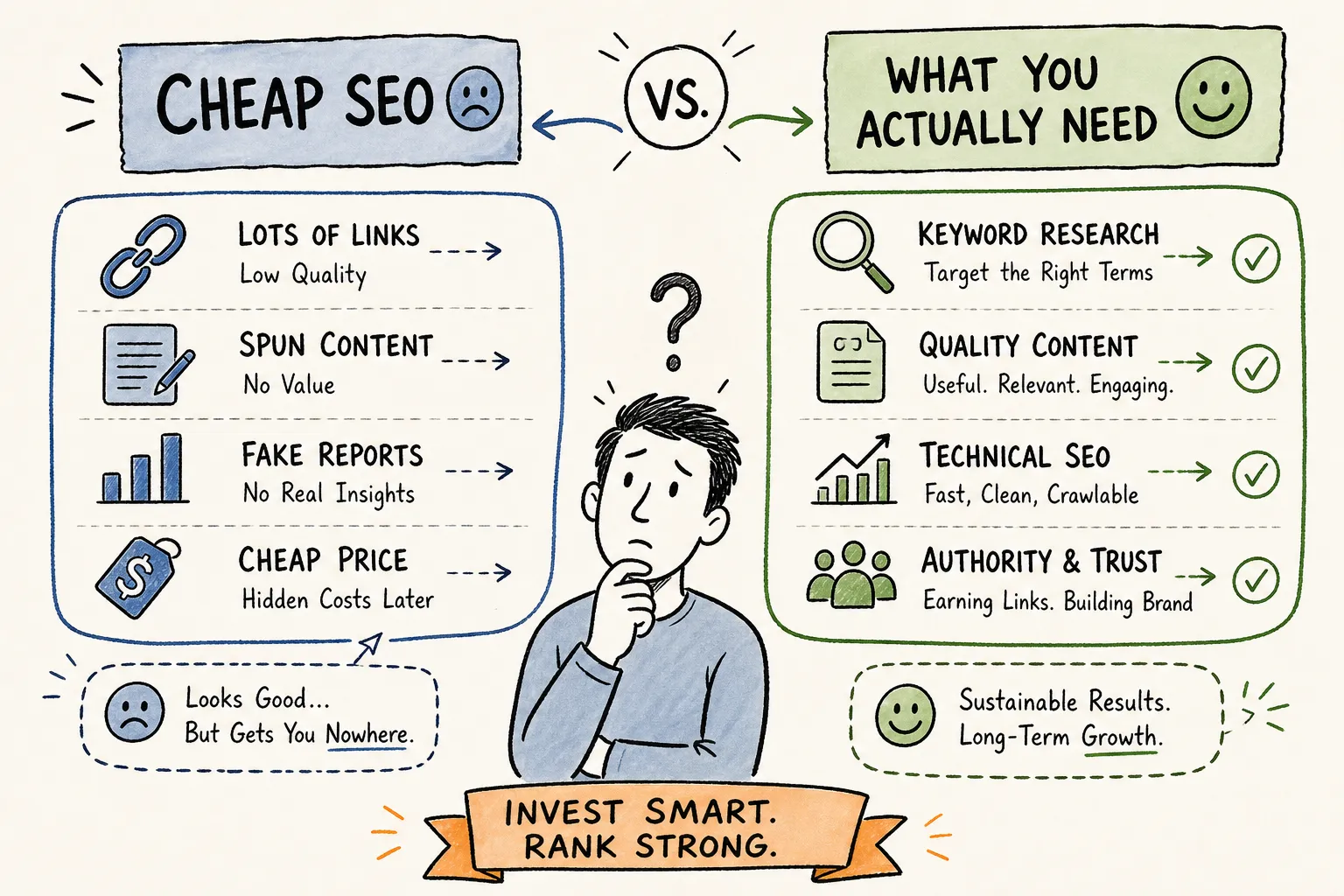
Those tactics didn’t disappear. They just got cheaper to run. Bulk backlink packages, spun content, and private blog networks still circulate at the lowest price tiers, carrying the same penalty risk they did a decade ago. Google has become significantly more sophisticated at detecting manipulative patterns, which means the damage from these shortcuts tends to materialize faster than it once did.
Affordable vs. cheap: why the distinction matters
Affordable SEO means legitimate strategy delivered at a price point accessible to small businesses. Picture a local agency charging $800/month to optimize your Google Business Profile, build citations, and produce two well-researched blog posts per month, that’s affordable. Cheap SEO, by contrast, means shortcuts that compromise your site’s standing with Google in exchange for short-term movement on metrics that don’t matter: think 500 automated backlinks from irrelevant sites or keyword-stuffed content produced by a content spinner. The first is a real category with real results. The second is a liability dressed up as a bargain. The rest of this guide is about helping you tell them apart.
Cheap SEO services: what different price points actually buy you in 2026
The most useful thing you can do before evaluating any SEO proposal is understand what’s actually normal at each price tier. In 2026, small business SEO pricing in the U.S. runs from roughly $300/month at the entry level to $3,500/month for more competitive campaigns. Here’s what each tier realistically delivers.
The $100, $500/month tier: what’s actually possible here
At this price point, you’re often getting automated tools, templated reports, and minimal human strategy. A $99/month automated content engine, for example, isn’t inherently worthless for a solo operator in a low-competition niche who just needs fresh content indexed, but it’s not a substitute for real strategy. Other agencies in the $250, $500 range may include keyword research and basic on-page optimization for a handful of pages, plus monthly reporting. Watch for setup fees in this tier, too; a $299/month retainer with a $350 onboarding fee changes the real first-month cost significantly.
The honest ceiling for this tier: if your market has any real competition, this budget will not move the needle. It can help you lay a foundation if your site is brand new and your niche is genuinely low-competition, but treat it as a starting point, not a growth engine. This is also the tier where low-cost SEO packages most frequently rely on automation rather than human judgment.
The $500, $1,500/month range: where cheap SEO services start delivering real value
This is where you start getting actual human strategy. At $500, $1,500/month, a legitimate agency can deliver on-page optimization for 5, 15 pages, local SEO setup, Google Business Profile management, basic link building from relevant sources, and monthly reporting with real data. For local service businesses, contractors, dentists, small retailers, this range covers the core work that drives local organic visibility.
It’s worth noting that many industry sources place the small business SEO pricing sweet spot closer to $1,000, $2,500/month for competitive markets. The $500, $1,500 range is often sufficient for businesses in low-to-moderate competition niches or those targeting a single service area. If you’re competing in a crowded local market, budget toward the higher end of this range. The ROI on local SEO tends to be faster and more measurable than broader organic campaigns, because local intent searches convert at higher rates, which makes this tier genuinely viable for businesses where a few extra calls or bookings per month more than covers the cost.
The $1,500, $2,500/month range: when more investment makes sense
If SEO is a meaningful revenue driver for your business, or if you’re competing in a market where established players have been investing in their online presence for years, the $1,500, $2,500 range gives agencies the scope to do real work. This covers fuller content strategies, active link outreach, technical SEO beyond the basics, and genuine customization instead of cookie-cutter packages. At this tier, you’re not buying more of the same deliverables, you’re buying strategic depth that compounds over time.
Standard deliverables in low-cost SEO packages
Knowing the price tiers is one thing. Knowing what to actually demand within those tiers is what protects you from paying for work that never gets done. Here’s what the five core deliverables look like at budget price points.
On-page and technical SEO: what’s included and what’s not
Entry-level packages typically cover title tags, meta descriptions, header hierarchy, image alt text, and internal linking for 5, 10 priority pages. On the technical side, expect an initial audit followed by fixes for the highest-impact issues: crawl errors, indexation problems, mobile usability, and basic site speed improvements. What you won’t get at budget price points is a full site architecture redesign or complex technical rebuilds. Those require significantly more hours than a $500/month retainer can support.
Local SEO and Google Business Profile work
Local SEO is where affordable packages often punch above their weight. The core work is well-defined, and the results are relatively quick to measure. A solid budget package should include GBP setup and optimization, citation building with NAP consistency cleanup across key directories, and sometimes ongoing GBP posting. When cheap local SEO is executed correctly, with proper NAP consistency, category optimization, and review management, a $500, $1,000/month package can generate real business results for service-area businesses. This deliverable is worth scrutinizing carefully in any proposal you receive.
Content and backlinks at lower price points
Budget packages typically include 1, 4 blog posts or page refreshes monthly, based on a brief rather than deep original research. That’s acceptable as long as the content is genuinely optimized for search intent rather than produced as thin filler. For backlinks, ask specifically: how many links per month, from what types of sites, and how are they sourced? A small number of quality manual placements from relevant local or industry sites is the right answer. Any mention of volume-based packages or automated outreach is a problem, not a feature.
Red flags that separate scams from legitimate bargains
This is the section that will save you real money. Every red flag below has a specific reason behind it, and knowing the “why” helps you spot variations of the same problem even when the language changes.
The ranking guarantees and timeline promises that should always raise alarms
No agency controls Google’s algorithm. Guaranteed page-one rankings are meaningless because the guarantee can’t actually be delivered. What usually happens is the agency targets a handful of ultra-low-competition keywords with near-zero search volume, hits those rankings, and calls it a success. You ranked for something nobody searches for, and your business didn’t get a single call from it. Any contract that defines success as a specific rank rather than qualified traffic, leads, or revenue is one to walk away from immediately.
Tactics and reporting patterns that hide poor-quality work
“Secret” or “proprietary” methods are rarely protecting anything valuable. They usually mean the provider won’t tell you they’re sourcing links from link farms or running automated content at scale. Vague monthly reports with no raw data, no backlink lists, and no clear task logs signal that the work isn’t being done. If a report shows you a rank screenshot and nothing else, you have no way to verify that any actual optimization work happened that month. Bulk backlink offers, specifically anything framing “500 links in 30 days” as a benefit, are the clearest sign of spammy link-building that will eventually get your site penalized.
One-size-fits-all packages with no audit or strategy
A legitimate SEO engagement starts with understanding your site, your market, and your competitors. If an agency quotes you a price without asking about your business, your niche, your existing rankings, or your competitors, they’re selling a product off a shelf, not building a strategy for your specific situation. That’s a meaningful distinction because SEO that works for a plumber in a small market will not work for an e-commerce store competing nationally, and a provider who treats both the same way is not doing real SEO work.
How to pick cheap SEO services for your small business
Here’s how to apply this framework when you’re actually vetting a proposal. These questions separate providers who can deliver from those who can only sell.
Questions to ask any affordable SEO provider before signing
Start with the specifics of the work itself. Ask what tasks will be completed each month and how they’ll be documented in your monthly report. Ask how they build backlinks, whether they can show examples from past clients, and how they define success for a business like yours. Then ask the accountability question that most buyers skip: what happens if your rankings drop after working with them? A provider with a real process will have a real answer. A provider selling shortcuts will get evasive.
What good SEO reporting looks like regardless of price
Legitimate providers report on keyword movement, organic click volume, conversion actions, and completed deliverables, not just a rank screenshot. Monthly reports should include a clear task log, backlink acquisition details, and honest context for any traffic changes, including explanations when things don’t improve. If a provider can’t tell you what they did last month and why it matters, that’s a dealbreaker at any price point.
What an ethical affordable SEO agency actually looks like
For context, here’s what that standard looks like in our own practice at Brandleap Agency. Our small-business SEO packages are built on semantic SEO strategy, transparent monthly reporting, and ethical link-building, without the shortcuts that put client sites at risk. We start every engagement with an audit, document every deliverable, and measure success in terms that actually connect to business outcomes: traffic, leads, and conversions, not vanity rankings on low-traffic keywords. Affordable and quality are not opposites. They just require a more careful vetting process on your end and a provider willing to be held accountable on theirs.
The bottom line on cheap SEO services
The cheap SEO market is real, the risks are real, and so are the legitimate options. The $100, $500/month tier is useful only in very limited circumstances. The $500, $1,500/month range is where many small businesses in low-to-moderate competition markets find genuine value, provided they choose the right provider. The $1,500, $2,500 range is worth considering when SEO drives meaningful revenue and the competitive landscape demands more depth.
When evaluating cheap SEO services, demand these deliverables regardless of price: documented monthly tasks, honest backlink sourcing, real reporting with organic traffic and conversion data, and a strategy that started with an actual audit of your site. The red flags to avoid: guaranteed rankings, time-bound promises, bulk link packages, vague reporting, and anyone who quoted you a price before asking a single question about your business.
Use this framework to evaluate the next SEO proposal that lands in your inbox. If you want to start with a provider that already meets these criteria, Brandleap Agency offers affordable, strategy-first SEO built specifically for small businesses and local service providers. Reach out for a free audit and a straightforward conversation about what your site actually needs.