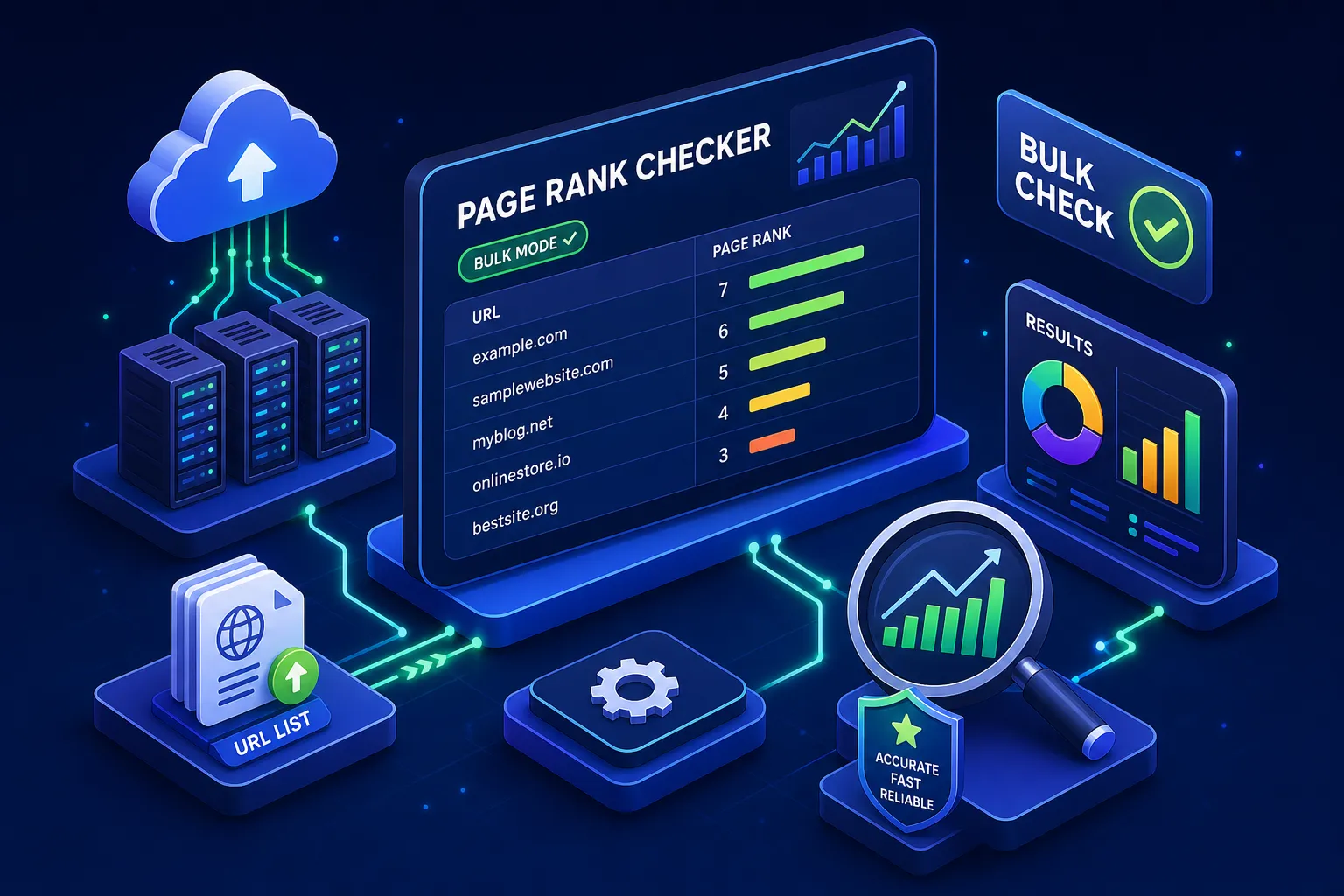
Checking domain or page authority for 100+ URLs one at a time is a bottleneck no serious SEO professional can afford. You click, wait, copy, paste, repeat, and by the time you’re done, half an hour is gone and you’ve barely scratched your prospect list. A reliable bulk website page rank checker cuts that process from hours to minutes, freeing you to focus on what the data actually means rather than how to collect it.
Before we get into the tools, there’s something worth clarifying upfront: “PageRank” on most tools today is not Google’s PageRank. Google retired its public Toolbar PageRank in 2016 and no longer provides public PageRank scores; the metric remains an internal signal that is not publicly exposed today. Every tool calling itself a “Google PageRank checker” is using a third-party proxy metric. Knowing that distinction protects you from putting weight in numbers that don’t reflect how Google actually evaluates your pages.
This article covers the best bulk rank-checking tools available in 2026, how to run a clean normalized batch URL rank audit, and how to turn raw scores into real SEO decisions. At Brandleap Agency, we run bulk rank audits as part of nearly every technical SEO engagement, and choosing the right bulk website page rank checker makes all the difference in what you discover.
Why “PageRank” doesn’t mean what it used to
Google officially removed Toolbar PageRank in 2016. The underlying algorithm still exists as one of Google’s hundreds of internal ranking signals, but it remains locked inside Google’s systems and is not publicly exposed today. Any tool claiming to show you “Google PageRank” is showing you a reconstructed proxy, not the real thing. That’s not a knock on those tools, it’s just important context before you start comparing scores across platforms.
The modern alternatives serve different purposes, and choosing the wrong one for your audit goal leads to bad conclusions. Here’s how they break down:
- OpenPageRank: A free, link-graph-based reconstruction using Common Crawl data. Scores run 0, 10. The best-known free option for lightweight bulk checks at meaningful scale.
- Moz Domain Authority (DA): Domain-level authority scored 0, 100. Strong for broad competitive comparisons, but it won’t tell you anything at the individual page level.
- Ahrefs URL Rating (UR): Page-level link strength scored 0, 100. The closest modern analogue to original PageRank for individual URLs.
- Ahrefs Domain Rating (DR) / Semrush Authority Score: Domain-level metrics that factor in referring domains, estimated organic traffic, and spam signals.
The rule of thumb is straightforward: page-level audits call for Ahrefs UR or OpenPageRank, domain-level screening calls for DR or Moz DA, and budget-constrained bulk checks are best served by OpenPageRank, the most widely used free option for high-volume work. Just note that Apify and DomCop also advertise large batch capacities; verify current free-tier limits against their documentation before planning a large-scale workflow.
How to pick a bulk website page rank checker
The tool landscape breaks cleanly into free options that handle large URL volumes and paid platforms that return richer data per URL. Where you land depends on your audit scope and whether you need the data for a quick screen or a detailed client report. When choosing a bulk website page rank checker, the most important variables are batch size limits, whether the tool operates at the domain or page level, and what export options are available downstream.
Free bulk checkers
The OpenPageRank Bulk Checker via Apify is the strongest free option for large-scale batch audits. According to Apify’s actor documentation, it accepts up to 5,000, 12,000 domains per run depending on configuration, and it includes API key rotation to manage rate limits across high-volume jobs. If you need to audit a large link prospect list or a competitor’s backlink profile, this is where you start.
The BulkSEOtools Bulk PageRank Checker handles up to 500 URLs per run; check BulkSEOtools’ current pricing page to confirm whether basic use requires an account. Their separate Bulk Domain Authority checker supports up to 200 URLs and returns Moz DA alongside the PageRank-style score, which makes it useful when you want both metrics in one pass. The PrePostSEO Bulk Google PageRank Checker caps at 10 URLs per check, acceptable for spot-checking individual pages, but it won’t work for any real bulk audit workflow.
For teams that want free bulk checking above 500 URLs, DomCop’s OpenPageRank tool allows up to 1,000 domains via textarea input. Between DomCop and Apify’s implementation, you have two well-known free options for different batch sizes, though both tools’ free-tier limits and API pricing can change, so confirm current terms directly in their documentation before building a workflow around either.
Paid bulk options: Ahrefs, Moz, and Semrush at scale
Ahrefs Batch Analysis supports up to 200 URLs per batch and returns URL Rating, Domain Rating, referring domain count, and estimated organic traffic per URL. It requires an active subscription, but it delivers the richest data set per URL of any tool in this category. If you’re running audits for paying clients, the depth justifies the cost.
Moz Link Explorer allows bulk input for DA, Page Authority, and spam score checks across multiple URLs, with CSV export built in. That export functionality makes it practical for agency reporting workflows where you need a clean file to drop into a client deck. Semrush Bulk Analysis returns Authority Score alongside backlink and traffic data, which is valuable for clients who want a single tool covering paid, organic, and authority metrics together rather than stitching reports from three platforms.
On API access and export: OpenPageRank offers a free public API with documented endpoints. BulkSEOtools provides CSV export on most of its bulk tools. Ahrefs and Semrush both support CSV export and API access on paid plans, with rate limits tied to subscription tier. If your workflow requires automation, Ahrefs and Semrush are the clear choices; if you’re building a free pipeline, OpenPageRank’s API is surprisingly capable.
How to run a clean batch URL rank audit
The quality of your audit output is entirely determined by the quality of your input and how you handle the data after it comes back. Rushing either step produces numbers you can’t trust.
Step 1: Prepare and normalize your URL list. Collect all target URLs or domains into a single spreadsheet column. Decide upfront whether you’re auditing at the domain level or the page level, that choice determines which tool and which metric you use. Then normalize the format before submission: lowercase all hostnames, strip UTM parameters and trailing slashes, remove fragments, and decide how to handle www vs. non-www variants consistently. Inconsistent formatting causes duplicate results and mismatched data in your output, which creates extra cleanup work after the fact.
Step 2: Run the bulk check and capture raw results. Submit your full cleaned list as one batch wherever possible. For a mass PageRank check using the OpenPageRank Bulk Checker, that can mean thousands of domains in a single paste. For Ahrefs Batch Analysis, chunk your list into groups of 200. Save the raw API response or exported CSV exactly as returned before you modify anything. That raw file is your audit baseline, and you’ll want it when you re-run the check in 90 days to measure change.
Step 3: Deduplicate, filter, and structure for reporting. Deduplicate by your canonical key (normalized domain or full URL) to catch any entries that slipped through your prep step. Apply score thresholds to reduce noise: filter out URLs that returned no data, failed lookups, or scores outside your audit’s relevant range. Sort descending by score so your highest-priority URLs appear first in the report and reviewers don’t have to hunt for what matters.
Reading bulk rank scores without drawing the wrong conclusions
OpenPageRank scores are best read in relative terms, not as absolutes. A score below 3 typically indicates a new or thinly linked domain, a useful directional signal, though treat these thresholds as editorial benchmarks rather than formally published standards. Scores in the 4, 6 range represent mid-tier authority. Scores of 7 and above signal a well-cited domain in the crawled open web. These bands are defensible in audit reports; citing decimal differences is not, because the dataset refreshes periodically (sources describe monthly to quarterly update cycles, so small movements between runs often reflect crawl timing rather than real authority shifts).
Any single bulk score gives you one data point. On its own, a PageRank-style score tells you nothing about content quality, keyword rankings, or conversion performance. Build the full picture by joining your bulk rank output with organic traffic data from Google Search Console, indexed page counts, and referring domain quality from Ahrefs or Semrush. That combination turns a raw number into a defensible audit finding you can present to a client or use to prioritize your roadmap.
Turning bulk rank data into actual SEO action
Sort your output by score ascending. Pages in the bottom quartile of your site with meaningful organic search intent behind them are your strongest link-building candidates. They have content worth ranking but lack the authority to compete. Cross-reference those low-scoring pages with their current ranking positions: a page sitting at positions 6, 15 with weak UR or OpenPageRank score is often a strong link-building candidate, increasing page authority can help it climb SERPs, though outcomes vary by keyword competitiveness and on-page quality. That’s a high-ROI priority that a bulk SERP rank checker surfaces in seconds.
For reporting, export your filtered output to a CSV structured with five columns: normalized URL, raw score, score tier (low, mid, or high), last checked date, and recommended action. That format works cleanly in Google Sheets, Notion, or any BI tool. Schedule bulk rank checks on a recurring cadence: monthly for active campaigns, quarterly for baseline monitoring. Keep raw, filtered, and report-ready tabs separate so historical data is never overwritten by a new run. That separation makes trend analysis straightforward when leadership asks whether the program is working.
When bulk audit results reveal more than a spreadsheet can fix
A bulk URL rank checker surfaces the data. It doesn’t diagnose why dozens of pages have weak authority, why your domain-level DR has stalled, or why competitors with fewer indexed pages consistently outrank you. Common warning signs include a large portion of indexed pages with near-zero authority scores, a flat or declining DR across multiple audit periods, and a backlink profile concentrated on a handful of pages while the rest of the site is ignored. Those patterns point to a strategy problem, not a tool problem.
At Brandleap Agency, the team uses bulk rank data as a starting point, not an endpoint. Audit findings feed directly into a prioritized technical SEO plan, a white-hat link building roadmap targeting the pages that need it most, and a content strategy aligned with the pages closest to a ranking breakthrough. The goal is never a clean spreadsheet, it’s measurable movement in organic visibility and qualified leads.
If your bulk audit results are pointing at problems you don’t have the bandwidth or expertise to close, Brandleap’s integrated approach covers the full path from identifying the gaps to resolving them with sustainable, transparent results. Reach out to Brandleap Agency, we’ll turn your audit data into a growth plan.
The bottom line on bulk website page rank checker tools
The right bulk website page rank checker depends on your audit goal and budget. OpenPageRank handles free bulk checks at serious scale. Ahrefs UR gives you the most accurate page-level authority signal when you need it. Moz DA and Ahrefs DR handle domain-level competitive comparisons. None of them replace each other, they serve different layers of the same audit.
Running a clean batch means normalizing your input before submission, saving the raw output before touching anything, and deduplicating against a consistent canonical key. Interpreting the results means reading scores in context alongside traffic, indexation, and backlink quality rather than treating a single number as a verdict. Whether you’re running a quick bulk URL rank checker pass on a prospect list or a full mass PageRank check across your entire site, the tools in this guide give you everything you need to audit at scale. What you do with the findings is what separates a useful audit from one that fills a folder and gets forgotten.