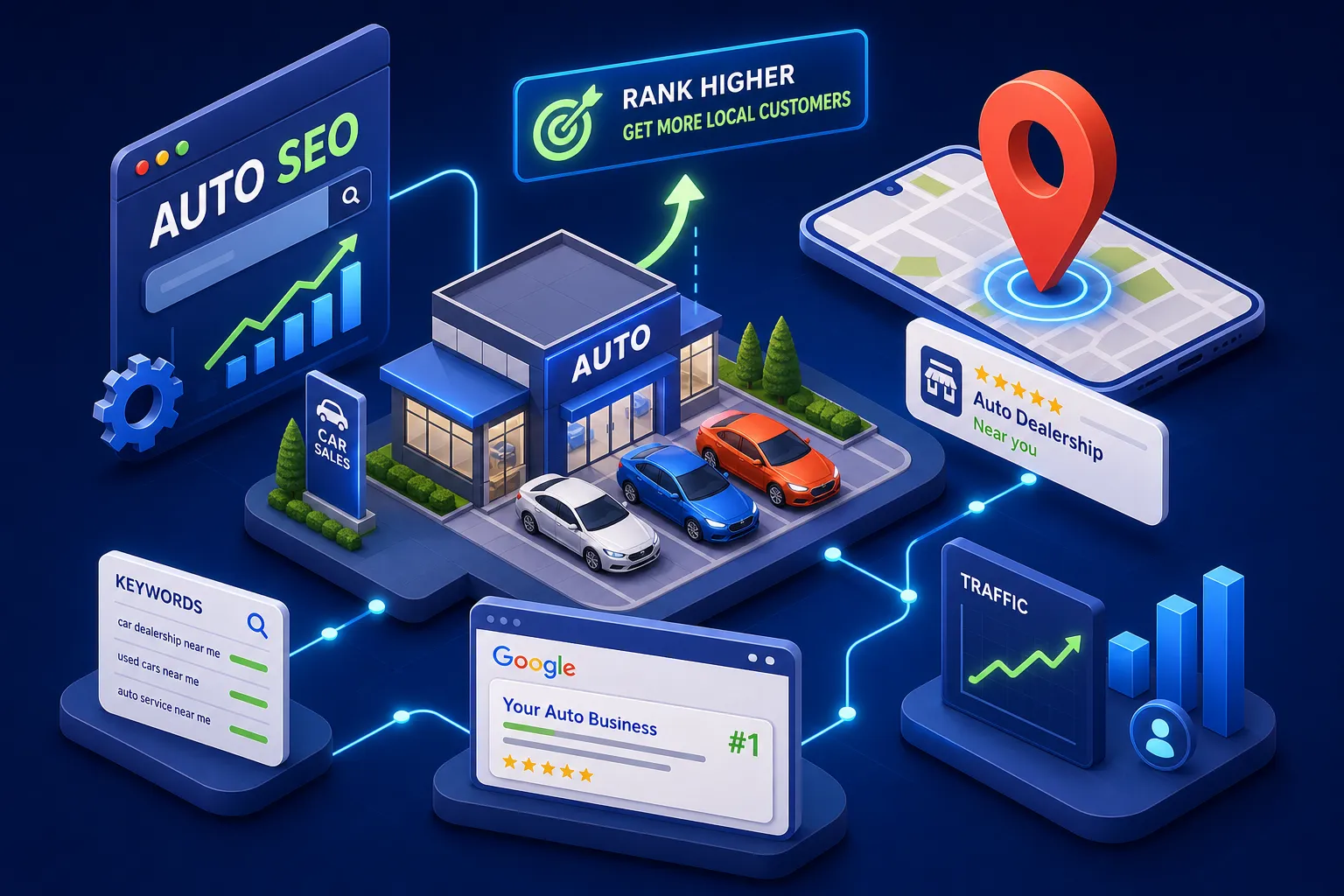
Many dealerships and repair shops lose local customers not because of their inventory or service quality, but because a competitor ranks higher on Google. Think about how often someone in your city searches “used trucks near me” or “transmission repair [your city name]”, and if your business isn’t appearing in the top results, that lead goes to whoever does. Specialized automotive SEO services exist to fix that specific problem, and understanding what they actually include will help you evaluate providers with a much sharper eye.
This article breaks down exactly what a complete automotive SEO engagement covers, what results are realistic at three, six, and twelve months, what these services cost in 2026, and which red flags to walk away from. Whether you run a single-location repair shop or a multi-rooftop dealership group, the same core local search principles apply. The goal is to help you hire well, or audit whoever you’re already paying.
What automotive SEO services actually cover
Not every agency delivers the same scope, so knowing the standard deliverables protects you from paying for half a service. A complete automotive SEO services engagement covers five core areas: technical SEO audits and fixes, on-page optimization of inventory and service pages, local SEO through Google Business Profile, structured data markup, and content production. Some agencies treat these as optional add-ons. They should be the baseline.
Technical foundation: what gets audited and why
Dealer websites carry heavy technical debt. Site speed problems, crawlability issues, broken internal links, and incomplete sitemaps all weaken how search engines read your pages. A reputable agency runs a full technical audit early in the engagement and produces a prioritized fix list with measurable outcomes tied to each issue.
Core Web Vitals, mobile performance, robots.txt hygiene, and redirect chains are all part of this initial review. These aren’t optional cleanup tasks, they determine whether Google can properly index your inventory and service pages in the first place. If a provider skips the audit phase or can’t show you the output, that’s a process problem worth flagging immediately.
On-page optimization for inventory, service, and location pages
Title tags, meta descriptions, headers, and page content on your vehicle detail pages and service department pages all need keyword alignment. A good provider optimizes these to match how local buyers actually search: city name plus make, model, or service type. Generic titles like “Vehicle Detail Page” or “Service Department” leave real ranking potential on the table.
For dealerships, this means optimizing model landing pages, financing and lease pages, and inventory categories. For repair shops, dedicated service pages for high-volume searches like “brake repair [city]” or “oil change [city]” carry significant local ranking weight when built correctly. This is the core of effective auto repair SEO, matching page structure to how real buyers search.
Structured data and schema markup for auto businesses
Schema markup tells search engines exactly what type of business you are and what your pages contain. For dealerships, the critical schema types are AutoDealer, Vehicle, and Offer markup on inventory pages. For repair shops, AutoRepair or LocalBusiness schema combined with Service and FAQPage markup is the right foundation. AggregateRating schema layered on top adds review trust signals that improve click-through rates in search results.
Schema is frequently missing or broken on dealer platforms, and many providers either skip it or implement it inconsistently. Properly validated schema is often a relatively quick, high-impact improvement on a technically underserved dealer site, and any agency that doesn’t include it in their standard engagement is leaving visibility on the table. You can verify this yourself by running your site through Google’s Rich Results Test before signing any contract.
Local automotive SEO services: GBP, reviews, and local keywords
For auto businesses competing in a specific city or metro, three elements drive local pack visibility more than anything else: a fully optimized Google Business Profile, an active review strategy, and the right local keyword targets. Most dealers and repair shops under-invest in all three simultaneously, which is exactly why consistent execution creates such a strong competitive advantage.
Google Business Profile optimization for dealerships and repair shops
Your Google Business Profile is often the first thing a local buyer sees before they visit your site. Your primary category is the single strongest controllable ranking factor on your profile, because it determines the core relevance match between your business and a search query.
Selecting the most precise primary category, adding legitimate secondary categories, and completing every attribute field are the foundation. From there, uploading regular photos, publishing consistent posts, and maintaining accurate hours all send ongoing relevance signals to Google. For multi-location dealers, each location needs a separately optimized profile with unique content. Duplicate descriptions and identical service listings across profiles dilute relevance signals rather than amplify them. Each rooftop should be treated as its own local entity with its own profile management workflow.
Review management as a local search ranking signal
Review volume, recency, and response rate all factor into how Google ranks local businesses in the map pack. The highest-converting review generation tactic for both dealerships and repair shops is a verbal ask at vehicle pickup, followed by an SMS with a direct Google review link sent within one to two hours of service completion. That combination consistently outperforms either method alone. A backup email one to three days later for non-responders rounds out a complete workflow.
Responding to every review within 24 to 48 hours matters more than most dealers realize. Responses add context and engagement signals to your profile, demonstrate responsiveness to prospective customers reading reviews before they call, and may support local visibility over time. Leaving negative reviews unanswered is both a trust signal problem and a missed local SEO for car dealerships opportunity.
Local keyword strategy specific to the auto industry
Automotive buyers search with specific patterns: “near me” queries, city plus make or model combinations, and service-specific phrases like “transmission repair Austin” or “used Honda Accord Dallas.” Mapping these intent patterns to dedicated landing pages, rather than trying to rank a single homepage for everything, is what separates agencies that drive leads from those that just drive traffic.
A single well-built location page targeting “Ford dealer [city name]” with locally relevant content, proper schema, and internal links from inventory pages will outperform a generic homepage optimized for broad terms every time. The local keyword strategy should produce a page map, not just a keyword list. This is a core distinction in effective auto dealer SEO.
Technical problems that quietly drain dealer website rankings
Automotive websites are among the most technically complex in local SEO. Inventory systems generate thousands of near-duplicate URLs, filters create parameterized versions of the same page, and vehicle detail pages often carry thin or templated content pulled from a data feed. These issues compound over time if left unaddressed, and many dealer platform providers don’t flag them at all.
Inventory page duplication and canonical tag mistakes
When a dealer website creates separate URLs for sorted or filtered inventory views, search engines see those as competing duplicate pages. Without proper canonical tags pointing to the primary inventory page, Google splits ranking signals across dozens of URLs instead of concentrating them on the page you actually want to rank. Fixing canonical tags on inventory filters often produces visible ranking improvements within 60 to 90 days, making it one of the highest-priority technical fixes on most dealer sites.
Paginated inventory listings create a related problem. When pagination is handled poorly, crawl budget gets wasted on low-value page variations rather than concentrated on your strongest inventory and service pages. A clean canonical strategy and consistent internal linking resolve this without removing the pagination buyers need to navigate your inventory.
Schema gaps and missing local business markup
Many dealer platforms either omit schema entirely or apply it inconsistently across location and service pages. AutoDealer schema, vehicle condition markup, Offer schema on VDPs, and review schema collectively help search engines surface richer, more clickable results in local searches. An agency that skips schema validation is leaving real visibility on the table, and you can verify this yourself by running your site through Google’s Rich Results Test before signing any contract.
What realistic results look like at 3, 6, and 12 months
SEO timelines frustrate auto business owners because most agencies give vague answers. The data tells a cleaner story. Ranking movement typically starts within 60 to 90 days. Traffic and local pack improvements become measurable by months three to six. The strongest compounding gains, where organic becomes a dominant lead source, usually materialize between months nine and twelve.
Based on client campaign data tracked across dealership engagements, a well-executed six-month program can move organic traffic from roughly 1,200 to 3,800 monthly visitors, lift a GBP local pack position from seventh to second, and grow organic leads from 12 to 47 per month. In our experience, these figures reflect what consistent technical fixes, content production, and GBP management produce together when executed without gaps, not a best-case scenario, but a repeatable outcome when the full scope of work is applied without shortcuts.
By month twelve, well-executed dealer SEO services compound through content authority, backlink growth, and expanded local page coverage. Dealerships that stay consistent through this phase routinely find organic search competing directly with their paid ad spend on a cost-per-lead basis. At that point, SEO stops being a marketing line item and starts functioning as owned infrastructure.
Pricing benchmarks for automotive SEO in 2026
Pricing varies widely, and what drives that variation is scope, local competition level, and the number of locations being managed. Here’s what each budget range realistically buys in 2026.
- Entry-level ($500 to $1,500/month): Basic on-page optimization, foundational technical fixes, and light local SEO. Suitable for single-location repair shops in low-competition markets. Expect limited content production and minimal link building.
- Standard growth ($1,500 to $3,500/month): Full local SEO including active GBP management, technical audits, content creation, citation building, and review support. This is where most single-location dealerships and established repair shops operate for consistent results.
- Competitive/dealership-focused ($3,500 to $7,500/month): Stronger content programs, active link acquisition, broader local market targeting, and more frequent technical maintenance. Appropriate for dealerships competing in larger metros or targeting multiple models and service categories.
- Enterprise/multi-rooftop ($7,500 to $15,000+/month): Dedicated strategists, large-scale content production, advanced technical oversight across multiple location pages, and in-depth reporting tied to sales outcomes. Dealer groups with multiple locations typically operate at this tier.
Price should follow scope, not the other way around. An agency quoting $800 per month for a competitive metro dealership with 500 inventory units is either cutting corners or doesn’t understand what the work actually requires. Use these benchmarks to sanity-check proposals before you commit.
How to evaluate and hire an automotive SEO agency
Knowing what to look for separates a costly mistake from a genuinely useful partnership. The strongest agencies in this space apply systematic local SEO frameworks built on proven fundamentals: GBP optimization, technical audits, citation consistency, and content tied to local buyer intent. When evaluating any car dealership SEO company, what matters is whether they can demonstrate a documented process across each of those areas, not just a polished sales deck.
KPIs and reporting standards you should require
Before signing any contract, require clear attribution for organic leads. That means GA4 conversion tracking for form fills and phone calls, call tracking integration so phone leads are assigned to organic traffic rather than “unknown,” and monthly reporting that ties organic leads to cost per lead. Any agency that only reports keyword rankings is measuring vanity metrics, not business outcomes.
The report you want answers three questions every month: how many organic leads came in, what did they cost, and how do they compare to your paid search cost per lead. If an agency can’t structure their reporting around those three questions, their framework isn’t built for accountability.
Red flags that signal a low-quality provider
Walk away from agencies that guarantee specific ranking positions. No credible SEO firm can promise position one for competitive terms because rankings shift based on competition, algorithm updates, and implementation quality. Also walk away from providers who refuse to explain their technical audit process, use the same templated monthly report regardless of what’s actually happening on your site, or can’t show case studies with measurable lead or traffic outcomes specific to auto businesses or comparable local industries.
Lock-in contracts without performance exit clauses shift all risk to you. A provider confident in their work offers transparency, not rigid terms. Similarly, any agency that won’t give you direct access to your own Google Search Console data is structuring the relationship to make it hard to leave, not easy to succeed.
Frequently asked questions about automotive SEO services
How do automotive SEO services improve local leads?
Automotive SEO services improve local leads by aligning your website, GBP profile, and content with how buyers in your area actually search. When your inventory pages rank for specific city-plus-model queries, your GBP listing appears in the local map pack, and your service pages target high-intent repair searches, the result is inbound traffic from people already looking for what you sell. That’s a fundamentally different lead source than paid ads, it compounds over time and doesn’t stop the moment you cut the budget.
What’s the difference between auto dealer SEO and general local SEO?
General local SEO covers the fundamentals that apply across industries: GBP optimization, citation building, review management, and on-page keyword targeting. Auto dealer SEO adds a layer of complexity unique to dealerships: inventory page canonicalization, VDP schema markup, model-specific landing pages, and the technical challenges of managing thousands of near-duplicate URLs generated by inventory filters. A provider without automotive-specific experience will often miss these issues entirely.
How long before automotive SEO produces measurable results?
Initial ranking movement is typically visible within 60 to 90 days for lower-competition terms. Meaningful traffic and local pack improvements generally show by months three to six. The strongest compounding gains, where organic search becomes a consistent lead source, develop between months nine and twelve. Any agency promising significant results faster than this without a clear explanation of how is overstating what the work can deliver.
Start with what you can measure right now
Automotive SEO services aren’t a luxury for dealerships and repair shops competing locally. They’re the infrastructure behind every showroom visit and service appointment that started with a Google search. The dealerships winning in local search today have optimized GBP listings, structured review programs, technically clean websites, and content matched to how local buyers actually search.
Start by auditing where you stand before evaluating any provider. Check your GBP completeness, run a crawl of your site to surface canonical and schema issues, and benchmark your local pack position for your top five search terms. That baseline gives you something concrete to measure progress against and makes it much harder for an agency to impress you with movement that was already happening organically.
Then use the deliverables, KPIs, and pricing benchmarks covered here as your evaluation framework. The right partner makes local search a predictable lead channel with clear reporting, honest timelines, and work that survives algorithm updates because it targets search intent rather than manipulating signals. If you want a second opinion on your current situation or are starting from scratch, Brandleap Agency offers structured audits and strategic roadmaps built for businesses that need organic search to produce real revenue, not just rankings. Request an automotive SEO services audit to see exactly where your site stands.