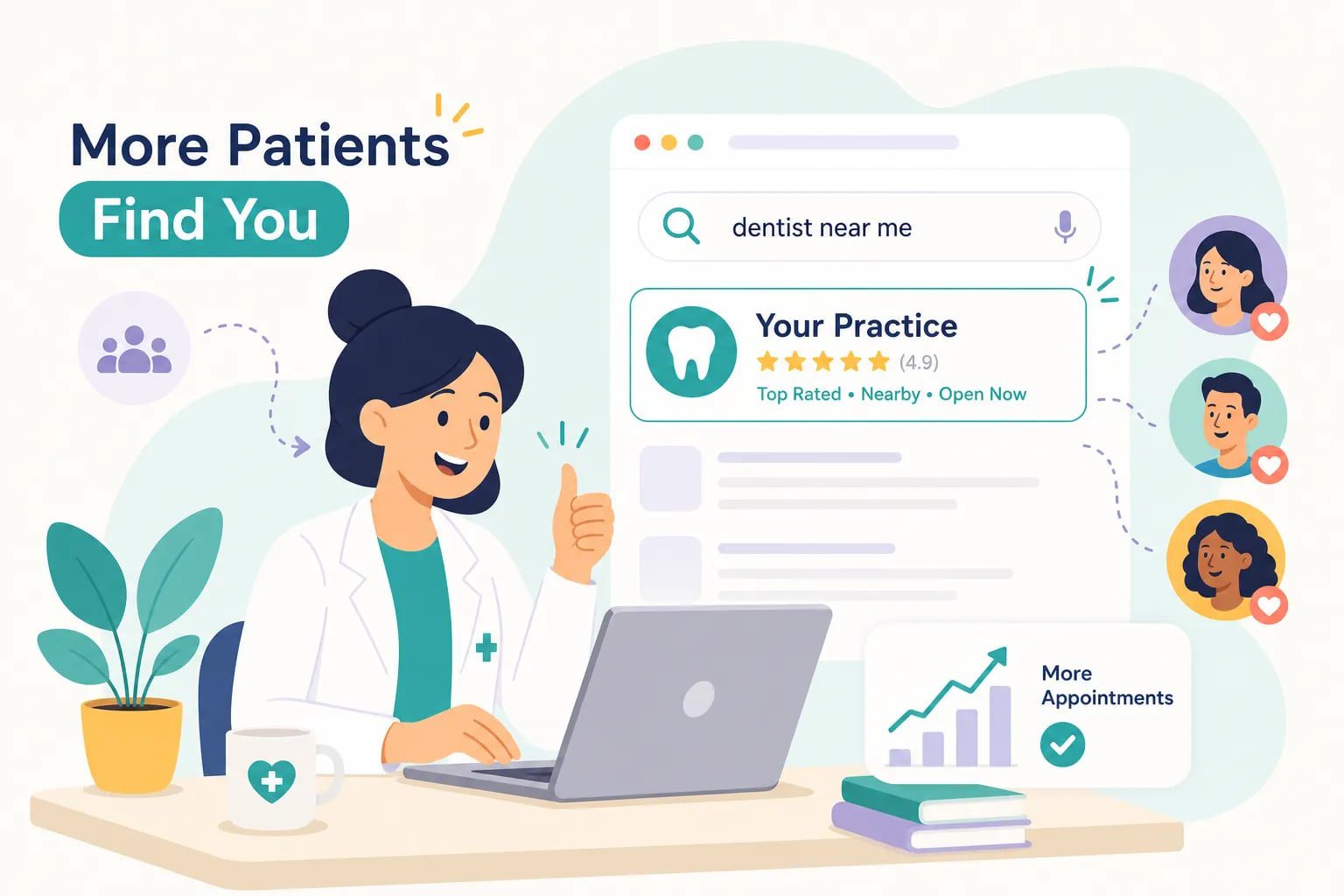
How do I get patients to find my practice online? It’s the question behind every missed appointment and every competitor ranking above you in Google. Today, many patients skip the word-of-mouth recommendation entirely. They open Google, type something like “dermatologist near me” or “family doctor accepting patients,” and book a highly visible option they find on that first page. If your practice isn’t ranking in those results, you’re invisible to a large share of your potential patient base, regardless of how good your care actually is.
Getting patients to find your practice online isn’t a matter of luck or ad spend alone. It comes down to a set of specific, repeatable tactics: a fully optimized Google Business Profile, location pages built for local search, a website that turns visitors into booked appointments, and a steady stream of authentic reviews. At Brandleap Agency, we see the same visibility gaps across healthcare clients, and the fix is almost always the same core framework. This guide lays out exactly what that looks like, in the order that moves the needle fastest.
Why your practice isn’t showing up in local search
Before a new patient picks up the phone, they’ve already searched, scrolled, read reviews, and compared several options online. A 2024 Pew Research survey found that over 80% of patients search online before choosing a provider. If your practice doesn’t appear in the local map pack or the first page of results, that patient chooses someone else, not because your care is worse, but because your digital presence isn’t working.
The practices that struggle most with online visibility tend to share three common problems: an incomplete or unclaimed Google Business Profile, a website with no location-specific pages, and a review count so low it signals inactivity to both Google and prospective patients. Each of these gaps independently limits your rankings, but together they make your practice nearly impossible to find through local search.
For single-location practices, none of these gaps typically require a full-time marketing hire to fix. They require a clear sequence, the right setup, and consistent upkeep. The sections below break that sequence into the highest-impact steps first, so you can prioritize what actually moves your ranking before you spend a dollar on ads.
How do I get patients to find my practice online? Start with Google Business Profile
Your Google Business Profile (GBP) is the single most important asset for local search visibility. It’s what fills the local map pack, the most clicked section of a local search results page. To compete, your profile needs to be fully claimed and verified, with your exact legal practice name, the most specific primary category available for your specialty, accurate hours, a complete service list with patient-friendly descriptions, and a direct booking link if your scheduling system supports it.
Choose the right category
Category selection matters more than most practice owners realize. Google uses it as a primary relevance signal, so choosing “Medical Clinic” when you’re actually a dermatology practice costs you real ranking potential. Upload genuine photos of your exterior, reception area, treatment spaces, and your team. Weekly posts to your profile, whether a new service announcement, a health tip, or a seasonal note, are widely recommended as a best practice and may meaningfully improve your GBP performance over time.
Run a NAP audit
NAP stands for name, address, and phone number, and it needs to match exactly across every directory where your practice appears. In Egypt, this includes Google, local healthcare portals, and any regional clinic directories relevant to your specialty in cities like Cairo or Alexandria. Even small variations, like “St.” versus “Street”, create inconsistency signals that hurt your local rankings. Auditing and correcting these mismatches in your first 30 days produces a fast, measurable lift in local visibility.
Build location and service pages that rank locally
A single homepage is not enough to rank for every service your practice offers. Patients searching “knee pain specialist in Maadi” or “pediatric dentist accepting new patients near me” need to land on a page that specifically matches that query. One page per major service and one page per physical location gives Google the content it needs to match your practice to high-intent local searches, a core principle of local SEO for doctors.
Each location page should include the full address, an embedded map, hours, services offered at that location, and a clear booking call-to-action. Service pages should answer the questions patients actually ask: what the treatment involves, what to expect, which conditions qualify, and how to schedule. Write in plain language, not clinical terminology. Patients scan fast, and pages that speak directly to their concern convert far better than pages organized around internal department names.
Adding MedicalOrganization or Physician schema to your site helps Google understand who you are and what you treat, which improves how your practice appears in map pack rankings. Combined with a fast, mobile-optimized site, these technical signals compound the content work you’ve already done on your GBP and location pages, and are a key part of effective practice website optimization.
Turn your website into a patient booking machine
Your homepage has one job: move a new visitor to book an appointment. The highest-converting practice websites lead with a clear headline that states who you help and what outcome you deliver, followed immediately by a single primary call-to-action, a “Book Appointment” or “Schedule a Consultation” button. Authentic provider photos generally outperform stock imagery when it comes to building patient trust. Trust signals, including board certifications, review ratings, and association logos, belong above the fold or within the first scroll.
Streamline the booking process
The booking process should be short, mobile-first, and low-friction. Ask only for what you need at first contact: name, phone or email, and preferred timing. Long intake forms before the appointment is even scheduled kill conversions. Practices that keep their initial booking form to three to five fields and follow up with automated confirmation and reminder sequences see significantly lower no-show rates. Conversion benchmarks vary by specialty and traffic source, but a well-optimized healthcare website typically converts 3 to 5% of visitors into consultation requests; with a strong hero section, sticky click-to-call, and a single CTA, some primary care sites reach 8 to 12%.
Optimize for mobile speed
More than half of healthcare searches happen on a mobile device. If your site loads slowly or your booking button is hard to tap on a phone screen, you’re losing patients to practices with faster, cleaner experiences. Aim for a load time under two seconds, based on our client benchmarks, crossing that threshold can meaningfully lift conversion rates. A sticky click-to-call button on mobile is a simple addition that drives measurable increases in call volume without requiring a full redesign.
Generate and manage reviews that build trust and rankings
Online patient reviews are both a ranking factor and a trust signal for patients comparing practices, making healthcare reputation management an ongoing priority, not a one-time task. The most effective approach is to ask satisfied patients for a review as a natural part of the post-visit workflow, whether through a follow-up text, an email, or a simple in-person request. The ask should be easy: one link, one step, and no complicated instructions. Practices that make this a consistent habit, rather than an occasional effort, build review volume steadily without feeling pushy.
Every response you post to a review is visible to future patients. Respond promptly, professionally, and without revealing anything that could identify a patient’s condition, treatment, or visit details. Even confirming someone was a patient in a public reply creates a compliance risk. For negative reviews, acknowledge the concern in general terms, thank them for the feedback, and invite them to contact the practice directly to resolve the issue. This approach protects your compliance posture while demonstrating to prospective patients that you take feedback seriously.
Google is the highest priority for review generation because it directly impacts your local search ranking and GBP visibility. Regional healthcare directories and local clinic portals relevant to your market, whether in Cairo, Alexandria, or other cities, are worth building over time because they carry authority in healthcare-specific nearby search results. Focus your review requests on Google first, then expand as your volume grows.
How do I get patients to find my practice online? The 90-day plan
The first month is about fixing what’s already broken. Claim and complete your Google Business Profile for clinics with the correct category, a full service list, photos, and a weekly posting cadence. Run your NAP audit across major directories and correct any mismatches. Launch or refresh your location pages with unique content, embedded maps, and clear CTAs. Begin sending post-visit review requests. These four steps alone produce measurable improvements in local visibility within 30 to 60 days.
The second month shifts focus to converting the visibility you’ve built. Add schema markup to your location and service pages. Improve your homepage structure around a single booking CTA, provider photos, and trust signals above the fold. Streamline your booking form. Set up automated appointment reminders if your scheduling system supports it. Use Google Analytics 4 to track your conversion rate week over week so you have a reliable baseline before you invest in paid ads.
By month three, you have a solid local foundation and a converting website, now paid channels amplify what’s already working. Start with Google Local Services Ads if your specialty qualifies; they operate on a pay-per-lead model and tend to produce strong cost-efficiency for clinics with established reviews. Typical healthcare CPLs in these campaigns range from $30 to $80 depending on specialty and market, though outcomes vary. Add branded search campaigns to protect your name in results. Meta Ads work best for retargeting visitors who didn’t book on their first visit, or for building awareness for elective or specialty services. Track cost per booked appointment, not just clicks, and cut anything that isn’t converting.
Getting this right takes a system, not a one-time fix
These building blocks hold true across nearly every practice type: a complete and active Google Business Profile, location and service pages that match what patients actually search for, a website that makes online appointment booking effortless, and a review strategy that builds trust over time. Paid ads accelerate what’s already working, but they can’t substitute for the foundation.
The 90-day plan in this guide is designed to produce quick wins in the first 30 days, steady improvement through month two, and sustainable, scalable growth by day 90. You don’t need to execute all of it at once. Start with GBP, fix your NAP, and launch one strong location page, the momentum builds from there.
If you’re still asking, “How do I get patients to find my practice online?” and managing all these moving parts alongside running a practice feels like too much, that’s exactly the problem Brandleap Agency solves for healthcare providers. Our team handles the technical SEO, content, local optimization, and paid media so you can stay focused on patient care, with transparent reporting tied to real outcomes like booked appointments and new patient growth, not just traffic numbers.