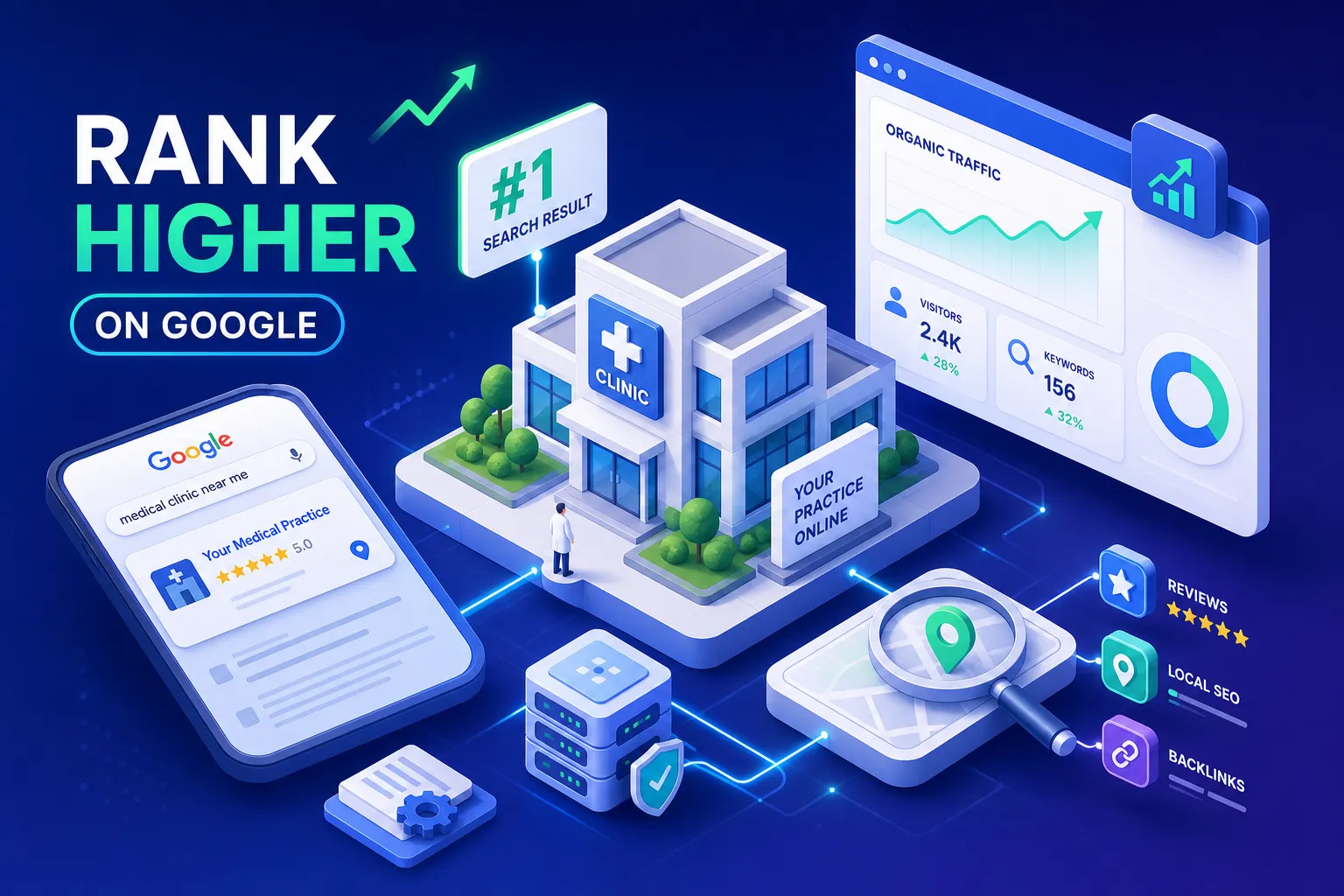
If you’ve ever wondered, how do I get my medical practice to rank on Google?, you’re not alone, and the answer is more systematic than most practice owners realize. Somewhere right now, a patient in your area is typing “family doctor near me” or “urgent care open today” into Google. Your practice offers exactly what they need. But the three clinics showing up in that Map Pack aren’t necessarily the best in town; they’re simply the ones that got their local SEO fundamentals right. That visibility gap costs you new patients every single week, and it compounds quietly until it shows up on your revenue report.
Local search is no longer optional for medical practices. It’s the primary channel through which patients discover, evaluate, and choose their providers. The good news: ranking higher on Google isn’t random. It follows a clear set of signals that any practice can build systematically. This guide gives you a practical 60-to-90-day playbook, the same prioritized framework that specialized healthcare SEO teams like Brandleap Agency apply when a practice needs to close the visibility gap without pulling clinical staff into a guessing game.
By the end of this article, you’ll know how to optimize your Google Business Profile, clean up your citations, collect reviews without triggering HIPAA concerns, build content that patients actually search for, implement medical schema, and track the numbers that confirm it’s working.
Why your Google Business Profile is the highest-leverage asset you control
Google ranks local businesses using three factors: relevance, distance, and prominence. Your physical address is fixed, so distance is largely outside your control. But relevance and prominence are both movable through your Google Business Profile (GBP). According to Whitespark’s annual Local Ranking Factors survey, GBP signals account for roughly 32% of local pack ranking weight, ahead of on-page factors, reviews, links, and behavioral signals combined. That makes your GBP the single most important place to start your 60-to-90-day plan.
Choosing the right primary category for your clinic
Your primary GBP category is the strongest individual signal on your entire profile because it tells Google exactly what kind of practice you operate. If you run a dermatology clinic, list it as “Dermatologist,” not “Medical Clinic.” If you serve a primary care population, “Family Practice Physician” or “Internist” is more precise than a generic label like “Doctor.” Choose the most specific category that accurately describes your core, highest-volume service. A more specific category expands your eligibility for related searches automatically. Getting this wrong costs you visibility across every query that matters to your practice type.
Completing the profile and keeping it active
A complete GBP profile signals to Google that your listing is trustworthy and current. Fill in your hours, address, phone number, accepted insurance, individual services, and add at least ten high-quality photos of your facility and staff. Beyond the one-time setup, ongoing activity matters: publish practice updates, answer questions in the Q&A section, and respond to reviews consistently. Google treats an active profile as a reliable, authoritative listing and rewards it with better placement.
How proximity and prominence work together
You can’t relocate your clinic to rank better by distance. What you can do is build prominence so that, among all the practices within a reasonable radius of any given searcher, yours looks like the most reputable option. Prominence grows through review volume and velocity, authoritative citations, and backlinks from relevant sources. Think of proximity as the playing field and prominence as your competitive edge within it.
How do I get my medical practice to rank on Google: NAP consistency and authoritative citations
NAP stands for name, address, and phone number. Every time your practice is mentioned online, these three elements need to match exactly. Not approximately. Exactly. A suite number listed as “Ste 200” on one directory and “Suite 200” on another creates conflicting data that Google has to reconcile, which lowers its confidence in your listing’s accuracy and quietly suppresses your local rankings. Most practice owners have no idea their 2019 listing on a general business directory still shows an old address.
What NAP consistency actually means for a medical practice
Your business name, street address format, suite or floor number, and primary phone number must be identical everywhere they appear online. Run a citation audit early in your 60-to-90-day plan to identify conflicts. Tools that aggregate citation data can surface inconsistencies quickly. Once you find them, correct or suppress the outdated listings before building new ones. Cleaning up conflicting data delivers a faster ranking lift than stacking new listings on top of messy existing ones.
The healthcare directories worth prioritizing first
Not all directories carry equal authority. For medical practices, start with government and licensing directories: the CMS/Medicare “Find a Provider” database, HRSA Find a Health Center, and your state medical board’s physician directory. These are federally maintained sources that Google treats as high-trust entity verification. Next, move to major healthcare consumer directories: Healthgrades, WebMD Physician Directory, and Zocdoc. These carry strong patient-discovery value alongside citation authority. General local citation platforms come after these, not before.
Getting more patient reviews without violating HIPAA
Reviews are one of the clearest local ranking signals, and they’re also one of the most misunderstood areas in healthcare marketing. Fear of HIPAA violations causes many practices to avoid soliciting reviews entirely, leaving them invisible compared to competitors who figured out the compliant approach. The rules are actually straightforward once you understand the core principle.
How to request reviews the HIPAA-safe way
HIPAA compliance in review requests comes down to one non-negotiable rule: never reference appointment-specific details in the ask. Don’t mention the provider the patient saw, the date of the visit, or any treatment. Your outreach should be generic and triggered by visit completion, not by clinical data. A compliant message reads something like: “Thank you for visiting our practice. We’d appreciate a few words about your experience.” Send the same standardized request broadly, and use vendors with a Business Associate Agreement (BAA) in place if their platform touches patient contact data. QR codes in the office and consented SMS or email messages are all viable channels, as long as the message itself contains no PHI.
Responding to reviews safely and professionally
Your public responses must follow two firm rules: never confirm someone is a patient, and never discuss clinical details in any form. A compliant response to a negative review follows this structure: “Thank you for your feedback. We take all concerns seriously and would like the opportunity to address this directly. Please contact our office so we can help.” That response acknowledges the reviewer, stays compliant, and moves the conversation offline. For positive reviews, a brief, generic thank-you is sufficient. High review volume with recent activity is what moves rankings, and every professional response also builds trust with prospective patients reading your profile.
Creating patient-focused content that captures local searches
Most practice websites have a single “Services” page with five bullet points. That approach doesn’t rank locally because it gives Google nothing specific to match against patient queries. Patients search with specific language: “telehealth appointments in Austin,” “what to expect during a Mohs surgery consultation,” “do I need a referral for a dermatologist in Dallas.” Your content needs to meet those queries directly.
Building service and condition pages that rank locally
Each major service your practice offers, and each condition you commonly treat, deserves a dedicated page, not a bullet point. These pages need local signals woven in naturally: city, neighborhood, surrounding region. They need to answer the questions patients have before an appointment, describe what the experience at your specific practice looks like, and use the same language patients use when they search. Boilerplate text lifted from a service description template won’t rank locally because it can’t differentiate your clinic from any other clinic anywhere.
Using patient FAQs to capture question-based searches
FAQ sections on service and provider pages are efficient ranking assets. Question-format queries, “how long does a physical exam take,” “does my insurance cover telehealth”, tend to have lower competition and high commercial intent. Pull FAQ topics directly from the questions your front desk answers on the phone every week, because those are the exact queries your patients type into Google. In the next section, you’ll see how FAQPage schema amplifies these pages further by making them eligible for expandable SERP features.
Adding medical schema markup to improve how Google reads your site
Schema markup is structured data added to your website code that tells Google precisely what your pages are about. Most medical practice websites skip it entirely, forcing Google to infer what your clinic does, who your providers are, and what services you offer by reading plain text. Schema removes that ambiguity and makes your site eligible for richer search result formats that increase click-through rates even without changing your ranking position.
MedicalOrganization and Physician schema: what to implement and where
Your homepage or main location page needs MedicalOrganization or MedicalClinic schema. The key properties to include are name, address, telephone, opening hours, medical specialty, and the isAcceptingNewPatients field. Each provider’s individual page should carry Physician schema with name, credentials, specialty, and a worksFor reference linking the physician back to the practice entity. This connection lets Google surface the right providers in specialty-specific queries and populate Knowledge Panel information accurately.
FAQPage and service schema that expand your SERP footprint
FAQPage schema applied to your patient Q&A sections makes those pages eligible for expandable results in Google search, increasing your visual presence on the page and lifting CTR. MedicalProcedure schema on service and procedure pages tells Google exactly what each treatment is and connects it to your practice entity. Structured data doesn’t guarantee a specific SERP feature, but it makes your site eligible for formats that competitors without schema simply can’t access. Brandleap Agency can implement this entire schema stack cleanly across every relevant page, so no clinical staff hours go toward JSON-LD code.
Tracking results and building your 60-90 day local SEO action plan
Local SEO for a medical practice typically shows early measurable signals within three months, with stronger and more reliable results between months six and twelve. Setting the right expectations from the start prevents the common mistake of abandoning the strategy before it has time to compound. The metrics you track should reflect the full patient journey from search to contact, not just rankings in isolation.
The metrics that actually tell you if local SEO is working
Track four core KPI groups on a rolling 90-day baseline:
- Google Business Profile data: impressions, direction requests, calls, and website clicks from your profile.
- Google Search Console: impressions and CTR for local-intent queries. Local Pack CTR typically benchmarks in the 7, 9% range, with strong performance above 12%.
- Organic sessions from local searches in GA4, filtered by geography.
- New patient conversion rates tied to organic channels.
One-time snapshots mislead you. Trend lines over 90-day windows tell you whether momentum is building.
A realistic 60-90 day action sequence for practice owners
Here is the priority order for execution:
- Weeks 1, 2: Audit and correct your GBP and NAP inconsistencies across existing directories.
- Weeks 3, 4: Submit your practice to priority healthcare directories, starting with government and licensing sources.
- Month 2: Build or significantly expand your service and condition pages with local signals and patient-focused content.
- Ongoing from Month 1: Activate your HIPAA-compliant review request workflow and publish at least one piece of patient-focused content monthly.
- Month 3: Implement the full schema stack and begin tracking KPI movement against your baseline.
Practices with multiple locations, large provider rosters, or strong existing competition typically see faster, more consistent results by working with a specialized healthcare SEO team. Brandleap Agency compresses this timeline by eliminating trial-and-error, handling the technical layers cleanly, and applying an integrated approach across GBP, citations, content, and schema from day one.
The path to page one is a process, not a mystery
The practices ranking at the top of Google in your area didn’t get there by accident. They built their visibility on the same fundamentals covered in this guide: an optimized Google Business Profile, verified NAP data, a consistent flow of HIPAA-compliant reviews, and location-specific content backed by properly implemented schema. None of that requires a large budget or a technical background, it requires consistent execution in the right sequence.
For practice owners and clinical staff already stretched thin, that consistency is exactly where most local SEO efforts stall. Not from lack of knowledge, but from lack of bandwidth.
That’s where a dedicated healthcare SEO partner changes the outcome. So if you’re still asking yourself, how do I get my medical practice to rank on Google, the answer starts with an honest look at where you stand today. Brandleap Agency works with medical practices to handle the full implementation of this framework, so your team stays focused on patient care while your organic visibility grows. Reach out for a no-obligation audit and find out exactly what’s holding your practice back in local search.
Frequently asked questions
How do I get my medical practice to rank on Google faster?
The fastest gains come from completing and actively maintaining your Google Business Profile, correcting NAP inconsistencies across your existing directory listings, and activating a HIPAA-compliant review request workflow. These three steps consistently produce measurable GBP impression and call volume improvements within the first 60 days.
How do I get my medical practice to rank on Google in a competitive city?
In dense markets, think Chicago, Houston, or Los Angeles, prominence signals matter most. That means a higher volume of recent reviews, citations from authoritative healthcare directories, and dedicated service pages with strong local signals. Working with a specialized healthcare SEO partner like Brandleap Agency gives you a systematic edge without diverting clinical staff time.
How long does local SEO take for a medical practice?
Most practices see early measurable signals within 60 to 90 days and meaningful ranking movement between months four and six. Competitive markets can take longer, but practices that execute the full framework, GBP, citations, reviews, content, and schema, consistently outperform those that address only one or two of these signals.