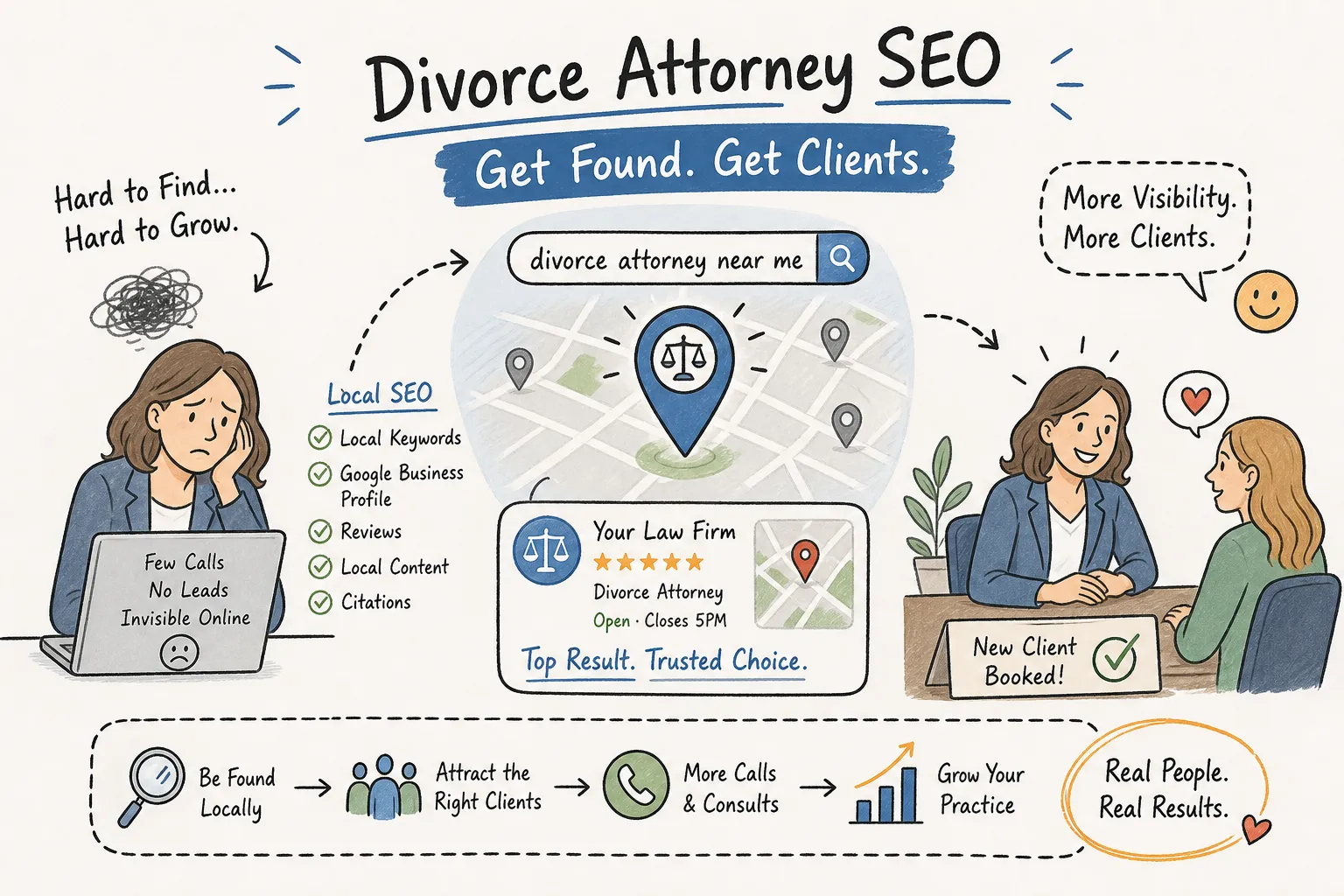
Most people searching for a divorce attorney are already in decision mode. They’re not browsing casually or comparison-shopping the way they would for a new appliance. They type “divorce lawyer near me” or “divorce attorney in Chicago free consultation,” scan the top results, and often call quickly once they find a firm that looks right. If your firm isn’t showing up in that window, you’re invisible to the exact people who are ready to hire. That’s why divorce attorney SEO isn’t optional for competitive family law practices, it’s the difference between a full consultation calendar and a quiet phone.
This guide walks through the local SEO fundamentals every family law firm needs: the right keywords, a high-performing Google Business Profile, service pages built to rank and convert, a compliant review strategy, and a framework for measuring whether any of it is actually working.
Why Local SEO Hits Differently for Family Law Practices
How divorce clients actually search online
People searching for a divorce attorney aren’t doing research six months in advance. The search happens when something breaks: a separation, a court date, a custody dispute that can’t wait. That emotional urgency produces queries that are hyper-local, hyper-specific, and driven by immediate hiring intent. Understanding this behavior is the foundation of any family law SEO strategy that produces real consultations rather than just website traffic.
The local pack is where consultations come from
For queries like “divorce lawyer [city]” or “family law attorney near me,” Google shows a local 3-pack above the organic results. According to local search research, that three-firm block captures a large share of clicks and calls for local attorney searches. Ranking in the organic blue links matters, but appearing in the local pack matters more for call volume. Your SEO program needs to target both, with GBP optimization and on-page local signals working together rather than as separate projects.
Divorce Attorney SEO: Targeting Keywords That Bring In Ready-to-Hire Clients
The three keyword buckets that convert best
Not all divorce-related keywords carry the same hiring intent. Prioritize these three categories before targeting informational terms like “how does divorce work in [state],” which attract readers who aren’t ready to pick up the phone:
- Immediate-hire searches: “divorce lawyer near me,” “divorce attorney near me”
- City-specific hire intent: “divorce attorney [city],” “best divorce lawyer in [city]”
- High-value case-type searches: “child custody lawyer near me,” “child support modification attorney [city]”
Long-tail and case-specific variations worth building pages for
Beyond the core terms, long-tail phrases tied to specific case types generate highly qualified traffic. Terms like “contested divorce lawyer in [city],” “uncontested divorce attorney [city],” “fathers’ rights attorney near me,” and “spousal support lawyer [county]” signal a client who knows exactly what they need. Each of these is a candidate for its own practice-area page or service-area page with targeted copy and a clear consultation CTA. A visitor who lands on a page built for their exact situation typically converts at a far higher rate than one who lands on a generic homepage, and that’s the core logic behind practice-area page SEO for family law firms.
Optimizing Your Google Business Profile for Divorce Attorney SEO
Choosing the right primary and secondary categories
Your primary GBP category should be “Family Law Attorney,” not the generic “Law Firm” or “Attorney.” The more specific the category, the stronger the relevance signal for local pack rankings. Add secondary categories only for services you actually offer: “Divorce Lawyer,” “Child Custody Attorney,” or “Mediation Service” are appropriate additions. Stacking unrelated categories dilutes your profile’s focus and sends a mixed signal to Google about what your firm actually does.
Keeping your NAP consistent across every listing
Name, address, and phone number inconsistencies across directories are one of the most common reasons law firms lose local rankings. Your GBP information must match your website contact page, state bar listing, Avvo, Justia, FindLaw, and any other citation source exactly. Even a small formatting difference, “Suite 200” vs. “Ste 200”, can create a mismatch signal. Audit your citations at least quarterly, especially after any office move or phone number change.
Profile activity signals that many firms underutilize
Fresh photos, regular GBP posts, and active Q&A responses tell Google your profile is maintained and current. A completed, engaged profile consistently outperforms one that was set up once and forgotten. Upload real office and team photos, post about firm news or community involvement regularly, and respond promptly to questions in the Q&A section. These behaviors are free and compound over time. Many competing firms underutilize these signals, which makes consistent activity a genuine competitive edge. Google Business Profile for lawyers is one of the highest-leverage tools in local attorney SEO, and it costs nothing beyond the time it takes to keep it active.
Structuring Service Pages That Rank and Convert
Practice-area pages vs. service-area pages: what each one does
Practice-area pages answer “what legal help do I need?” while service-area pages answer “who serves me near me?” A well-structured family law website needs both. Build one strong practice-area page per major service, divorce, child custody, spousal support, property division, prenuptial agreements, and add location-specific pages only for the cities or counties your firm realistically serves, with genuinely unique content for each. Swapping a city name into a template and calling it a page doesn’t work. Google can spot thin duplication, and so can clients.
On-page elements that tell Google this page is relevant
For each service page, your title tag should follow the pattern “Divorce Lawyer in [City] | [Firm Name].” The meta description should state the service, location, and a specific differentiator. Use LegalService schema markup on practice-area pages, FAQPage markup on any page with question-and-answer content, and Person schema on attorney bio pages. These structured data types help Google understand what each page covers and can improve your SERP appearance with rich results that stand out from competitors who haven’t implemented them.
Where conversions break down on most attorney websites
The most common conversion failure is burying the call-to-action at the bottom of a long page. Your consultation CTA needs to appear above the fold, not after 1,200 words of legal explanation. Use a phone number and a short contact form on every service page. Placing testimonials and bar credentials near the top reduces hesitation before a potential client even starts reading. A client who lands on your divorce service page from a local search is already motivated; your page needs to remove friction, not add it. A short, direct CTA like “Call now for a divorce consultation in [City], no obligation” gives them an immediate next step.
Building a Review Strategy That Stays Within Ethics Rules
When and how to ask for reviews without pressure
The best time to request a review is at or shortly after case resolution, when client satisfaction is highest. Send a personalized request within 24 to 48 hours of closing the matter. Keep the message short, direct, and optional: thank the client for trusting your firm, explain that honest feedback helps other people find the right attorney, and include a direct link to your Google Business Profile or Avvo page. One polite follow-up after three to five days is reasonable if there’s no response. Anything beyond that crosses into pressure and can damage the relationship you worked to build.
What a compliant review request looks like
A review request that stays within ABA Model Rules and most state bar guidelines asks for honest feedback, never a specific star rating. It offers no incentive, suggests no language for the client to use, and avoids asking the client to share any sensitive case details publicly. Under Rule 7.1, any testimonial you use in marketing must be truthful and not create misleading impressions about outcomes. The template that works best is one that feels genuinely human: a brief thank-you note with a direct link and no strings attached. For positive reviews, respond professionally and promptly. For negative reviews, exercise caution, avoid disclosing any client confidences in your reply, and in line with ABA guidance and many state-bar opinions, consider whether a public response is appropriate at all before posting one.
Tracking Results and Knowing When to Bring In a Law Firm SEO Partner
The KPIs that actually matter for a family law firm
Overall website traffic is a vanity metric. The numbers that matter are local pack ranking positions for your primary keywords, GBP call and direction request volume, organic form submissions from service pages, and cost per consultation lead compared to what you’re spending on paid channels. Most law firms start seeing measurable local ranking movement within three to six months of consistent optimization work. Competitive city-level keywords often require six to twelve months before landing on page one, but the organic visibility you build compounds in ways that paid traffic alone cannot.
When it makes sense to hand this off to an agency
Running a full divorce attorney SEO program in-house is possible, but it requires consistent attention across GBP management, content publishing, citation maintenance, link building, and technical site health. For firms that want an end-to-end program without coordinating multiple vendors, a full-service agency can handle all of those channels under one roof, from technical SEO and service page content to citation building and off-page authority development. Brandleap Agency offers exactly this kind of integrated attorney SEO services for family law firms, with senior-level strategy applied directly to your firm’s growth. That means no overhead from managing separate contractors for each channel, and no delegating your marketing to staff unfamiliar with the competitive dynamics of local attorney SEO.
Start With One Strong Page and Build From There
Divorce attorney SEO is a long-term asset, not a one-time project. The firms ranking at the top of Google for “divorce attorney [city]” didn’t get there by accident. They built a system around local keyword targeting, an optimized Google Business Profile, service pages built for conversion, a compliant review program, and consistent performance tracking. Each layer compounds the one before it.
You don’t have to launch everything at once. Start with your GBP and one strong service page targeting your highest-priority city and practice area. Get those right, then layer in additional location pages, long-tail content, and citation building over the following months. SEO for divorce lawyers rewards consistency, small, steady progress builds durable organic rankings that deliver compounding returns over time, unlike paid ads, which stop the moment the budget does.
If you’d rather skip the learning curve and get the full program running faster, Brandleap Agency works with family law firms to build and execute exactly this kind of local SEO strategy. Reach out for a GBP audit or a full strategy consultation, and we’ll show you where your firm stands and what it would take to move up.