Most glass company owners are excellent at their craft but invisible on Google. A glass company SEO service is what closes that gap. Right now, a competitor across town may be pulling in calls every day because their business shows up first when someone searches “windshield repair near me.” That difference isn’t about who does better work. It’s about who has a stronger local SEO foundation.
Glass-related searches carry unusually high purchase intent. When someone types “windshield replacement near me” into Google, they aren’t researching options; they’re ready to call. That urgency is why SEO for glass companies tends to produce strong ROI compared to many informational or research-driven categories. Rank for the right terms, and your phone rings.
This guide covers the full picture: how to optimize your Google Business Profile, build service and location pages that rank, generate reviews that carry SEO weight, fix the technical issues quietly hurting your site, and what realistic results look like over 6 to 12 months. If you’re evaluating whether to hire an SEO agency for glass shops or want to understand what good work actually looks like, this is the playbook.
Why local search is the main growth channel for glass companies
The demand is already there: high-intent glass searches in the U.S.
The search volume numbers for glass services are hard to ignore. According to keyword research tools, “windshield replacement” and “windshield repair” each generate around 74,000 monthly U.S. searches, while “auto glass repair” adds another 49,500. Window repair pulls 14,800 searches per month, and “glass replacement” contributes 8,100 more. These aren’t curiosity searches. They’re buyer searches, made by people with a cracked windshield in their driveway or a broken storefront that needs a quote today.
This level of purchase intent means glass service businesses convert organic traffic at a higher rate than many industries. A well-built local service page for auto glass or window replacement typically converts between 3% and 7% of organic visitors into a call or form submission, meaning glass replacement SEO and auto glass SEO efforts pay off faster than campaigns in lower-intent categories.
The local map pack is where the calls come from
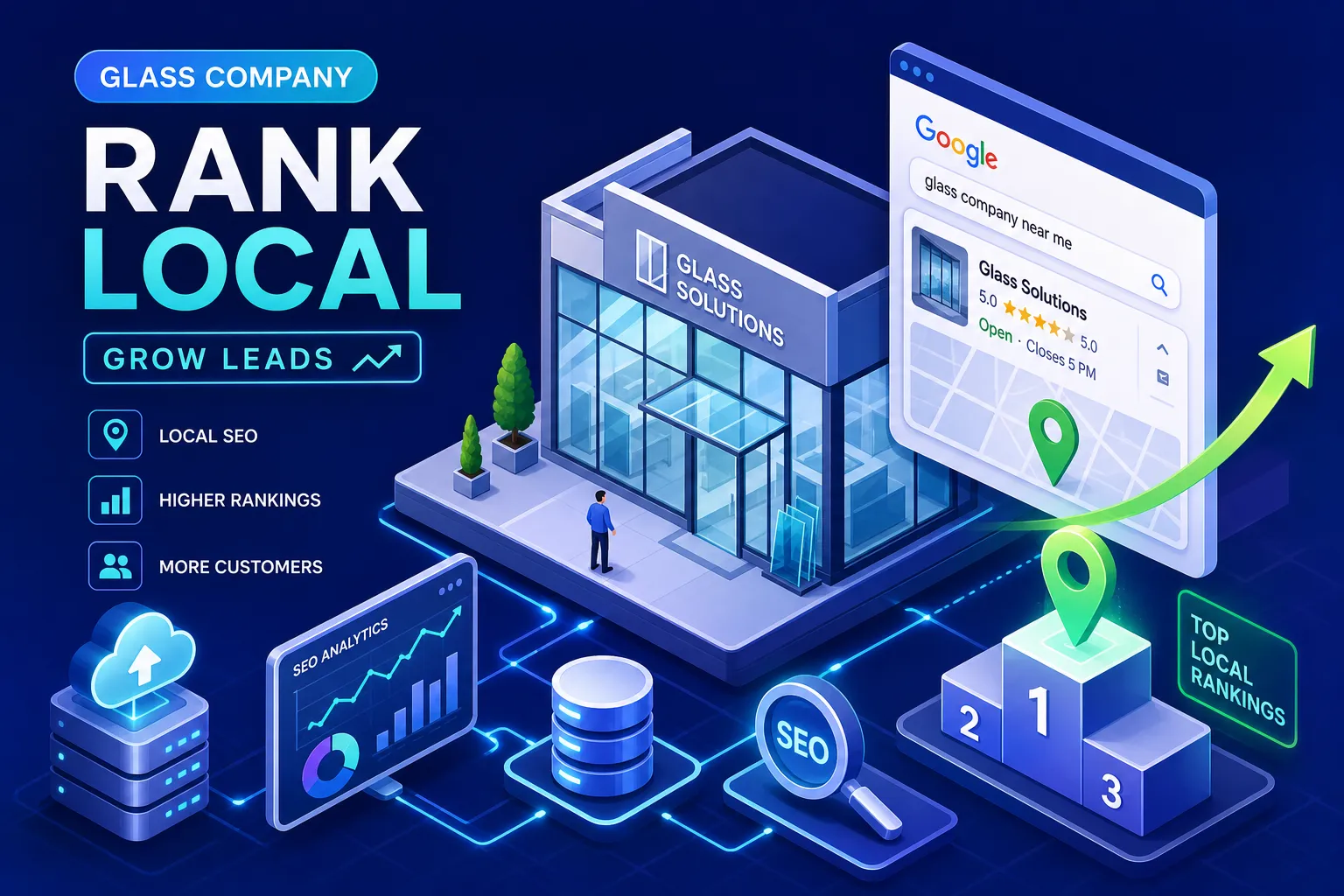
When someone searches “windshield repair near me” on a phone, the first result they see isn’t a website. It’s the Google local map pack: three business listings with ratings, hours, and a click-to-call button. That three-pack drives the majority of local calls for glass shops, and it operates on a different set of signals than traditional organic rankings. Getting into it requires a specific strategy built around Google Business Profile, review volume, and location relevance.
For glass companies, the map pack isn’t optional. It’s the primary battleground. Businesses that dominate the three-pack in their metro area capture the bulk of local call volume, often before a potential customer ever scrolls to an organic website listing. Everything in this guide connects back to that goal.
Glass Company SEO Service: Google Business Profile Optimization
Choosing the right primary category and service attributes
Category selection determines which searches your GBP is eligible to appear in, and most glass shops get this wrong. For auto glass businesses, the correct primary category is “Auto Glass Shop.” For glaziers handling residential and commercial flat glass, a segment where local SEO for glaziers is often underutilized, “Glazier” is the best primary option, with “Glass Repair Service” as a secondary. Using a generic category like “Glass Shop” as your primary leaves ranking opportunities on the table.
Beyond the primary category, fill out every service attribute in your profile. List individual services such as windshield repair, windshield replacement, shower glass installation, storefront glass, and mobile service. Google uses these to match your listing to specific searches, and a fully built-out services section consistently outperforms a sparse one.
What your GBP description and photos actually do
Your business description should mention mobile service availability, insurance billing support, same-day turnaround, and your service area. These are the exact details searchers check before they decide to call, and having them in your profile reduces the hesitation that costs you leads. Write the description for a real customer, not a search engine.
Photos generate more engagement than most glass company owners realize. Before-and-after shots of completed jobs, photos of technicians working, mobile service vehicles, and finished shower glass or storefront installations all signal credibility. Profiles with strong photo libraries tend to earn more profile views and direction requests than profiles with generic stock images or no photos at all, a pattern consistently reported across local SEO case studies.
Keeping your listing consistent and updated
NAP consistency matters more than most shop owners expect. Your business name, address, and phone number must match exactly across your website, GBP, Yelp, Angi, and every other directory where your business appears. Even minor inconsistencies, “St.” versus “Street,” for example, can weaken local ranking signals and confuse Google about which listing to trust.
Regular GBP posts and Q&A updates help demonstrate that your business is active and legitimate. While the direct ranking impact of posts is debated among local SEO experts, consistent activity is widely recommended and keeps your listing fresh for users comparing options.
Glass Company SEO Service: Service Pages and Location Pages That Rank
One dedicated page per service type
A single catch-all “Services” page doesn’t rank for specific searches. Google needs pages built around individual topics to understand what you offer and match it to what people search. For glass repair SEO services to work properly, that means separate pages for windshield repair, windshield replacement, shower glass installation, storefront glass repair, and any other core service. Each page should target a specific high-intent keyword, mention the primary service area naturally in the content, and end with a clear call to action, a click-to-call button, a quote form, or both above the fold.
Location pages for every city or suburb you serve
If your glass business covers multiple cities or suburbs, you need dedicated location pages for each one. A page with an H1 like “Windshield Replacement in [City], Mobile Same-Day Service” that includes genuine local context, references to neighborhoods or landmarks, and locally sourced reviews will consistently outperform a generic “Service Areas” page. Target high-intent modifiers, “near me,” “mobile,” and “emergency”, in your page titles and content to capture searchers at the exact moment they’re ready to book.
The trap most glass companies fall into is duplicating pages with only the city name swapped. Thin, templated location pages dilute your site’s authority instead of building it. Each page needs enough unique content to stand on its own.
On-page structure that converts local visitors
Every service and location page should follow a structure built for both ranking and conversion. Start with an H1 that includes the service and city name. Put your phone number above the fold so a mobile user can call without scrolling. Add trust signals close to the CTA: review snippets, years in business, certifications, or warranty information. Include a short FAQ section covering insurance coverage, turnaround time, and mobile availability, these questions come up before nearly every call, and answering them on the page reduces friction significantly.
Review generation: the ranking signal most glass shops ignore
Why reviews affect local rankings, not just reputation
Google’s local algorithm treats review volume, recency, and content as ranking signals, a pattern consistent with industry testing and Google’s own local ranking documentation. A glass shop with 150 recent reviews will typically outperform a shop with 30 older reviews in local map pack results, even when other factors are comparable. Reviews that mention specific services, “mobile windshield repair,” “same-day replacement,” or “helped with my insurance claim”, reinforce relevance for those exact searches. This isn’t just about looking trustworthy. It’s an active SEO lever.
A repeatable process for collecting more reviews
The most effective review system is simple: ask at job completion, then follow up. Ask in person at the end of every appointment, and send a text or email within 24 hours containing a short link directly to your GBP review form. The follow-up step is where most businesses drop the ball. Customers mean to leave a review and forget unless prompted. A direct link removes the friction that kills follow-through.
When you ask, prompt the customer to mention the specific service they received, how fast it was completed, or whether your technician came to them. Specific, detailed reviews carry more ranking weight than generic five-star ratings, and they do a better job of converting the next customer who reads them before calling.
Technical SEO and schema markup every glass company website needs
The technical issues that quietly kill local rankings and conversions
Most glass company websites share a predictable set of technical problems: slow mobile load times, thin or duplicated location pages, contact forms that break on phones, and pages accidentally blocked from being indexed. Each of these has a direct cost. Broken forms lose leads immediately and contribute to poor user experience metrics that can indirectly harm rankings. Core Web Vitals problems hurt both rankings and bounce rates. Duplicate city pages without unique content dilute your site’s authority instead of reinforcing it. These issues don’t fix themselves, and they won’t surface without a proper technical audit.
Mobile performance is non-negotiable for glass companies, because the majority of high-intent searches happen on phones. Research consistently shows that load times beyond three seconds correlate with significant drop-off in conversions. If your site is slow on mobile or your contact form doesn’t submit cleanly on a small screen, you’re losing leads at the exact moment of peak intent.
The schema types that glass company sites are missing
Structured data helps search engines understand your business and your pages with precision. For glass companies, four schema types deliver the most impact:
- LocalBusiness, establishes your location, hours, and service area
- Service, defines each core offering clearly for search engines
- FAQPage, captures common questions and improves how your listings appear in search results
- BreadcrumbList, clarifies your site structure and improves crawling efficiency
For auto glass businesses specifically, using the AutomotiveBusiness or AutoRepair subtype within LocalBusiness schema gives search engines a more precise entity match. AggregateRating schema can display star ratings directly in search results when your review data is properly implemented and policy-compliant, a visibility boost that costs nothing beyond correct markup.
What results look like and how to evaluate a glass company SEO service
Realistic timelines: early traction vs. consistent lead flow
The first three to six months of SEO for a glass shop typically produce ranking movement, GBP visibility gains, and early traffic growth. That period is foundational: fixing technical issues, building out service pages, optimizing GBP, and beginning review generation. Some quick wins, GBP corrections, fixing crawl errors, adding missing schema, can show early visibility changes within weeks. Consistent, meaningful lead flow from SEO typically builds between months six and twelve, as content authority compounds and rankings stabilize for high-intent terms.
Local service pages for glass companies convert at roughly 3% to 7% of organic traffic. At 500 monthly organic visitors, that’s 15 to 35 leads per month from SEO alone. At 1,000 monthly visitors, you’re looking at 30 to 70 leads. Getting to those traffic levels takes time, but the pipeline becomes predictable once it’s built, unlike paid advertising that stops the moment you pause spending.
What to look for when evaluating an agency’s offer
Not all SEO services are built for local service businesses, and generic packages don’t address the specific needs of a glass shop. When evaluating any SEO agency for glass shops, ask whether they build dedicated service and location pages, manage your GBP actively, implement schema markup, and report on calls and form submissions rather than just keyword rankings. An agency that tracks impressions and positions but can’t tell you how many calls came from SEO isn’t measuring what matters. For a glass company, monthly budgets of $1,000 to $3,000 typically cover solid local SEO execution; competitive multi-city campaigns usually run $3,000 and up.
How Brandleap helps glass and trade businesses build local search presence
Brandleap Agency works with home service businesses and trade contractors to build structured local search presence focused on generating consistent inbound leads. That means full GBP management, service-page and location-page architecture built for both ranking and conversion, review strategy, technical audits, and schema implementation, handled as a complete, coordinated package rather than disconnected tactics. For glass companies, that combination of local authority signals is what the map-pack leaders have built over time.
If you want to understand exactly where your site stands and what’s holding back your rankings, Brandleap offers a no-obligation glass company SEO service audit. It identifies what’s working, what isn’t, and what to prioritize first, so you’re not guessing at a strategy or wasting budget on the wrong fixes.
The Businesses Winning Local Glass Searches Are the Most Optimized, Not the Biggest
A strong glass company SEO service isn’t one tactic in isolation. It’s GBP optimization, dedicated service and location pages, consistent review generation, and a technically sound website, each reinforcing the others. The glass shops ranking at the top of the map pack in 2026 have put those pieces in place and maintained them.
Some early wins can appear within weeks of starting. Consistent lead flow takes six to twelve months to build. The upside is that unlike paid traffic, organic and map-pack visibility compounds over time. A page built well today earns leads for years.
If you’re ready to stop relying on referrals or paying for every click, the first step is knowing where you stand. Request a free glass company SEO service audit from Brandleap Agency and get a clear picture of exactly what needs to change, and in what order, to start ranking locally in your market.