A homeowner’s roof starts leaking on a Tuesday afternoon. She picks up her phone, types “roof repair near me,” and calls the first company that shows up. She doesn’t scroll through reviews or compare three estimates. She calls the first result. The contractor who answers that call didn’t earn it by being the best roofer in town. They earned it by showing up first on Google. That’s the core promise of SEO for roofing contractors, and it’s why search visibility is the most valuable asset a roofing business can build.
Roofing is one of the highest-ticket, highest-intent service categories in local search. A single residential replacement averages $9,000, $12,000, which means one closed job per month from organic search pays for a full SEO retainer several times over. The contractors who understand this treat search visibility as infrastructure, not an optional marketing line item. The ones who don’t are left wondering why their phone stays quiet while a competitor two miles away stays fully booked.
At Brandleap Agency, we work directly with contractors and service businesses on local search strategy, and the pattern is consistent: the right roofing SEO approach doesn’t just generate more leads, it generates better ones at a fraction of the cost of paid ads. This guide gives you the exact tactics that move the needle, realistic timelines, the KPIs worth tracking, and a framework to evaluate any agency you’re considering hiring.
Why local search is the primary battleground for roofing leads
How homeowners actually search for roofers
Most roofing searches either include a location modifier directly (“roof replacement Denver”) or trigger Google’s local results automatically through proximity signals. These aren’t casual browsing searches. A homeowner searching “emergency roof repair near me” is ready to hire someone often within 24 hours. The contractor in the Map Pack gets the call; everyone else gets nothing.
Google’s Map Pack captures roughly 42, 44% of all clicks on local roofing searches, according to local search click-share studies. Businesses in the top three spots receive three to five times more calls than companies appearing only in the organic blue-link results below. On mobile, that gap widens further because the Map Pack dominates the screen and puts the call button one tap away. Paid ads compete in the same space, but they disappear the moment the budget runs out. Local SEO for roofing contractors compounds over time, paid traffic does not.
The visibility gap between ranked and unranked roofers
A roofing company outside the top three Map Pack results captures a fraction of available clicks. The gap isn’t theoretical. Agency-published roofing SEO campaign reports have documented lead increases ranging from 145% to 425%, with one campaign producing 280% more phone calls and 350% more form submissions over a comparable window. Those numbers represent the difference between an optimized and an unoptimized competitor operating in the same market.
Think of local search visibility the way you think about a service van or a licensed crew. You wouldn’t skip one and expect to run a profitable roofing business. Local search presence deserves the same logic, it’s infrastructure, not a luxury. Contractors who treat roofing lead generation through organic search as optional are effectively handing market share to the competitor who doesn’t.
SEO for roofing contractors: the tactics that drive the most leads
Google Business Profile optimization: your highest-leverage starting point
Your Google Business Profile controls your Map Pack visibility, and the Map Pack is where high-intent roofing searches convert fastest. GBP optimization consistently ranks as the single biggest lever for local lead growth in the roofing category. The specific actions that matter: selecting the correct primary category (Roofing Contractor), writing a keyword-informed business description, uploading real project photos, and configuring service areas accurately.
Google’s local ranking algorithm weighs three core factors: relevance, proximity, and prominence. Every element of your GBP addresses at least one of them. According to Google Business Profile benchmark data, an optimized profile can produce up to 63% more leads and 18% higher conversion rates compared with an unoptimized one. That’s not a rounding error; that’s the difference between a full pipeline and a slow month.
Service-area pages for roofing lead generation across multiple cities
Your homepage can’t rank for “roof replacement Austin” and “roof replacement Round Rock” at the same time. Dedicated location pages solve this problem by giving Google a clear, relevant page to surface for each city-and-service combination. A service-area page that actually ranks includes unique content for that city, an embedded Google Map, local schema markup, and internal links from your main services pages.
The common mistake here is building thin or duplicate location pages where only the city name changes and the rest of the content is identical. Google treats these as low-quality, and they can trigger a quality issue rather than a ranking boost. Each page needs genuine local content: neighborhoods served, common roofing problems in that market, local weather considerations, or completed project examples from that area.
Reviews and citations: the infrastructure behind sustained rankings
Reviews drive two things simultaneously: prominence signals that help your GBP rank, and trust signals that convince a homeowner to call you instead of the listing below yours. A steady review acquisition process, asking after every completed job, outperforms sporadic bursts every time. Recency matters to Google; ten reviews from three years ago carry less weight than two reviews from last month.
Citations, meaning consistent Name, Address, and Phone (NAP) data across directories like Angi, BBB, HomeAdvisor, and industry-specific sites, reinforce local authority and support ranking stability. In a mid-sized US market, a competitive baseline sits around 25, 50 quality citations, with the emphasis on consistency over volume. Incorrect NAP data across directories can actively hurt your rankings even when you have high citation counts.
What realistic SEO timelines look like for roofing contractors
When to expect your first organic leads
First measurable leads typically appear at the 3, 6 month mark, a timeline consistent with findings across multiple contractor SEO studies. Low-competition markets can see movement in 60, 90 days; dense metro areas often take 6, 9 months before rankings become meaningful. Google needs to crawl, index, and re-evaluate your site’s authority relative to established local competitors. There are no shortcuts that hold up long-term, and any agency promising page-one placement in 30 days is using tactics that create more problems than they solve.
GBP optimization typically shows the fastest early movement because it doesn’t depend on domain authority the way organic rankings do. For contractors starting from scratch, Map Pack visibility tends to improve before blue-link organic positions do, often by month two or three, giving you an early signal that the strategy is working before full organic traction kicks in.
What the 6, 12 month window actually delivers
Rankings stabilize meaningfully after month six. By month twelve, contractors in mid-competition markets typically see consistent lead flow and a measurable cost-per-lead advantage over paid search. For context: organic SEO averages $25, $100 per lead at maturity, while Google Search Ads for roofing run $124, $350 per lead, and Local Service Ads fall in the $30, $95 range. That spread gets more pronounced the longer SEO compounds.
The compounding effect is the real argument for starting now rather than later. The content, authority, and rankings built in month six keep generating leads in month thirty-six. A contractor who starts today will be fielding steady organic calls next season while a competitor who waited is still in the early-momentum phase.
The KPIs that tell you whether your roofing SEO is actually working
The metrics that map directly to revenue
Lead volume from organic search is the primary metric: calls, form fills, and quote requests that trace back to Google. Traffic without leads is noise. Cost per lead (CPL) comes next: your total SEO spend divided by qualified organic leads. From there, this number should improve month over month as rankings and authority build, which is why it’s a better long-term indicator than keyword positions alone.
Revenue attribution closes the loop: jobs booked and revenue closed that can be traced to organic leads. Use this formula to calculate your return: (Revenue from organic leads minus SEO cost) divided by SEO cost. This is the number that tells you whether SEO is the best use of your marketing budget, and for most established roofing SEO campaigns, the answer is clearly yes.
Supporting metrics that explain performance changes
Organic sessions and keyword rankings for your priority service-plus-city combinations give you a directional read on momentum. Google Business Profile metrics, including views, direction requests, and call clicks, show whether your local presence is gaining traction. Website conversion rate from organic traffic is particularly useful: if traffic is growing but conversion rate is flat, the problem is on-site, not in your rankings.
Bounce rate and pages per session can signal whether your landing pages are matching what a searcher expected to find. A high bounce rate on a service-area page usually means the content isn’t relevant or credible enough to hold the visitor’s attention.
How to evaluate a roofing SEO agency before you sign anything
The questions that separate specialists from generalists
Ask for documented results from roofing or home-services clients specifically. A generalist agency may rank a software company without ever having built a service-area page architecture or managed a GBP for a trades contractor. The playbook is different, and experience in your vertical matters. If they can’t show you before-and-after lead numbers from a roofing client, that’s a meaningful gap.
Ask how they build local citations, manage Google Business Profiles, and approach service-area page architecture. Vague answers reveal a templated, non-customized process. Ask for a clear reporting cadence and which KPIs appear in their monthly reports. If they lead with rankings but never mention leads or revenue, their focus is misaligned with yours. You care about jobs booked; rankings are just a mechanism to get there.
What a contractor-focused SEO partner looks like in practice
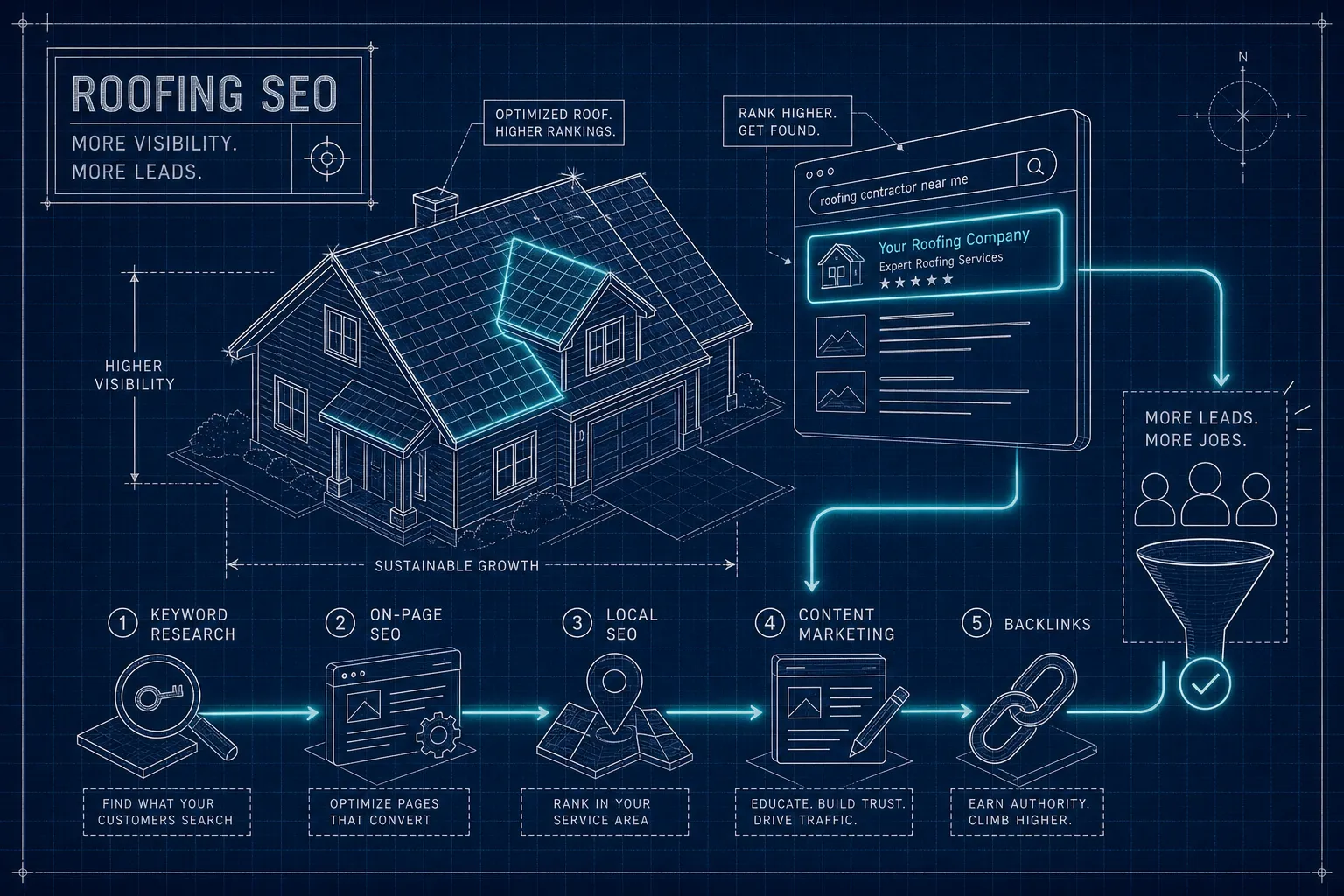
The best roofing SEO agencies treat each campaign as an integrated local search strategy: GBP management, technical site health, content for service pages, and off-page authority building all running in parallel. These aren’t separate workstreams that get siloed. They reinforce each other, and a team that manages all of them under one roof produces better results faster than a contractor managing three separate vendors.
Brandleap Agency is built around this integrated model: a founder-led specialist team covering every layer of contractor SEO, from technical fixes and citation building to conversion-optimized service pages, with senior-level strategic oversight applied directly to each client engagement. Request a discovery call or site audit before committing to any agency. A reputable team will surface real issues and give you a clear plan before asking for a retainer.
Roofing SEO pricing in 2026: what the numbers actually look like
Pricing tiers by market size and campaign scope
Basic single-city campaigns in low-competition markets typically run $750, $1,500/month. Mid-level growth campaigns covering multiple service areas in average-competition markets sit at $1,500, $3,500/month. Competitive metro or multi-location work runs $3,500, $7,500+/month. One-time project fees for SEO audits, site setup, or initial location-page builds typically range from $750, $5,000 depending on scope.
Frame those numbers against job value: as noted above, one residential roof replacement averages $9,000, $12,000. One closed job per month from a mid-level SEO retainer pays for the campaign three to four times over. The ROI math is favorable before the compounding effects even kick in.
Pricing red flags worth watching
Agencies promising page-one rankings within 30 days are using tactics that may produce short-term movement before triggering penalties. Lock-in contracts of 12+ months with no performance benchmarks or exit clauses should prompt serious questions about accountability. Pricing under $500/month for a full local SEO campaign almost always signals outsourced, low-quality work with no strategic oversight, which typically creates more cleanup work down the road than it solves.
Start your roofing SEO strategy now
SEO for roofing contractors isn’t a marketing add-on. It’s the system that puts your business in front of homeowners at the exact moment they’re ready to hire. The tactical hierarchy is clear: GBP optimization first, service-area pages second, reviews and citations as ongoing infrastructure, all tracked through lead volume and cost per lead.
Results take 3, 6 months to appear and 6, 12 months to stabilize. Contractors who start their roofing SEO strategy now will be fielding consistent organic calls next season. The ones who wait will be watching their competitors pick up those calls instead.
Use the questions in this guide to audit your current agency or evaluate new ones. If you’d rather hand the entire strategy to a specialist team, Brandleap Agency works with contractors and service businesses that need senior-level local SEO, a founder-led team covering every layer from technical SEO to GBP management to conversion-focused content. Request a free roofing SEO audit today and get a clear picture of exactly where your rankings stand and what it takes to move them.