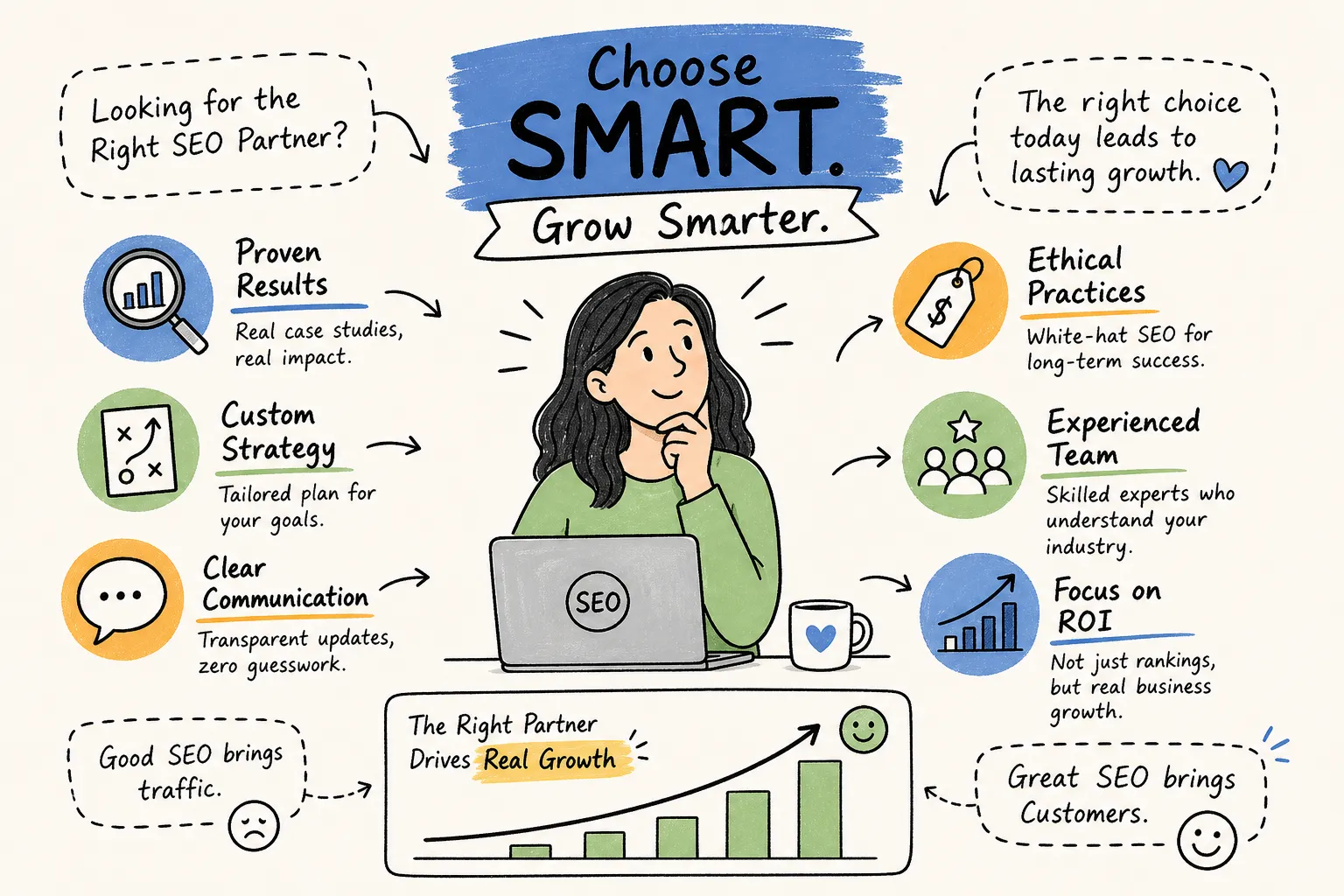
Many SEO companies are operating in the USA right now, and the range in quality is staggering. Some U.S. businesses lock into a $500/month contract, get a flurry of activity in month one, and then watch their rankings stagnate for the next year, a risk pattern that shows up repeatedly in agency post-mortems and client exit surveys. Others spend $10,000/month with a well-known agency, receive polished reports, and still can’t connect the work to a single new customer. Both outcomes are avoidable, but only if you know what to look for before you sign.
The cost of getting this decision wrong isn’t just the wasted budget. Poor SEO execution can leave you with Google penalties, a damaged backlink profile, or months of momentum to rebuild before any real progress begins. Not all SEO firms operating in the U.S. are built for the same type of client. Some focus entirely on local map-pack visibility; others work exclusively with enterprise brands running multi-market campaigns. A growing number of agencies are built specifically to close the gap between advanced SEO strategy and small-business pricing, Brandleap Agency is one of them.
Five decisions shape this choice: which type of agency fits your goals, what to budget in 2026, what realistic results look like and when, which red flags should end the conversation, and which questions to ask before any contract is involved.
1. What type of SEO company matches your business goals
Local SEO firms vs. national and enterprise agencies
A local SEO company in the USA is built for service-area and brick-and-mortar businesses. Their core work centers on Google Business Profile optimization, local citation building, review management, and map-pack rankings. If your customers find you through searches like “plumber near me” or “dentist in [city],” a local SEO firm is the right tier. For most single-location businesses, paying for national content strategy or enterprise technical architecture is unlikely to be cost-effective, you’re funding capabilities your customers will never benefit from.
National and enterprise SEO agencies target broader, more competitive keyword landscapes across multiple locations, product categories, or business units. They’re built for large-scale technical work, coordinated content programs, and cross-market authority building. Choosing the wrong tier, in either direction, means either paying for capabilities you don’t need or working with a firm that’s too small for your scope.
Specialty SEO service providers worth knowing
Beyond the local-versus-national divide, there are specialty tiers worth understanding. E-commerce SEO firms focus on product and category page optimization, faceted navigation, and large catalog indexation. Technical SEO shops build around site architecture, Core Web Vitals, and crawl efficiency. Full-service digital agencies bundle SEO with paid ads, social, and content strategy under one roof.
A local contractor running a single-location business doesn’t need an enterprise-level technical audit. A scaling e-commerce brand does need category-level SEO expertise and probably some Google Ads management running alongside organic growth. Identifying your tier first keeps you from being oversold services that won’t move your specific needle.
2. How SEO pricing is structured and what to budget in 2026
Monthly retainer ranges by business size
The monthly retainer is the most common pricing model among U.S. SEO agencies. For small businesses working with boutique firms, local SEO retainers typically run $1,500 to $3,000 per month. Mid-market companies running regional or multi-location campaigns should budget $3,000 to $7,500 per month. Competitive e-commerce brands typically see quotes in the $5,000 to $15,000 range, and enterprise-scale campaigns start at $10,000 per month and can reach well beyond $50,000.
The meaningful range for legitimate ongoing SEO work in 2026 sits between $1,500 and $10,000 per month depending on competition, site complexity, and content velocity. Any quote under $1,500/month from a full-service agency is a signal that scope is too limited to move the needle, at that price point, you’re usually buying activity, not results.
Project fees, hourly consulting, and when they make sense
Monthly retainers aren’t always the right model. SEO audits and site migrations are commonly sold as standalone projects, running $1,500 to $5,000 for smaller sites and $5,000 to $30,000-plus for complex enterprise work. These are smart options for businesses that need a specific deliverable without a long-term commitment.
Hourly consulting rates from reputable U.S. SEO professionals range from $75 to $300 per hour depending on seniority and specialization. If you need strategic input on a specific problem, a content architecture review, or guidance during a site migration, hourly consulting can deliver high value without locking you into a retainer. The key is knowing exactly what outcome you need before you start the clock.
3. What realistic results look like and when to expect them
The first 90 days: foundation before performance
The first three months of any SEO engagement are spent on technical fixes, content creation, indexation improvements, and baseline data collection. This phase is about earning the right to rank, not ranking yet. Clients should track Google Search Console impressions, crawl coverage, Core Web Vitals scores, and pages published, these are the leading indicators that the foundation is being built correctly. The honest framing is: “We expect to prove technical progress, content momentum, and early visibility gains, not full ROI yet.”
Revenue impact in the first 90 days is rare, and any agency that promises otherwise is overpromising. Significant organic traffic gains and lead flow take longer to materialize, which is exactly why the KPIs at this stage are process-based, not revenue-based.
Months 4 through 12: when rankings, traffic, and leads materialize
Rankings for lower-competition and long-tail terms typically begin shifting between months three and six. Meaningful organic traffic growth follows. By months seven through twelve, a well-executed SEO campaign should show clear contributions to leads, conversions, and revenue. The exact pace depends on your competitive landscape, site health at the start of the engagement, and content velocity.
The right KPIs to track as the campaign matures include organic sessions, top-10 keyword count, organic conversions, and assisted revenue. Watching rankings in isolation misses the point entirely. A keyword moving from position 12 to position 4 matters only if it’s translating into clicks, and clicks matter only if they’re converting into customers.
4. Red flags that should end the conversation with any U.S. SEO company
Promises no legitimate SEO firm will ever make
Any U.S. SEO company that guarantees a number-one ranking or a specific traffic number within a fixed timeline is either uninformed or dishonest. Search rankings are shaped by dozens of factors outside any agency’s control: algorithm updates, competitor activity, your own site’s authority history, and how Google interprets user intent at any given moment. A reputable firm sets realistic expectations and ties their success metrics to business outcomes, not vanity positions.
Be especially cautious when pricing is suspiciously low and promises are unusually high. That combination almost always signals either automated “SEO” that generates no real results or black-hat tactics that produce a short-term bump followed by a Google penalty from which recovery takes months.
Opacity in process, reporting, and link-building tactics
Vague answers about what work will actually happen each month are a serious warning sign. If an agency describes its approach as “proprietary” or deflects questions about link-building methods, they either don’t have a real process or they have one they know won’t hold up to scrutiny. Transparency is non-negotiable here.
The same applies to reporting. If they can’t tell you which KPIs they’ll track, how often they’ll report, and what success looks like at 90 days, they’re operating without a real methodology. Refusal to share case studies or references from clients in a similar situation should stop the conversation before it goes any further.
5. Questions to ask before you sign a contract
Questions about process, proof, and who actually does the work
Before signing anything, ask every prospective SEO firm these questions directly. What does your SEO process look like from onboarding through month three? Can you walk me through a case study for a business similar to mine? Who will manage my account, and is any of the work outsourced?
Those questions expose whether you’re talking to a real team with a documented methodology or a thin operation that resells services from an overseas fulfillment center. A strong agency answers each one with specifics, names, examples, and timelines. A weak one pivots to sales language every time you ask for detail.
Questions about reporting, timelines, and what success means
Follow up with these: How do you measure success, and which metrics will appear in monthly reports? What ranking improvements can I realistically expect in the first six months? How do you adjust strategy if results aren’t tracking to expectations? A trustworthy SEO firm will answer these with specifics tied to your business goals, not traffic projections disconnected from revenue.
One more question worth asking: do I own the website, content, analytics accounts, and any assets created during the engagement? The answer should always be yes. If an agency holds your accounts or content hostage behind a contract, that’s a red flag about how they operate, not just a legal technicality.
How to shortlist an SEO company in the USA and make your final call
Matching your evaluation criteria to the right firm
Narrow your list by matching your business type, budget, and goals to the agency’s documented experience. A local service business should prioritize firms with proven Google Business Profile work and local pack results. An e-commerce brand needs to see category-level SEO wins and an understanding of large-catalog indexation. A B2B company should look for agencies that understand long-cycle lead generation, not just organic traffic growth.
Once your shortlist is down to three to five firms, compare pricing transparency, contract terms, reporting cadence, and who specifically will manage your account. The right agency for your business isn’t necessarily the most recognized or the most expensive. It’s the one whose capabilities, process, and pricing align with where you actually need to go. If you’re searching for the best SEO companies in the USA for your size and budget, that alignment matters far more than brand name or office location.
Why Brandleap Agency is worth considering for businesses that need both affordability and advanced strategy
Some U.S. businesses find a real gap in the market: basic local SEO packages offer limited capabilities, while high-end enterprise agency pricing puts advanced strategy out of reach. Boutique agencies in the $1,500 to $5,000/month range do exist, but finding one with genuine strategic depth takes work. Brandleap Agency is a U.S.-based SEO consultancy built for exactly that middle tier, small and mid-market businesses that need more than checkbox SEO without paying enterprise rates.
Semantic SEO is a core part of how Brandleap approaches client work, and in our experience, it’s a capability most budget agencies skip entirely. The difference shows up in search performance: ranking for isolated keywords versus building the topical authority that earns consistent visibility across an entire subject area. For businesses that need results-driven SEO without a six-figure annual contract, Brandleap is worth a direct conversation.
The buyer’s framework that keeps you from overpaying or settling
Getting this decision right comes down to knowing which type of agency fits your goals, setting a realistic budget, understanding what results to expect and when, walking away from red flags without hesitation, and asking the hard questions before any contract is signed. None of these steps require you to be an SEO expert. They just require you to hold the agency to the same standard you’d hold any business partner.
Use the questions in this guide on your next agency call. You’ll quickly determine whether you’re talking to a team with a real process and provable results, or a sales operation that will look great until month three when nothing has moved. The right SEO partner exists for your budget and your goals. The framework above is how you find them.
If you’re a U.S. business ready to hire an SEO company and put that framework to work, Brandleap Agency is worth the first call. Reach out for a direct conversation about your goals, your current site, and what a realistic SEO roadmap looks like for your specific situation.