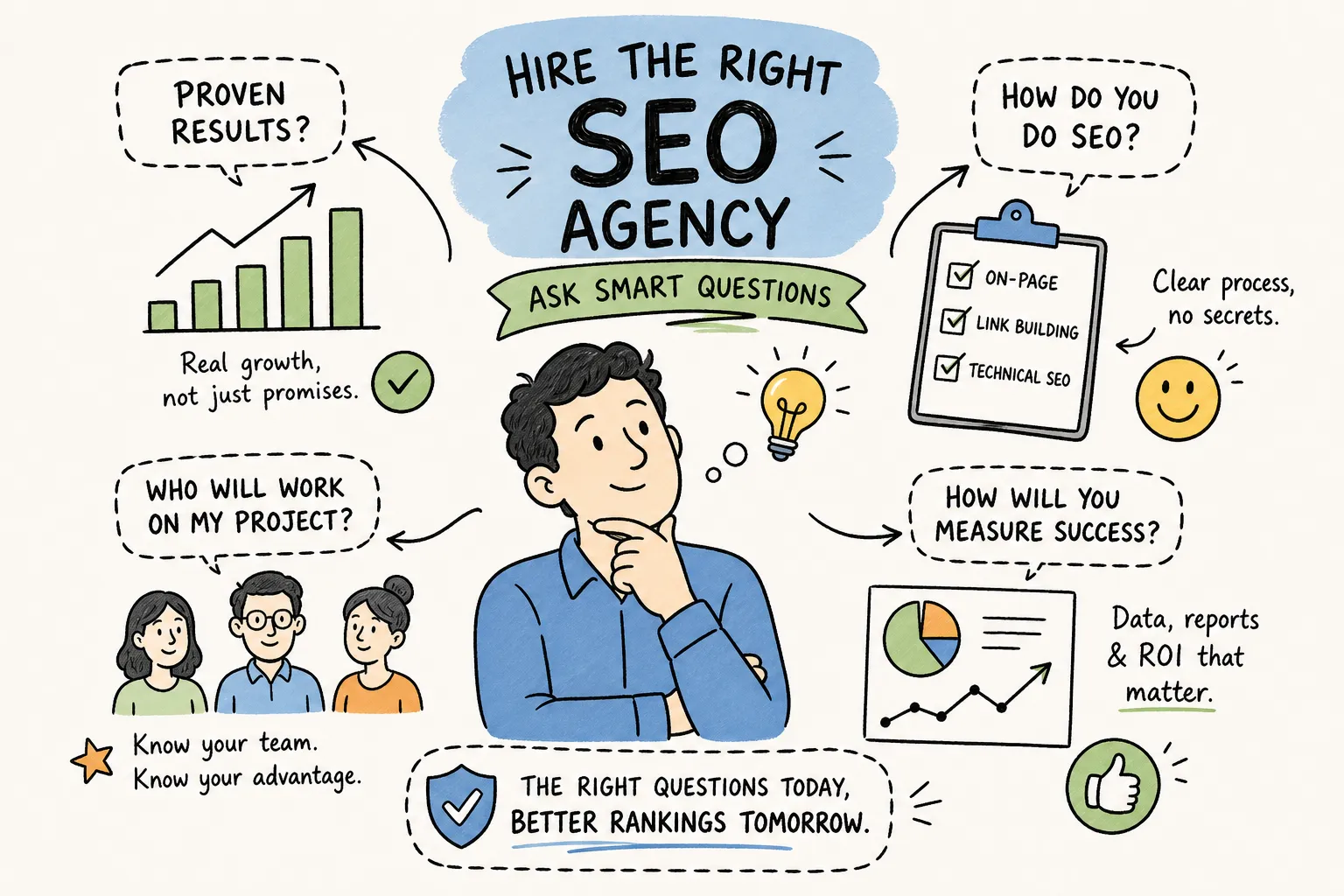
Most small business owners skip a proper SEO agency checklist when hiring help for their website. They sit through a polished pitch, nod at phrases like “holistic strategy” and “full-funnel approach,” and sign a contract before asking a single hard question. Then the months pass, the invoices pile up, and the needle barely moves.
The problem usually isn’t effort on either side. It’s that there was never a framework to evaluate the agency before money changed hands. At Brandleap Agency, we’ve seen this pattern across industries: businesses that skipped the vetting process and paid for it later. What separates agencies that deliver from agencies that disappear after onboarding is almost always visible before you sign, if you know what to look for.
This article gives you that framework. What to ask, what to verify, what should make you walk away, and what legitimate SEO reporting actually looks like. Run every agency you evaluate through this before you commit a dollar.
The questions to ask before you ever sign a contract
Most buyers start with pricing and work backward. That’s the wrong sequence. Budget matters, but it’s the last thing to discuss, not the first. The right questions reveal process and accountability, and those answers will tell you more than any proposal document. For a starter list of focused queries to vet an SEO partner, see 10 Questions to Ask Before Hiring an SEO Consultant, 2026.
How do they build and execute your SEO strategy?
A genuine strategy answer has substance. You want to hear about keyword research with search intent mapping, a competitive analysis that identifies priority pages, a phased content plan, and a technical audit that runs before any execution starts. That sequence matters because you can’t build on a broken foundation.
If the answer sounds like “we’ll rank you on page one” or “we use proven techniques,” stop the conversation. That’s a pitch, not a strategy. Ask them to walk you through specifically how they’d approach your site, your competitors, and your market. Vague answers at this stage tend to predict vague results later.
SEO Agency Checklist: What Does Onboarding Look Like in the First 30 Days?
Reputable agencies follow a structured process from day one. Access to Google Search Console, GA4, your CMS, and Google Business Profile should be requested within the first 48 hours. Expect a kickoff call within the first five business days. A triage audit identifying high-priority technical issues should be completed within two weeks, and a 90-day roadmap should land in your inbox before day 28.
These aren’t arbitrary milestones, they represent the structured onboarding sequence that separates agencies with real workflows from those still figuring things out. If an agency can’t describe these steps specifically, that gap tells you something important. Ask them directly: what’s in your 30-day deliverables package? A real SEO deliverables list at the 30-day mark includes an audit report, baseline metrics, quick-win implementation, and a documented content and technical roadmap. For a practical look at onboarding best practices, this guide to SEO onboarding best practices is a useful reference.
Who will actually work on your account?
Ask for names and roles, not department names. You want to know whether there’s a dedicated account manager, who handles technical implementation versus content production, and what the average client load looks like per person. Ask about response time commitments too. An account manager spread thin across a large book of business won’t have the bandwidth to understand your market, your customers, or your goals.
Also ask whether any work is outsourced. Some agencies run a front-end team and subcontract the actual deliverables to offshore vendors. You’re entitled to know that before you sign. Generic answers about “our team of experts” with no specifics are a yellow flag worth probing.
Technical Items in Your SEO Agency Checklist
After an initial conversation, shift from questions to proof. Ask for a sample audit or a walkthrough of their technical SEO process. Use what you see as your benchmark to evaluate whether they’re actually equipped to do the work they’re promising. Compare their approach against a formal technical SEO checklist for agencies to spot gaps quickly.
What their audit process should include
A credible agency audit covers four core areas, and reviewing them is a core part of any technical SEO checklist worth using:
- Crawlability: robots.txt accuracy, XML sitemap validation, broken link identification, and internal linking depth to confirm critical pages are reachable within three to four clicks (a widely used audit heuristic).
- Indexation: noindex tag audits, canonical tag implementation, and a reconciliation between your sitemap URL count and what Google has actually indexed.
- Core Web Vitals: real-user field data from Google Search Console on LCP, INP, and CLS across both mobile and desktop, not just lab metrics from a speed test tool.
- Structured data: schema markup validation and JavaScript rendering checks to confirm content is visible to search engines, not just browsers.
If an agency’s version of an “audit” is a one-page PDF with traffic numbers and a handful of keyword gaps, that’s a teaser, not a technical audit. A real audit is a working document with specific issues, severity classifications, and a remediation plan attached.
How they handle on-page and content optimization
On-page work from a serious agency includes title tag and meta description optimization for click-through rate, H1 hierarchy review, keyword placement in the first 100 words, internal linking structure improvements, and content depth aligned with search intent. These aren’t optional extras, they’re the documented on-page process that should apply to every page being actively worked on.
Ask to see a sample deliverable from a past client. Agencies with a documented process can show their work. Those without a real on-page methodology will produce a generalized document that could apply to any site in any industry. That’s a template, not a strategy. For a quick checklist you can use to evaluate on-page quality, consult this on-page SEO checklist.
Red flags that should make you walk away
Most red flags are visible before the contract is signed. The mistake is dismissing them because the pitch is compelling or the price is right. These are filters, not negotiation points.
Guaranteed rankings or instant results
No agency can guarantee specific Google rankings. Search is dynamic, competitive, and influenced by hundreds of factors outside any agency’s control. Any agency promising “page 1 in 30 days” is either using black-hat tactics that risk a manual penalty, or telling you what you want to hear to close the deal. Walk away from both.
Recovery from low-quality link schemes or spammy tactics is a slow process, commonly cited estimates run six to twelve months, though timelines vary by situation. That’s months of lost ground on top of whatever you paid. Fast-ranking promises almost always come paired with shortcuts that cost more than they earn.
Vague or absent reporting
If an agency can’t show you a sample report or describe exactly what appears in their monthly update, that’s a serious gap. Good agencies define KPIs upfront, tie them to actual business goals, and give clients direct access to dashboards rather than locking data behind a summary PDF once a month.
Ask what tools they use and whether you get dashboard access directly. If the answer is “we’ll send you a monthly report,” ask what’s in it. If they can’t name the KPIs they track, you don’t have enough information to evaluate their accountability.
Cookie-cutter packages with no strategy variation
A flat “starter package” with identical deliverables for every client is a production line, not a strategy. Every business has a different competitive landscape, different technical debt, different content gaps, and different revenue goals. An SEO campaign built without accounting for any of that isn’t built around your business, it’s built around the agency’s efficiency.
Ask how they scope work for smaller budgets. A strong answer involves prioritization: technical fixes first because they compound, then content growth targeting high-intent queries, then link building once the foundation is solid. If the answer is “our package covers it all,” push for specifics. You’ll learn a lot from what they can’t articulate.
What good SEO reporting actually looks like
Before you sign with anyone, build a baseline understanding of what quality reporting looks like. That way, you’re evaluating reports against a standard, not just your gut.
The KPIs that actually matter
There are four KPI categories worth tracking consistently:
- Visibility: keyword rankings and your overall search footprint.
- Traffic: organic sessions and impressions from Google Search Console.
- Engagement: click-through rate, bounce rate, and time on page.
- Conversions: organic leads, goal completions, and revenue attribution from organic search.
Rankings alone tell you almost nothing about business performance. A site can rank on page one for dozens of keywords and still generate zero leads if the intent mapping is off or the landing pages don’t convert. Any agency presenting ranking reports without downstream engagement and conversion data is giving you an incomplete picture by design. For a deeper primer on which SEO metrics map to business outcomes, review this guide to SEO KPIs to measure success.
Reporting cadence and what to expect month to month
Most reputable agencies deliver monthly reports as their baseline cadence, with quarterly deep-dive reviews for strategic realignment. Real-time dashboards using Google Search Console and GA4 should be accessible to you directly, not gated behind the agency account. That’s not a minor point. If you lose access to your own data when you switch agencies, you lose the historical baseline that powers year-over-year comparisons and trend analysis.
In the first 90 days specifically, expect a progress check at day 30 that confirms quick wins shipped, technical fixes implemented, and content work started. A day-60 update should begin showing impressions movement in Google Search Console, though early results vary by site and market. By day 90, you should have a running content engine, resolved technical issues, and early conversion data to evaluate. Anything less than that level of transparency falls short of what a legitimate SEO partnership should deliver. For additional context on the first 90 days with an agency, see resources like what to expect in the first 90 days with an SEO agency.
Finding the right fit, not just the right credentials
Credentials and case studies are necessary but not sufficient. The agency-client relationship also depends on communication style, how much the agency teaches versus obscures, and whether you feel like a partner or a ticket number in their system.
Why an education-first agency changes the outcome
Some agencies deliberately keep their process opaque so clients stay dependent. Others explain what they’re doing and why at every stage, which means clients can give better feedback, approve work faster, and actually understand how their investment is working. That transparency removes the information bottleneck that slows most SEO programs down.
Brandleap Agency operates on this model. The goal isn’t just to handle SEO on your behalf, it’s to help you understand what’s being done and why, so you can engage with the process as an informed partner. When you know why a technical fix matters, you prioritize it faster. When you understand what a content brief is targeting, your feedback sharpens. The result is a tighter feedback loop that accelerates measurable outcomes. If you want broader guidance on hiring digital marketing help, our overview on How to Hire a Digital Marketing Agency the Right Way, 2026 is a good next read.
Tailored strategy vs. generic execution for small businesses
Small businesses don’t have enterprise budgets, so they can’t afford to chase every tactic simultaneously. The right agency scopes work around leverage: where does the highest impact live right now, and what’s the sequenced plan to build from there? A phased approach starting with technical hygiene, expanding into intent-driven content, and scaling into link building is how small budgets produce compounding results.
Brandleap’s approach to affordable SEO is built around exactly this progression. Start where the leverage is highest, prove the model with measurable wins, and scale from a foundation that holds. That’s the difference between burning budget on broad tactics and building an engine that grows quarter over quarter. If you need guidance specific to your region, including how to choose a partner in a particular market, review our piece on SEO Agency in India: How to Choose the Right Partner, 2026 for an example of choosing the right fit by market.
Use this SEO agency checklist before you sign anything
Hiring an SEO agency is one of the higher-stakes decisions a small business makes. The right partner accelerates growth; the wrong one costs you time and money while handing market position back to your competitors. The five areas covered here give you the structure to evaluate any agency before you commit: the questions to ask upfront, the technical capabilities to verify with proof, the red flags that filter out bad fits, the reporting standards you should hold any partner to, and the relationship factors that make a partnership sustainable over the long term.
Run the agency through every section of this SEO agency checklist before you sign anything. Ask the hard questions about onboarding, demand a sample audit deliverable, push back on vague answers, and make direct dashboard access a non-negotiable. If an agency can’t hold up to these questions with specific, documented answers, they’re not ready to grow your business.
If you want to see what agency-standard SEO looks like from the inside, the team at Brandleap Agency is happy to walk you through our process, show you our deliverables, and answer every question on this list. That initial conversation is free. Signing with the wrong agency isn’t.