Many small businesses sign a local SEO package agreement based on little more than a PDF with bullet points and a monthly number. The proposal looks professional and the pitch sounds confident. Then three months pass and the phone isn’t ringing any differently. Often, that outcome has less to do with Google and more to do with unclear deliverables and mismatched expectations from the start.
A local SEO package is only worth buying when you know exactly what’s inside it, what each piece does, and how success gets measured. This breakdown gives you the 2026 pricing benchmarks, the core local SEO deliverables at each tier, honest timelines by industry, reporting standards to expect, and the red flags that tell you to walk away before you sign anything.
What a legitimate local SEO package actually includes
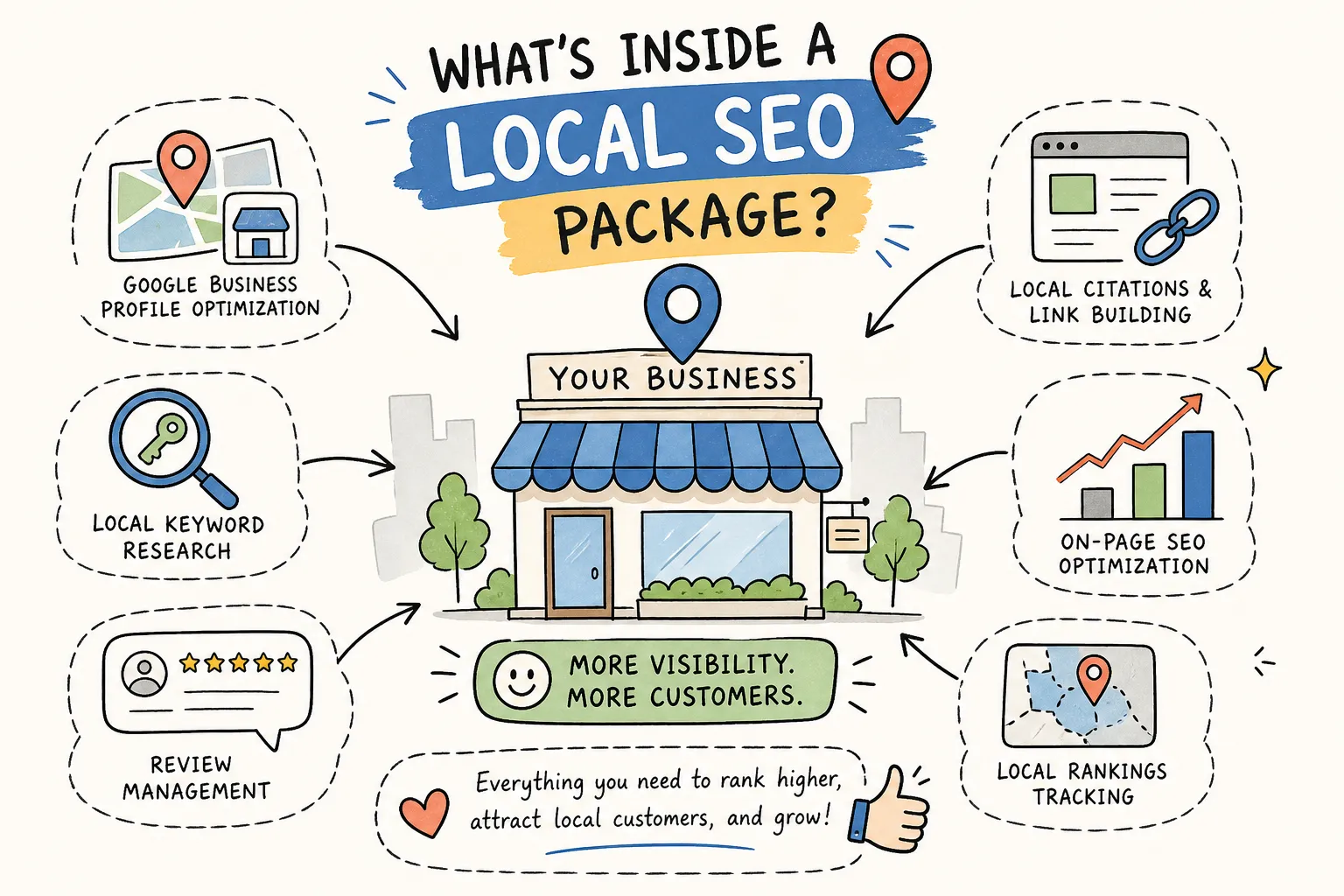
Before you compare prices, you need a clear picture of what the work actually involves. These four deliverables should appear in every serious local search package, regardless of tier.
Google Business Profile management: the center of local search
Your Google Business Profile is the highest-leverage asset in local SEO. The primary business category alone is the strongest single relevance signal Google uses to match your listing to search queries. Real GBP management goes well beyond a one-time setup. It includes category selection, secondary category refinement, attribute completion, photo updates, regular posts, Q&A monitoring, and ongoing optimization as Google rolls out new features. At the basic tier, expect a one-time setup and optimization. At standard and premium tiers, expect active monthly management that keeps the profile fresh and competitive.
Citation building and NAP consistency across directories
A citation is any online mention of your business name, address, and phone number. Inconsistent NAP data across directories quietly suppresses local rankings because Google uses citation consistency as a trust signal. A proper citations service starts with an audit to find mismatches, cleans up duplicate or incorrect listings, and then builds new citations across core directories. For U.S. businesses, the essential targets include Google Business Profile, Apple Business Connect, Bing Places, Yelp, Facebook, BBB, and the major data aggregators: Data Axle, Neustar Localeze, and Foursquare. Premium packages extend this to industry-specific directories like Angi for home services, Avvo for legal, and Healthgrades for healthcare.
On-page SEO for location and service pages
On-page work at the basic level covers title tags, meta descriptions, and NAP placement on your core pages. Standard and premium packages go further: city and service page creation, LocalBusiness schema markup, FAQ sections targeting local questions, internal linking between location and service pages, and conversion elements like click-to-call above the fold. A local SEO package that skips location page work may leave meaningful traffic potential untapped, because these pages are how you rank for “service + city” searches beyond the local pack.
Review management and reputation signals
Reviews affect both rankings and conversions. Review quantity, velocity, recency, and average rating are all prominent factors in Google’s local ranking signals. At the basic tier, review management typically means setup guidance. Standard packages include a systematic outreach strategy for requesting new reviews. Premium packages include active generation workflows, monitoring across platforms, and managed responses to both positive and negative reviews. If a package doesn’t address reviews at all, it’s missing one of the most direct levers for local pack visibility.
2026 local SEO pricing tiers: what basic, standard, and premium packages cost
The figures below reflect published market pricing for single-location businesses in 2026, drawn from industry pricing guides. Use them to benchmark any proposal you receive.
Local SEO package pricing by tier
Basic packages ($300, $800/month): what you get and when it makes sense
Basic local SEO plans, what many providers call small business SEO packages, make sense for businesses in low-competition markets, startups with no existing online presence, or businesses that just need a clean foundation before scaling. Typical local SEO deliverables at this level include GBP setup and initial optimization, a citation audit and basic cleanup, core on-page optimization for the homepage and key service pages, and a baseline monthly report. Content creation, active link building, and review management are usually absent. This tier can produce early visibility improvements, but it won’t sustain growth in markets with even moderate competition.
Standard packages ($800, $1,500/month): the small business sweet spot
This is the realistic entry point for a single-location business serious about generating calls and leads from local search. Standard packages typically include everything in the basic tier plus localized content creation, ongoing citation management, a review strategy, light link building, and monthly performance reporting tied to actual business metrics. Most small businesses in moderate-competition markets will find that packages priced in this range deliver a meaningful return when the deliverables are clearly defined. Based on published market pricing guides, the average midpoint for a single-location small business in 2026 is approximately $1,250/month.
Premium packages ($1,500, $3,000+/month): when you need the full stack
Premium local search packages are not a markup on the same work. They reflect a genuinely different scope of effort applied to harder competitive environments. Legal, dental, and healthcare businesses in major metro areas compete against established practices with strong domain authority, aggressive review counts, and years of consistent optimization. At this tier, expect active content production, aggressive local link outreach, review generation and response management, competitive gap analysis, and deeper analytics. If your market is hard and your competitors are well-funded, the premium tier is where you need to be.
Realistic timelines: when to expect rankings, calls, and leads
The most common source of frustration with local SEO isn’t bad work. It’s mismatched expectations. Here’s what consistent results across industries actually look like.
Industries that move faster: restaurants and home services
Restaurants and home services businesses in moderate markets often see initial ranking movement within 4, 8 weeks of GBP cleanup and citation work. That early movement is a leading indicator, not a sign that the work is done. Meaningful call volume and direction requests typically build over 2, 4 months of sustained effort. The GBP fixes produce the early signals; consistent on-page work and citations produce the sustained lead flow. Don’t confuse the first positive movement with the finish line.
Competitive industries that take longer: legal, dental, and healthcare
Legal and dental businesses in larger markets should plan for 3, 6 months before seeing meaningful ranking shifts, and 6, 12 months before lead volume becomes consistently reliable. Google applies stricter quality signals to health and legal categories, and the competitors in those spaces have been investing in SEO for years. Any agency that promises fast local pack rankings for a law firm or dental practice in a major metro is selling you something that doesn’t exist. Plan for a 6, 12 month runway and evaluate the agency on the consistency of their effort and the trajectory of their KPIs, not on month-two results.
What good reporting looks like in a local SEO package
A monthly report is your primary tool for holding an agency accountable. Here’s what separates useful reporting from noise.
KPIs that actually tie to business outcomes
Strong local SEO reporting tracks GBP actions (calls, website clicks, direction requests), local pack rankings for priority keywords, organic traffic from the target service area, conversion metrics like form fills and phone calls, review volume and average rating, and citation consistency. Rank tracking alone is a thin proxy for business results. A serious package connects SEO activity to revenue-adjacent metrics that show whether the work is actually driving customers through the door.
What a monthly report should contain
Every report should show current versus prior-period values, the trend direction for each key metric, a plain-English explanation of what changed and why, and a short next-steps plan tied to the data. You should finish reading the report knowing exactly what happened last month and what the agency is doing about it next month. If a report is a screenshot of keyword positions with no context or action plan attached, that’s a red flag worth taking seriously.
Multi-location SEO pricing: how scope and cost scale
If you operate more than one location, the pricing model changes. Most agencies structure multi-location work with a base strategy fee of roughly $1,000, $3,000/month for planning, tools, and oversight, plus a per-location execution fee in the range of $200, $500 per location per month for standard programs. Volume discounts typically begin at 5, 10, or 20+ locations, but they’re usually embedded in the structure rather than advertised as a percentage off.
Each additional location requires its own GBP management, citation work, location page optimization, review management, and location-specific reporting. At scale, agencies also layer in localized content production, local link building per market, and technical coordination across all location pages. When comparing multi-location quotes, always request a per-location deliverables breakdown. A blanket per-location fee without defined per-location scope is one of the most common ways agencies expand billing without proportionally expanding effort. Understanding multi-location SEO pricing before you negotiate puts you in a much stronger position.
How to spot a weak package and evaluate real value
Not every agency selling local SEO is delivering it. These are the warning signs to watch for before you sign a contract.
- Guaranteed rankings. No agency can guarantee specific positions. Walk away from anyone who claims otherwise.
- Vague language with no task list. Phrases like “ongoing optimization” mean nothing without a defined scope of monthly work.
- Reports built entirely on impressions and clicks. If the reporting never connects activity to leads or calls, it isn’t accountability, it’s noise.
- Citations sold as a complete program. Citation building is one component of a local SEO package, not a standalone strategy.
- Long-term contracts with no performance clause. Any agency confident in its work will agree to measurable benchmarks.
When evaluating any proposal, use a results-driven benchmark for comparison. Ask every agency to map their deliverables against the five core components: GBP management, citation building, on-page work, review strategy, and monthly reporting tied to business KPIs. The benchmark is not the price, it’s the clarity of what you’re paying for and the metrics used to prove it’s working. Brandleap Agency publishes its tier deliverables openly, which makes it a useful reference point when auditing proposals line by line. Use any transparent agency’s published scope as your comparison baseline.
Key takeaways: evaluating a local SEO package
A local SEO package is worth the investment when it maps deliverables to outcomes, when the local SEO pricing matches the competitive scope of your market, and when reporting connects the work directly to calls, leads, and revenue. You now have the framework to evaluate any proposal: the right questions to ask, the pricing benchmarks to use, and the red flags that should stop a deal before it starts.
Pull up any proposal you’re considering and compare it against these standards. If the agency can’t clearly answer what gets done each month, who does it, and how success is measured, that’s your answer, before you’ve signed a thing.