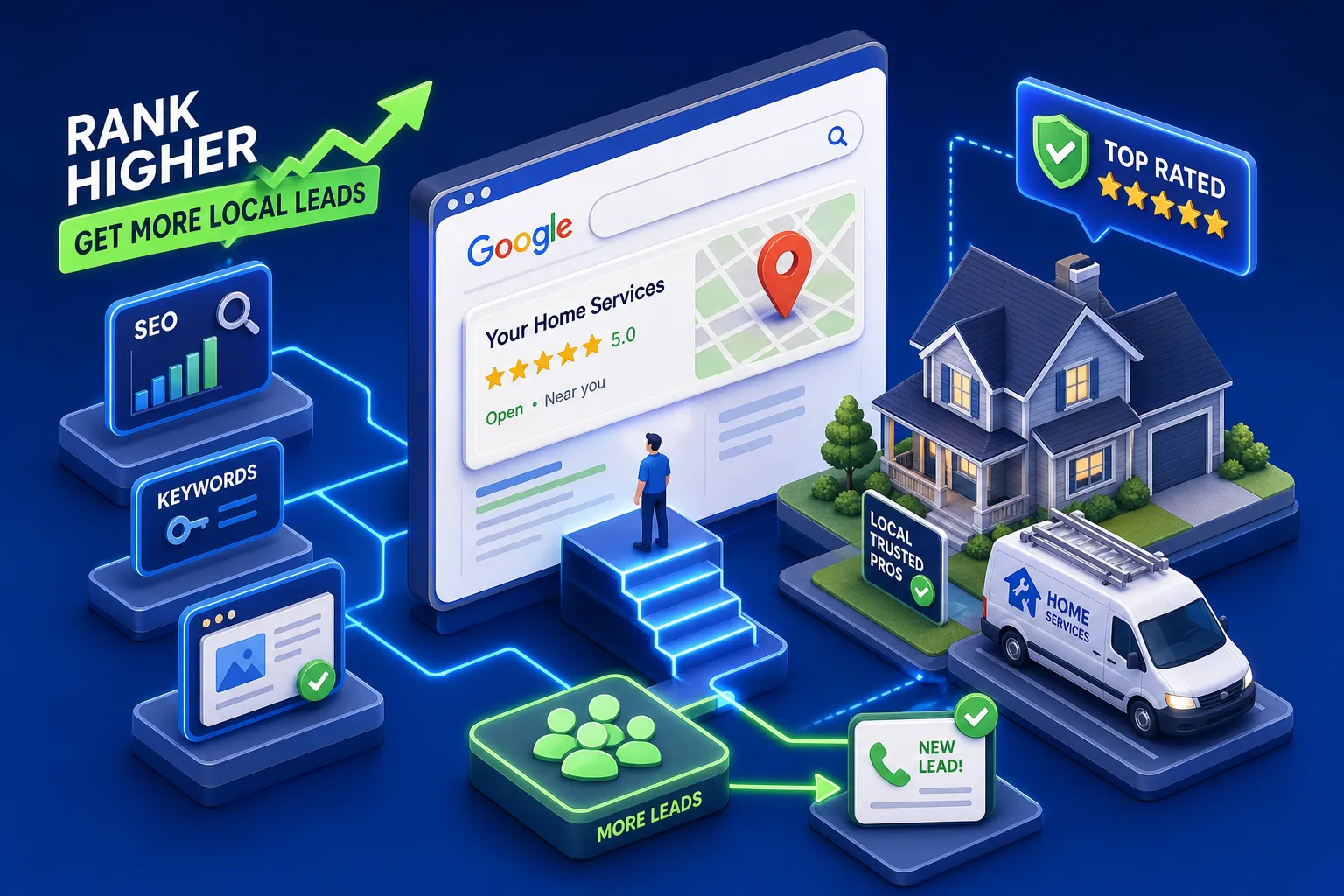
Home services SEO is the discipline that puts your business in front of homeowners at the exact moment they’re searching for a contractor, and the place that matters most is the local pack, the three listings Google places above every other result. That’s where homeowners click, call, and book. The organic results below it? Research consistently shows that local pack listings capture a substantially larger share of clicks than the organic results beneath them, so most searchers never scroll that far.
SEO for home service businesses works differently from standard SEO. Your competition isn’t a national content site; it’s the three other plumbers, HVAC techs, or roofers in the same zip code. The tactics that win here are specific: Google Business Profile signals, service-area pages, and review velocity. Not blog articles about industry trends.
At Brandleap Agency, working with home service businesses across the US, the team consistently finds the same pattern during site audits: contractors doing excellent work with little to no local search presence. This guide walks through the exact levers that change that. By the end, you’ll know how to audit your current setup, apply the highest-impact tactics, and track whether they’re actually moving the needle.
Why the local pack is where home service jobs actually come from
Google uses three factors to rank local results: relevance, distance, and prominence. Relevance is how well your listing matches what someone searched for. Distance is how close your business is to the searcher. Prominence reflects how well-known and credible your business appears across the web. For contractors, distance is largely fixed by geography. Relevance and prominence are the two you control.
According to 2026 local SEO ranking factor studies, GBP signals carry roughly 32% of local pack ranking weight, making your Business Profile the single highest-leverage asset in your home services SEO strategy. Get that right and you’re already ahead of most competitors who set up their profile years ago and never touched it again.
When a homeowner sees your listing in the map pack, they take one of three actions: call, click for directions, or visit your website. Very few scroll past the pack to the organic results below. Each of those actions feeds behavioral data back into Google’s algorithm, which compounds over time. More visibility drives more calls and clicks, and those actions feed even more visibility. The loop works in your favor once you get into it.
Most contractors are held back by the same four gaps: an incomplete GBP, no city-specific pages, a thin or stale review base, and no schema markup. The rest of this guide addresses each one in order.
Home services SEO starts with your Google Business Profile
Your primary category is the single most important field in your entire GBP setup. It should match the service that generates the most revenue for your business, not a generic label. If you’re a plumber, select “Plumber,” not “Contractor.” Google uses this field to determine which searches your profile is relevant for, so getting it wrong means missing the calls that matter most. Add secondary categories for additional services you actually offer.
NAP consistency
NAP consistency is the next foundation piece. Your name, address, and phone number must match exactly across your website, your GBP, and every directory listing online. If you operate as a service-area business with no public storefront, set your service areas accurately in GBP rather than listing a fake address. Google has seen every version of that workaround and it doesn’t help your ranking.
Profile completeness and photos
Once the fundamentals are right, fill in everything else. Include hours and services with specific names, “AC installation” or “emergency drain cleaning” rather than just “HVAC.” Write a business description with natural keyword references. Add relevant attributes like licensed and insured, and include a booking link if you have one. Profiles with fresh, high-quality photos get significantly more engagement than profiles with stock images or nothing at all. Upload photos of your team, vehicles, job sites, and before/after work on a regular basis. Publish GBP posts showing recent jobs, seasonal service reminders, or promotions, this signals active management to Google.
Messaging and Q&A
Turn on messaging only if someone on your team can respond within minutes. Slow messaging responses hurt more than no messaging at all. Populate the Q&A section proactively with the questions homeowners actually ask: your service area, pricing ranges, emergency availability. These small completeness signals add up into stronger prominence scores over time.
Service-area pages for home services SEO: rank in every city you serve
A city page built by swapping a city name into a copy-paste template won’t rank and can actively hurt your site. Google identifies thin, repetitive location pages as doorway pages, and that label comes with ranking penalties. Each city page needs unique local proof: neighborhood names, project photos from that area, climate or permit context specific to that city, and customer reviews from local homeowners.
A simple test: would only a contractor who actually works in that city know this content? If the answer is no, the page isn’t ready to publish. The minimum viable word count to avoid thin-content risk is around 400 words, with 500 to 800 words being a safer target for competitive local terms. The goal isn’t word count; it’s specificity.
The structure that performs best starts with a clear URL, H1, and title tag combining service plus city and state, for example: “Roof Repair in Austin, TX.” Follow with sections covering: services offered in that city, recent local project examples, why homeowners in that area choose you, local customer reviews, city-specific FAQs, and a contact block with a form and phone number. Add schema markup on each page to reinforce what the content already communicates in plain text.
Build a service-area hub page that links to every individual city page. Each city page links back to the hub and to relevant service-specific pages. This internal linking structure helps Google understand your geographic coverage and distributes page authority across the site rather than concentrating it on the homepage.
Review generation and citations: the trust signals that push you up the pack
Industry ranking factor studies consistently place reviews at roughly 17 to 20% of local pack ranking weight, and the pattern in 2026 is clear: review velocity matters as much as total count. Consistent monthly review growth can outperform a larger but stale review base, a contractor generating steady new reviews each month will often outrank a competitor sitting on hundreds of reviews that are several years old. In competitive metro markets, you’ll typically need 200 or more reviews to hold a top-three position. In smaller or less competitive markets, 75 to 100 can be enough. The real benchmark is the average review count of the current top-three competitors in your exact city and service category.
The highest-converting ask happens immediately after a completed job, while the experience is fresh. Send a direct Google review link via SMS or email; every extra click the customer has to make reduces completion rates significantly. Encourage customers to mention the service type and their neighborhood naturally in the review. Never script or gate reviews; both practices violate Google’s policies and can get your listing penalized.
Reply to every review, positive or negative, promptly, ideally within a few days of it going live. For positive reviews, personalize the reply, reference the service or location, and add a natural keyword. For negative reviews, stay professional, address the specific concern, and offer a path to resolution. Prospective customers read your response to a negative review more carefully than the complaint itself.
Citations are business listings on directories like Yelp, Angi, HomeAdvisor, BBB, and industry-specific platforms. Inconsistent NAP across directories creates conflicting signals that weaken your prominence score. Audit and clean up discrepancies before building new citations. Focus on quality local and industry-specific directories over raw volume; a relevant citation in a home-services category carries more weight than a generic one.
Schema markup and technical signals every contractor site needs
Schema markup is the confirmation layer. It reinforces what your GBP and city pages already claim, in a format Google can read without interpretation. Use the most specific LocalBusiness subtype available for your trade: GeneralContractor, Plumber, Electrician, HVACBusiness, or RoofingContractor. Include PostalAddress with full address fields, areaServed for geographic coverage, and telephone and openingHours. Add AggregateRating only when legitimate reviews are visible on the page; Google can verify this and inconsistencies create trust issues.
On individual service pages, use Service schema tied back to the business entity via the provider property. Include areaServed on those pages to connect geographic and service relevance. Schema isn’t a magic ranking switch; it helps Google confirm what the page is already saying in plain text, which matters most in competitive markets where every signal counts.
The majority of home service searches happen on mobile. A slow site loses the call before it starts. Monitor Largest Contentful Paint, Cumulative Layout Shift, and Interaction to Next Paint through Google Search Console’s Core Web Vitals report. Compress job photos before uploading, use a fast hosting stack, and remove unnecessary third-party scripts that bloat load time. Research on Core Web Vitals consistently shows that faster mobile load times correlate with meaningfully better conversion rates, shaving two or more seconds off your load time can make a measurable difference.
Tracking results and deciding when to bring in a specialist
Track these KPIs every month without exception. Convert the following into your standing monthly review:
- GBP actions, calls, direction requests, website clicks, and photo views, all available directly in GBP Insights
- Local pack ranking positions, use a rank tracker for your primary service-plus-city combinations rather than manual searches, which vary by device, location, and search history
- Organic traffic, monitor city and service pages via Google Search Console
- Lead-to-booked-job rate, the industry benchmark for inbound calls is 70 to 85%, with top performers consistently hitting 85% and above
- Cost per lead from organic and GBP, compare against your paid channels to determine whether your SEO investment is earning its place in the budget
DIY contractor SEO is viable at the start, but it has a ceiling. Technical issues, competitive markets, and page authority building require dedicated expertise and consistent time investment. Signs it’s time to hand off the work: you’re executing everything in this guide and still not moving in rankings, competitors are pulling away despite your efforts, or the business has scaled to a point where your time costs more than the service itself.
When evaluating agencies, look for contractor-specific local SEO experience, transparent reporting on GBP and organic metrics, and a clear documented process for city page builds and citation audits. At Brandleap Agency, local SEO for contractors is one of the core verticals the team is built around. The agency handles every layer: GBP optimization, service-area page builds, citation cleanup, review workflows, schema implementation, and ongoing rank tracking. The founder-led, consultant-driven model means the strategy applied to a plumbing business or HVAC company comes from senior-level experience, not a junior account manager following a checklist.
Put the system together and track what moves
Home services SEO is not complicated, but it is specific. The local pack is where the leads come from, and the levers that control it, GBP signals, service-area pages, review velocity, citations, and schema, are all within reach for any contractor willing to be systematic about implementing them in the right order.
Track GBP actions, local rankings, and lead conversion rates every month. If the numbers move, the system is working. If you see no measurable improvement after a few months of consistent execution, something in the foundation needs attention: an incomplete GBP, thin city pages, a review velocity problem, or technical issues slowing down your site.
For contractors who want to skip the trial-and-error and have an experienced team run the full local SEO system, Brandleap Agency is built for exactly that. The first step is an audit: find out where your biggest ranking gaps are before investing time or budget in the wrong place. Reach out to the Brandleap team and get a clear picture of where you stand and what it will take to move up.