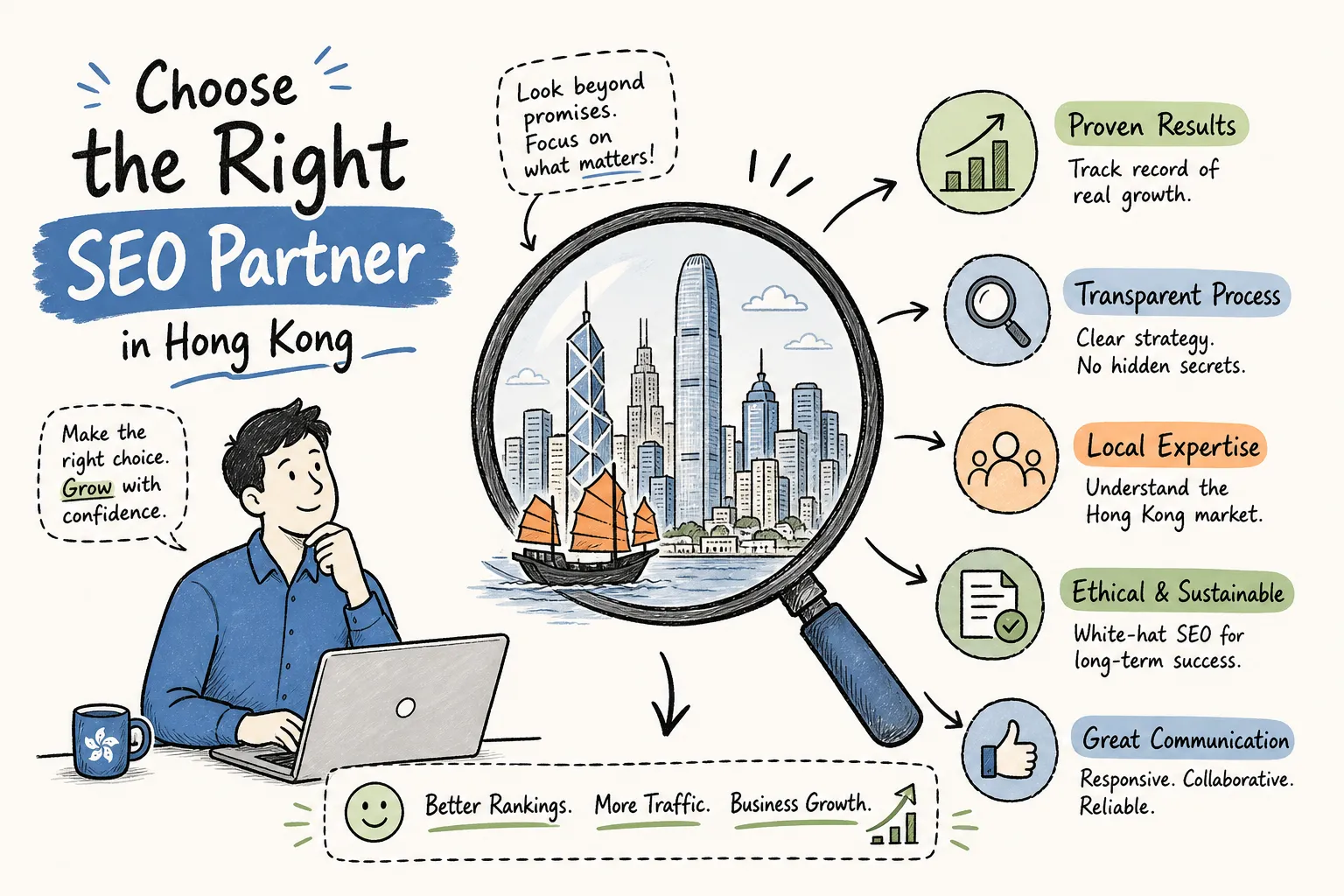
Hong Kong has no shortage of agencies promising first-page rankings. The harder problem is knowing which ones can actually deliver them. Choosing the wrong SEO company in Hong Kong doesn’t just waste budget, it costs you months of momentum while a competent competitor builds organic authority you’ll have to chase down later.
This guide isn’t a “top 10 agencies” roundup. It’s a practical vetting framework built around the specific realities of Hong Kong’s search landscape. Whether you run a business based in Hong Kong or you’re a US company preparing to enter the Asia-Pacific market, evaluating an SEO partner follows the same logic: look past the pitch, verify the proof, and match the agency’s real capabilities to your market reality.
At Brandleap Agency, we specialize in helping US businesses navigate international digital expansion, including Asia-Pacific market entry. This guide reflects the framework we apply to separate genuine capability from polished sales decks. Use it before you sign anything.
Why the Hong Kong SEO market works differently from what you expect
SEO is not the same discipline everywhere, and Hong Kong is a clear example of why that assumption gets businesses into trouble. The city’s digital landscape has structural features that directly shape what kind of agency you actually need. Treating it like a standard English-language SEO engagement will leave real gaps in your strategy.
Google is the dominant search engine for most Hong Kong users, so any serious SEO agency in Hong Kong should have deep Google expertise. But businesses targeting mainland Chinese visitors or cross-border demand also need to account for Baidu, which operates on entirely different ranking factors and a separate technical ecosystem. An agency that only knows Google-first tactics will miss that channel entirely.
The bilingual, mobile-first user reality
Hong Kong users switch fluidly between English and Cantonese in the same search session. A query for a restaurant in Central might start in English and continue in Traditional Chinese depending on the platform and the user’s context. Mobile usage is high across the city, and district-level search intent becomes a genuine strategic variable. Searches anchored to Central, Tsim Sha Tsui, or Causeway Bay behave differently from broad national campaigns, and keyword strategy has to reflect that granularity.
Google vs. Baidu: knowing when each matters
For businesses serving primarily Hong Kong residents, Google optimization is sufficient, and a strong Google-focused agency is the right fit. Baidu expertise becomes relevant when your target audience includes mainland Chinese visitors, cross-border shoppers, or customers based in the Pearl River Delta. Before you start any agency conversation, clarify your audience geography. That single answer will tell you whether Baidu capability is a must-have or a nice-to-have on your vendor shortlist.
The bilingual SEO challenge: what most Hong Kong agencies get wrong
Some providers advertise “Chinese SEO” but deliver machine-translated content and direct keyword mappings that read as unnatural to native speakers. This is the most overlooked differentiator when evaluating any SEO firm in Hong Kong, and it’s the area where vague agency claims collapse fastest under scrutiny.
Authentic local search optimization requires understanding how Hong Kong users phrase queries colloquially in Traditional Chinese, not just how search terms translate on paper. A keyword that performs well in Simplified Chinese for a mainland audience often carries different intent, tone, or commercial meaning when applied literally to a Hong Kong context.
Cantonese vs. Mandarin vs. Simplified Chinese: they are not interchangeable
Traditional Chinese is used in Hong Kong and Taiwan. Simplified Chinese is used in mainland China. Spoken Cantonese phrasing influences how Hong Kong users type queries, which means colloquial terminology in a Hong Kong search does not map directly to Mandarin equivalents or mainland search behavior. An agency that conflates these will build keyword strategies that miss Hong Kong search intent entirely, ranking for terms that real local users are not typing.
What culturally adapted content actually looks like
Genuine content localization for Hong Kong goes well beyond character sets. It means understanding local purchase behavior cues, culturally relevant references, and the commercial tone that resonates with Hong Kong consumers. Locally written Traditional Chinese content often outperforms generic Chinese-language copy in both rankings and engagement, because it satisfies user intent more precisely and tends to earn lower bounce rates. Any agency worth hiring should be able to show you examples of this kind of work, not just claim it exists in their service menu.
What a qualified Hong Kong SEO firm actually looks like
Shifting from what to avoid to what to actively seek: a strong agency should have verifiable case studies with real traffic and ranking metrics, demonstrated multilingual SEO capability, and hands-on technical experience with the platforms Hong Kong businesses actually use. The bar for “proof” should be high. Generic client logos and vague testimonials don’t clear it.
Agency benchmarks worth knowing
When researching established SEO agencies in Hong Kong, you’ll find a range of publicly documented results. Digital Squad has published case studies reporting 246% organic traffic growth and 2,578% lead growth over 12-month engagements. YouFind has documented traffic gains of up to 300% across a client base of more than 1,000 accounts. Primal maintains consistent Clutch reviews with clients citing communication quality and timely delivery. First Page holds Google Premier Partner status with multilingual SEO capability. These data points illustrate the evidence standards you should expect any serious candidate to meet, or to explain clearly why their results are comparable. Ask agencies to link directly to their case studies, Clutch profiles, or Google Partner listings so you can verify the claims independently.
Case studies and client proof that actually mean something
A credible case study names the client type and industry, shows organic traffic percentage change, reports keyword ranking improvements, and specifies the timeline over which results were achieved. Lead volume or conversion data strengthens the case further. A vague testimonial that says “they improved our rankings” with no numbers attached is not evidence, it’s marketing copy.
Technical SEO and platform experience to verify
For Hong Kong’s e-commerce market, Shopify is widely used and commonly requested, making Shopify-specific SEO expertise an important capability to verify. That includes multilingual configuration, hreflang implementation for bilingual sites, GA4 tracking setup, canonical tag management for product variants, and structured data for product and collection pages. Ask any agency you’re evaluating to walk you through how they handle these specifically. A capable team will give you concrete answers. A weak one will generalize.
Hong Kong SEO pricing: what to budget and what to expect for it
The Hong Kong SEO market breaks into three practical tiers. Small business retainers run approximately HK$3,500 to HK$12,000 per month. Mid-market retainers typically fall between HK$12,000 and HK$18,000 per month. Enterprise-level engagements start at HK$18,000 to HK$24,000 or more monthly, depending on scope, language requirements, and account complexity. SEO pricing in Hong Kong also varies based on whether the engagement covers both English and Traditional Chinese SEO or only one language track.
What’s included at each price tier
Basic packages in the lower tier typically cover on-page optimization, foundational keyword targeting, and basic technical health. Mid-tier retainers add content creation, link building, and more structured reporting. Enterprise engagements expand to include full technical audits, multilingual strategy, dedicated account management, and often Baidu or cross-market planning. Before you compare prices, confirm you’re comparing equivalent scope. A HK$6,000/month package and a HK$20,000/month package are not competing for the same deliverables.
Project-based vs. ongoing retainer: which structure fits your goal
A one-time project engagement makes sense when you need a technical audit, migration support, or an initial optimization sprint before committing to ongoing work. If you’re a US business entering Hong Kong for the first time, a scoped project audit can validate your site’s readiness and surface gaps before you lock in a long-term retainer. For businesses already operating and seeking compounding organic growth, a monthly retainer is the right structure, SEO results accumulate over time rather than delivering in a single sprint.
Nine questions to ask any Hong Kong SEO agency before you sign
Confident, competent agencies welcome these questions. Weak ones hedge, pivot to generic assurances, or promise outcomes they can’t substantiate. Use this list as your standard vetting framework before any contract conversation.
The questions that reveal real capability fast
- How do you approach bilingual keyword research for Traditional Chinese and English, and what tools do you use for each language?
- Who creates your Traditional Chinese content: native writers, translators, or automated tools?
- Can you walk us through a recent case study with the client type, timeline, and specific traffic or ranking metrics?
- How do you handle hreflang implementation and crawlability for bilingual sites?
- What does your reporting cadence look like, and which KPIs will you be accountable to?
- What is your link-building approach specifically for the Hong Kong market?
- How do you optimize Google Business Profile for local Hong Kong search visibility?
- Do you have Baidu optimization capability, and how do you determine when it applies to our situation?
- How do you define success for a business with our specific model, and what does the first 90 days look like?
Red flags that should end the conversation
Walk away from any agency that guarantees first-page rankings. No credible SEO provider makes that promise because no one controls Google’s algorithm. Other warning signs include no publicly verifiable case studies, one-size-fits-all packages with no language differentiation, vague monthly reports that show impressions without tying them to business outcomes, and agencies that treat Traditional Chinese as a translation add-on rather than a core SEO discipline requiring its own research and strategy.
What US businesses expanding into Hong Kong actually need from an SEO partner
A US business with a strong domestic digital presence faces a different challenge than a purely local Hong Kong company. You’re not starting from zero in terms of domain authority or brand recognition, but you are starting from zero in terms of local search relevance, Hong Kong-specific keyword targeting, and bilingual content infrastructure. That combination requires a partner who understands both sides of the equation.
Working with two disconnected agencies, one for the US and one for Hong Kong, creates real operational and strategic risk. Brand consistency breaks down. Technical decisions in one market create conflicts in the other. Reporting becomes fragmented, and no single partner owns the outcome.
Why a globally-oriented agency changes the equation
Brandleap Agency operates with a cross-market SEO mindset built for exactly this scenario. Rather than handing US clients off to a local-only Hong Kong provider with no visibility into the broader brand strategy, Brandleap manages the strategic alignment between US-based domain authority and Hong Kong-specific optimization as a unified effort. That means your international expansion builds on your existing digital assets rather than competing with them.
The case for one accountable partner over two regional vendors
Integrated campaign management is the smarter default for US businesses scaling internationally. A single accountable partner can align keyword strategy, content architecture, technical decisions, and reporting metrics across both markets without the friction of inter-agency coordination. The result is a faster path to organic visibility in Hong Kong and a stronger, more coherent global digital presence overall.
The right SEO company in Hong Kong fits your market reality, not a generic template
Bring these criteria into every shortlisting conversation: understand the local market before you evaluate, verify bilingual SEO depth rather than just English capability, check case study metrics instead of client logos, align your budget to realistic deliverables for your tier, and ask the hard questions before any contract is signed.
Finding the right SEO company in Hong Kong is not about finding the biggest agency or the cheapest retainer. It’s about finding a partner whose real capabilities match your specific market goals, whether that means ranking in Traditional Chinese for local Hong Kong searchers, building Google visibility for a cross-border e-commerce audience, or establishing organic authority as a US brand entering Asia-Pacific for the first time.
If you’re a Hong Kong business building organic reach or a US brand preparing to expand into the Asia-Pacific market, Brandleap Agency brings the cross-market SEO expertise and integrated digital marketing execution to drive measurable rankings growth and sustainable organic revenue. Connect with our team to start with a growth audit tailored to your market entry goals.