
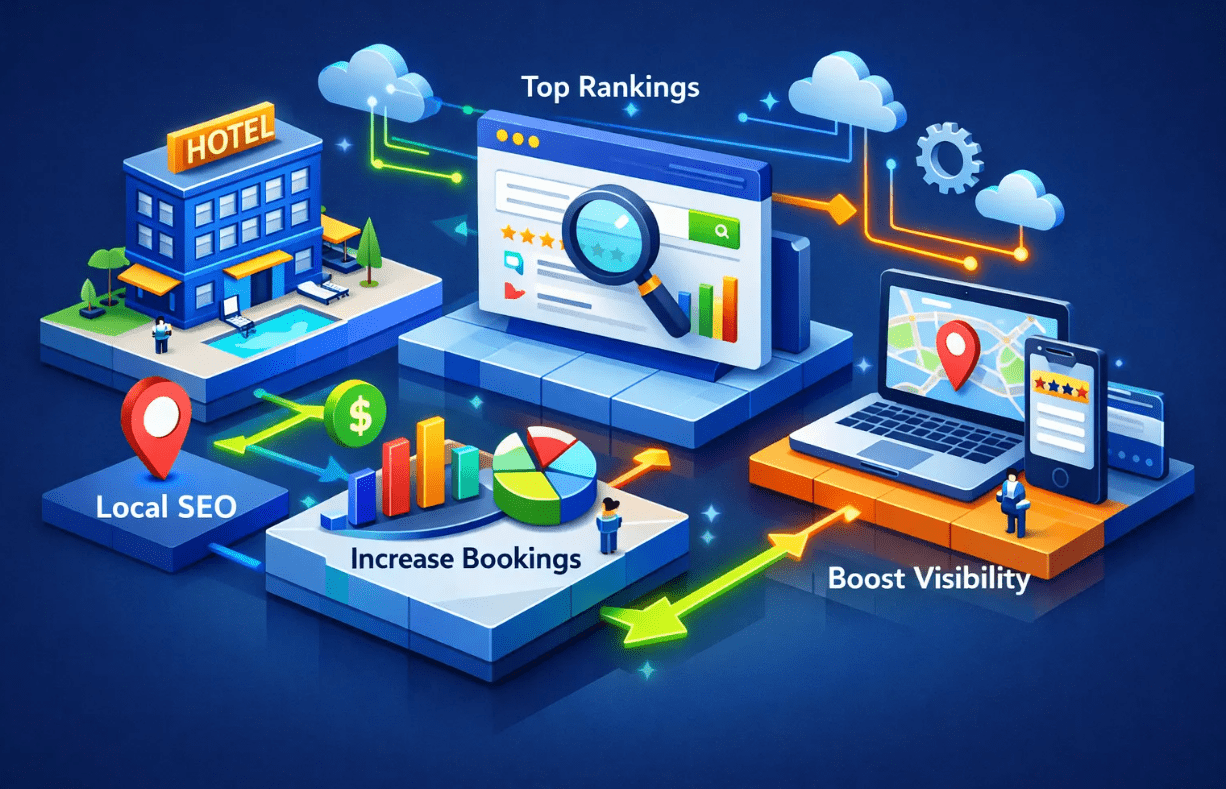
SEO for hotels in Thailand is about one goal: getting travellers to find your hotel on Google, trust it, and book directly instead of paying a commission to an online travel agency. The strongest approach combines a well-optimised Google Business Profile, destination and room pages that answer real questions, a language plan that matches your guests, and tracking that shows direct bookings, not just visits.
Thailand is one of the most competitive hotel markets in Asia. Bangkok, Phuket, Chiang Mai, Koh Samui, Pattaya, Krabi, and Hua Hin each have hundreds of properties, and booking platforms dominate the first page of results. This guide gives independent hotels, resorts, and boutique stays nine practical ways to compete without a giant budget.
What SEO for hotels Thailand needs to achieve
The opportunity is large. Thailand’s Tourism and Sports Ministry reported that the country welcomed about 32.97 million foreign tourists in 2025. Reporting on the full-year figures shows the top five source markets were Malaysia, China, India, Russia, and South Korea. Visitors come from many countries and search in many languages, which makes planning your search strategy more complicated than in a single-language market.
Online travel agencies are strong at ranking for broad searches like “hotels in Phuket”. Your edge is everything they cannot offer: your own brand search, local knowledge, rate benefits, and direct guest relationships. For a broader introduction to hotel optimisation, see our guides on outranking OTAs on Google and local SEO for hotels.
1. Understand how travellers search
Guests rarely type only a hotel name. They search by place, trip type, and need. Mapping these patterns tells you which pages to build.
| Search pattern | Example | Best page or channel |
|---|---|---|
| Hotel + destination | boutique hotel in Chiang Mai | Homepage and destination page |
| Area or landmark | hotel near Nimman, resort near Patong | Location page |
| Trip type | family resort in Phuket, honeymoon villa Samui | Experience or room page |
| Feature | pet friendly hotel Bangkok, beachfront pool villa | Room or amenity page |
| Brand | your hotel name + reviews | Homepage and Google profile |
| Question | best area to stay in Krabi | Blog guide |
Confirm search volumes in Keyword Planner or your own tool before you commit. Volumes differ widely by destination and season, so treat any single number as a guide, not a promise.
2. Optimise your Google Business Profile
Your profile is often the first thing travellers see on Google Maps and in search. Google says local ranking depends on relevance, distance, and prominence, so accuracy and completeness matter. Work through this list.
- Choose the most accurate primary category, such as Hotel, Resort, or Boutique Hotel, and add relevant secondary categories.
- Fill in amenities and attributes carefully: pool, airport shuttle, free breakfast, accessibility, and pet policy.
- Upload recent, high-quality photos of rooms, views, dining areas, and the entrance, so guests can find you.
- Add your real booking or website link, and keep the phone number and WhatsApp or LINE contact consistent.
- Check whether you can link your booking engine through Google’s hotel tools, since eligibility and requirements can change.
- Use Q&A and updates to answer common questions about check-in, transfers, and cancellation.
3. Build destination and room-type pages
A single homepage cannot rank for every search. Create focused pages that each serve one intent.
- Room and villa pages: one page per room type, with size, bed options, view, photos, amenities, and a clear booking button.
- Location pages: explain how far you are from the beach, nightlife, airport, or transit, using real distances and travel times.
- Experience pages: honeymoons, families, long stays, wellness retreats, or workations, if you genuinely offer them.
- Offer pages: seasonal packages and direct-booking benefits.
Write each page for a specific guest. “Family pool villa in Phuket with two bedrooms” is clearer, and easier to rank, than “luxury accommodation”. Add structured data such as Hotel or LodgingBusiness markup where appropriate, and check it in Search Console.
4. Plan your languages with data
English is the starting point for most international hotels, but your guests may search in Thai, Russian, Chinese, Korean, Hindi, or other languages. Do not translate everything at once. Look at your Search Console country report and your booking data to see where guests really come from, then add languages in that order.
One caution: many travellers from mainland China rely on platforms other than Google, so Google SEO will reach only part of that market. For languages you do add, use separate URLs and hreflang tags. Our guide to bilingual SEO in Canada explains the technical setup in detail, and the same principles apply to Thai and other language versions.
5. Compete with OTAs using content they cannot copy
You will rarely beat large booking platforms for the broadest searches. Aim to win the searches where local knowledge matters most.
- Local guides: best areas to stay, how to get from the airport, rainy-day activities, and honest walking-distance advice.
- Brand searches: make sure your site and profile fill the results when someone searches your hotel name, so a platform does not take that traffic.
- Direct-booking value: explain benefits such as flexible changes, a complimentary extra, or a better room selection, and keep promises accurate.
- Real photos and video: show actual rooms, not generic stock images.
- FAQ content: answer check-in times, transfers, family rooms, and cancellation rules in simple language.
6. Fix technical and mobile issues
Most travellers research and book on their phones, often on mobile data. Slow pages lose bookings before they begin. Check these basics, or ask for a technical SEO review.
- Compress images and use modern formats so galleries load quickly.
- Test pages with Core Web Vitals reports in Search Console.
- Make the booking button visible without scrolling on a phone.
- Check that your booking engine pages load fast and are not blocked by robots rules.
- Use clean URLs, a sitemap, and descriptive title tags for every room and location page.
New to the reports? Start with our guide to Google Search Console for business owners.
7. Manage reviews and reputation
Reviews influence both rankings and booking decisions. Collect them on Google and the main travel platforms you use, and reply to every review in a polite, specific tone. Thank guests by name when appropriate, and address complaints calmly with a clear next step. Never buy reviews, write your own, or offer rewards for positive ratings, as this breaks platform rules and can damage trust.
8. Plan around Thailand’s travel seasons
Demand moves with the calendar. Cooler months are generally popular, while the rainy season brings lower demand in many beach areas. Festivals such as Songkran and Loy Krathong also create booking peaks. Because SEO takes time to build, publish seasonal pages and offers two to three months before the busy period, and update them every year instead of creating new addresses.
9. Measure direct bookings
Traffic alone does not pay the bills. Track the numbers that connect search to revenue.
- Search Console: impressions and clicks for destination, room, and brand queries.
- GA4: booking-engine clicks, completed bookings, and enquiry forms as conversions.
- Messaging: clicks to WhatsApp, LINE, email, and phone.
- Profile insights: calls, direction requests, and website clicks.
- Channel mix: the share of bookings that come direct compared with OTAs, reviewed monthly.
A worked example: a boutique hotel in Chiang Mai
This is an illustrative scenario, not a client result. Imagine a 20-room boutique hotel near Nimman. It relies heavily on booking platforms and wants more direct bookings from couples and remote workers.
- Profile: fully completed, with accurate amenities, recent photos, and a booking link.
- Pages: separate pages for each room type, plus a “stay in Nimman” location page and a “work-friendly hotel” page that lists internet speeds and desk setups.
- Content: two guides, one on the best areas to stay and one on getting from the airport.
- Offer: a clear direct-booking benefit explained on the homepage and booking page.
- Tracking: GA4 conversions for bookings and WhatsApp clicks, reviewed monthly.
After a few months, the manager compares direct and OTA bookings by month, keeps the pages that attract enquiries, and improves the rest. The method is simple, and it scales to larger properties.
What your hotel homepage should include
Your homepage carries your brand searches, so it must work hard for both search engines and guests. Many hotel sites lean on a large slideshow and little text, which gives Google little to understand. A better layout explains who you are, where you are, and why a guest should book with you.
- A clear heading that names the property type and destination, such as “Boutique Hotel in Chiang Mai”.
- A real hero photo of the property, plus a visible booking or availability button.
- Three to four reasons to book direct, written plainly and kept accurate.
- A short location summary with distances to the airport, beach, or main attractions.
- An overview of room types, each linking to its own page.
- Recent guest reviews and any awards you can prove.
- A short FAQ covering check-in, transfers, and cancellation.
- Contact options guests actually use, including WhatsApp or LINE, and your registration or licence details if you choose to display them.
Keep the text natural and useful. Repeating the same phrase many times does not help rankings and makes the page harder to read.
How SEO works alongside Google Ads and hotel metasearch
SEO is not the only way to reach guests, and the best plans combine channels. Paid search can protect your brand name, fill quiet periods quickly, and test which offers attract clicks. Hotel metasearch and Google’s hotel results can also show your rates, and requirements for taking part can change, so confirm the current rules before you invest time.
Use SEO for the foundation. It builds visibility that does not stop when a budget ends, and it improves the pages that your ads send visitors to. Compare the cost per direct booking from each channel against what you pay in OTA commission, and move effort toward whatever gives the best return. Our AI SEO services page also explains how to prepare your content for AI-generated travel answers.
A 30-day starter plan
- Week 1: Audit your profile, listings, and website. Fix inconsistent names, phone numbers, and hours.
- Week 2: Research keywords for your destination and room types, and set up GA4 booking conversions.
- Week 3: Rewrite your top room and location pages, add FAQs, and compress your images.
- Week 4: Publish one local guide, ask recent guests for reviews, and record baseline numbers.
An SEO audit can speed up the first step if you would like an outside review.
Common hotel SEO mistakes
- One page for everything. Rooms, location, and offers need their own pages.
- Stock photos only. Guests want to see the real property.
- Ignoring mobile speed. Heavy galleries drive visitors back to booking platforms.
- Translating without a plan. Poor machine translation hurts trust.
- Neglecting your profile. Outdated hours, photos, or links cost bookings.
- Tracking only visits. Without booking data you cannot see what works.
Frequently asked questions
Can a small hotel in Thailand rank above OTAs?
For your brand name and specific local searches, yes. For broad searches, large platforms are hard to beat, so focus on niche and location-based queries.
How long does SEO for hotels in Thailand take?
Profile improvements may help within weeks, while page and content gains usually take three to six months, depending on competition.
Do I need a Thai-language website?
Only if you want Thai-speaking guests. Check your guest data first, then add languages in order of demand.
Is Google Business Profile important for hotels?
Yes. It appears in Maps and local results, and gives travellers photos, reviews, contact details, and booking links.
Should hotels use SEO or paid ads?
Many use both. Ads give quick visibility, while SEO builds lasting direct traffic. Start with the profile and key pages, then test a small ad budget.
Conclusion
SEO for hotels Thailand is a long-term way to lower your dependence on booking platforms. Start with your Google profile, build clear room and location pages, choose languages from real data, and track direct bookings. Be patient, update before each season, and keep improving the pages that guests actually use.
Looking to improve your website’s search visibility and generate more qualified leads? Brandleap Agency can help you build a data-driven SEO strategy tailored to your business goals.