What Is the Google September 2026 Spam Update?
On 24 September 2026, Google announced the September 2026 spam update. It applies globally, to all languages and locations, and Google said the rollout could take up to two weeks. It is the fourth confirmed Google spam update of 2026, following updates in March, June, and August.
Google described it as a normal spam update. That means no new spam policies were introduced. Instead, Google improved the automated systems that detect content and tactics that break its existing spam policies. Google has not said which specific tactic this update targets.
How Google Spam Updates Work (and What SpamBrain Does)
Google’s spam detection runs continuously. A “spam update” is the label Google uses when it makes a notable improvement to those systems. The best-known system is SpamBrain, an AI-based system that recognizes known spam patterns and learns to detect new ones.
Two points matter for site owners:
- Spam updates are algorithmic. Google does not send a notification or a manual action message in Search Console.
- A spam update is not the same as a core update. A spam update enforces spam policies; a core update re-evaluates overall content quality and relevance.
Which Tactics Can Trigger a Ranking Drop?
Google’s spam policies cover practices that deceive users or manipulate search results. The most common ones we see in audits include:
- Scaled content abuse: publishing large volumes of low-value pages, whether written by people, AI, or both, mainly to rank.
- Link spam: buying links, link exchanges at scale, and low-quality guest posting networks.
- Cloaking and sneaky redirects: showing search engines different content from what users see.
- Site reputation abuse: hosting third-party content on an established domain to borrow its ranking signals.
- Expired domain abuse: buying old domains to push thin content.
- Keyword stuffing and hidden text: repeating terms unnaturally to influence rankings.
Using AI to help create content is not spam by itself. The issue is publishing content that adds little value for the reader.
How to Check Whether the Spam Update Affected Your Site
A drop in Google Search Console does not automatically mean a spam update caused it. Before concluding, run this check:
- Match the dates. Compare the start of your decline with the rollout window. The September 2026 update began on 24 September. The August 2026 update ran from 18 to 21 August. A decline that began well before a rollout is unlikely to be caused by it.
- Look at clicks and impressions separately. A fall in impressions with stable clicks often points to ranking volatility on low-position queries rather than a loss of real traffic.
- Segment the data. Check by page, query, country, and device to see whether the drop is site-wide or limited to certain pages.
- Rule out technical issues. Review indexing, crawl errors, redirects, robots.txt, sitemap status, and Core Web Vitals.
- Check for a core update or seasonality. Overlapping updates and normal demand changes can look similar in a chart.
Spam Update Recovery: A Practical Checklist
Google’s guidance is to review its spam policies and fix anything that does not comply. There is no quick trick, and recovery is not guaranteed, especially where link spam is involved. These are the steps we recommend:
- Audit content quality. Find thin, duplicated, or auto-generated pages. Improve them with original insight, or merge or remove them.
- Review your backlink profile. Identify paid, manipulative, or irrelevant links. Remove them where you can, and use the disavow tool only as a last resort for clear link schemes.
- Fix deceptive practices. Remove hidden text, doorway pages, misleading redirects, and any cloaking.
- Strengthen E-E-A-T signals. Add author bios, real credentials, sources, case studies, and clear contact and business information.
- Clean up site structure. Consolidate overlapping pages, fix internal linking, and make sure every indexable page has a purpose.
- Monitor; don’t panic. Wait for the rollout to finish, then compare 2 to 4 weeks of data before making major changes.
What Not to Do After a Ranking Drop
- Do not rewrite or delete large parts of your site while the update is still rolling out.
- Do not buy more links or publish more low-quality content to “make up” for lost traffic.
- Do not assume the update is the cause without checking dates and data first.
How Brandleap Agency Approaches Algorithm Volatility
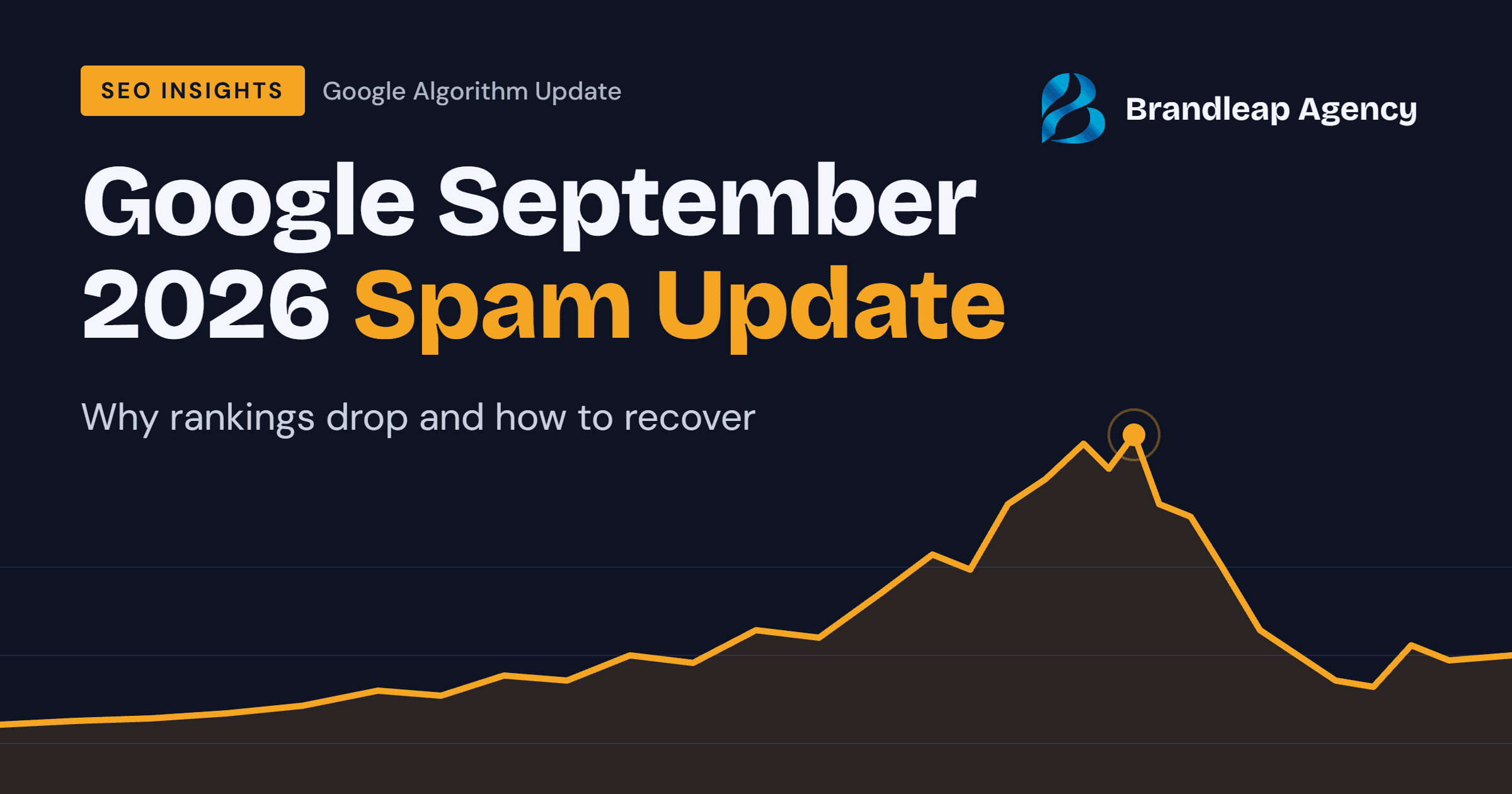
At Brandleap Agency, we treat every Google update as a diagnostic exercise, not a reason to react. We track impression and click trends in Google Search Console, compare them with confirmed rollout dates, and audit content, links, and technical health before recommending any change. Our own site’s impressions have also moved noticeably in recent weeks, and we review those movements with the same process we use for clients.
If your rankings or impressions have dropped and you want a clear answer on the cause, our SEO team can run a recovery audit and give you a prioritized action plan.
Frequently Asked Questions
What is the Google September 2026 spam update? It is a global update, announced on 24 September 2026, that improves Google’s automated spam detection. It may take up to two weeks to roll out.
How do I know if the spam update hurt my site? Compare the date your drop began with the rollout dates, then check page-level and query-level data in Search Console. Declines that started before the rollout are likely caused by something else.
Does Google send a notification for spam updates? No. Spam updates are algorithmic and do not appear as manual actions in Search Console.
Is AI-generated content considered spam? Not by itself. Content becomes spam when it is mass-produced mainly to manipulate rankings and offers little value to users.
How long does recovery take? It varies. After fixing policy issues, improvements usually appear gradually over weeks or months, and Google does not guarantee a full recovery.
Should I wait for the rollout to finish before making changes? Yes, for major changes. Fix clear issues straight away, but wait until the rollout ends to judge the real impact.
Final Thoughts
The September 2026 spam update is a reminder that sustainable SEO depends on genuine value, clean links and transparent practices. If your rankings have shifted, start with data, confirm the cause, and fix what is actually broken. Need a second opinion? Contact Brandleap Agency for an SEO audit.