
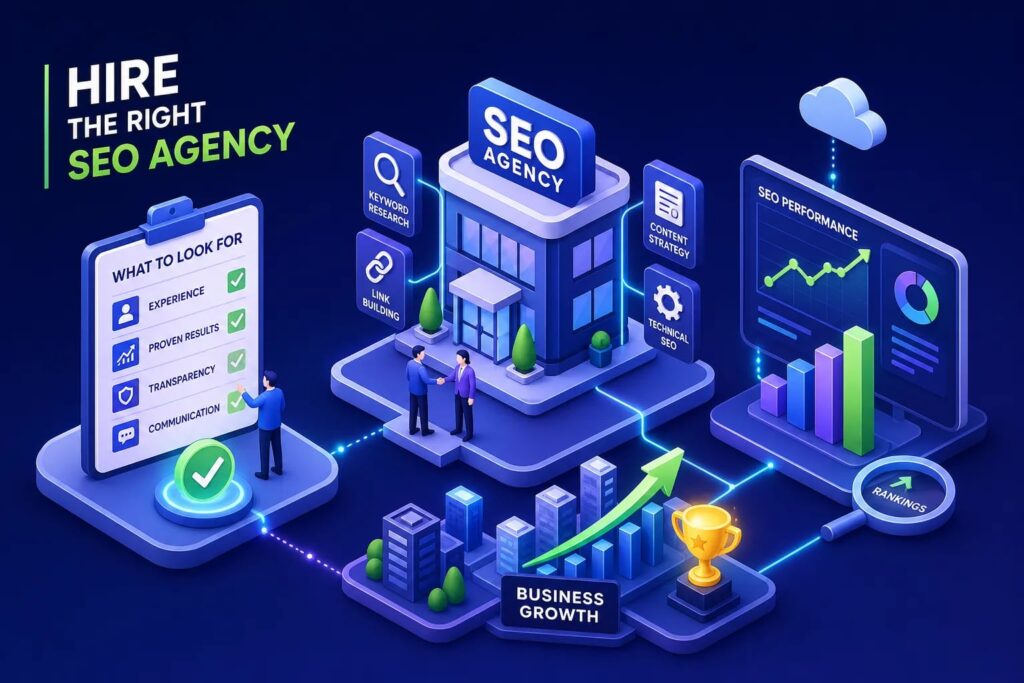
When you hire an SEO agency for your business, the difference between a smart investment and a six-month money pit usually comes down to preparation. Most buyers don’t struggle to find agencies. They struggle to tell a capable one from a convincing one, and that distinction rarely becomes clear until the contract is signed and the results aren’t coming. Knowing what you need, what fair pricing looks like, and which promises are red flags dressed up in agency language changes the entire dynamic before you’ve spoken to a single firm.
This guide walks you through the full process: defining your goals, understanding realistic pricing, vetting proposals, spotting bad actors, and making a final decision you won’t regret.
Define what you actually need before you talk to anyone
The biggest mistake businesses make when choosing an SEO firm is starting with agency research instead of goal clarity. Without a defined outcome, you’ll evaluate agencies on presentation quality and charisma rather than strategic fit, and you’ll end up paying for effort that doesn’t connect to your actual business.
SEO success looks very different depending on your business model. A local HVAC company needs calls, map pack visibility, and rankings for service-area queries. An e-commerce brand needs category page rankings and product traffic that converts. A B2B software company needs qualified organic leads from decision-maker queries. Each of those goals requires a different strategy, a different content mix, and different success metrics. Before you reach out to any agency, write down one to three specific outcomes you expect SEO to move, and make sure those outcomes are tied to revenue or leads, not just rankings.
You also need to know your own baseline before you start conversations. Pull your current organic traffic, top landing pages, and keyword visibility from Google Search Console and GA4. Agencies know most clients don’t have this data ready, and some use that gap to inflate their impact claims. If you’d rather skip the manual data pull, the free SEO audit from Brandleap Agency gives you a structured review of your site’s technical health, keyword visibility, and growth opportunities, so you walk into every agency conversation knowing your actual baseline, not the version a sales pitch hands you.
How to hire an SEO agency for your business: what pricing actually looks like in 2026
Published pricing ranges online tend to conflate freelancers, boutique agencies, and enterprise firms in a way that confuses more than it helps. Here’s what the market actually looks like for small and mid-sized businesses in 2026.
The three main pricing structures are monthly retainers, project-based fees, and hourly consulting. Monthly retainers are the most common model for ongoing SEO work. Local or limited-scope engagements typically run $500 to $2,500 per month, while more comprehensive programs for growing businesses land between $1,500 and $5,000 per month. Mid-sized companies in competitive markets typically spend $2,500 to $10,000 per month when content production and link acquisition are included.
Project-based pricing works well for one-time audits, site migrations, or content strategy buildouts. Hourly consulting, typically $75 to $300 per hour, is most useful for strategy guidance or a second opinion. Performance-based pricing exists but is rare and carries its own risks around misaligned incentives.
What each budget tier should actually deliver
Use this as a buyer’s benchmark when evaluating what any agency is proposing relative to what you’re being asked to pay:
- Under $2,500/month: local SEO, on-page optimization, citation building, and light content work
- $1,500 to $5,000/month: technical SEO, content production, monthly reporting, and foundational link building
- $5,000 to $10,000/month: broader content programs, competitive link acquisition, and dedicated team hours across multiple channels
If an agency promises an enterprise-level deliverable set at a local SEO price point, ask exactly how that’s possible. That question is a useful red flag detector, agencies using low pricing to win the deal and underfunding delivery rarely give a satisfying answer. The response will tell you a great deal about what you’re actually buying.
How to vet an SEO agency before you read a single proposal
A sales call can reveal as much or more about an agency as a polished proposal. The right questions expose whether you’re talking to a practitioner with a real process or a sales team with a well-designed pitch deck. This is one of the most underused steps in hiring the right SEO agency for your business, most buyers skip straight to the proposal stage and miss what the conversation would have told them.
Questions to ask an SEO agency on the first call
Every shortlisted agency should be able to answer these questions clearly:
- Can you show verified case studies with baseline-to-outcome data, not just traffic screenshots?
- Who will actually work on our account, and how much of the work is done in-house?
- How do you define success, and which KPIs tie to business outcomes like leads or revenue?
- What does the first 90 days look like in specific deliverables, not phase labels?
- What happens if results stall after six months?
Strong answers include named team members, specific timelines, results tied to conversions or revenue, and transparent link-building methods. Answers that should end the conversation: deflections to a “proprietary process” they can’t describe, success defined as traffic alone, or pressure to sign before you’ve received a full proposal. Any agency that can’t describe their strategy clearly in plain language probably doesn’t have one worth paying for.
On case studies specifically: ask if you can see the raw Google Search Console or GA4 data behind the results. Ask which exact pages and queries drove the gains. Ask for a reference from a client whose business resembles yours in size and industry. Every legitimate agency should accommodate all three without hesitation.
Reading a proposal like someone who’s been burned before
A polished proposal is not proof of a competent agency. The details buried in the scope section, contract terms, and reporting structure are where you find out what you’re actually buying.
A trustworthy proposal includes specific deliverables with counts and descriptions: audits, pages optimized, content pieces produced, links earned. It clearly states that your Google Analytics, Search Console, and CMS access stay in your accounts, not the agency’s. It defines a reporting cadence, monthly reporting with a review call is the industry standard, and it includes reasonable exit and renewal terms, typically with notice periods in the 30-to-60-day range.
Watch for these red flags that most clients miss the first time around:
- Scope written as generic counts (“8 blogs, 15 links”) with no strategic rationale for why those numbers were chosen
- No mention of what is out of scope, which is how agencies charge for every small request that wasn’t anticipated
- Multi-month lock-in with no performance milestones or review checkpoints built in
- Guaranteed rankings of any kind, they’re a red flag that often indicates reliance on risky or black-hat tactics that can result in Google penalties, and no ethical practitioner makes that promise
- Automated “audit” reports passed off as strategic insights
The absence of an out-of-scope section is one of the most costly things a client can overlook. Without that definition, common scope creep charges, additional content requests, technical fixes outside the core spec, extra reporting, pile up on top of the retainer. If the proposal doesn’t define what’s not included, treat everything as potentially billable.
Realistic performance timelines so you don’t fire a good agency too early
SEO compounds over time, but that doesn’t mean you should wait a full year before asking hard questions. The right approach is to judge different things at different stages, not apply the same standard across the entire engagement.
At month three, judge on execution quality and leading indicators: deliverables completed on schedule, technical fixes shipped, keyword impressions trending up in Search Console, and conversion tracking confirmed in GA4. You’re not judging revenue yet; you’re judging whether the agency is doing the work and whether early signals are moving in the right direction. Roughly 60% of tracked keywords moving up within 90 days is a healthy sign. Below 40% warrants a direct conversation with your agency about what’s stalling.
At month six, judge on directional improvement. Organic traffic growth of 10 to 25% year-over-year is healthy at this stage. You should see non-brand organic clicks rising, priority pages improving in position, and early conversion attribution showing up in GA4. If traffic is growing but conversions are flat, that signals an intent mismatch in the keyword targeting, not just slow SEO.
At month twelve, judge on business outcomes: conversions, organic CPA trend, year-over-year traffic lift, and revenue attribution to organic channels. Organic conversion rates in the 1.5 to 4% range for B2B and 2 to 6% for B2C are reasonable reference points. Your cost per acquisition from organic should trend down 5 to 15% per quarter if the strategy is working. Share of voice in your keyword market, tracked quarter over quarter, is one of the clearest long-term indicators of whether the agency is building durable visibility or chasing short-term gains.
Making your final decision, and the one step to take first
At this point, you have a shortlist, proposals in hand, and a set of answered vetting questions. The final decision comes down to strategic fit, transparency, and whether the agency’s process matches your business model, not who presented the nicest deck.
Score each finalist on: case study quality, team transparency, proposal specificity, reporting standards, contract fairness, and relevant experience. Weight the criteria by what matters most for your business. A local service business should weight local SEO experience heavily. An e-commerce brand should weight content depth and technical execution. One clear rule: if you’re still unsure after scoring, the agency hasn’t made their case clearly enough, and that uncertainty doesn’t improve once you’ve signed.
Before you commit to anyone, get your baseline in order. Walk into every final conversation knowing your site’s actual gaps so you can evaluate whether an agency’s proposed strategy addresses the real problems or a version of the problems that’s easier for them to solve. The free SEO audit from Brandleap Agency gives you exactly that: an independent review of your technical health, keyword visibility, and growth opportunities before any agency tells you what they plan to fix. That context puts you in control of every conversation.
The right hire starts with the right preparation
Hiring the right SEO agency for your business isn’t about finding the most impressive website or the lowest price. It’s about finding a team that defines success the same way you do, communicates with specifics instead of vague promises, and earns your trust with proof before they ask for a contract signature.
Use the steps in this guide as your filter: clarify your goals first, benchmark pricing against realistic deliverables, ask hard questions on every call, and read every proposal with an eye toward what’s missing, not just what’s promised. The agencies that hold up under scrutiny are worth the retainer. The ones that don’t will cost you far more than the price on the proposal.
If you want to walk into those conversations fully prepared, start with a free SEO audit from Brandleap Agency. You’ll know exactly what’s holding your site back before any agency tells you what they plan to fix, and that’s not a small advantage. It’s the difference between hiring an SEO agency for your business with confidence and hoping you picked the right one.

BrandLeap Agency & BrandLeap Fashion | Founder & CEO
Mithun is an experienced SEO consultant recognized for helping businesses improve their digital presence through technical SEO, content optimization, and sustainable organic growth strategies. Working in the digital marketing industry since 2019, he has developed expertise in increasing search visibility, driving targeted traffic, and building long-term growth through data-driven SEO solutions. He has worked with businesses across multiple industries, helping brands strengthen their online authority and achieve measurable growth results.