Deciding between an SEO freelancer vs agency is one of the most consequential choices a UK business owner faces in digital marketing, and the assumption that hiring a freelance SEO consultant is automatically the lean, smart option is worth challenging before it costs you months of lost organic momentum. Working with an agency is not simply expensive overhead dressed up in dashboards and monthly calls. The question of which model suits your business is genuinely worth answering carefully, because the wrong call is not just a financial loss: it delays organic growth in ways that are difficult to recover from.
The honest answer depends on what you actually need to achieve, not on which option sounds more affordable at first glance. In 2026, that distinction matters more than ever. Many agencies are shifting towards multi-specialist models that aim to reduce account-management layers, bring more hands-on expertise to each account, and deliver at the pace of a good consultant without the single-point-of-failure risk. Before you choose, you need the full picture.
SEO freelancer vs agency: the “freelancers cost less” myth needs a closer look
UK rates tell a more complicated story
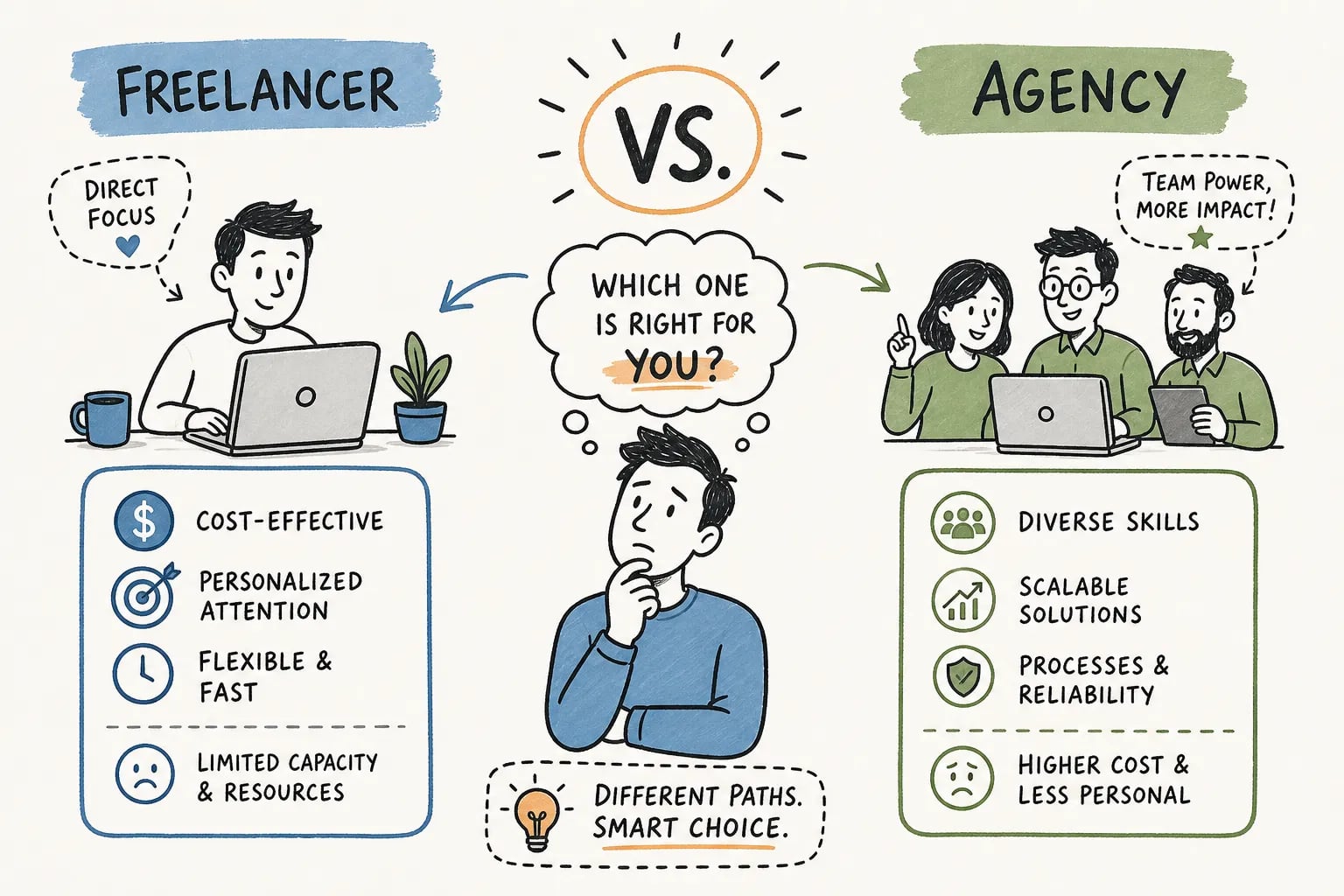
Most businesses assume a freelancer will automatically be cheaper than an agency. According to freelance rate surveys and industry benchmarks, that assumption rarely holds once you look at the full picture. Junior freelance SEO consultants in the UK typically charge £30 to £60 per hour. Mid-level consultants sit between £50 and £120 per hour. Senior specialists commonly reach £80 to £250 per hour, with monthly retainers frequently landing between £1,500 and £5,000. The most typical midpoint for an established freelancer doing ongoing work is closer to £800 to £2,500 per month, a range that overlaps significantly with what a focused agency charges for comparable scope.
The assumption that a freelancer saves you money breaks down quickly at the senior end of the market. A specialist with a decade of experience and a strong track record will price accordingly. The rate card is not junior-by-default simply because one person is delivering the work. When you are comparing SEO consultant hourly rates UK-wide, the senior tier frequently narrows the gap to near nothing.
What the price tag does not include
A freelancer’s monthly rate covers their time and expertise. It rarely covers the developer who implements their technical recommendations, the content writer who produces articles they have briefed, or the link builder who executes outreach. When you outsource SEO services to a single consultant, you often end up paying for all of those additional resources separately, alongside the tool subscriptions required to do any of this properly.
These hidden costs compound quickly. For example, a freelancer at £1,200 per month, plus a developer at £600, a content writer at £500, and tool subscriptions at £200, brings your actual spend to around £2,500 before anyone has built a single backlink, figures that will vary by region and project scale, but are representative of many mid-market engagements. An agency retainer at a similar figure that bundles these disciplines can deliver comparable or greater throughput per pound, particularly where coordination overhead would otherwise be high.
Where a freelance SEO consultant genuinely wins
The use cases where a single specialist is enough
Not every SEO challenge requires a full team, and it would be dishonest to suggest otherwise. A focused technical audit, a local SEO campaign for a single-location service business, or a clearly defined content gap project are excellent fits for a skilled freelance SEO consultant. The key word is “clearly defined.” If you know precisely what you need, can specify it in a brief, and have internal resource to handle implementation and content production, a freelancer can deliver strong value without the overhead of a broader agency engagement.
Local service businesses with a single geographic market and a manageable competitor set are the clearest example. The scope is bounded, the deliverables are predictable, and one specialist with deep local SEO knowledge can move the needle meaningfully within a sensible timeframe. That is a genuinely good use of a freelance engagement.
The flexibility advantage: real, but conditional
Freelancers can adjust scope, pause engagements, and restart work more easily than most agencies with formal contracts. For businesses with irregular cash flow or strong seasonal trading patterns, this adaptability has genuine value. Being able to scale back in a quiet quarter without navigating a rigid retainer structure is a practical advantage worth acknowledging.
However, that flexibility comes with a condition most businesses underestimate: it depends entirely on the individual freelancer’s availability, workload, and reliability. A change in the consultant’s circumstances, illness or overcommitment, for instance, can stall a campaign at the worst possible moment. Continuity risk is often not explicitly priced into freelance hourly rates and is sometimes overlooked until it causes a serious problem.
When campaign complexity shifts the ROI calculation toward an agency
Multi-channel execution is not a one-person job
The moment a campaign requires Core Web Vitals work, content cluster development, digital PR for backlink acquisition, schema implementation, and conversion tracking alignment, all running simultaneously, a single consultant hits a structural ceiling. A skilled freelancer can be excellent at two or three of those disciplines. Delivering expert-level execution across all of them at the same time, without something slipping, is a fundamentally different challenge.
Agency engagements more consistently present a fuller measurement stack, covering traffic, rankings, and conversion outcomes, precisely because multiple specialists run their respective workstreams in parallel rather than sequentially. The difference is throughput as much as skill. When one person has to choose which workstream to delay this month, the campaign rarely looks like it is working, even when the underlying strategy is sound.
Consistent delivery under pressure
Businesses running time-sensitive product launches, managing sites with significant technical debt, or competing in crowded national markets need delivery continuity that does not depend on one person’s schedule. Structured agency delivery means formal SLAs, documented processes, reporting cadences, and a team that absorbs absence without dropping the campaign. Work continues when someone is unavailable, when priorities shift, or when a campaign grows faster than anticipated.
Contrast that with the informal nature of most freelance engagements, where response times, reporting formats, and escalation paths are rarely contractually defined. That informality feels like flexibility right up until you need accountability.
Why “agile agency” is not a contradiction
The multi-specialist model that changes the comparison
The traditional objection to agencies is fair when aimed at generalist firms built around account management layers and junior execution. That structure produces exactly the problems critics describe: slow communication, diluted attention on smaller accounts, and senior expertise reserved for the pitch rather than the delivery. That objection does not apply to purpose-built specialist teams where each person owns a distinct discipline at an expert level.
Some specialist agencies are structured precisely to address this gap. A model built on dedicated specialists across technical SEO, content strategy, off-page authority building, paid media, and web development aims to deliver the depth of a senior freelancer across every channel simultaneously. When the agency is composed of specialists rather than generalists, the “hire a freelancer for specialist depth” argument loses much of its force. You are not trading depth for breadth, you are aiming to access both at once.
Brandleap Agency is built on this principle: a team of channel specialists rather than a generalist account management structure, designed specifically for businesses that need expert-level execution across every layer of their SEO strategy without the opacity that has given larger agencies their reputation.
Speed, accountability and expertise in the same package
A well-structured specialist agency does not feel like a slow corporate machine. It communicates directly, moves quickly on implementation, and aligns strategy across disciplines without the client needing to coordinate multiple contractors themselves. Managing three separate freelancers, each with their own timelines, briefs, and communication styles, is a project management burden that falls entirely on the business owner. A single agency retainer can significantly reduce that burden by coordinating workstreams under one accountable team.
A practical decision framework for UK businesses
SEO freelancer vs agency: the budget and scope test
Run this as a scope test first and a budget test second. The budget tiers below are a guide, not a rule:
- Under £800 per month: A freelancer covering one clearly defined SEO area is often the right call, provided you have internal resource for implementation and content production.
- Between £800 and £2,500 per month: This is where the SEO freelancer vs agency comparison is most contested. Scope is the deciding factor. If the campaign requires more than one specialist discipline running concurrently, the agency case strengthens considerably.
- Above £2,500 per month: The case for a multi-specialist agency becomes significantly stronger. The budget can now support a proper team, and the scope almost certainly demands one.
Questions to ask before committing
Put these to both a freelance consultant and an agency before signing anything:
- Who specifically will do the work, and can you name them?
- What happens if that person is unavailable?
- What tools do you use, and who covers the cost?
- How is success defined and measured in month one versus month six?
- What is the notice period, and what do you hand over at the end of the engagement?
Ask the agency version and the freelancer version of each question. An agency that cannot name the specialist doing the technical work is a red flag. A freelancer who has no answer for what happens during illness is equally telling. The answers you receive will tell you more than the case studies.
What to demand before signing anything
The KPI set that actually reflects business outcomes
Require these non-negotiable metrics from any SEO partner:
- Organic conversions (leads, calls, bookings, or purchases)
- Non-brand organic traffic trend
- Keyword visibility for commercial terms
- Organic click-through rate on priority pages
- Technical health benchmarks covering indexation and Core Web Vitals
These are outcome-linked metrics. Any provider unwilling to be measured against conversion-related outcomes is signalling a lack of confidence in their own results.
Distinguish these clearly from vanity metrics. Raw ranking counts, total backlink volumes, and traffic figures inflated by branded search tell you very little about whether SEO is generating business value. If your monthly report leads with these figures and buries conversions in a footnote, ask why before you renew.
Contract terms, SLAs and the red flags that protect you
Demand a defined scope with specific deliverables, asset ownership clauses confirming you own the content, accounts, and data, a clear termination and handover process, and a written prohibition on black-hat tactics. On the SLA side, require defined response times for urgent technical issues, a reporting cadence with agreed formats, and an escalation path when deadlines slip.
Two red flags should end the conversation immediately. First, any provider who guarantees specific ranking positions: no honest SEO professional makes that promise because the algorithm is not theirs to control. Second, a provider who is vague about who will actually execute the work. Both signals point to inexperience or a willingness to oversell, neither is a foundation for a productive working relationship.
The honest answer, without a universal winner
There is no universal winner in the SEO freelancer vs agency debate. A skilled freelance SEO consultant remains the right choice for focused, clearly bounded work at a manageable scale where internal resource supports implementation. An agency becomes the stronger choice the moment a campaign demands multi-channel execution, specialist depth across several disciplines, or delivery continuity that cannot afford a single point of failure. If you are weighing up in-house SEO vs agency vs freelancer, the same scope-first framework applies: define the workload before the budget.
Ultimately, your decision between an SEO freelancer vs agency should be guided by scope, continuity, and measurable KPIs, not by which option sounds more affordable in the first conversation. Use the framework in this article before committing to either, and hold the chosen partner to outcome-based metrics from day one. The checklist above is not a formality: it is the fastest way to separate providers who deliver from those who simply present well.
If you want to evaluate a team of genuine specialists across technical SEO, content strategy, off-page authority building, and paid media, without trading away speed or direct communication, Brandleap Agency is worth a conversation. The model is built for businesses that need expert-level execution across every layer of their digital strategy, without the overhead and opacity that larger generalist agencies are known for.