Introduction
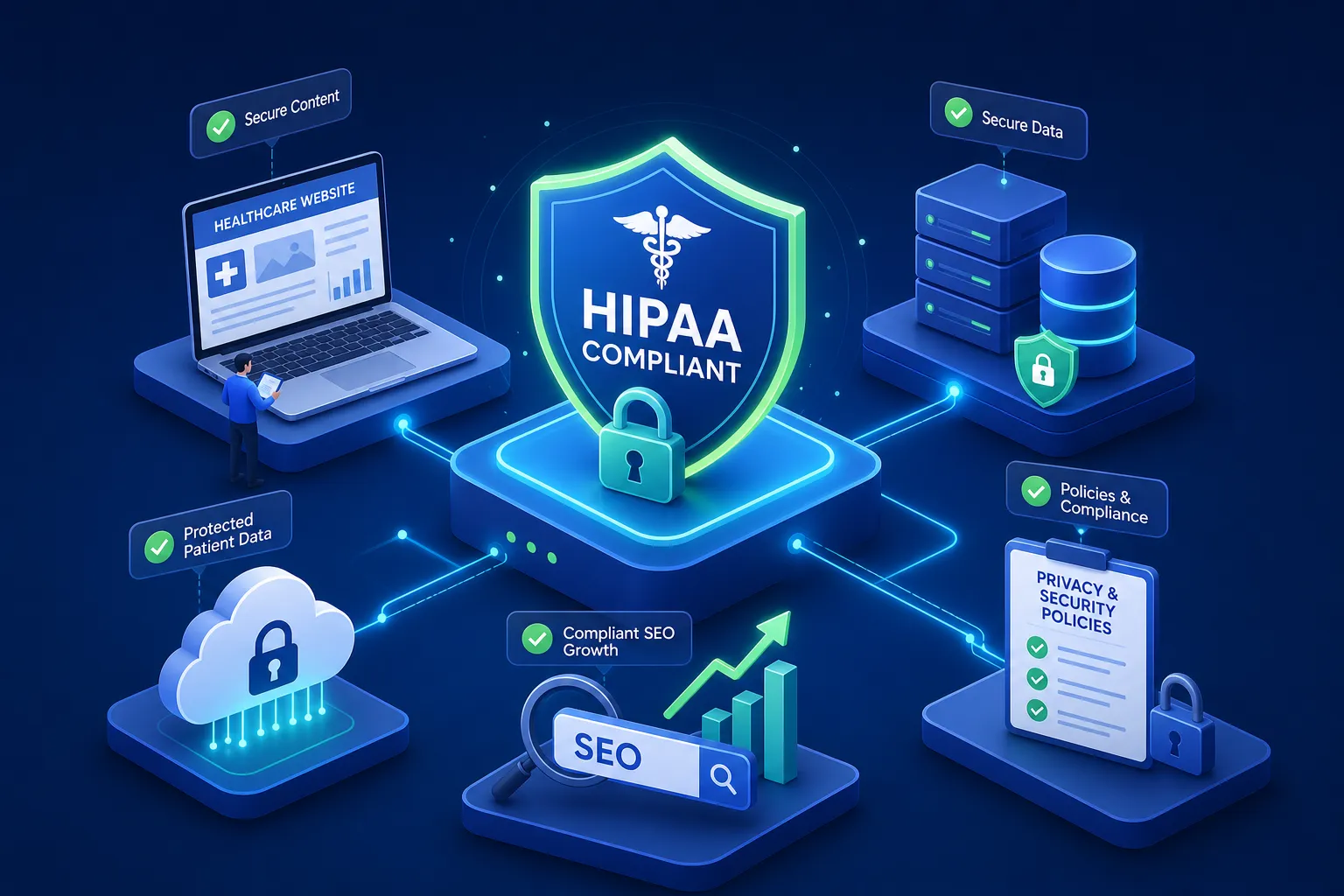
Healthcare organizations face a problem that most other industries don’t: the same tools that power organic growth can quietly create regulatory exposure. Every analytics pixel, tracking script, form integration, and UTM parameter carries the potential to pull protected health information into systems that were never designed to handle it. HIPAA-compliant SEO requires configuring every layer of your marketing stack, analytics, forms, tag management, and content to avoid exposing PHI while still driving measurable organic growth. Most healthcare websites are running these risks right now, often without anyone on the marketing team realizing it.
HIPAA-compliant digital marketing isn’t about scaling back your SEO efforts. It’s about building those efforts on a foundation that accounts for both search performance and patient privacy. At Brandleap Agency, working alongside healthcare providers has made one thing clear: you can’t separate technical SEO from regulatory awareness and expect to get this right. They have to operate together. Teams that treat them as separate disciplines are the ones that end up with a compliance gap and a legal exposure they didn’t see coming.
By the end of this article, you’ll understand which HIPAA rules govern your marketing stack, how to configure analytics without creating PHI risk, what belongs on your pages and what doesn’t, and how to audit your site for the vulnerabilities hiding in plain sight.
What HIPAA actually means for your healthcare website
HIPAA’s reach extends well beyond filing cabinets and patient records. The moment your website collects, stores, processes, or transmits protected health information, HIPAA applies. That scope pulls in your analytics platform, your contact forms, your chat widget, your appointment booking tool, and any third-party vendor those systems communicate with.
The four HIPAA rules that affect your marketing stack
The Privacy Rule controls when PHI can be used or disclosed. For websites, this applies to forms, patient portals, chat integrations, and any analytics tool that receives health-related identifiers. The Security Rule covers electronic PHI specifically and requires administrative, physical, and technical safeguards across every system that stores, processes, or transmits it. This is the rule that governs your hosting environment, your database configuration, and your data transmission standards.
The Breach Notification Rule gives you a 60-day window to respond when a vendor or system causes a reportable incident involving unsecured PHI. The Omnibus Rule expanded HIPAA obligations to business associates and their subcontractors, the rule that makes vendor agreements a compliance requirement, not just a contractual preference. If a tool in your marketing stack can receive or infer PHI, the vendor behind it may need to sign a Business Associate Agreement (BAA).
When your website actually triggers HIPAA obligations
Not every healthcare website automatically falls under HIPAA scope, but the threshold is lower than most marketers assume. If your site includes a patient portal, appointment request forms, symptom checkers, condition-specific content where users can identify themselves, or any chat integration on a health-related page, HIPAA applies. HHS guidance on tracking technologies on hospital websites and web apps is direct on this point: user-authenticated pages with embedded tracking technologies must be configured so no PHI is disclosed to a tracking vendor without a valid legal basis.
The practical implication is that even a basic “request an appointment” form on a general practitioner’s website can trigger the Security Rule if the form data touches a third-party system that hasn’t signed a BAA. The liability exposure is real, and it catches marketing teams off guard more often than it should.
Why your analytics setup is probably a compliance risk
This is where the gap between standard marketing practice and healthcare compliance hits hardest. The analytics tools running on most healthcare websites are not configured for HIPAA-compliant SEO, and a cookie consent banner doesn’t fix that. The exposure comes from how data flows through your tracking stack, not just from what users click on.
GA4 and the BAA problem
Google does not offer a BAA for Google Analytics or GA4. Google’s own product documentation states: “We do not offer Business Associate Agreements in connection with this service.” That means any PHI flowing through a GA4 tracking script on a healthcare page, whether through URL parameters, form field data captured in page views, or referral strings containing health context, constitutes an impermissible disclosure under HIPAA. GA4 is the default analytics tool for most websites, which makes this one of the most widespread compliance gaps in healthcare digital marketing today.
GA4 isn’t completely off the table. It can be used on pages that are definitively PHI-free, such as general blog content, provider overview pages, or location pages that don’t involve any patient interaction. The problem arises when it fires across an entire domain, including authenticated pages, booking flows, and form confirmation pages.
Privacy-first analytics alternatives that support BAAs
Piwik PRO offers HIPAA compliance under enterprise arrangements and will sign a BAA, making it a workable managed solution with built-in compliance documentation. Self-hosted Matomo is another option for organizations that want full data control without a third-party BAA requirement. The trade-off is straightforward: Piwik PRO handles more of the compliance infrastructure on the vendor side, while self-hosted Matomo puts the operational responsibility squarely on your team, including installation, encryption, patching, and access controls. Both are viable paths; the right choice depends on your team’s technical capacity and risk tolerance.
When evaluating any analytics platform for HIPAA-compliant analytics use, three questions determine whether it belongs in your stack: Will they sign a BAA? Where is data stored? Can the tool be configured to exclude specific pages or filter specific data fields?
Configuring HIPAA-compliant SEO tracking without losing visibility
Server-side tagging offers a practical middle ground. Rather than sending raw browser data directly to analytics vendors, server-side implementations let you filter and sanitize data before it reaches any third-party system. At minimum, PHI-sensitive pages should be excluded from analytics tracking entirely. Patient portals, appointment booking flows, and form confirmation pages should not fire any third-party scripts. This approach still gives you a clear picture of organic performance on informational content, it just separates that measurement from patient data workflows.
Safe keyword strategy and patient-safe content creation
The keyword strategy itself isn’t the compliance risk. HIPAA-compliant SEO targets the same informational and local intent searches that patients use every day: “primary care doctor near me,” “what causes lower back pain,” “pediatric clinic in Chicago.” None of those require collecting PHI to rank. The risk appears when condition-specific or personally identifiable detail ends up embedded in URLs, UTM parameters, or page titles that get sent to analytics tools.
What never belongs in a URL, UTM string, or page copy
PHI should never appear in URLs, query strings, or campaign parameters. These values leak into browser history, server logs, analytics reports, and third-party referral data, often automatically. That means no patient names in page slugs, no diagnosis codes in UTM tags, and no condition-specific identifiers in campaign naming conventions. Use service-line references in your campaign names, not descriptions of a patient’s health situation. A UTM tag like utm_campaign=orthopedics-spring is fine. One that references a specific condition tied to an individual is not.
Content types that build authority without privacy risk
Educational blog content drives organic traffic without any PHI exposure. Symptom explainers, treatment overviews, provider introductions, and local health guides are high-value content investments that attract search traffic and establish topical authority. FAQs structured for featured snippet capture and local schema markup on provider pages deliver strong organic results with no compliance trade-off. Patient testimonial content should use only voluntarily submitted, consented reviews.
At Brandleap Agency, healthcare content strategy focuses on building exactly this kind of topical authority, content that earns search visibility without creating compliance exposure. The goal is content that informs, not content that collects.
Technical controls that keep PHI out of your SEO systems
The infrastructure layer determines whether PHI can leak into marketing systems in the first place. Getting the content strategy right doesn’t help if the technical foundation allows patient data to flow through non-compliant channels.
Hosting, HTTPS, and encryption requirements
Every healthcare website must enforce HTTPS across all subdomains, with TLS 1.2 or higher for all traffic, APIs, and vendor integrations. Data at rest must be encrypted using AES-256 or equivalent across databases, backups, and any object storage where form submissions land. The hosting environment itself needs a BAA: cloud providers and CDN vendors that could touch PHI must fall within your compliance scope. Production and staging environments should be separated so that live patient data never appears in development or testing workflows.
Form handling rules that prevent accidental PHI capture
Contact forms and appointment request forms are among the highest-risk surfaces on a healthcare website. Use POST-only submissions. Avoid GET requests, which expose form data in the URL. Disable autocomplete on sensitive fields. Place a visible notice above open-text fields telling users not to submit personal health information. Prefer structured fields, dropdowns, and checkboxes over free text wherever possible. That reduces the chance of patients typing PHI into a generic message field.
Route form submissions to a HIPAA-compliant database or patient management system. Plain-text email notifications containing form contents are not a compliant workflow unless the email system also carries a BAA. This is a detail that surprises most healthcare marketing teams: even a basic “you’ve got a new form submission” email can trigger a compliance issue if it includes the message body.
Tag managers, pixels, and server-side filtering
Third-party tracking pixels, including advertising pixels, heat mapping scripts, and session replay tools, should be blocked from any page where PHI could appear: appointment booking flows, patient portal login pages, and form confirmation pages. Server-side tagging allows healthcare organizations to intercept and sanitize data before it reaches vendor endpoints. This is the technical bridge between maintaining analytics visibility and staying compliant. It requires more setup than standard tag management, but it’s a far better investment than blocking all tracking and flying blind on organic performance.
HIPAA-compliant SEO audit checklist
Everything above comes together in a structured audit process. The goal is to identify where PHI exposure is possible, confirm which vendors in your stack have signed BAAs, and establish a measurement model that gives you organic performance data without passing patient information through non-compliant systems.
Technical audit: where to start
Start with your highest-risk pages: any page with a form, a login, a booking widget, or a chat integration. Use a browser developer tool or a tag auditing tool to check which scripts are firing on those pages. Confirm whether each vendor in your marketing stack has signed or will sign a BAA. Review your URL structures and UTM parameters for any condition-specific or personally identifiable language. Trace form submission workflows end to end and confirm that data lands in a compliant system, not in a plain-text email notification.
Vendor controls: BAA questions every healthcare marketer should ask
Before onboarding any tool that will touch healthcare website data, ask these questions directly:
- Will you sign a BAA, and under which plan or tier?
- Where is data stored, and in which country?
- What logging and access controls exist around our data?
- Can you provide your HIPAA compliance documentation or SOC 2 report?
- Can we configure your tool to exclude specific pages or filter specific data fields?
If a vendor can’t answer those questions clearly, they aren’t ready for healthcare use. That applies to analytics platforms, CRMs, chat tools, scheduling software, and email platforms equally.
Content and measurement controls: tracking SEO performance without compromising compliance
Replace PHI-risky metrics with business-outcome KPIs that don’t require passing patient data through analytics. Track organic traffic to non-PHI pages using a HIPAA-compliant analytics platform. Measure appointment bookings and new patient inquiries through your practice management system rather than through ad pixels. Rank tracking tools monitor keyword performance without touching user data at all, giving you clean visibility into search position movement. This model still produces a clear picture of organic growth; it just keeps measurement entirely separate from patient data workflows.
The right framework makes growth and compliance the same goal
HIPAA-compliant SEO is not a constraint on organic growth. It’s a framework that protects your patients and your practice while still allowing you to build search visibility, generate quality leads, and compete in local markets. The healthcare organizations that get this right treat compliance and SEO as two sides of the same strategy, not two separate problems assigned to two separate teams.
The technical, legal, and content layers involved here make this one of the more complex corners of digital marketing. Getting it right requires fluency in both search strategy and regulatory requirements, and most marketing teams have deep expertise in one but not both. This is where having the right partner matters. Brandleap Agency works with healthcare providers to build HIPAA marketing best practices into organic strategies from day one, technically sound, growth-ready, and built to keep patient data out of places it doesn’t belong. That includes compliant analytics configuration, PHI-safe SEO architecture, and content that earns topical authority without creating regulatory exposure.
If your practice is ready to grow its online presence without taking on regulatory risk, get in touch with Brandleap Agency for a HIPAA-aware SEO audit. We’ll identify where your gaps are and build a roadmap that moves the needle on both fronts.