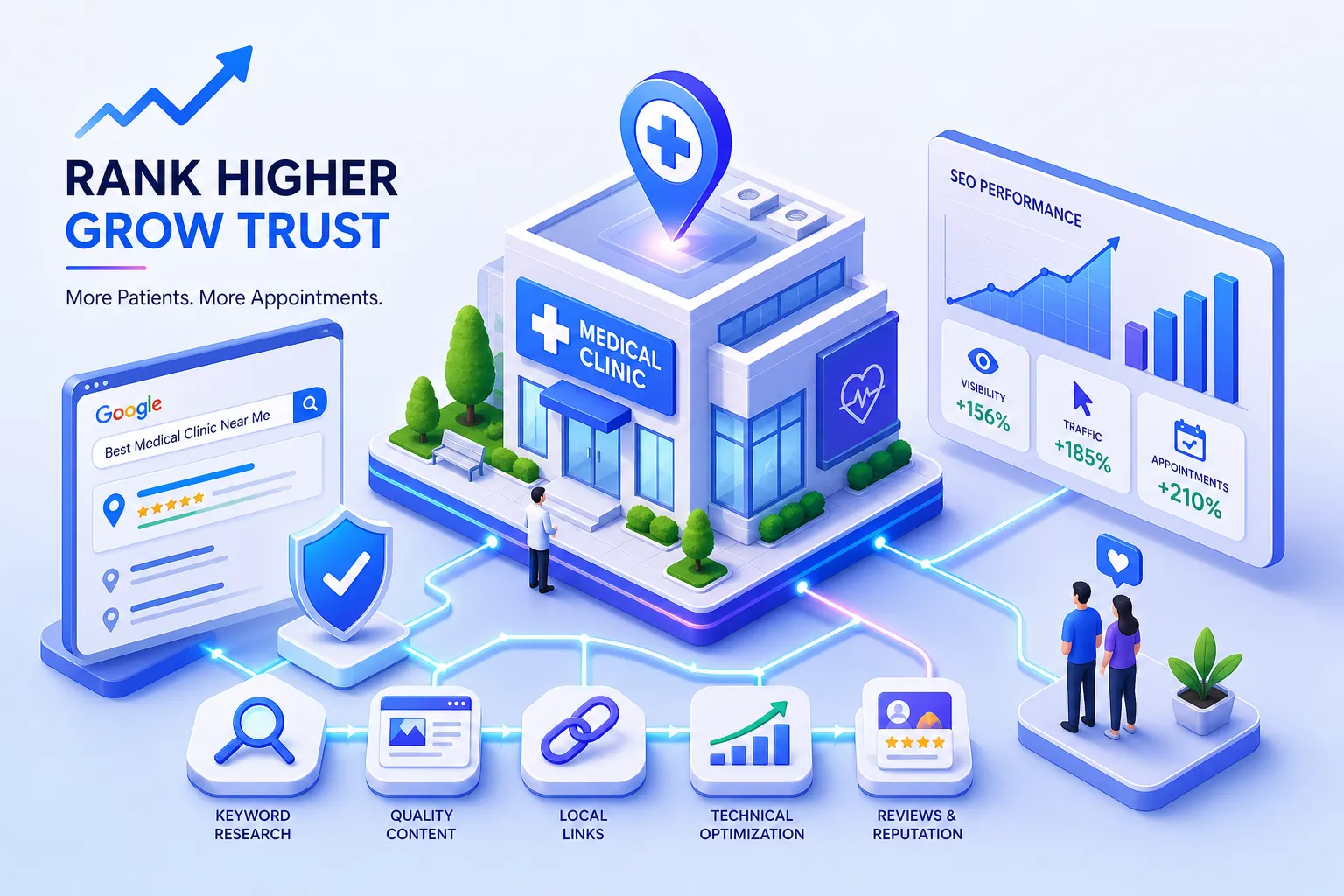
If you’re asking what is the best SEO strategy for a medical clinic, the honest answer is that most clinics already provide good care, they just lack the online visibility to show it. Many clinics provide quality service but struggle to appear when patients search for exactly what they offer. That visibility gap costs real appointments. At Brandleap Agency, the most common issue we see with new clinic clients follows a consistent pattern: a competitor down the street ranks ahead of them in Google Maps, not because that competitor delivers better care, but because their SEO foundation is stronger. That’s not a quality problem. It’s a fixable visibility problem.
This guide covers a complete healthcare SEO strategy built for 2026, grounded in real data and structured around actions that drive appointment bookings. By the end, you’ll have a clear 90-day plan covering local search, patient-intent keyword targeting, E-E-A-T content, technical performance, and the tracking setup that tells you what’s actually working.
This is written for clinic owners and healthcare marketers who want to own local search results, not just have a website that exists. If you’re ready to move from invisible to booked, here’s where to start.
What Is the Best SEO Strategy for a Medical Clinic?
According to a Kyruus Health patient access survey, about 77% of U.S. patients research a physician online before booking an appointment. That single statistic explains why local SEO is the primary channel through which patients discover, evaluate, and choose a provider. Before any content strategy or paid ads effort makes sense, the local foundation needs to be solid. Local search signals, specifically Google Business Profile completeness, NAP consistency, and review volume, drive map-pack visibility, which captures a large share of local patient clicks.
The right priority order matters here. Many clinics jump to blogging or social media before fixing the local signals that directly influence whether they appear in the top three map results. Getting those foundational levers right first produces faster, more measurable improvements in patient inquiries than almost anything else you can do.
Optimizing Your Google Business Profile for Patient Searches
Your Google Business Profile is the single strongest local ranking lever available to a medical clinic. A fully completed profile, one that includes the legal clinic name (no keyword stuffing in the name field), the most specific primary category available, relevant secondary categories, regularly uploaded photos, filled-out services, and an active Q&A section, directly influences map-pack eligibility. Google uses profile completeness as a trust and relevance signal, and incomplete profiles consistently lose ground to fully built-out competitors.
Posting regular updates through GBP keeps the profile active and signals ongoing engagement. Add health-specific attributes such as telemedicine availability, accepted insurance, and languages spoken. These details appear in search results and directly affect whether a patient chooses to click. Completeness isn’t a one-time task; it’s a sustained practice that compounds over time.
NAP Consistency and Healthcare Directory Citations
Your clinic’s name, address, and phone number must be identical across every listing online. Even a single inconsistency, such as “Suite 200” on one directory but “Ste. 200” on another, can quietly undermine the local trust signals Google uses to validate your clinic’s legitimacy. Audit your listings across the core healthcare directories: Healthgrades, WebMD, Vitals, Zocdoc, Yelp, RateMDs, and Doctor.com. These are priority Tier 2 citation sources for the healthcare space (sitting below foundational platforms like GBP and Apple Maps), and they’re where patients actively search for providers.
After those are clean and consistent, move to supplemental directories like HealthProfs and specialty-specific listings relevant to your practice type. Keep a master NAP format document and update it immediately whenever your address or phone number changes. A single outdated listing left uncorrected across a dozen directories creates conflicting signals that hurt local rankings.
Patient Reviews as a Sustained Ranking Signal
Reviews influence both your Google ranking position and the click-through rate patients give your listing once they see it. The key is volume combined with recency, not a one-time push that produces 20 reviews in a week and then goes quiet. Google’s local algorithm favors a steady stream of recent reviews over periodic bursts.
The most effective HIPAA-compliant approach is an automated post-visit SMS or email sent within 24 to 48 hours of checkout, using neutral language (“We’d appreciate your feedback”) with no mention of diagnosis, treatment, or clinical details. Staff scripting at discharge and QR codes at checkout are strong complements. Use a HIPAA-compliant vendor with a signed BAA if the platform handles any patient contact data. Respond to reviews consistently and publicly, but never confirm someone is a patient or reference any clinical details in your response.
Targeting the Keywords Patients Search Before They Book
Not all search traffic is created equal. Ranking for broad terms like “clinic” or “primary care doctor” drives impressions but rarely drives appointment bookings. The queries that convert patients are the ones with scheduling intent, urgency, and location specificity baked directly into the search.
Understanding which queries actually convert, versus which ones generate traffic from people who will never book, is what separates a well-built medical practice SEO strategy from one that looks good in reports but doesn’t fill the schedule.
High-Intent Query Patterns for Common Clinic Services
The highest-converting patient queries follow a consistent pattern: service plus location, service plus urgency modifier, or service plus booking signal. For primary care, queries like “same-day doctor appointment,” “new patient primary care near me,” and “family doctor open now” convert because the patient is actively looking for access, not information. For urgent care, “urgent care open now,” “walk-in clinic [city],” and “same-day urgent care” reflect immediate need and often lead to a same-day visit.
Dermatology patients tend to search with scheduling intent attached: “dermatologist near me,” “skin check appointment,” and “acne treatment dermatologist [city]” all signal a patient who wants care, not a general education article. The modifiers to prioritize across all service types are “open now,” “same-day,” “near me,” “book appointment,” and “new patient.” These are the conversion signals, and they should appear naturally on your service pages and in your metadata.
Local SEO: The Best SEO Strategy for Medical Clinics Targeting Long-Tail Searches
Broad head terms are high competition and low conversion for most clinics. A query like “new patient family doctor [city]” has strong booking intent and significantly less competition than “primary care doctor.” Long-tail, location-specific queries convert better because they filter for patients who are ready to choose a provider, not ones who are browsing generally.
Map each keyword to a specific service page, not your homepage. A dedicated “urgent care [city]” page is far more likely to outperform your homepage for that query, because it gives Google a precise, relevant signal and gives the patient exactly the information they need to book. Build individual, optimized pages for each core service and location, and treat each page as its own local SEO asset. This structure scales as your clinic grows and gives Google clear signals about what each page is designed to do.
Content That Builds Patient Trust and Earns Google’s Confidence
Healthcare content operates under a different set of quality standards than almost any other industry. Google classifies health-related content as YMYL (Your Money or Your Life), meaning the bar for quality, accuracy, and trustworthiness is exceptionally high. Clinic pages that don’t meet these standards don’t just rank poorly, they risk being assessed as low quality by Google’s quality evaluation framework.
What E-E-A-T Actually Means for Healthcare Content
Google’s E-E-A-T framework stands for Experience, Expertise, Authoritativeness, and Trustworthiness. It has direct and practical implications for every page on your clinic’s website. Top-ranking clinic pages use named medical authors with visible credentials (MD, DO, board certifications), “medically reviewed by” attributions when content is written by non-clinicians, and authoritative source citations placed inline near the clinical claim, not buried in a footer. Pages that skip these signals compete at a significant disadvantage against those that take credibility seriously.
Every service and condition page should include a “last reviewed” date and a visible author or reviewer byline. Avoid absolute claims like “cures” or “guaranteed results”; use qualified language instead (“evidence suggests,” “may help”). Pair this with an informational disclaimer clarifying that the content doesn’t replace professional medical advice. These aren’t just legal precautions, they’re ranking signals that quality evaluators look for.
Service Pages vs. Educational Blog Content: What to Prioritize First
Service pages should typically be prioritized before blog posts. A well-optimized “urgent care [city]” or “same-day dermatology appointment [city]” page will generally generate more patient bookings than a blog post about cold symptoms. Get your core service pages built with high-conversion search terms, full E-E-A-T signals, and clear conversion paths before investing in educational content.
Once service pages are performing, targeted blog content builds topical authority and supports those core pages. Question-based patient queries like “do I need urgent care for wheezing” or “what to expect at a first skin check” work well as blog topics because they match what patients search during the research phase before booking. Blog content should funnel readers toward a service page with a clear next step, not end without a call to action.
Technical SEO and Schema Markup Your Clinic Website Can’t Skip
Technical performance directly affects both rankings and patient experience. A clinic website that loads slowly on mobile, shifts visually as content loads, or lacks proper structured data is leaving real search visibility on the table. The performance gap between the average clinic site and a top-performing one is often narrower than it looks, the right targeted fixes can close it meaningfully within a single sprint.
Core Web Vitals Benchmarks for Top-Performing Clinic Websites
Top-performing medical clinic pages hit three specific benchmarks: LCP (Largest Contentful Paint) under 2.0 seconds, INP (Interaction to Next Paint) under 200 milliseconds, and CLS (Cumulative Layout Shift) under 0.1. The median healthcare site still sits around 3.6 seconds LCP on mobile, which means most clinics have a real speed gap relative to the sites outranking them. Since patient traffic is overwhelmingly mobile-first, these numbers have direct consequences for both rankings and bounce rates.
The practical fixes that move the needle most are image compression, reducing total JavaScript (target under 220KB compressed), and improving Time to First Byte (TTFB target: under 220ms). Run your core patient-facing pages through Google’s PageSpeed Insights tool and fix the highest-impact issues first. A page-weight target under 1.6MB is a useful working benchmark for clinic pages that need to load fast on mobile connections.
Implementing MedicalClinic and Physician Schema Markup
Schema markup helps Google understand your clinic as a recognized local medical entity, which supports both map-pack rankings and organic visibility. Use MedicalClinic schema in JSON-LD format on each clinic location page. Include name, address (PostalAddress), telephone, opening hours, geo coordinates, and medical specialty at minimum. Each location page should carry its own unique schema block with location-specific address and geo data.
Use IndividualPhysician schema on each doctor’s profile page, including the physician’s name, credentials, medical specialty, and organizational affiliation. JSON-LD is Google’s preferred format; avoid inline microdata. Validate every schema implementation using Google’s Rich Results Test before publishing, and ensure the schema properties match the visible content on the page exactly. Mismatches between schema and visible content reduce trust signals rather than building them.
Building a 90-Day SEO Action Plan That Actually Gets Done
Strategy only creates results when it’s executed in the right sequence. The 90-day framework below is built around the reality that foundational local and technical fixes produce the fastest early returns, while content and authority-building compound over time. Clinics that try to run everything simultaneously without fixing the foundation first consistently underperform those that sequence their efforts correctly.
Days 1, 30: Fix the Local and Technical Foundation First
The first 30 days are about eliminating the foundational gaps that silently block visibility. Work through this priority list in order:
- Complete and audit your Google Business Profile: categories, services, photos, Q&A, and business details
- Audit NAP consistency across all directories and correct every mismatch
- Set up a compliant post-visit review request workflow with proper HIPAA safeguards
- Run a Core Web Vitals audit and fix the highest-impact speed issues on core patient-facing pages
- Implement MedicalClinic schema on location pages and IndividualPhysician schema on provider pages
- Establish baseline tracking: Google Search Console, Google Analytics conversions, and GBP insights
These moves deliver the highest leverage before content efforts have time to compound. Clinics that start here typically see measurable improvements in GBP impressions and clicks within the first 30 days, even before a single new piece of content is published.
Days 31, 90: Build Content Authority and Track What Moves the Needle
The second and third months shift focus to content production and performance tracking. As outlined in the service pages section above, your core service pages need appointment-driven search terms, clear conversion paths, and complete E-E-A-T signals, named authors, review dates, and source citations. Once those pages are solid, launch targeted blog content around high-value patient questions that support the core pages and build topical authority around your specialties.
Set up rank tracking for your priority local keywords and monitor GBP call and direction request data weekly. Review your Search Console performance at day 60 and adjust content priorities based on what queries are gaining traction. Track appointment-related conversion events in Google Analytics so you’re measuring patient actions, not just traffic. At day 90, you should see local keyword movement and early signs of improved patient inquiry volume for less competitive terms.
For clinics without in-house marketing capacity, partnering with a specialized healthcare SEO agency compresses this timeline significantly, every layer runs in parallel rather than sequentially. Brandleap Agency handles this full scope in a single coordinated strategy: GBP optimization, citation cleanup, technical fixes, E-E-A-T content, and schema markup, all moving forward together instead of one piece at a time over months.
Start Building the SEO Foundation Your Clinic Deserves
That’s what the best SEO strategy for a medical clinic looks like in 2026: local SEO and Google Business Profile first, then booking-intent keyword targeting mapped to dedicated service pages, followed by E-E-A-T content that earns Google’s trust, technical performance fixes grounded in real benchmarks, and a 90-day execution plan with clear KPIs at each milestone. No single piece is especially complicated on its own. The challenge is executing all of them consistently and in the right sequence.
Clinics that start with the local foundation and build systematically from there typically see measurable improvements in map-pack visibility and patient inquiries within 60 to 90 days. The compounding effect of strong SEO means those gains accelerate over time. Clinics that wait, assuming their current website is “good enough,” are losing ground to competitors executing this exact clinic SEO checklist right now.
For clinics that want the full strategy implemented without the trial and error, Brandleap Agency handles exactly this, end to end. From GBP audits and citation cleanup to schema implementation, patient-intent content, and technical performance fixes, everything runs under one integrated strategy. Reach out to Brandleap Agency to get a clinic SEO audit and a clear roadmap built around your specific market and services.