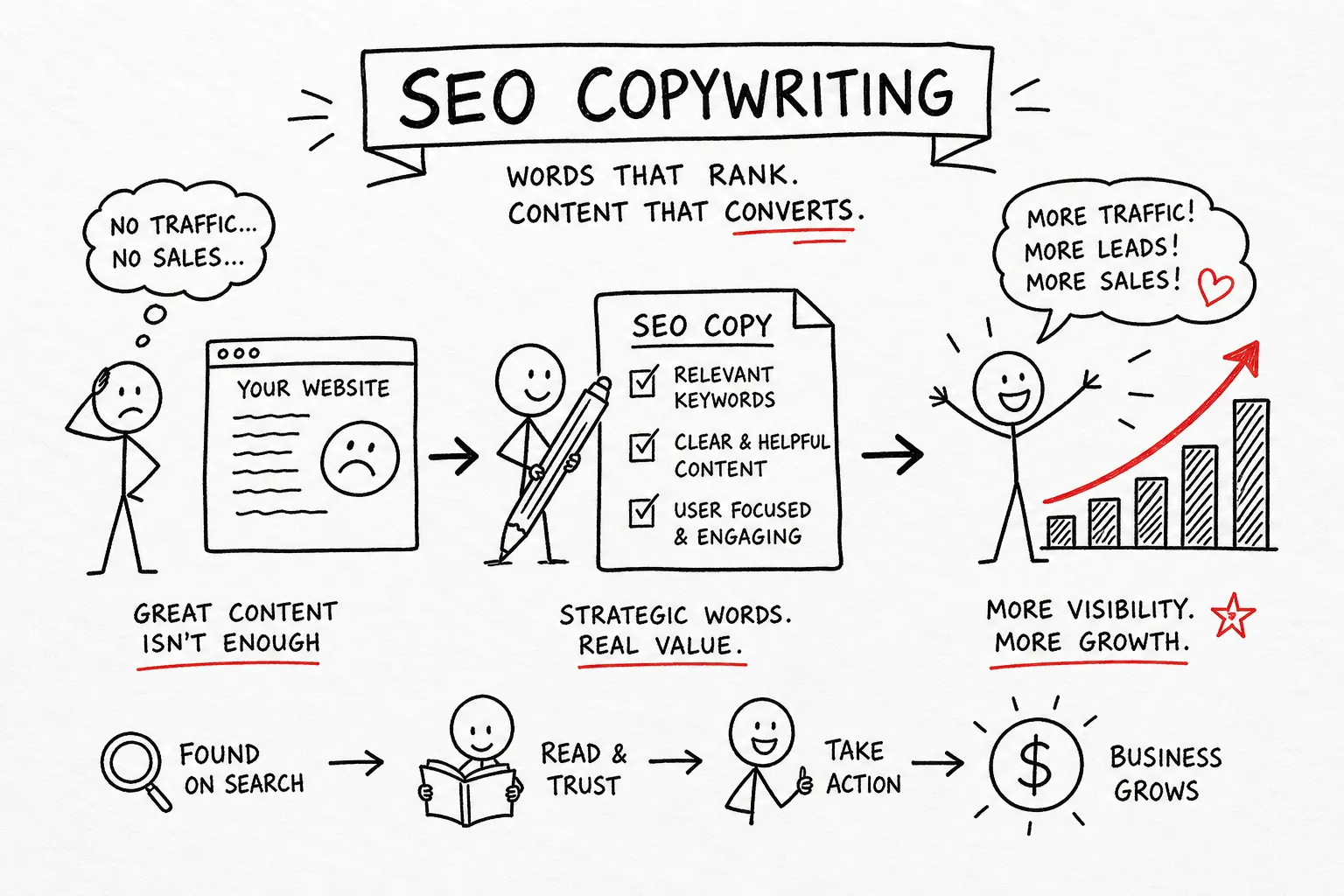
Most small business websites rely on SEO copywriting services that were never actually built, copy that sounds professional and describes services clearly, but consistently underperforms in search. The reason isn’t the writing quality. The content was never structured around how real people search or what Google needs to determine a page’s relevance. Pages built without SEO signals tend to rank lower than optimized content, regardless of how polished the prose is.
SEO copywriting services are designed to improve the likelihood that the content you publish earns rankings and converts the visitors those rankings produce, though results depend on competition, technical SEO, backlinks, domain authority, and execution. This is a specific discipline. It requires more than sprinkling keywords into existing paragraphs, and it looks very different from standard content writing or generic SEO content writing services that treat optimization as an afterthought.
At Brandleap Agency, we treat SEO copywriting as one piece of a broader semantic content strategy, not a standalone deliverable. The goal is compounding authority across related pages over time, building topical depth that signals expertise to search engines rather than chasing a single article that may or may not gain traction. This article covers what these services include, how vendors price them, what results you can realistically expect, and how to evaluate your options before signing anything.
What SEO copywriting services actually involve
SEO copywriting is the practice of creating web content that satisfies both the reader’s intent and Google’s ranking signals at the same time. That definition sounds straightforward, but the execution requires research, structured planning, semantic depth, and a solid understanding of how search engines interpret relevance in 2026.
This is not about inserting a target phrase into your existing homepage and calling it optimized. It is a process that starts before anyone writes a single sentence, and it covers a specific range of content types: service pages, blog posts, landing pages, category pages, product descriptions, and meta content like title tags and meta descriptions. Businesses searching for website copywriting services often underestimate how much strategic groundwork goes into each piece before the writing begins.
How this differs from standard copywriting
Standard copywriting focuses on persuasion and brand voice. The goal is to move a reader toward an action, whether that’s a purchase, a phone call, or a subscription. SEO copywriting does all of that and adds a structural layer: keyword mapping, search intent alignment, heading hierarchy, and internal linking strategy that tells search engines what the page is about and who it should be shown to.
A standard copywriter writes for readers. An SEO copywriter writes for readers and organizes the content so search engines can accurately assess the page’s topic, its depth, and its relevance to a specific query. Both outputs can read well. Only one of them has a realistic shot at ranking.
The role of search intent in every piece of content
Every page a search engine indexes targets a specific type of intent. Common categories include informational, commercial, transactional, navigational, and local intent, among others. The format, depth, and angle of the copy must match that intent, or the page will not rank regardless of how well it’s written. A service page that reads like a blog post or a blog post that pitches too hard too early signals a mismatch that pushes the page down the results.
Mismatched intent is one of the most common reasons well-written pages sit on page three indefinitely. Fixing it is often faster than starting from scratch, but it requires knowing what intent you’re targeting before the first draft is written.
Core deliverables you should expect from any serious provider
Buyers often discover what’s missing from a content package only after the work is delivered and the results aren’t there. Before you evaluate any vendor proposal, you need a baseline understanding of what a legitimate SEO copywriting engagement should include by default, not as upgrades or add-ons. The three areas below are where serious providers distinguish themselves from content mills.
Keyword research, content briefs, and intent mapping
A proper engagement starts before writing begins. The provider should identify primary and secondary keywords, map the search intent behind each target query, and build a content brief that defines the structure, required entities, and angle for every piece. The brief is what separates content with a purpose from content that fills space.
Without a brief, the resulting copy is a guess. With one, every heading and paragraph has a specific job tied to what the target audience is actually searching for, and the writer has clear criteria to meet before the draft is considered complete.
On-page SEO copywriting, meta tags, and revision rounds
On-page SEO copywriting goes well beyond placing a keyword in the headline. A complete deliverable includes an optimized title tag, a meta description, a logical H1 through H3 structure, internal link placement recommendations, and image alt text guidance. These elements are part of the work, not a separate line item.
Meta tags are a standard deliverable, not an upgrade. Revision rounds should also be defined in writing before the engagement begins. Industry norms range from one to three included revision rounds, with higher-tier services offering unlimited edits until the client is satisfied. Final delivery should be publish-ready, either as a formatted document or placed directly into your CMS if that service is included.
Results small businesses can realistically expect
SEO copywriting is not a quick fix. Anyone who tells you otherwise is misrepresenting how SEO works. What it is, when done consistently, is a compounding asset. Each optimized page builds on the ones before it, and over time that creates ranking momentum across a cluster of related topics rather than isolated one-off wins.
This is the model Brandleap Agency uses when building content programs for clients: every piece fits into a semantic architecture designed to grow topical authority across multiple related searches, not just rank for one term once.
Organic traffic and ranking improvements
Businesses that publish consistently optimized content typically see measurable ranking improvements within 3 to 6 months for low-to-medium competition keywords. For more competitive terms, the realistic window is 6 to 12 months. New domains or sites with weak technical foundations may need longer, particularly if backlink development hasn’t started alongside content production. These timelines vary based on domain strength, content consistency, and the competitive landscape for your target queries.
The results worth benchmarking are specific: starting keyword positions, target positions, and organic session growth tied to individual pages. Break that single sentence into a clear expectation: document your baseline before the engagement begins, then measure movement against it at 30, 60, and 90 days. Any vendor worth hiring should be able to show you before-and-after data from existing client work, not general claims about content performance.
Conversion impact beyond traffic volume
Traffic without conversion is a vanity metric. Good SEO copywriting improves on-page engagement: time on page, scroll depth, and click-through to the next step in the buyer journey. The copy has to match what the visitor expected to find based on the search that brought them there. When intent is matched at the page level, conversion rates lift alongside traffic because the visitor immediately recognizes they’re in the right place.
This is why intent alignment matters from the first sentence, not just the keyword in the title. Visitors who land on a page that delivers exactly what they were looking for stay longer, explore further, and convert at higher rates than visitors who arrived on a technically optimized page that doesn’t address their actual question.
SEO copywriting services pricing in 2026
Pricing in this category is genuinely opaque, and the range is wide enough that a $200 article and a $2,000 article can look identical on a proposal. Understanding the rate structure helps you budget accurately and recognize when a price is either unrealistically low or unjustifiably high.
Per-word and per-piece rates
Entry-level SEO writers typically charge $0.03 to $0.10 per word. Mid-tier professionals with documented SEO results land between $0.10 and $0.25 per word. Specialist or senior writers command $0.25 to $0.80 or more per word, particularly for competitive niches or content with a direct revenue connection like landing pages and conversion-focused service pages. These figures reflect current market rates based on industry surveys and freelance platform data for 2026.
Per-piece pricing for standard SEO articles runs $150 to $800 depending on length, complexity, and what’s included. Strategic landing pages built for competitive keywords and conversion goals often fall between $750 and $3,000. If a per-piece quote doesn’t specify word count, what optimization is included, and how many revision rounds are covered, the number means very little.
Monthly retainer packages and what they include
Retainer pricing varies significantly by scope. Small content-only retainers often start around $800 per month for a few articles with basic optimization. Agency retainers that include strategy, content production, and reporting commonly start at $2,500 per month and scale to $15,000 or more for larger programs with multiple content types, technical oversight, and performance reporting.
A retainer proposal should specify exactly what’s included: number of pieces per month, word counts, keyword research, optimization passes, and reporting cadence. If the deliverables are vague, the monthly price is meaningless. Ask for a scope breakdown before comparing costs across vendors.
How to evaluate and shortlist vendors before you hire
Comparing vendors without a framework leads to decisions based on price or gut feel, and neither reliably predicts results. The signals and questions below give you a concrete basis for comparison before you commit to any content marketing agency or freelancer, whether you’re looking for a full-service SEO copywriter for hire or a team to manage an ongoing content program.
The comparison signals that actually distinguish effective providers
The most reliable signal is before-and-after organic traffic data tied to specific pages and specific time periods. A vendor who can produce Search Console screenshots showing baseline impressions, post-engagement traffic growth, and ranking improvements for identifiable pages has credible, verifiable proof of impact. That is the highest-confidence signal available.
Case studies rank second. Strong ones include starting metrics, a clear description of what actions were taken, and measurable outcomes across rankings, traffic, and conversions. Reviews and testimonials are useful only when they cite specific outcomes, not general satisfaction. Watch for these red flags: testimonials without numbers, portfolios without linked live examples, and any agency that promises first-page rankings within 30 days.
Questions to ask every candidate before signing anything
Request two or three case studies in your industry or a comparable niche, with baseline and outcome metrics visible. Find out what their revision policy is in writing, confirm their average turnaround time per content type, and ask whether keyword research and content briefs are included in the quoted price or billed separately. These questions reveal whether the provider has a real process or just a content production machine.
Ask how they define success. If the answer doesn’t connect their work to organic traffic, rankings, or conversions, the relationship will be frustrating from day one. An SEO copywriting vendor who can’t describe a clear line from their content to measurable business outcomes is not positioned to help you grow. Walk away and keep looking.
Next steps for SEO copywriting services
Professional SEO copywriting services are not about writing well in isolation. They are about writing content that earns rankings and converts the traffic those rankings produce. The two goals are inseparable, and a service that delivers on one without the other is only doing half the job.
At Brandleap Agency, every content engagement is built inside a semantic content architecture, where each page is part of a larger topical structure designed to compound authority across related searches over time. That approach produces durable organic growth instead of a few scattered wins that plateau after a couple of months, and it’s what separates a genuine SEO content writing service from a vendor that simply fills a content calendar.
Start by pulling up your five most important website pages and checking them against the deliverable checklist in this article: keyword research, content brief, on-page SEO copywriting, meta tags, proper intent alignment, and revision terms. If those elements aren’t present, your current copy is leaving rankings and revenue on the table. Contact Brandleap Agency to get a content strategy in place that fixes that systematically.