You’ve spent months refining your website. The pages are clean, the keywords are mapped, the content is solid. But your rankings haven’t moved. If this sounds familiar, professional off page SEO services are likely the missing piece, the external credibility signals that tell search engines independent sources find your site worth referencing. On-page optimization alone doesn’t earn Google’s trust. You also need the external world to vouch for you.
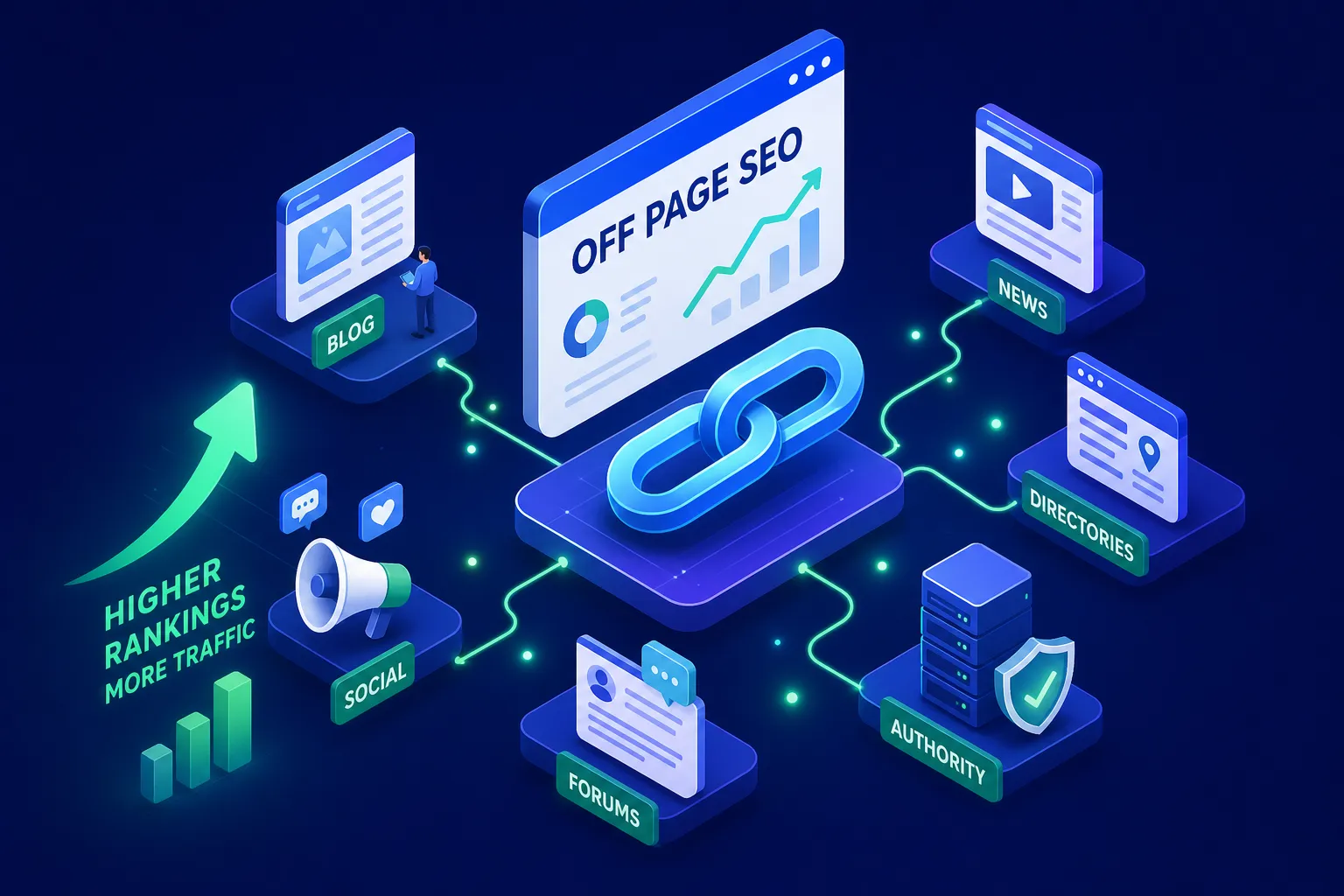
Off-site SEO is that external credibility layer. It covers the backlinks, brand mentions, digital PR placements, and citations that signal to search engines that independent sources find your content worth referencing. Google treats these signals as third-party votes of confidence, and without them, even a technically perfect website struggles to outrank competitors who have spent time building genuine authority.
At Brandleap Agency, we treat off-site work as part of a broader growth architecture, not a standalone checklist of link placements. That distinction changes outcomes significantly. This article covers what off page SEO services actually include, why external signals drive rankings, what ethical link acquisition looks like, how to read a proposal, and which warning signs tell you to walk away from a provider immediately.
What off-page SEO services actually cover
The core of any off-site program is link building: earning contextual, editorial backlinks from relevant external websites. The key word there is “earning.” Reputable link building services focus on editorial placements, guest post outreach, resource page links, and partner mentions, not bulk-purchased links from low-quality directories or networks. Volume-focused link packages and quality-first backlink building are not the same thing, and confusing the two is how businesses end up with Google penalties instead of ranking gains.
Link building services
Quality link building targets editorial placements on sites with real traffic, genuine audiences, and topical relevance to your niche. A backlink audit service is a smart starting point here: it identifies toxic links already dragging on your profile, flags gaps in your current domain authority, and prioritizes the outreach targets most likely to move rankings. Without that baseline, campaigns run blind.
Citation and brand mentions
Beyond backlinks, authority also comes from brand mentions and citations, references to your business name, URL, or NAP data (name, address, phone number) across directories, editorial content, and industry publications. Citation and brand-mention services handle NAP consistency, structured directory submissions, and unlinked editorial references. Google uses named entities and trusted references as part of how it understands what a site is and who it serves, so these signals reinforce your entity trust even when no hyperlink is present.
Digital PR and link acquisition
Digital PR sits at the premium end of off-site work. This tactic earns coverage from journalists, publications, and industry outlets through genuinely newsworthy content: original research, surveys, data stories, or expert commentary that reporters can cite in their work. The result is high-authority backlinks from DR 60, 80+ publications, earned media mentions, and strong co-citation signals that associate your brand with trusted sources. When you combine link building, citation work, and digital PR into one coordinated program, you build the kind of external reputation that makes rankings durable.
Why off-site authority is what Google actually rewards
Google treats backlinks as votes of confidence from independent sources. A site that earns genuine editorial coverage and contextual links has demonstrated to the algorithm that other credible parties find it worth citing. Think of it this way: a business with strong word-of-mouth referrals from respected sources will almost always outrank one with a perfectly designed storefront and no external validation. That dynamic plays out in search results every day.
What matters here is link quality, not link volume. Reputable link outreach agencies screen targets using domain authority, organic traffic, topical relevance, and editorial context. According to a 2025 Ahrefs survey of SEO professionals, 52% require a minimum Domain Rating of 50+ before counting a placement as a credible link, and 22% require DR 60+. One high-quality editorial backlink from a niche-relevant publication with real traffic can move rankings more than dozens of low-relevance placements from sites with no audience.
Off-site signals also connect directly to Google’s E-E-A-T framework: Experience, Expertise, Authoritativeness, and Trustworthiness. When your brand earns coverage in trusted publications, gets cited by industry experts, and accumulates consistent directory listings, you’re building the exact signals Google looks for when evaluating whether a site deserves prominent search placement. Editorial brand mentions strengthen E-E-A-T in a way that no amount of on-page optimization can replicate on its own.
Ethical tactics worth investing in right now
Ethical guest posting means pitching original, expert-written content to editorially governed publications in your niche or an adjacent one. The article would be publishable on its own merits. The site has editorial standards, real traffic, and an audience that overlaps with yours. Done well, guest posting delivers contextual backlinks, brand visibility, referral traffic, and audience exposure in a single placement. Where it becomes risky is when agencies post on irrelevant sites, use thin or spun content, or chase link volume without editorial standards. That’s not guest posting, that’s link spam dressed up as content.
Digital PR is widely considered the strongest long-term off-site tactic because the coverage is genuinely earned. You create original data, a research report, or a compelling expert commentary, and journalists choose to cite it because it’s newsworthy. What separates digital PR from standard guest posting is scale and authority: campaigns built on original research typically earn placements from DR 60, 80+ domains, compared to the DR 30, 60 range more common with guest posting. The campaign mechanics matter too, the more specific and data-driven your content asset, the more journalists have a reason to cite it rather than paraphrase it.
For local service businesses, citation work is non-negotiable. Consistent NAP listings across structured directories, Google Business Profile optimization, and earned editorial references in local publications all strengthen the trust signals Google uses to determine local pack rankings. Influencer and thought-leader outreach rounds out the picture: not as a link scheme, but as a tactic for brand mentions, qualified referral traffic, and community-level awareness built through transparent collaboration with creators who already reach your target audience.
What a real off-page SEO proposal looks like
A strong proposal from a reputable provider specifies exactly what you’re getting. That means the type and quantity of link placements per month, outreach logs showing which sites were contacted and at what stage, live URLs as proof of delivery, content assets created to support link earning, and a defined reporting cadence. Reputable agencies sell outcomes and evidence, not vague “authority building.” If a proposal doesn’t specify link sourcing criteria, placement type, target site quality thresholds, or reporting format, ask directly before signing anything.
On pricing, the 2026 U.S. market breaks down predictably by business size and campaign scope. Small and local businesses typically spend $500 to $2,500 per month. Mid-size or regional brands usually fall in the $2,500 to $7,500 range. Enterprise campaigns in competitive verticals can run $7,500 to $20,000 or more per month. Standalone off-page service packages, without a broader SEO retainer, typically sit between $500 and $5,000 per month depending on backlink volume, link quality targets, and niche competitiveness. Monthly retainers dominate the market for ongoing work; project-based pricing applies to one-time audits or outreach campaigns.
The KPIs you track should reflect real business outcomes. Core metrics include keyword ranking movement, organic traffic growth, referring domain growth (quality-weighted, not just count), referral traffic engagement, and brand mention volume. Set realistic timelines: early signals like backlink acquisition and brand mentions can appear within the first few weeks of a campaign, but ranking movement and meaningful organic traffic growth typically require three to six months of sustained outreach. Monthly reporting is standard, and strong reports compare current period to prior periods with placement-level detail rather than summary totals alone.
Red flags that signal a provider to avoid
Any provider guaranteeing a specific ranking position should be disqualified immediately. Rankings depend on algorithm signals no agency controls. Promising “guaranteed #1 rankings” or “instant page-one results” is either a lie or a sign that the provider plans to use tactics that produce short-term lifts followed by penalties, neither of which serves your business.
Watch out for proposals that promise a fixed number of links per month without specifying site quality, organic traffic, or topical relevance. Volume-focused link pitches almost always signal automated outreach, bulk directory submissions, or private blog network placements. PBNs are networks of sites built specifically to pass link equity, and Google actively penalizes sites that acquire links from them. Any provider advertising PBN access should be ruled out without further conversation. Link spam, comment spam, and mass-produced guest posts on irrelevant sites belong in the same category: tactics that may produce brief metric movement before causing long-term damage.
Vague reporting is its own red flag. Proposals that promise impressions, “DA increases,” or click metrics without connecting those numbers to traffic, leads, or revenue are often hiding weak performance behind vanity metrics. Before signing, ask for examples of recent link placements, the criteria used to qualify linking sites, whether placements are editorial or paid-for, and how the provider ties placements to ranking and traffic outcomes. Answers that are heavy on slogans and light on specifics are sufficient reason to walk away.
Why results compound when off-page is part of a complete strategy
Links pointing to a well-structured site with strong on-page relevance and clean technical SEO pass more value than links to a site with crawl issues, thin content, or broken internal linking. The frame that works here is straightforward: off-site work earns authority, on-page work ensures that authority flows to the right pages, and technical SEO ensures nothing blocks it from being counted. Pull any one of those layers out and the system underperforms.
Brandleap Agency builds off-page strategy as part of exactly this kind of compounding system. Link acquisition, brand mention tracking, and digital PR are layered on top of technical foundations and content-rich on-page work rather than executed in isolation. This integration is what separates buying links from building genuine off-site authority that survives algorithm updates and keeps paying off over time.
Expect the first months to focus on audit, strategy, and initial placements. Months three through six typically show ranking movement. Sustained campaigns show meaningful traffic and lead growth over six to twelve months. The real question isn’t whether off-site SEO is worth investing in. The question is whether you’re choosing a provider who integrates this work into a full strategy built for compounding results.
Choose integration over isolated link buying with off page SEO services
Off page SEO services cover link building, digital PR, brand mentions, citation work, and outreach. All of it works together to build the external trust that Google rewards with better rankings and more qualified organic traffic. Individually, each tactic contributes. Together, with the right technical and on-page foundation underneath them, they compound in ways that isolated link buying never will.
When evaluating providers, look for specificity in proposals, ethical tactics with clear editorial standards, quality-first link criteria rather than raw volume, and a reporting structure that connects placements to real business outcomes. Walk away from any provider leading with ranking guarantees, bulk-link packages, or PBN access.
If you want off-site SEO built into a full-stack strategy with transparent reporting and a team that understands how integration drives results, Brandleap Agency is ready to map out what that looks like for your specific goals and competitive niche. Reach out and we’ll show you exactly where your authority gaps are and how to close them.